

The best AI ad copy is never the raw output. It’s a first draft that gets edited for truth, tightened for voice, and matched to what the landing page actually says. This article gives you real before-and-after examples, prompts you can copy today, and the exact checks Australian advertisers need before anything goes live.
TL;DR:
- Specific, provable claims and real proof points, such as verified review counts or precise offers, significantly improve ad effectiveness over generic statements.
- Mismatches between ad promises and landing page content, as well as unedited drafts, are common conversion killers that undermine ad performance.
- Maintaining a consistent brand voice and avoiding fabricated testimonials or unverified statistics are critical for compliance and trust, especially under Australian advertising laws.
- Building a claim bank and systematically editing AI drafts for truth and tone supports scalable, compliant ad copy creation.
- The true cost of AI ad copy is mainly in the editing process, which ensures the final message is accurate, on-brand, and effective.
The gap between a flat AI draft and an ad that converts almost always comes down to specificity. A generic AI output says “Great service at a great price.” An edited version says “Same-day quotes, fixed price, no callout fee for Melbourne bookings before 2pm.” One sentence is forgettable. The other gives someone a reason to click, and it’s provable, which matters more than it sounds.
Below are examples across the formats small business owners actually use: search ads, social captions, video hooks and carousel copy. Each one shows the brief, the raw AI draft, the edited final version, and the specific lesson behind the edit. Treat these as templates, not scripts, because your claim bank (your real offers, real proof, real exclusions) will always be different from the one used here.
Search headline, outcome led. Brief: local plumber, same-day service. Raw AI draft: “Fast, Reliable Plumbing Services You Can Trust.” Edited: “Same-Day Plumber, Fixed Quote Before We Start.” Takeaway: swap the vague adjective (“reliable”) for a specific, checkable process step.
Search description, price-anchored. Brief: bookkeeping firm, monthly package. Raw AI draft: “Affordable bookkeeping solutions tailored to your business.” Edited: “Bookkeeping from $180/month, fixed fee, no lock-in contract.” Takeaway: a real number beats “affordable” every time, but only state a figure you can back up.
Facebook feed caption, social proof. Brief: hairdresser, new client offer. Raw AI draft: “Join hundreds of happy clients who love our salon!” Edited: “Over 40 five-star Google reviews from clients across [suburb].” Takeaway: never let AI invent a social proof number. Replace it with your real, verifiable count.
Facebook feed caption, scarcity. Brief: workshop with limited seats. Raw AI draft: “Don’t miss out on this amazing opportunity!” Edited: “12 seats left for the March intake. Doors close Friday.” Takeaway: scarcity only works when it’s real and specific. Vague urgency reads as filler and erodes trust.
Instagram Reels hook, emotional angle. Brief: physiotherapist targeting chronic back pain. Raw AI draft: “Say goodbye to pain and hello to a better life!” Edited: “Still adjusting your day around back pain? Here’s what changed for our clients.” Takeaway: AI defaults to broad emotional statements. Editing toward a specific pain point makes the hook feel like it’s speaking to one person.
Video hook, problem first. Brief: pest control business. Raw AI draft: “Pests got you down? We’re here to help!” Edited: “Found droppings in the pantry again? Here’s what that actually means.” Takeaway: a concrete, slightly uncomfortable detail earns more attention in the first three seconds than a cheerful platitude.
Carousel slide one, myth-busting angle. Brief: financial adviser. Raw AI draft: “Myth: You need to be rich to invest.” Edited: “Myth: You need $50,000 to start investing. Here’s the real minimum most platforms allow.” Takeaway: AI often writes the myth correctly but leaves the correction generic. The fix is always the specific fact, not a vague reassurance.
LinkedIn ad, credibility angle. Brief: B2B consulting for trades businesses. Raw AI draft: “We help trades businesses grow with proven strategies.” Edited: “We’ve worked with electrical and plumbing businesses on lead systems for six years.” Takeaway: “proven strategies” is unprovable. A timeframe and an industry are specific enough to be believable.
Google Ads description, exclusion-based honesty. Brief: skin clinic promoting a treatment package. Raw AI draft: “Get flawless skin fast with our expert treatments.” Edited: “Six-session package, results vary by skin type, free consult first.” Takeaway: adding the exclusion (“results vary”) isn’t a weakness. It’s what keeps the ad compliant and, honestly, more believable.
Facebook carousel, price-anchoring across slides. Brief: interior design service, three tiers. Raw AI draft: “Packages to suit every budget and style!” Edited: Slide 1: “Consult only, $150.” Slide 2: “Room refresh, from $1,200.” Slide 3: “Full home styling, from $4,500.” Takeaway: AI tends to summarise pricing tiers into one vague sentence. Breaking each tier onto its own slide with its own number does the selling for you.
Short video hook, outcome plus timeframe. Brief: personal trainer, 8-week program. Raw AI draft: “Transform your body in no time!” Edited: “What 8 weeks of two sessions a week actually looks like.” Takeaway: replace “no time” (meaningless) with the real commitment. It sets honest expectations and tends to attract people who’ll actually stick with the program.
Search headline, comparison angle. Brief: solar installer versus DIY panels. Raw AI draft: “Why Professional Solar Installation Is Better.” Edited: “DIY Solar Kits vs Licensed Install: What the Warranty Covers.” Takeaway: AI drafts often assert superiority. The edit reframes it as information the reader can weigh themselves, which reads less like a sales pitch and more like a decision aid.
If you want a deeper look at why the landing page has to say the same thing as the ad, website copywriting that drives conversions covers the consistency problem from the other end.
Good AI ad copy isn’t a lucky prompt. It’s a process, and the process matters more than which AI tool you use.
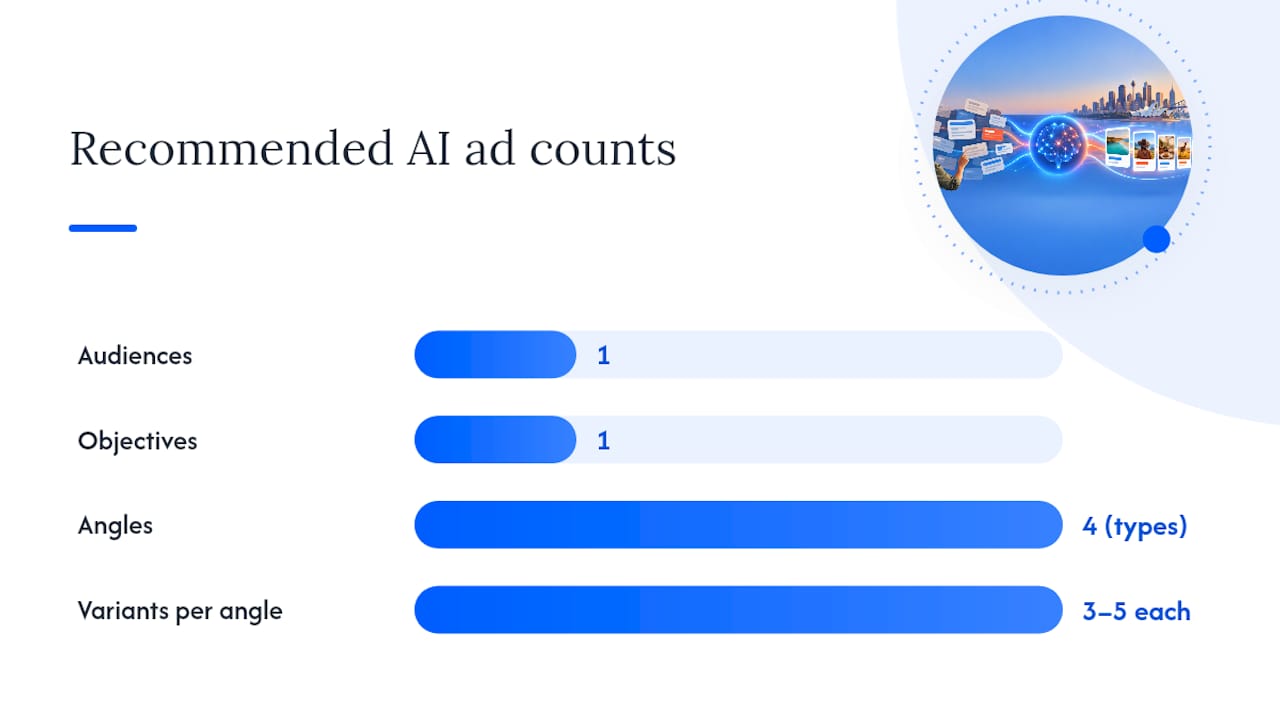
Define one audience and one commercial objective. “Get more leads” isn’t a brief. “Get 20 quote requests from homeowners within 15km by the end of the month” is. AI performs better with a tight brief because it has less room to guess.
Assemble a claim bank before you prompt. List your actual offers, your verified proof (real review counts, real turnaround times, real prices) and your exclusions (what the offer doesn’t include). This is the single biggest lever for avoiding hallucinated statistics or invented testimonials in your output.
Write the brief and the prompt together. Feed the AI your claim bank, your audience, your platform and your tone. Ask for multiple angles, not multiple versions of the same angle.
Generate three to five variants per angle. Don’t ask for ten and hope one works. Ask for a handful built on genuinely different angles: outcome, proof, scarcity, price.
Edit for truth and voice. Strip anything you can’t prove. Rewrite anything that doesn’t sound like your business. This is the step most people skip, and it’s the one that actually separates good AI ad copy from the kind that gets you a warning.
Match the ad to the landing page, then test. If the ad promises a fixed price, the landing page needs to show that fixed price. Mismatches here tank conversion rates even when the ad itself is well written.
Before anything ships, run a quick human-check pass: can every claim be proven? Does the ad match what Ad Standards would expect from a human-written equivalent, given that production method doesn’t change advertiser accountability? Is there anything that reads as an invented statistic or fake testimonial?
Pro Tip: Keep your claim bank as a single running document, not a one-off note. Every time you verify a new proof point (a review count, a completion time, a price), add it. Future prompts get faster and safer every time you reuse it.
A good prompt gives the model the claim bank, the platform’s constraints and an explicit list of what to avoid. Here are three you can adapt.
Google Ads prompt: “Write five Google Ads headlines (30 characters max) and three descriptions (90 characters max) for [business], targeting [audience] in [location]. Use this offer: [offer]. Use this proof: [real review count/turnaround time]. Exclude: invented statistics, guaranteed outcomes, testimonials, superlatives like ‘best’ or ‘number one’. Match the tone: [brand voice, e.g. warm, direct, no jargon].”
Meta/Facebook prompt: “Write three Facebook feed captions (under 125 words) for [business] promoting [offer] to [audience]. Include one scarcity angle using this real detail: [actual limited spots/dates]. Include one social proof angle using this real number: [verified count]. Do not invent statistics or testimonials. Tone: [brand voice].”
LinkedIn prompt: “Write two LinkedIn ad variations for [business] targeting [job title/industry]. Use this credibility marker: [years in business/client industries served, real and verifiable]. Avoid vague claims like ‘proven strategies’ or ‘industry-leading’. Keep it factual and specific. Tone: [brand voice].”
Three quick before-and-afters, shown earlier in the examples list, follow this same rationale: replace the vague AI phrase with the specific, provable fact from your claim bank, then check it reads like your business, not a template.
Exclusions worth pasting into every prompt you write:
Track cost per click (CPC) and click-through rate (CTR) for attention, then conversion rate (CVR), cost per acquisition (CPA) and return on ad spend (ROAS) for whether the ad actually pays off. Small business owners should prioritise CPA and ROAS over CTR, because a high-clicking ad that doesn’t convert is expensive curiosity, not revenue.
AI-generated ad copy is still advertising in the eyes of the law, and every claim in it must be truthful, accurate and capable of proof. That means no vague, unprovable lines slipping through just because a machine wrote them.
Research from Ad Standards and Roy Morgan found 72% of Australians are concerned about AI-generated content in advertising, which is exactly why human review before publishing isn’t optional.
You don’t need to reverse-engineer this workflow alone. The Compelling Homepage Copy Workshop and the Drive Traffic & Get Clicks That Count – Ads That Convert Workshop walk through exactly this process: building a claim bank, prompting for angles, and editing AI drafts so they hold up under ACCC and Ad Standards scrutiny.
Participants get practical templates, direct mentorship, and 12 months of access to materials, so the skill sticks well past the workshop day. If you’re ready to build this into your actual marketing system rather than trial-and-error it, the Business Strategy Workshop ties ad copy into the bigger picture of brand direction and lead conversion.
General-purpose chat assistants (the kind most business owners already use for everyday writing) handle ad copy drafting well when given a detailed brief and a claim bank, but they don’t know your business unless you tell them, and they’ll happily invent a statistic if you let them. Their strength is speed and volume of angles; their weakness is a total absence of built-in fact-checking.
Dedicated ad-copy generation tools built into ad platforms themselves tend to produce copy that’s already formatted to character limits and platform norms, which saves editing time. Their drawback is that they’re trained to optimise for engagement patterns, which can nudge copy toward hype language (“unbeatable”, “revolutionary”) that then needs stripping out for compliance reasons.
Browser-based writing assistants that plug into your existing workflow are useful for consistency checks across a batch of ads, but they generally still need the same claim-bank discipline applied manually. None of these categories replace the edit step. Whichever you use, the tool is only ever producing a draft, and if you’re exploring how to operationalise AI tools at scale rather than one prompt at a time, white-label AI agent options are worth understanding, even if that’s a bigger step than most small businesses need yet.
The honest comparison isn’t “which tool is best” so much as “which tool fits your existing process without becoming another subscription you forget to use.” A tool that sits inside your ad platform saves clicks. A general chat assistant gives you more creative range but demands a tighter brief.
Most AI writing tools that generate ad copy sit on a subscription model, either a flat monthly fee for unlimited generations or a tiered plan based on volume of outputs per month. Free tiers exist across most major tools but usually cap the number of generations or restrict access to more capable underlying models, which matters when you’re running several campaigns at once.
The real cost of AI ad copy isn’t the subscription. It’s the editing time. A $20 to $30 monthly tool subscription is trivial next to the hours spent verifying claims, matching tone, and checking landing-page consistency, and that editing time is where the quality actually gets built. Business owners who skip that step save money on labour and risk it on compliance instead.
If you’re weighing whether to build this skill in-house or keep paying for one-off freelance ad copy, the workshop model sits in between: a one-off investment (like the Lead Generation System Workshop at $350 AUD per year) that teaches the skill once rather than paying per ad indefinitely.
The honest answer is: AI-generated copy improves conversion rates when the editing step is done properly, and it doesn’t when it isn’t. The lift doesn’t come from AI writing the ad. It comes from AI generating more angle variations faster, which gives you more raw material to test.
A business running one ad angle for months because writing new copy felt like a chore will typically see better results the moment it starts testing three or four AI-drafted angles against each other, purely because testing itself surfaces what resonates. The AI didn’t create the improvement. The volume of testable variations did.
Where AI-generated copy tends to underperform is when businesses publish the raw draft without editing it against their landing page. A mismatch between an ad’s promise and a landing page’s actual offer is one of the most common, and most avoidable, conversion killers, regardless of who or what wrote the ad.
The most common pitfall is publishing the first draft. AI models are trained to sound persuasive, which means they default to superlatives (“the best”, “unmatched”, “guaranteed”) that are exactly the kind of unprovable claims that draw ACCC attention.
The second is letting AI invent social proof. If you ask a model for a testimonial-style line without giving it a real quote, it will write a convincing one anyway, and a fabricated testimonial is a serious compliance risk, not a shortcut.
The third is pasting customer data into public tools to “personalise” copy. This breaches privacy obligations under the Australian Privacy Principles and is entirely avoidable by never including identifiable customer information in a prompt in the first place.
The fourth, and possibly the most damaging to long-term brand trust, is voice drift: publishing AI copy that reads nothing like the rest of your marketing. A customer who sees inconsistent tone across your ads and your website starts to wonder which version of your business is real.
Treat your brand voice as a filter, not an afterthought. Before you prompt, write down three or four words that describe how your business actually talks (direct, warm, no-nonsense, technical) and feed those words into every prompt, every time.
Run every AI draft through the same two-question check: is this provable, and does this sound like us? If either answer is no, it gets edited before it gets published, not after.
Keep a simple register of what prompts you used and what edits you made. This isn’t bureaucracy for its own sake. It’s the difference between being able to demonstrate due diligence if a complaint arises and having no record of your process at all.
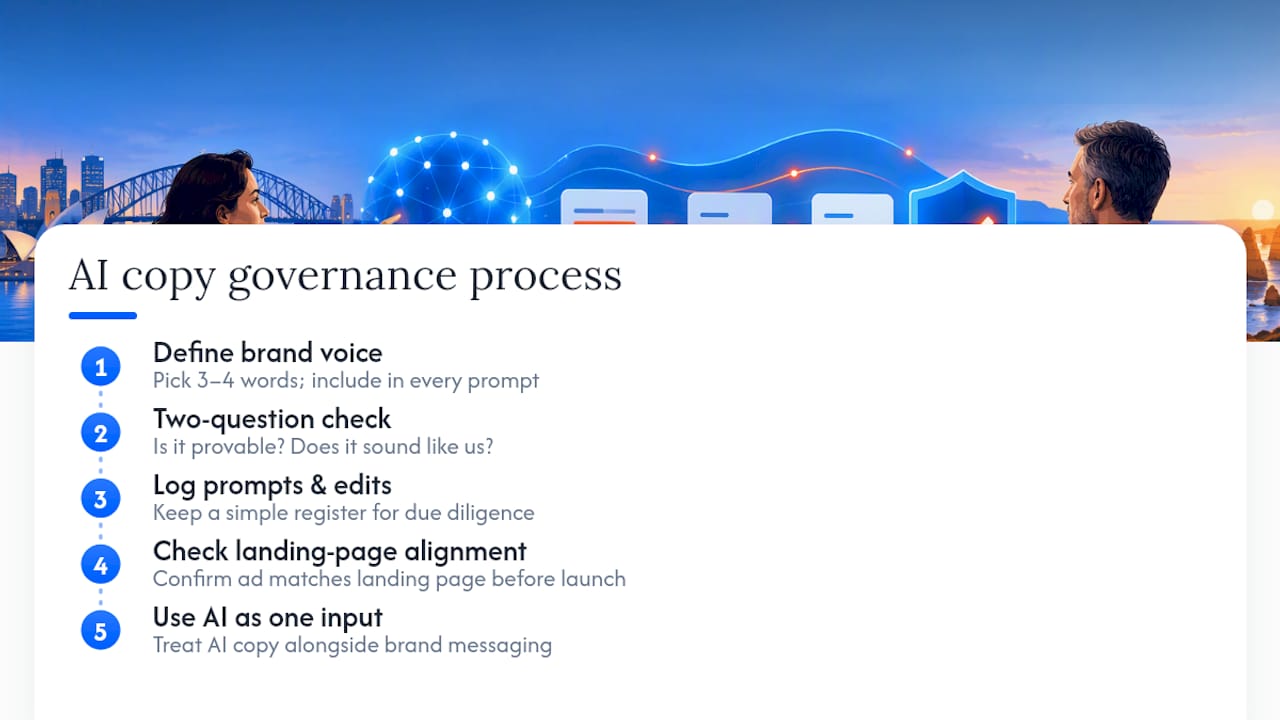
Finally, treat AI-generated copy as one input into a broader marketing system, not a replacement for one. An ad, however well written, only works if it sits on top of clear brand messaging and a website that delivers on what the ad promises, which is why checking landing page alignment before launch is worth the extra ten minutes.
For primary guidance rather than secondhand summaries, go direct to the source. The ACCC’s advertising and selling guide covers misleading practices in plain language. The OAIC covers privacy obligations for AI tools, Ad Standards covers advertiser accountability, and IP Australia covers intellectual property risks in AI-generated content.
AI-generated commercials typically start as a script drafted by a chat-based AI tool, then are edited by a human for tone, accuracy and brand fit before production. The most effective ones follow the same rule as written ad copy: specific, provable claims outperform generic AI phrasing, and the ACCC still requires every claim to be truthful and capable of proof regardless of how the script was written.
Ad copy is the written text in an advertisement, such as a headline, description or caption designed to prompt a specific action. A strong example replaces a vague claim (“great prices”) with a specific, provable one (“Bookkeeping from $180/month, no lock-in contract”), which is the core edit shown throughout the examples above.
There’s no single, universally recognised “30% rule” for AI advertising in Australia. If you’ve seen this term used elsewhere, treat it cautiously. The consistent rule that does apply is that AI-generated content must meet the same advertising standards as human-written content, with no exception based on production method.
There’s no single best tool. General-purpose AI chat assistants offer flexibility and speed for drafting multiple angles, while ad-platform-native tools save formatting time but need the same editing discipline. The right choice depends on your existing workflow, and either way, the editing and compliance-check step matters more than the tool itself.