

The role of AI in content creation is to act as a production assistant that accelerates drafting, optimises structure, and scales output without replacing the human judgement that makes content worth reading. Tools like ChatGPT, Jasper, and Grammarly have moved from novelty to standard workflow components for content creators and marketers worldwide. By mid-2025, approximately 35% of newly published websites contained AI-generated or AI-assisted content. That figure signals a fundamental shift in how content gets made, not just how fast it gets published. The creators winning in this environment are not the ones using AI the most. They are the ones using it the most deliberately.
The role of AI in content creation sits within a broader category the industry calls generative AI, which refers to machine learning models trained to produce text, images, or code from a prompt. In practical terms for marketers and creators, this means tools that can draft blog posts, rewrite paragraphs for tone, suggest headlines, or generate social media captions at speed.
The most widely used AI content generation tools each serve a distinct purpose:
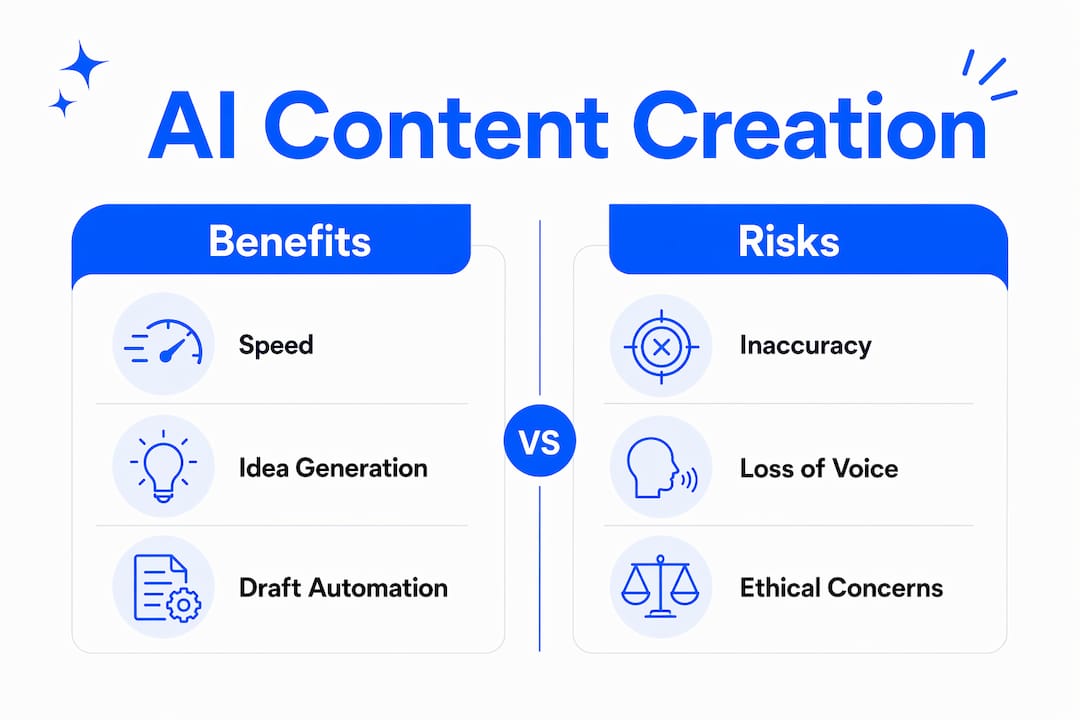
The core benefit of automated content creation is speed. A content brief that once took two hours to research and draft can be produced in twenty minutes with AI handling the scaffolding. That time saving compounds across a content calendar. A team producing four articles a week can realistically scale to ten without adding headcount.
Pro Tip: Use AI to generate three different angle options for a single topic before you start writing. Choosing the strongest angle upfront saves far more time than editing a weak draft later.

AI also reduces writer’s block by giving creators a starting point rather than a blank page. The psychological shift from “write something” to “improve this draft” is significant. Most experienced writers report that editing AI output feels faster and less draining than generating original copy from scratch.
AI in writing carries real risks that creators must manage deliberately. The most significant is content homogenisation. AI content proliferation leads to homogenisation and positivity shifts in online texts, meaning the internet is filling with content that sounds similar, reads optimistically, and lacks distinctive voice. If your content sounds like everyone else’s, it does not build brand recognition or audience loyalty.
The key risks to manage include:
“The question is not whether AI wrote it. The question is whether a human took responsibility for it.” This is the standard that both search engines and regulators are moving toward in 2026.
The practical takeaway is that AI output is a raw material, not a finished product. Treating it as anything else creates legal, reputational, and quality risks that outweigh the time savings.
The most effective approach to AI-assisted content creation is a staged production process, not a generate-and-publish shortcut. Using separate AI and human editing passes improves content quality and reduces generic errors and tone mismatches compared to single-step AI generation.
Here is a practical workflow that experienced content marketers use:
Brand voice is the hardest thing for AI to replicate. AI works best when trained on an author’s existing content to maintain individual style, with human oversight providing critical judgement and alignment. Practically, this means feeding Jasper or ChatGPT samples of your best-performing content before asking it to draft anything new. The output will be noticeably closer to your natural voice.
Pro Tip: Build a “voice document” of 10–15 sentences that capture your brand’s tone, vocabulary, and style. Paste it into every AI prompt as context. The difference in output quality is immediate.
A strong brand content strategy also acts as a guardrail for AI use. When your topics, tone, and audience are clearly defined, AI has less room to drift into generic territory.
The impact of AI on content marketing strategy in 2026 is most visible in how search results are changing. Google’s guidance states that SEO fundamentals remain foundational and AI content must add distinct value to rank well. Google is not penalising AI content. It is penalising content that fails to be genuinely useful, regardless of how it was produced.
The bigger challenge is the rise of AI Overviews in Google Search. CTR for Google queries with AI Overviews dropped significantly between 2024 and 2025. That means fewer readers clicking through to your site even when your content ranks. The traffic model that content marketers relied on for a decade is under real pressure.
| Metric | Pre-AI Overview (2024) | Post-AI Overview (2025–2026) |
|---|---|---|
| Organic click-through rate | Higher for informational queries | Significantly reduced |
| Direct traffic attribution | Reliable for content ROI | Harder to attribute accurately |
| Brand lift measurement | Secondary metric | Now a primary success indicator |
| Zero-click search exposure | Minimal concern | Major distribution factor |
| Content differentiation need | Moderate | High, unique insights required |
Marketers must adapt metrics to track brand lift and engagement rather than relying solely on direct click-through. Assisted conversions, branded search volume, and direct traffic trends are now more meaningful signals than raw organic traffic numbers.
The content that performs best in this environment is specific, experience-based, and impossible to replicate with a generic AI prompt. Original research, client case studies, and first-person expertise are the formats that AI Overviews cannot easily summarise away. Pairing strong content with solid organic SEO practices gives your work the best chance of being cited rather than replaced by an AI summary.
AI in content creation works best as a staged production process where AI handles drafting and humans control accuracy, voice, and strategic direction.
| Point | Details |
|---|---|
| AI accelerates production | Tools like ChatGPT and Jasper cut drafting time significantly, but require human editing to maintain quality. |
| Homogenisation is a real risk | By mid-2025, 35% of new websites used AI content, increasing the need for distinctive, experience-based writing. |
| Copyright requires human input | AI-generated content alone is not copyrightable; document your creative contributions for legal protection. |
| SEO now rewards uniqueness | Google’s 2026 guidance confirms that AI content must add distinct value, not just cover a topic. |
| Measure beyond traffic | With AI Overviews reducing click-through rates, track brand lift and assisted conversions as primary success metrics. |
I have watched a lot of content creators adopt AI tools with enormous enthusiasm, then quietly admit six months later that their content feels flat. The pattern is almost always the same. They use AI to generate the idea, the structure, and the draft, then spend their energy polishing the output. The human thinking happens last, if at all.
That is backwards. The most valuable thing you bring to content is your point of view, your specific experience, and your knowledge of your audience. Those things cannot be prompted into existence. They have to come first.
The workflow I have seen work consistently is this: you decide what to say, and AI helps you say it faster. Not the other way around. When AI reads your existing writing style before drafting, the output is genuinely useful. When it starts cold with a generic prompt, you get generic content.
The legal and SEO dimensions reinforce this. Google rewards content with demonstrable unique insights. Copyright protection requires documented human creative input. Both of those requirements push in the same direction: the human has to be genuinely involved, not just a final proofreader.
My honest advice is to treat AI the way a good editor treats a junior writer. You give it clear direction, you review everything it produces, and you take full responsibility for what goes out under your name. That mindset protects your brand, your legal position, and your audience’s trust.
— Peggy
Understanding how AI fits into your content workflow is one thing. Knowing how to apply it to your specific business, audience, and goals is where the real results come from. Mybworkshops offers expert-led workshops designed specifically for service-based business owners who want to build marketing that actually works in an AI-influenced environment.

Whether you are starting from scratch with your brand or looking to sharpen your SEO and content strategy, Mybworkshops gives you the frameworks, tools, and mentorship to move forward with confidence. The Brand-Building Workshop is a practical starting point for creators who want to produce content that stands out, converts, and holds up under Google’s evolving quality standards. Stop guessing and start building a content engine that works for you.
AI in content creation automates drafting, rewriting, and structural tasks, allowing creators to produce content faster. Human oversight remains essential for accuracy, brand voice, and originality.
Google does not penalise AI content directly. Its 2026 guidance states that content must add distinct, genuine value to rank well, regardless of how it was produced.
The US Copyright Office states that AI-generated content is not copyrightable unless a human contributes sufficient creative input. Documenting your edits and creative decisions is essential for legal protection.
Train AI tools on samples of your existing content before generating new drafts. Tools like Jasper allow custom voice settings, and feeding ChatGPT a style guide significantly improves output consistency.
Track brand lift, branded search volume, and assisted conversions alongside direct traffic. These metrics better reflect content impact in an environment where AI Overviews answer queries without requiring a click.