Send a real, immediate welcome email the moment someone signs up, deliver exactly what you promised, then follow with three to four more emails over the next one to fourteen days. Each email should move the reader one small step closer to trusting you: value first, then your story, then proof you can help, then a low-pressure invitation to buy or book. Keep it short. A five-email sequence that respects someone’s inbox will always beat a twelve-email series that wears out its welcome.
TL;DR:
- Sending a series of three to five welcome emails over several days increases total revenue by allowing multiple micro-commitments without overwhelming new subscribers.
- The first email must deliver the promised resource instantly and set clear expectations while avoiding broken links or confusing layouts.
- Subsequent emails should focus on sharing the business story, providing actionable content, addressing objections with proof, and making a low-friction, specific offer.
- Monitoring reply rates, click-to-landing, unsubscribes, and complaints during a manual pilot helps identify issues before full deployment, ensuring better engagement and compliance.
- Proper domain authentication, obtaining clear consent, and including a working unsubscribe link are essential for legal compliance and deliverability in Australian markets.
A welcome email sequence is a short series of automated emails triggered the moment someone joins your list, downloads a resource, or makes their first purchase. It’s not a newsletter. It’s not a sales pitch dressed up as a greeting. It’s the handshake between “we just met” and “I trust you enough to buy from you.”
The reason it works comes down to timing. New subscribers are paying attention right when they sign up, and that attention fades fast. Campaign Monitor’s research found that 74% of consumers expect a welcome message straight after subscribing, and welcome emails typically generate significantly more opens and clicks than ordinary promotional email. Some single welcome sends report very high open rates, well ahead of anything a regular campaign will produce.
That gap isn’t really about clever copywriting. It’s about intent. Someone who has just handed over their email address is curious, warmed up, and briefly your most engaged audience member. A single welcome email captures a fraction of that opportunity. A short sequence captures more of it, because it gives you several chances to build the relationship instead of betting everything on one message that might land in a busy inbox at the wrong moment.
For a small business, a welcome sequence should do four things:
That last point matters more than most business owners realise. Asking a brand-new subscriber to book a consultation in Email 1 is like proposing marriage on a first date. Asking them to open, then click, then reply, then book, respects the pace at which trust actually gets built. It’s a similar idea to the one behind effective sales follow-up cadences: you earn the bigger yes by collecting smaller ones first.
None of this replaces having a clear offer and a well-positioned brand behind it. A welcome sequence can only ever amplify what’s already there. If your positioning is muddy or your website doesn’t explain what you actually do, no amount of clever email automation will fix that gap.
A short series of a few emails spaced over several days is a common practical default for most small businesses. AWeber’s analysis of welcome email series found that this length of series typically produces around 51% more total revenue than a single welcome email, while still keeping open and click rates strong in the earlier sends.
There’s a real trade off buried in that number. Shorter series (just one to three emails) tend to hold the highest open and click rates per email, because attention is freshest closest to signup. But stretching the series to four or five emails captures more total revenue, because you get more chances to convert without asking too much too soon. For most service businesses and small retailers, five emails is a practical sweet spot: enough room to build a relationship without causing subscriber fatigue.
Here’s a timing structure that works for most industries:
Adjust the cadence to your business model. A free trial signup might compress this into five days because urgency matters. A high-touch professional service, like a bookkeeper or a physiotherapist, can afford to stretch the final email out closer to day fourteen, since trust builds more slowly when the purchase decision carries more weight. Ecommerce sits somewhere in between, often adding an extra reminder email if a cart or offer hasn’t converted.
Stop the sequence the moment someone takes the action you wanted, whether that’s a purchase, a booking, or a reply. Continuing to send “please buy” emails to someone who already bought is the fastest way to look like you weren’t paying attention. Unsubscribes and prolonged inactivity should also pull someone out of the flow. There’s little value in emailing someone for months who hasn’t opened a single message.
This is where most small businesses either nail it or lose the plot completely. Every email in the sequence needs one clear intent, and it should never try to do two jobs at once. Here’s a practical five-email structure you can adapt to your brand voice today.
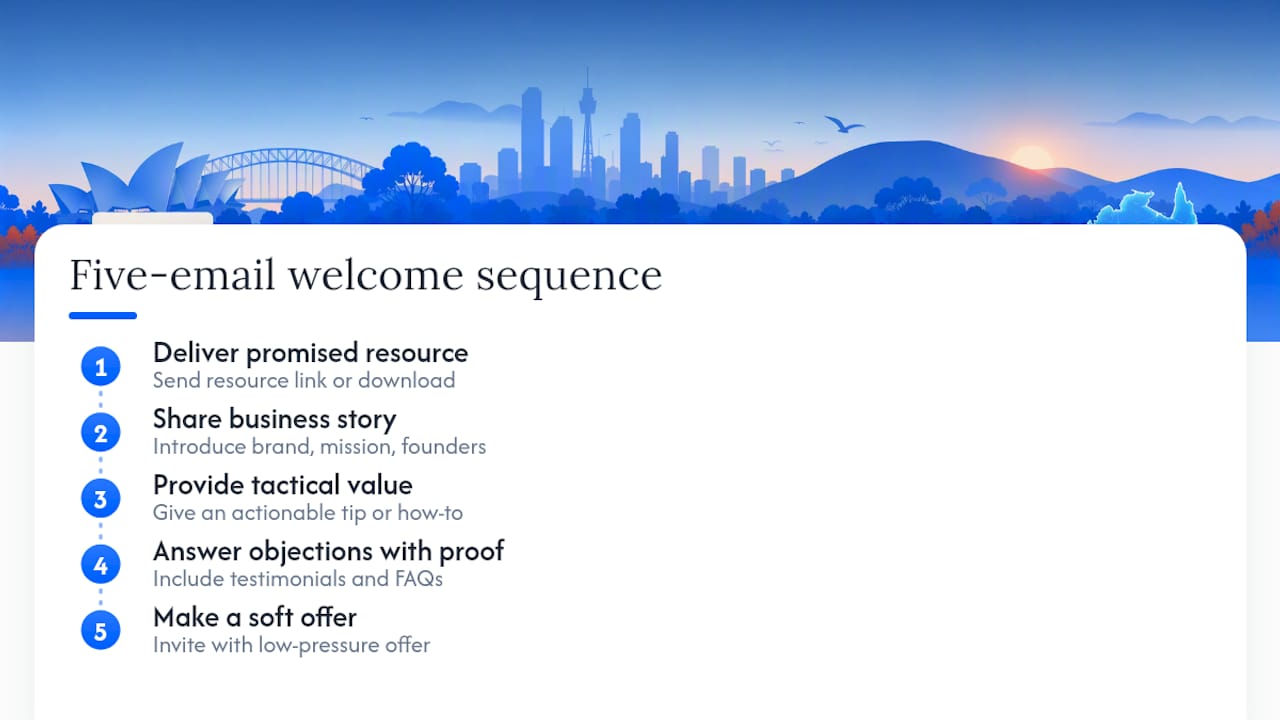
This email has exactly one job: give the subscriber what they signed up for, with zero friction. If you promised a checklist, a discount code, or a guide, it needs to be one click away, and that click needs to work. Test it yourself before this goes live, because a broken download link in Email 1 tells a new subscriber everything they need to know about how seriously you take follow-through.
Beyond delivery, this email should set expectations. Tell the reader what they’ll get from you and how often, so nothing that follows feels like spam. This is also the natural place to point people toward a well-built thank you page, since that page can reinforce the same message and offer a next step for people who don’t check email straight away.
Subject line examples:
Body prompt: Thank them, deliver the resource in the first two sentences, tell them one thing to expect next, and close with a single, clear call to action (view the resource, watch a short video, or reply with a question).
This email builds the relationship, not the sale. It’s where you explain why the business exists, what problem you set out to solve, or what experience led you here. Readers don’t buy from businesses they don’t feel some connection to, and a short, honest story does more work here than a features list ever will.
Ask for a small, easy action: follow you somewhere, reply with a one-word answer, or click through to read a case study. This is the first rung on the micro-commitment ladder.
Subject line examples:
Body prompt: Open with a short, specific story (one paragraph), connect it to the reader’s own problem, and end with one easy ask that takes less than thirty seconds.
Now you earn trust through usefulness, not persuasion. Share your best checklist, your most popular blog post, or a step-by-step “how to” that solves a real problem your ideal customer faces. This is the email that separates businesses people remember from businesses people forget.
If your business struggles with weak calls to action in emails generally, this is the section worth revisiting alongside general guidance on boosting email conversion rates, since the same clarity principles apply here.
Subject line examples:
Body prompt: Lead with the specific problem this content solves, give one genuinely useful tip inline (not just a link), then direct them to the full resource with a single button or link.
If your product or service has a longer consideration cycle, this email tackles the questions holding people back. Answer the two or three objections you hear most often, and back them up with a specific result, a review, or a short case study if you have one.
Subject line examples:
Body prompt: State the objection plainly, answer it in two to three sentences, then point to one piece of proof (a testimonial, a before-and-after, a specific outcome).
This is the only email in the sequence that asks for the sale, and it should feel like a natural next step rather than a hard pitch. Make the call to action specific and low friction: book a fifteen-minute call, start a free trial, or use a time-limited introductory offer.
Subject line examples:
Body prompt: Recap the value delivered so far in one sentence, then make one specific, low-friction offer with a single button. Avoid stacking multiple options here; one clear path converts better than three.
Design every one of these emails mobile first. Use a single column layout, keep HTML light so images don’t dominate load time, and add proper alt text to every image in case it doesn’t render. Most welcome emails get opened on a phone screen within minutes of signup, so anything that requires pinching and zooming loses the reader before they’ve read a word.
The subject line and preview text work together as a pair, not separately. If your subject line asks a question and the preview text answers it before the reader even opens the email, you’ve killed your own open rate. Write them to complement each other, not repeat each other.
A few things consistently move the needle:
Pro Tip: Write your Email 1 subject line last, after you’ve written the body. It’s much easier to summarise what you’ve already said than to write a punchy line first and then force the email to match it.
Click-through rate, reply rate, and revenue attributed to the sequence are the three numbers that tell you whether your welcome sequence is working. Open rate is useful as a rough health check, but it should never be your primary success metric, and treating it as one will lead you to optimise for the wrong thing.
Here’s why opens have become unreliable. Apple’s Mail Privacy Protection automatically pre-fetches images for a large share of iPhone and Mac users, which registers as an “open” whether or not the person actually read the email. Stripo’s research on welcome email benchmarks found open rate figures ranging anywhere from around 35% to 84% depending on the dataset, largely because of these privacy protections and inconsistent definitions between single sends and full series. The clean takeaway: welcome emails do open at roughly double the rate of a regular campaign, but treat the exact percentage as directional, not gospel.
Statistic to remember: welcome emails average roughly 2× the open rate of standard campaigns, but with a swing of up to 49 percentage points across different datasets according to Stripo’s benchmark research, which is why clicks and revenue matter more than the raw open number.
What should you actually track?
Before you obsess over any of these numbers, get the technical basics right. Authenticate your sending domain with SPF, DKIM, and DMARC records, and warm up a new sending domain slowly rather than blasting your full list on day one. Poor authentication sends good copy straight to the spam folder regardless of how well written it is. If domain records sound unfamiliar, this is the point to ask whoever manages your website or email platform to set them up properly, rather than guessing.
Every commercial email you send in Australia needs three things: consent, clear sender identification, and a working unsubscribe link. Get these wrong and you’re not just risking deliverability, you’re risking a real breach of the Spam Act 2003 (Cth), which ACMA actively enforces.
Here’s the practical checklist:
None of this needs a lawyer on retainer or a compliance department. It needs a properly configured email platform, a habit of recording consent at the point of signup, and a functioning unsubscribe link tested before every send, not assumed to be working.
Before rolling any welcome sequence out to a full list, pilot it manually against your first 50 to 100 subscribers. This isn’t overcaution, it’s how you catch the mistakes that automation will otherwise repeat at scale for months. Practical guidance from automation and compliance specialists backs the same approach: manual monitoring early on sets a realistic baseline before you trust the system to run unsupervised.
During that pilot window, watch three signals closely:
If those numbers look off after the first batch, adjust before the sequence reaches your full list, not after.
In our workshops, we see three mistakes come up again and again. The first is over-optimising for opens, chasing a vanity number while revenue and replies sit flat. The second is missing unsubscribe wiring, either an unsubscribe link that’s broken, hard to find, or missing entirely from a test send. The third is weak single-CTA focus, cramming three competing calls to action into one email and diluting all of them. Every one of these is fixable once you know to look for it, which is exactly why a structured pilot phase, and a second set of eyes on the setup, catches problems that a rushed launch never will.
Pro Tip: Send yourself the entire sequence using a personal email address before it goes live. Reading it as a subscriber, days apart, on your phone, exposes broken links and awkward pacing that you’ll never spot staring at a builder screen.
Getting a compliant, trackable welcome sequence live doesn’t need to take weeks. Work through this checklist in order:
If you’d rather not build this alone, or you’ve tried and the results have been patchy, a well-designed workshop can fill that gap.
A welcome sequence only works when it sits on top of solid brand positioning, a website that actually converts, and messaging that speaks to the right person. Bolting good email copy onto a shaky foundation rarely lifts results the way business owners hope. Structured, hands-on sessions can provide a completed strategy, ready-to-adapt templates, and direct feedback from experienced practitioners, not just theory to figure out on your own.
Three things you’ll walk away with: a welcome sequence template mapped to your actual offer, a conversion checklist you can reuse across every future campaign, and feedback from peers and mentors who’ll tell you honestly what’s working and what isn’t. If you want to build your lead generation and email systems properly rather than piecing them together from blog posts, our Lead Generation System Workshop walks through exactly this, or you can browse the full Workshops archive to find the session that matches where your business is right now.
For deeper data and legal detail behind the guidance in this article, these are worth bookmarking. Campaign Monitor’s welcome email effectiveness research breaks down engagement benchmarks in more depth. AWeber’s guide to welcome email series covers small business sequence structure and revenue impact. For legal obligations, business.gov.au’s guidance on email and text marketing and the Sprintlaw summary of Spam Act opt-out obligations cover consent, sender identification, and unsubscribe rules in plain language. Stripo’s open rate research is a useful reference if you want to dig deeper into why open rate benchmarks vary so widely.
Strong welcome emails deliver a promised resource immediately, use a named sender rather than a generic company address, and focus on one clear action per email rather than multiple competing offers. The five-email structure covered earlier in this article, delivery, story, value, proof, offer, gives a practical template to adapt.
A three email sequence is a shorter version of a welcome series, typically covering delivery, a value-driven follow-up, and a soft offer, sent over three to seven days. It suits businesses with a simpler offer or a shorter consideration cycle, though a four or five email version often produces more total revenue for small businesses with more to explain.
Open by delivering exactly what you promised in the first two sentences, use a warm but honest tone that matches how you’d actually speak to a new customer, and end with one single, clear call to action. Avoid cramming multiple asks or links into the first message.
The strongest subject lines are short, honest, and specific about what’s inside, such as “Here’s your [resource name]” or “Welcome! Here’s what you asked for.” Avoid vague curiosity hooks that oversell what the email actually delivers, since that damages trust and long-term deliverability.