

Building a brand from scratch for your startup means defining who you are, who you’re for, and why you matter — then expressing that clearly and consistently across every touchpoint. Brand development for startups is not a logo exercise. It is a strategic process that shapes how customers perceive, trust, and choose your business. Shopify’s 2026 guide outlines a 7-step process covering market research, brand voice, naming, storytelling, visual identity, and application. Frameworks like Metabrand’s phased model and the Minimum Viable Brand (MVB) concept give startups a practical path to launch fast and refine over time. This guide walks you through each phase so you can build brand from scratch startup style: strategically, efficiently, and with lasting results.
The foundation of any strong startup brand is clarity before creativity. Before you choose a colour palette or write a tagline, you need to know exactly who you are serving and why your offer matters to them.
Start with market research. Study your competitors, identify gaps, and understand what your target customers actually value. This is not about copying what works. It is about finding the white space where your brand can own a distinct position. Tools like Google Trends, Reddit communities, and direct customer interviews all surface insights that generic market reports miss.
From your research, craft three core documents:
Once those are written, develop your target audience personas. Go beyond demographics. Document the goals, frustrations, and decision triggers of your ideal customer. A persona for a B2B SaaS startup looks very different from one for a local service business, and your brand language should reflect that difference.
The final foundational step is your brand story. A compelling brand story connects your origin, your mission, and your customer’s world into a single narrative. It answers the question every potential customer is silently asking: “Why should I trust this business over anyone else?”
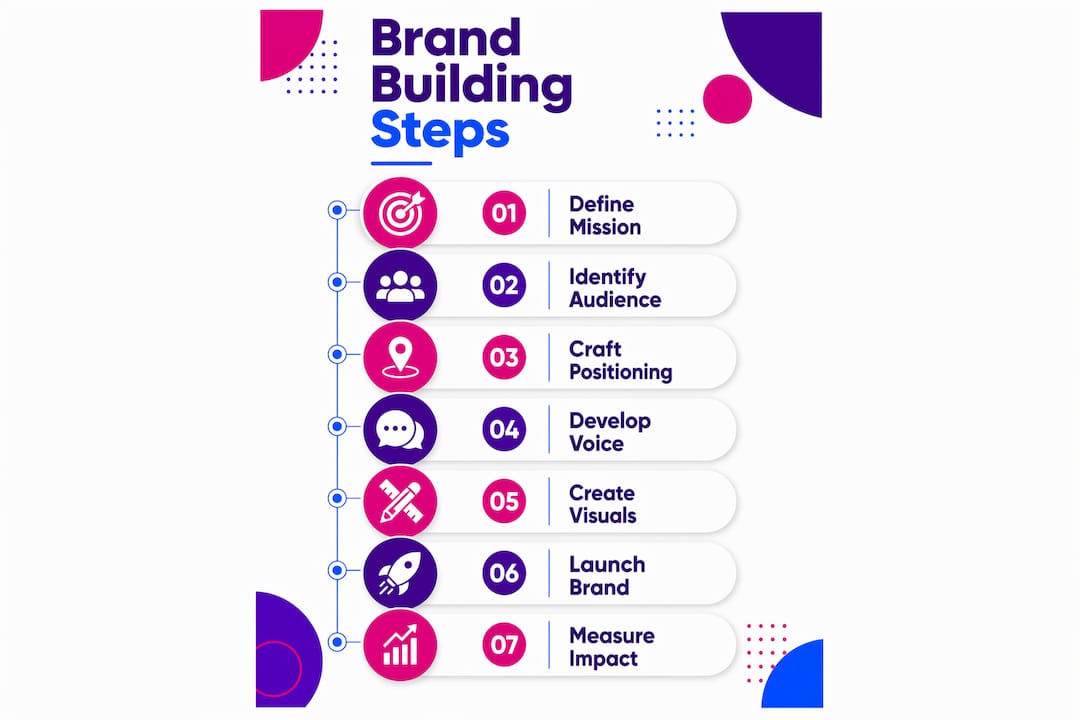
Pro Tip: Write your positioning statement before you brief any designer. If you cannot explain your brand in two sentences, a logo will not fix that problem.
Understanding what defines your brand at this stage saves you from expensive restarts later.
Brand voice is the personality your business expresses in every piece of written and spoken communication. It is one of the most underestimated assets a startup can develop early. A consistent voice builds recognition faster than any visual element because it shows up in every caption, email, and sales conversation.
Asana’s messaging framework resource defines the core components of a messaging framework as positioning statements, brand pillars, mission and vision statements, and core themes. These components guide consistent language across your website, social media, and sales materials. Without them, your team produces content that sounds like it comes from five different businesses.
To define your brand voice, answer these questions:
Once defined, document these in a messaging guide. This does not need to be a 40-page PDF. A single page covering your voice traits, sample phrases, and a “we say / we don’t say” table is enough to keep a small team aligned.
Practical brand guidelines must answer daily execution questions around tone, logo usage, and messaging to keep teams consistent. A decorative brand book that sits in a shared drive and never gets opened is not a guideline. It is a wasted afternoon.

Pro Tip: Record yourself explaining your business to a friend, then transcribe it. That natural, unscripted language is often your most authentic brand voice.
Visual identity is the face of your brand, but it is not the brain. Strategy must precede design every time. Startups that rush to a logo before clarifying their mission, audience, and positioning end up redesigning within 18 months. That cycle is expensive and demoralising.
Once your strategy is solid, your visual identity should include:
These elements combine into a brand style guide. The style guide is a practical reference document, not a trophy. It tells anyone producing content for your brand exactly how to apply each element correctly.
For startups not ready for a full brand identity investment, the Minimum Viable Brand (MVB) is the answer. An MVB includes only the essential elements needed to launch and test with real customers: a name, a simple logo, a core colour, and basic product or service descriptions. You gather feedback, learn what resonates, and refine from there.
| Approach | Best For | Investment Level |
|---|---|---|
| Full Brand Identity | Funded startups with defined positioning | High |
| Minimum Viable Brand | Early-stage startups testing the market | Low |
| Brand Refresh | Established brands with outdated assets | Medium |
Pro Tip: Before briefing a designer, collect 10–15 visual references that feel right for your brand. This single step cuts revision rounds in half and produces better results.
For practical guidance on creating an on-brand logo, Mybworkshops walks you through the process step by step.
Launching your brand is not a single moment. It is a series of deliberate applications across every channel your customers encounter. Metabrand’s phased branding process covers Discovery, Strategy, Verbal Identity, Visual Identity, and Activation as the full sequence. Skipping phases produces fragmented identities that confuse customers and slow growth.
Follow this sequence when launching your brand externally:
Once live, track your brand performance using behaviour-based metrics. Blazon Agency recommends monitoring branded search volume growth, referral rate, and repeat purchase rate as indicators of brand strength. These metrics tell you whether customers are actively seeking your brand or simply stumbling across it.
| Metric | What It Measures |
|---|---|
| Branded search volume | How often people search your business name directly |
| Referral rate | How frequently existing customers recommend you |
| Repeat purchase rate | Customer loyalty and brand preference over time |
Brand evolution is not rebranding. Evolution means refining your messaging, updating your visual assets, and deepening your positioning as you learn more about your customers. A structured, phased approach avoids the costly full rebrands that happen when startups skip the strategy phase at the beginning.
Pro Tip: Set a quarterly brand review in your calendar. Spend 30 minutes checking whether your website, social profiles, and sales materials still reflect your current positioning. Small drift compounds quickly.
Building a startup brand from scratch requires a strategic foundation before any design work begins, with iterative refinement guided by real customer feedback.
| Point | Details |
|---|---|
| Strategy before design | Define mission, audience, and positioning before briefing any designer. |
| Messaging framework first | Document brand voice, pillars, and tone to keep all content consistent. |
| Use the MVB approach | Launch with essential brand elements and refine based on customer feedback. |
| Track behaviour-based metrics | Monitor branded search, referral rate, and repeat purchases to measure brand strength. |
| Treat brand as a decision system | Your brand foundation should guide every future marketing and communication choice. |
I have worked with enough early-stage businesses to spot the pattern immediately. The founder spends three weeks agonising over a logo, picks a colour palette from a mood board, and launches with a beautiful visual identity that says absolutely nothing about who they serve or why they are different. Six months later, they are back at square one wondering why no one is connecting with their brand.
The uncomfortable truth is that most startups confuse brand assets with brand strategy. A logo is an asset. A colour palette is an asset. Your brand strategy is the decision system that determines what those assets should communicate and to whom. When you separate the two, you end up with strong visuals and weak communication. Customers see something polished but feel nothing.
What actually works is treating your brand foundation as a living framework, not a one-off deliverable. Your positioning statement, your voice guidelines, your audience personas: these are the documents you return to every time you write a caption, brief a designer, or plan a campaign. They stop you from drifting.
The MVB approach changed how I think about launching. You do not need a perfect brand to start. You need a clear enough brand to learn. Get the essentials right, put them in front of real customers, and let the feedback sharpen your positioning. That is far more valuable than spending months perfecting something in isolation.
Consistency is the compounding asset most startups underestimate. Every time your brand shows up the same way across your website, your social content, and your client conversations, you are building recognition. Recognition builds trust. Trust converts.
— Peggy
If you have read this far, you already understand that building a startup brand takes more than a logo and a colour scheme. It takes a clear strategy, a consistent voice, and a structured process to bring it all together.

Mybworkshops offers targeted, expert-led workshops designed specifically for service-based business owners who want to build their brand with confidence. The Brand-Building Workshops for Beginners walk you through setting your business direction, developing your brand identity, and creating a DIY branding framework you can actually use. Whether you are starting from scratch or untangling a brand that has lost its direction, Mybworkshops gives you the structure, mentorship, and practical tools to move forward. Explore the full workshop range at Mybworkshops and take the guesswork out of your brand.
Building a brand from scratch means defining your business identity, audience, positioning, and voice before developing any visual assets. It is a strategic process, not a design exercise.
A Minimum Viable Brand can be developed in two to four weeks, covering a name, logo, core colour, and basic messaging. A full brand identity with strategy, verbal identity, and visual system typically takes two to three months.
A Minimum Viable Brand is a lean brand identity with only the essential elements needed to launch and test with customers. It allows startups to enter the market quickly and refine based on real feedback.
Strategy always comes first. Rushing visuals before clarifying brand purpose causes expensive redesigns. Define your mission, audience, and positioning before briefing any designer.
Track behaviour-based metrics including branded search volume, referral rate, and repeat purchase rate. These indicators show whether customers are actively seeking your brand rather than simply discovering it by chance.