

Your landing page design directly determines whether a visitor becomes a lead or clicks away. The core elements that drive conversions are a clear, benefit-led headline, a single call-to-action (CTA), trust signals above the fold, fast load speed, and mobile-first layout. Get these right and you give every ad dollar a real chance of returning a result.
Here is what high-performing landing pages share:
These are not design preferences. They are conversion-tested principles that separate pages earning leads from pages burning ad spend.
A landing page has one job: convert a visitor from a specific ad or campaign into a specific next step. That is what makes it fundamentally different from your homepage or a general service page.

Your homepage serves multiple audiences at once: existing clients, job seekers, curious browsers, and potential buyers. It carries multiple messages and multiple CTAs. A dedicated landing page strips all of that away and focuses on a single, qualified visitor with a single intent.

The practical difference shows up in conversion rates. A homepage typically converts at 2–5%. A purpose-built landing page, with specific positioning and the right structural elements, converts at 5–15% for service businesses, with strong pages reaching 10–20%.
There is also a direct financial incentive beyond the conversion rate itself. Google Ads calculates a Quality Score for every keyword in your account, and landing page experience is one of its three components. A poor landing page raises your cost per click and lowers your ad position. Improving your landing page experience score from Below Average to Above Average can reduce your CPC by 20–50% on competitive keywords. That is a cost reduction before you spend an extra dollar.
Pro Tip: Build a separate landing page for each distinct offer or ad campaign. A page written for “emergency plumber Brisbane” should not be the same page you send “bathroom renovation quotes” traffic to. Specificity is what earns the conversion.
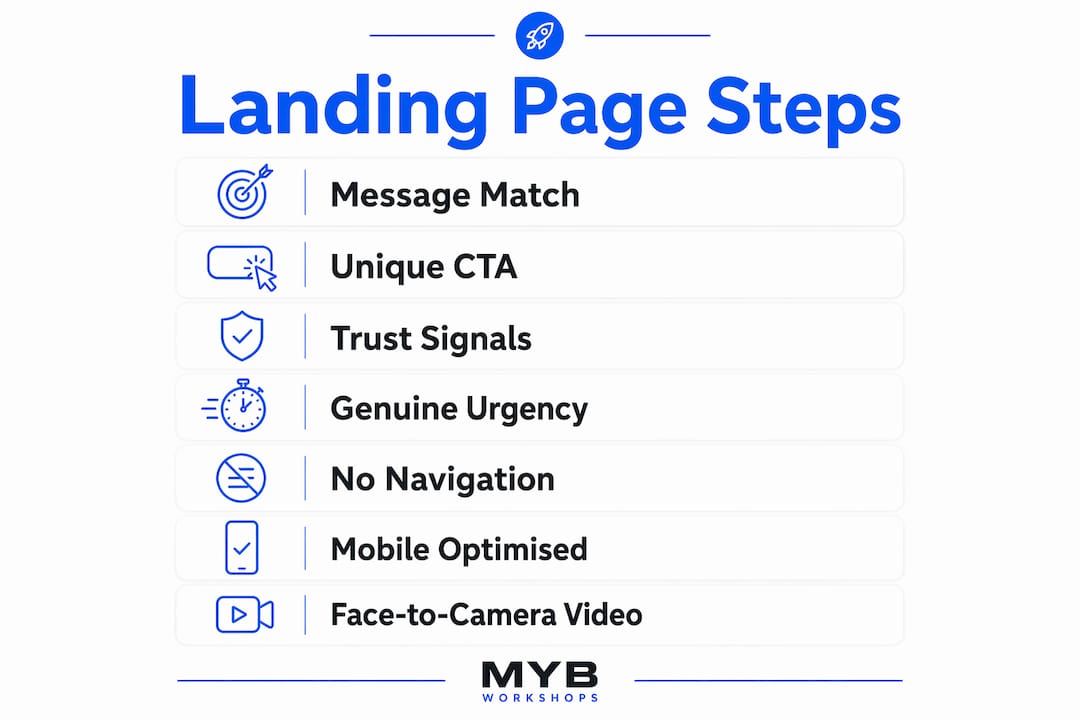
The headline on your landing page should echo the exact language of the ad that brought the visitor there. Not a paraphrase. Not your brand tagline. The same words. Visitors who see a direct continuation of what they clicked feel confident they are in the right place. Visitors who see something different leave.
This principle, called message match, is the single most important conversion rate optimisation factor on any landing page. It costs nothing to implement and produces immediate results.
Every button-coloured element on the page competes for attention with your primary CTA. Pick a colour that appears nowhere else on the page. A CTA button in a contrasting, unique colour can lift click-through rates by 20–35%. Repeat the same CTA three to five times down the page at each section break, not five different CTAs with different wording.
Cold traffic arrives sceptical. The first task of your page is to answer “is this business real and credible?” before asking for anything. Trust signals that work for Australian service businesses include:
High-converting landing pages display multiple trust signals above the fold. Placing them at the bottom of the page means only the small percentage of visitors who scroll all the way down ever see them.
Real urgency, such as limited appointment availability or a quote valid for seven days, motivates action. Fake countdown timers and “only 2 spots left” claims that reset on refresh damage your credibility the moment a visitor notices. Use urgency honestly or not at all.
Eliminating navigation menus and secondary offers reduces decision fatigue, which is a leading cause of visitor bounce. The only choices on a landing page should be “convert” or “leave.” Footer links, blog links, social media icons, and secondary CTAs all give visitors a reason to wander before they act.
Over 60% of Australian paid-traffic visits arrive on mobile. Designing for desktop and scaling down almost always produces a compromised mobile experience. Mobile-first means: headline readable without zoom, CTA button at least 44px tall, phone number tap-able with a tel: link, no horizontal scrolling, and a sticky bottom bar with the primary CTA and phone number persistent across the scroll.
A real person talking to camera for 60–90 seconds boosts conversions on lead generation pages by 15–40%. An unpolished phone-shot video from the business owner converts better than a slick corporate production, because it signals that a real person will answer the phone. Keep it simple: 15 seconds on what the page is for, 30 seconds on how it works, 15 seconds on the next step.
Pro Tip: Specific, named, verifiable social proof consistently outperforms vague claims. “473 Australian tradies used our playbook in 2025” is a claim a visitor can actually verify. “Trusted by thousands of happy customers” is not.
Optimisation is not a one-time task. It is a repeating cycle of testing, measuring, and improving. Here is the order of work that produces the fastest results.
Fix page speed first. Loading times over 2.5 seconds on mobile reduce conversion rates by up to 20% per additional second. Quick wins: compress images to WebP or AVIF format, lazy-load below-the-fold images, remove unused scripts, and enable caching. If your Largest Contentful Paint is above 3.5 seconds, fixing speed will return more conversion lift than any copy change.
Rewrite the hero section. Your headline needs to answer three questions in one glance: who is this for, what do I get, and why now. If it takes a visitor more than three seconds to answer those questions, the hero is the problem.
Shorten your form. Five to seven fields is the maximum before completion rates drop. For most service businesses, name, phone, and a brief description of the enquiry is enough to qualify a lead. You can gather the rest in the follow-up conversation.
Add multiple conversion paths. The form is one option, not the only one. Display a click-to-call number throughout the page, and consider a booking widget for visitors who prefer to schedule themselves. Multiple conversion paths convert better than a single forced path.
Run A/B tests systematically. Test one element at a time: headline, CTA wording, form length, hero image, or trust signal placement. Give each test at least two weeks and enough traffic to reach a reliable sample. Sustained A/B testing programmes can improve conversion rates by over 500% through compounding incremental wins.
Check your Google Ads Quality Score. In your Google Ads account, review the landing page experience component for each keyword. A “Below Average” rating is an explicit flag that Google considers your page poorly matched to user intent, and you are paying more per click as a result.
Use heatmaps and session recordings. Tools like Microsoft Clarity show you exactly where visitors stop scrolling, what they click, and where they abandon the page. This behavioural data tells you where friction lives, so you can fix the right things rather than guessing.
| Optimisation action | Priority | Expected impact |
|---|---|---|
| Fix mobile page speed (LCP under 2.5s) | High | Up to 20% conversion lift per second saved |
| Rewrite hero with specific positioning | High | 30% lift over generic pages |
| Add trust signals above the fold | High | Significant lift for cold paid traffic |
| Shorten form to 5–7 fields | High | Meaningful increase in form completions |
| Add click-to-call alongside form | Medium | Captures phone-preferring buyers |
| Run A/B tests on headline and CTA | Medium | Compounding gains over time |
| Install heatmap tracking | Medium | Identifies friction points for targeted fixes |
The biggest misconception business owners carry into landing page work is that design is about aesthetics. It is not. Landing page design is a performance discipline, and every decision should be measured against one question: does this help the visitor take the next step?
Personalised landing pages that dynamically match user search queries can increase conversion rates by up to 202%. That figure reflects what happens when message, market, and offer are precisely aligned. The page feels like it was built for the exact person reading it, because it was.
Decision fatigue caused by multiple navigation options or competing CTAs is the primary reason for high bounce rates. A focused page forces a binary choice and improves lead quality. This is not a theory. It is the consistent finding across conversion data from Australian businesses running paid traffic.
Page load speed and mobile responsiveness are not just user experience factors. They are directly tied to Google’s ad quality metrics and your campaign costs. A slow page costs you twice: once in lost conversions and again in higher CPCs from a lower Quality Score.
The most under-used conversion element on Australian landing pages is specific, named social proof. Testimonials with full names, suburbs, industries, and real photos outperform anonymised quotes. Video testimonials outperform written ones. A 30-second phone-camera clip from a real client beats a professionally produced anonymous one every time.
Pro Tip: Review your highest-traffic landing page and highlight every sentence that could describe any competitor. Those sentences are doing nothing for your conversion rate. Replace them with specific outcomes, named credentials, and verifiable proof.
Mybworkshops takes this approach into its workshop programme, combining strategic clarity with practical testing and mentoring so business owners build pages that work as part of a broader marketing system, not as isolated design projects. You can see how businesses have grown through this structured approach.
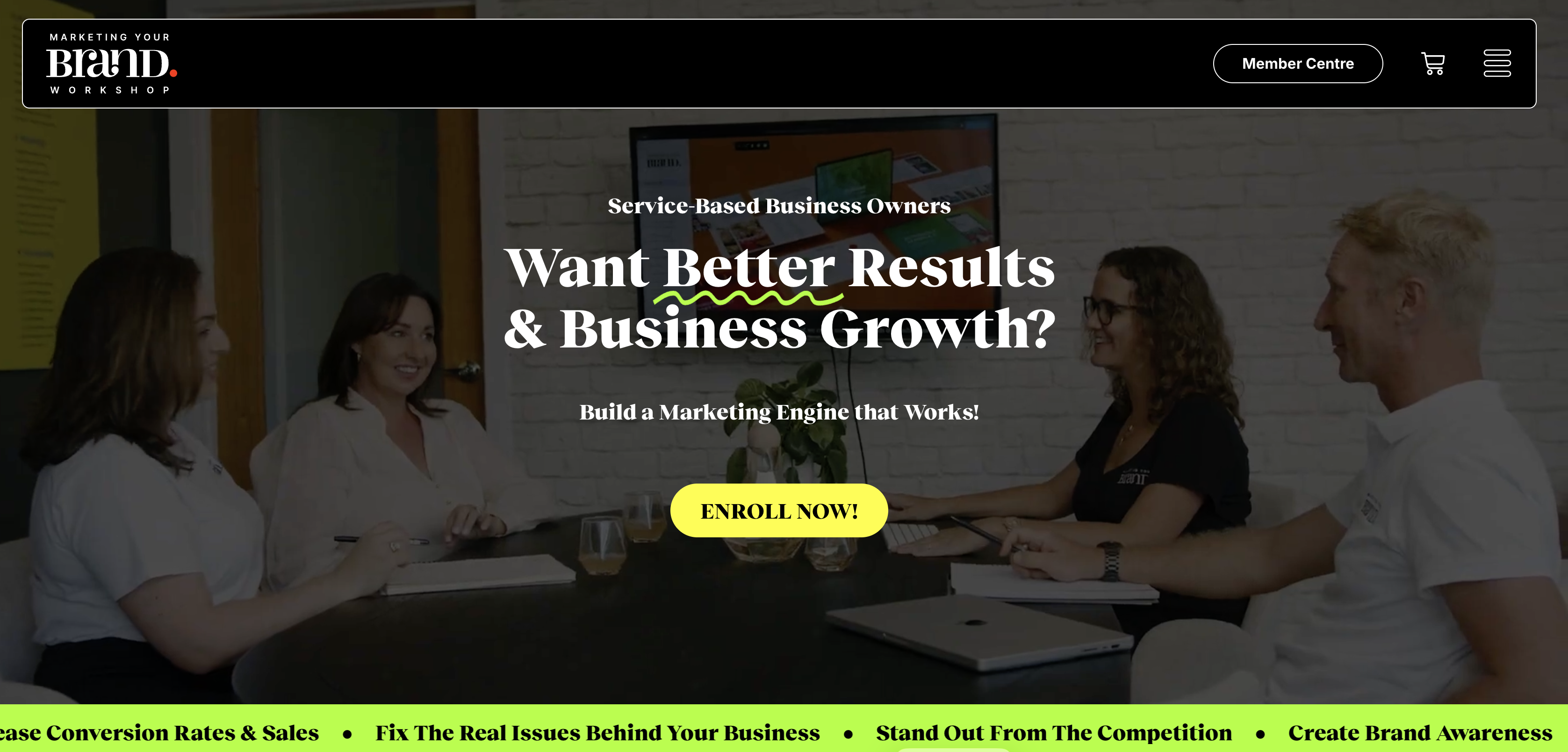
If your landing pages are sending paid traffic to a page that was not built to convert, you are paying for clicks that go nowhere. Mybworkshops runs expert-led workshops that walk service-based business owners through the exact framework for building pages that attract the right visitors and turn them into enquiries.
The Ads That Convert workshop covers landing page structure, message match, trust signals, and testing, all within a practical system you can apply to your own business. Browse the full workshop catalogue to find the right starting point.
Landing page design directly drives conversion rates by aligning visitor intent with a focused, distraction-free page that builds trust, loads fast, and makes the next step obvious.
| Point | Details |
|---|---|
| Message match is foundational | Your headline must echo the exact ad copy that brought the visitor to the page. |
| One CTA in a unique colour | A contrasting CTA colour that appears nowhere else on the page can lift click-through rates by 20–35%. |
| Trust signals above the fold | Credentials, ratings, and named testimonials must appear before the visitor scrolls to reduce scepticism. |
| Speed and mobile execution | Loading times over 2.5 seconds reduce conversions by up to 20% per additional second on mobile. |
| Test systematically | Sustained A/B testing programmes can improve conversion rates by over 500% through compounding wins. |
Landing page design controls how well a page matches visitor intent, builds trust, and removes friction from the conversion path. Strong design, with a clear headline, single CTA, trust signals, and fast load speed, directly determines whether a visitor becomes a lead.
Service business landing pages on paid traffic typically convert at 5–15%. Pages with specific positioning, trust signals above the fold, a short form, and clean mobile execution can reach 10–20%.
Loading times exceeding recommended thresholds on mobile can notably reduce conversion rates per additional second. Fixing page speed often delivers more conversion lift than any copy or design change.
Yes. Landing page experience is one of the three components of Google Ads Quality Score. Improving from Below Average to Above Average can reduce your cost per click by 20–50% on competitive keywords.
One primary CTA, repeated at each section break down the page. Multiple competing CTAs create decision fatigue and reduce the likelihood of any single action being taken.