

A brand messaging template is a one-page document that locks in your master narrative, core message, key pillars, proof points, and voice rules, so every piece of copy your business produces sounds like it came from the same place. This page gives you fillable templates, a step-by-step build process, and a short rollout plan you can work through in one to two weeks. This structure is designed to help service business owners fix messaging chaos without hiring anyone.
TL;DR:
- A brand messaging template ensures consistency across all channels by capturing the master narrative, core message, pillars, proof points, and voice rules in one document.
- Building a messaging framework involves a focused two to three-hour session, starting with audits of key touchpoints and collecting proof points to keep claims credible.
- The template should include a concise master narrative, a clear core message, supporting pillars with proof, audience-specific variants, voice guardrails, and proof mapping to avoid empty promises.
- Rollout should prioritize updating the homepage, initial contact points, and primary social channels, with the template stored in accessible locations and linked directly to content tools.
- Regular validation of messaging effectiveness through headline tests, client feedback, claim proof checks, and quarterly audits helps maintain clarity and trust against growing AI-generated copy.
Brand messaging is the specific language you use to explain what you do, who it’s for, and why it matters, consistently, across every channel. It’s different from positioning, which is the strategic decision about where you sit in the market. Messaging is the words that bring that decision to life on your homepage, in your emails, and in the pitch you give at a networking breakfast.
Most small businesses don’t lose consistency because their writing is bad. They lose it because nobody wrote the words down in one place. One version lives in an old Canva file, another sits in a Facebook ad from eight months ago, and a third only exists in the founder’s head. Add a new team member, a freelance copywriter, or an AI writing tool into that mix, and the drift compounds fast, especially as output scales faster than governance can keep up.
A template fixes this by giving everyone the same starting point. Once you have one, you get:
This isn’t about sounding polished for its own sake. It’s about your customers hearing the same promise no matter where they find you, which is the foundation of strong DIY branding done properly.
A messaging framework is only useful if it has the right fields. Miss one, and you’ll be back to guessing within a month. Here’s what a solid template captures:
If a pillar has no proof attached, that’s your signal to revise it or drop it before it ever reaches a client.
Give yourself a working session of two to three hours, spread across a few sittings if needed, and follow this order. Trying to write everything at once is how most people abandon the exercise halfway through.
Preparation. Before you write a word, audit your three highest-traffic touchpoints, usually your homepage, your enquiry email or first reply, and one social channel. Pull the actual language you’re using right now. Then collect three to five proof points: a client outcome, a number, a review, a certification, anything documentable. This step alone often reveals how much your existing messaging has already drifted.
Pro Tip: Write your master narrative last if you’re stuck. Sometimes the pillars and proof points make the bigger story obvious, and writing top-down first just leads to vague, generic language.
Forrester’s research on AI use inside marketing teams found that a large share of agencies now lean on AI tools to cut costs, which raises the risk of copy losing its distinct voice unless someone is actively protecting the guardrails. A written template is what gives an AI tool, or a new hire, something specific to follow instead of generic instructions.
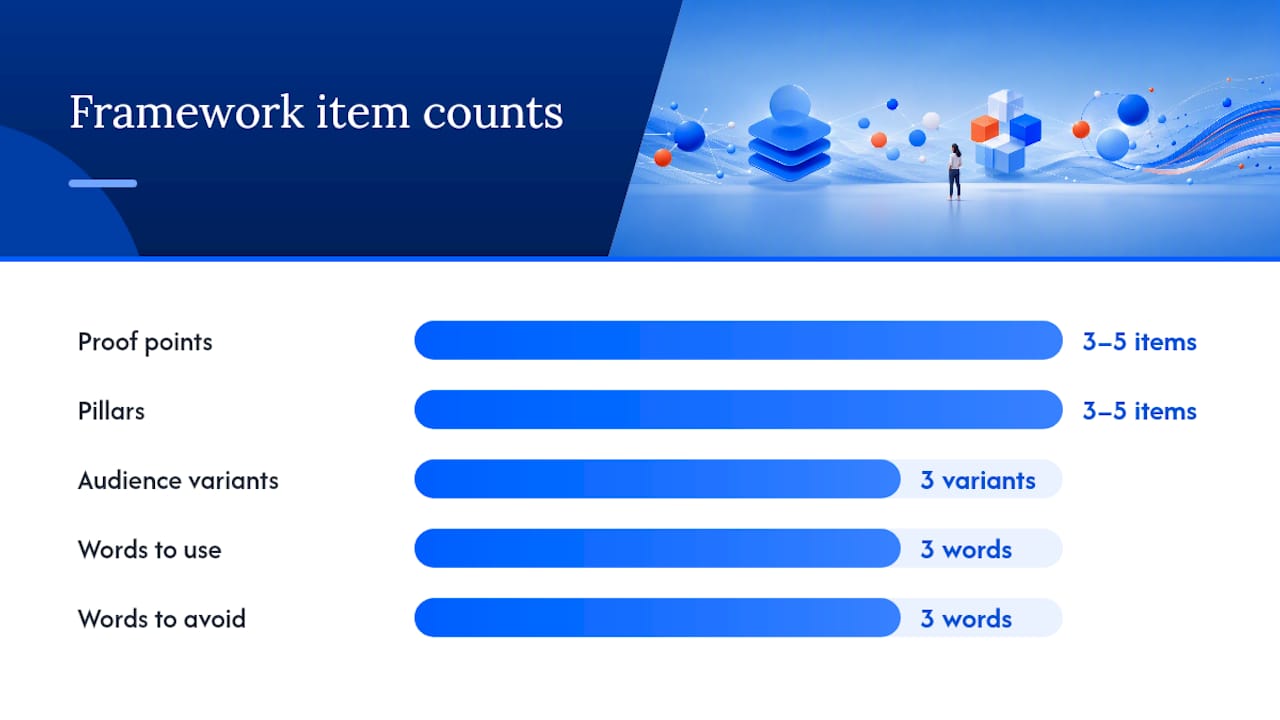
These are ready to copy into a document, a shared drive, or a Canva template right now. Fill in the brackets and you have a working draft within the hour.
Brand messaging matrix
Elevator pitch template
Borrowed from the structure used in Princeton’s career development elevator pitch guide: “I help [audience] who struggle with [problem] achieve [outcome] through [method], which matters because [stakes].” Example: “I help cafe owners who struggle with no-show bookings fill their tables through a simple deposit system, which matters because a single empty Saturday can cost more than a week of marketing.”
Pillar cards
Each card holds four fields: the claim, the value to the client, the proof, and a short phrase for social captions. A cleaning business pillar card might read: Claim, “we’re reliable”; Value, “you never wonder if we’ll show up”; Proof, “zero missed appointments across 300 bookings this year”; Short phrase, “Reliability you don’t have to chase.”
Practitioner write-ups on template systems for solo operators consistently point to one pattern: locking fonts, palette, layout, and a voice checklist into a reusable kit is the most practical lever small teams have for holding a brand together as output grows.
Tone checklist and sample lines
Run every piece of copy through three questions: Does this sound like something we’d say out loud? Does it match our locked pillars? Would our best client agree this is true? Then check channel fit:
Drop the filled matrix, elevator pitch, and pillar cards straight into a CMS content block or a Canva brand template, and you have a live reference instead of a document nobody opens again.
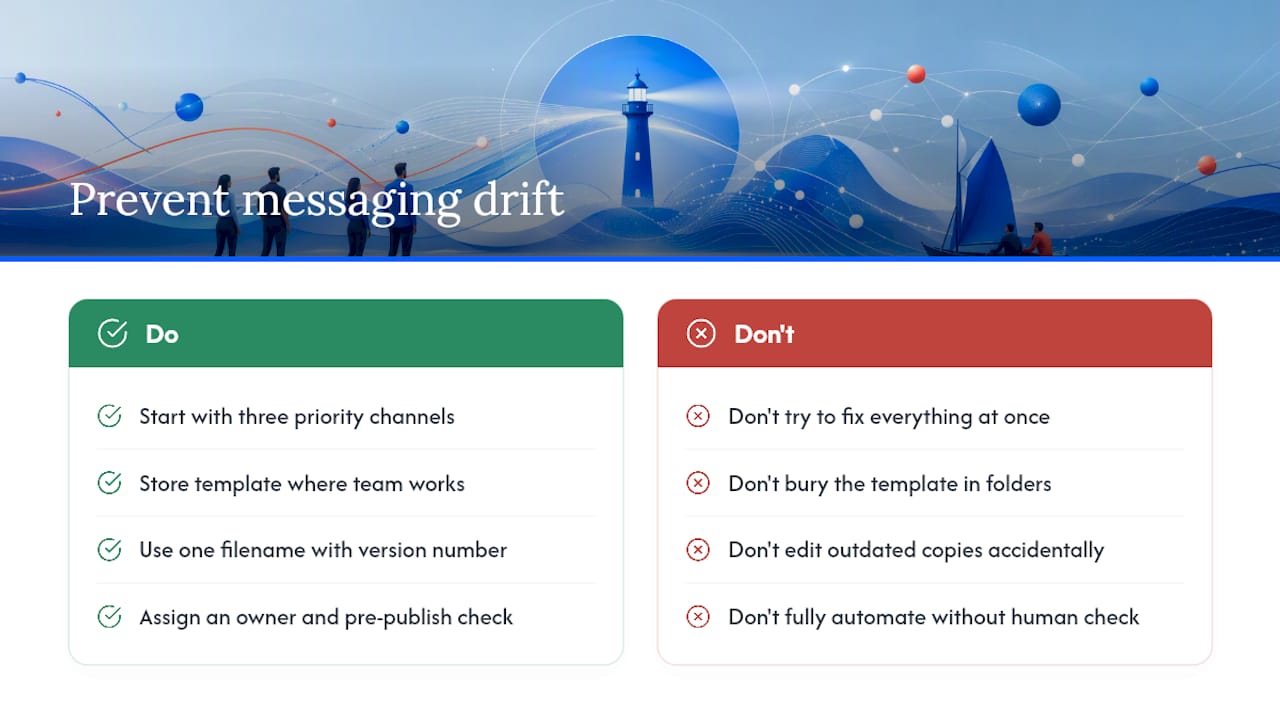
Start with your three highest-priority channels, homepage hero, first-contact email or booking reply, and your most active social profile, because that’s where new and existing clients form their first real impression. Fixing everything at once isn’t realistic for a small team, and it isn’t necessary.
Store the template somewhere your team actually works, not buried in a folder nobody opens. Link it directly from your CMS, your shared drive, and your content calendar, so it becomes the default reference the moment someone sits down to write. Use one clear file name and a version number (“Messaging Framework v3, March 2026”) so nobody edits an outdated copy by accident, a habit that also protects consistency across every channel you publish on.
Build a small template kit alongside it: your writing matrix, a locked colour and font set, and a shortlist of six to ten priority assets (homepage, email signature, proposal template, social bio, one-pager, invoice footer). Assign one person as the messaging owner, even in a business of two, and set a five-minute pre-publish check as a standing habit, not an afterthought.
Pro Tip: If you use scheduling or email tools with saved templates, load your locked pillar language into those templates once. That single setup step does more to prevent drift than any amount of reminding people to “check the doc.”
Keep automation modest. A saved snippet or a content calendar tag that flags “uses core message v3” is useful. A fully automated AI content pipeline with no human checkpoint is how you end up with technically on-brand but oddly generic copy, which is part of why governance gaps are widening even at businesses spending heavily on AI tools.
You don’t need a research department to test this, just a few repeatable checks run on a schedule.
Trust is becoming harder to earn and easier to lose as more brands lean on AI-generated copy, which makes a documented, provable message one of the more durable advantages a small business can build.
Reading a framework is one thing. Sitting down with people who’ve built dozens of these and walking out with your one-page messaging system already drafted is another. MYB Workshops runs a dedicated session built around exactly this problem, helping service business owners clarify their messages and attract the right clients instead of guessing at wording alone in a spreadsheet.
The workshop mirrors the build steps in this article, the master narrative, the pillars, the proof mapping, the audience translations, but with a mentor in the room checking your draft against real client examples as you write it, not weeks later. You leave with a working document, not homework. If you want to test the waters first, grab the free mini brand template as a starting point, then browse the full workshop line-up when you’re ready to build the whole system properly, with a group of other business owners doing the same work alongside you.
It’s a rule of thumb suggesting people need roughly three seconds to form a first impression of a brand, seven exposures before they start to recognise it, and around 27 touchpoints before real trust builds, a reminder that consistent messaging across many small moments matters more than one perfect campaign.
A completed example includes a master narrative like “We help tradies stop dreading tax time,” a core message such as “Bookkeeping that runs itself while you run the job,” and pillars backed by proof, such as a documented 24 hour quote turnaround.
Definitions vary across sources, but most cover purpose, positioning, personality, voice, visual identity, customer experience, and consistency, with messaging sitting at the intersection of positioning, voice, and consistency.
Common approaches include positioning around a specific niche, building messaging around proof rather than claims, translating one core message across different audience segments, locking voice guardrails, and reviewing consistency on a regular cadence, all of which a documented brand messaging framework is designed to support.