

AI can cut the time to usable market insight from weeks to hours, but only if you verify what it gives you. It’s genuinely good at synthesis, reading through mountains of reviews, transcripts and reports and pulling out the themes. It’s not good at replacing the judgement calls that follow. Your first move: define the decision you’re trying to make, then gather the source material you’ll feed it.
TL;DR:
- AI excels at quick synthesis and theme extraction but cannot replace human judgment in decision-making and requires clear, specific source material.
- Verifying AI claims with citations, triangulating data, and checking a representative sample of outputs are essential to prevent the spread of fabricated or biased information.
- Matching the right AI tools to the task—such as synthesis models, live search engines, or social listening platforms—is crucial for effective market research.
- Running a structured workflow with decision framing, assembling diverse source types, and small-scale testing ensures trustworthy insights and reduces costly mistakes.
- Workshops teach a repeatable system for turning AI-generated data into actionable insights, emphasizing verification habits, evidence-based prompting, and practical decision memos.
Before you open a chat window and start typing questions, it helps to know what AI for market research is genuinely built for and what it isn’t. Columbia Business School’s research breaks the value into three stages: scoping and design, data collection and analysis, and reporting. AI earns its keep in all three, but differently in each.
Here’s where it makes a real difference for a service business owner working without a research team:
None of this replaces talking to actual customers. It just means you spend your limited hours on the decisions that matter, not on formatting spreadsheets.
Most AI market research failures come from asking a chatbot vague questions and trusting whatever comes back. A tighter process fixes that, and it’s the same one taught across evidence-first prompting frameworks.
An AI-assisted pass through this process typically takes hours to a couple of days and costs whatever your existing AI subscription already runs. A traditional commissioned study covering the same ground can take weeks and run into thousands of dollars, according to small-business research guides. That gap is exactly why AI has become useful for owners who never had a research budget to begin with, not because it’s more accurate than a properly fielded study.
Pro Tip: Never let the AI summarise from memory. Paste the actual source text or links into the prompt every time, and ask it to quote the line it drew each claim from. That one habit catches most fabricated statistics before they reach your decision memo.
There’s no single tool that does everything well, and chasing one is a waste of a Tuesday afternoon. Match the tool category to the job.
Whatever you choose, prioritise tools that let you export the raw data behind their summaries. If you can’t check the working, you can’t trust the output.
The risks are well documented and not hard to guard against once you know what to look for. Large language models hallucinate, meaning they sometimes generate a plausible-sounding statistic that doesn’t exist anywhere in your sources. They can also work from stale training data or reflect biases baked into whatever they were trained on.
A short verification checklist handles most of this:
Roughly 30 to 40% of organisations surveyed by Columbia Business School researchers are now experimenting with digital twins or letting AI guide decisions they previously wouldn’t have used external data for at all. That’s a fast uptake for a tool this new, and it’s exactly why the verification habit matters. Skipping it because “the AI said so” is how bad decisions get made faster than ever.
One more thing worth a single sentence: never paste customer names, health details or financial information into a public AI tool without checking its data handling terms first.
An AI summary isn’t a decision. It’s an input, and it needs a confidence rating before anyone acts on it: high (backed by multiple sources and your own data), medium (directionally useful but thin on evidence), or low (interesting but untested).
In a small team, assign this explicitly. One person curates the source list, another checks citations and runs the sample spot-check, and someone owns the small test that follows. Without that split, everyone assumes someone else verified it, and nobody did.
The output that matters is a one-page decision memo: the decision being made, the evidence behind it, the confidence rating, and the smallest test you’re running next. Set a review date. If the test doesn’t move the metric you defined at the start, sunset the idea and move to the next hypothesis rather than quietly keeping it alive because you’re attached to it.
A structured, three-phase approach emphasises: plan the decision and source list, run the AI-assisted synthesis with verification built in, then test the smallest version before committing budget. It’s the same plan → run → test rhythm the workshops use for broader marketing and website decisions, not just research.
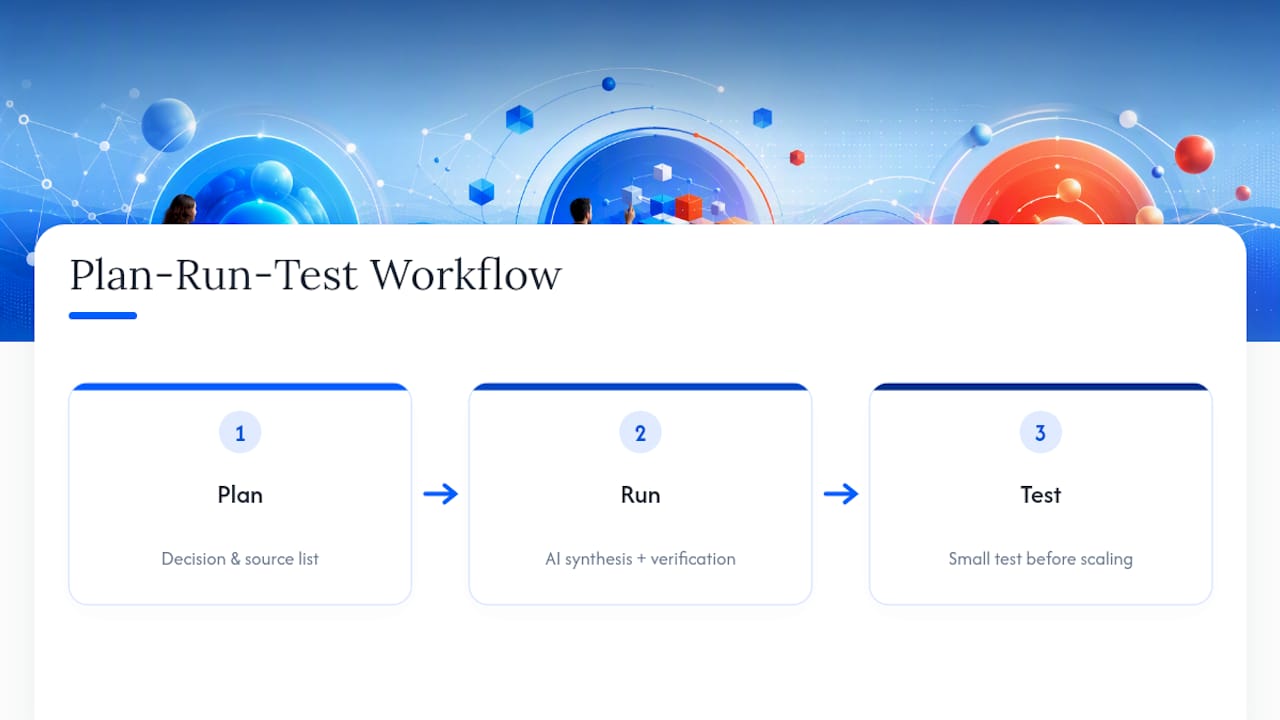
The program teaches evidence-first prompting, how to build a decision memo that survives scrutiny, and the verification habits that stop a confident-sounding AI output from becoming an expensive mistake. Participants have reported clearer decisions and less wasted ad spend, often the result of testing small before scaling anything.
Chatbots and scraping tools will get you data. What most small-business owners are missing isn’t more tools, it’s a repeatable system for turning that data into a decision worth acting on.
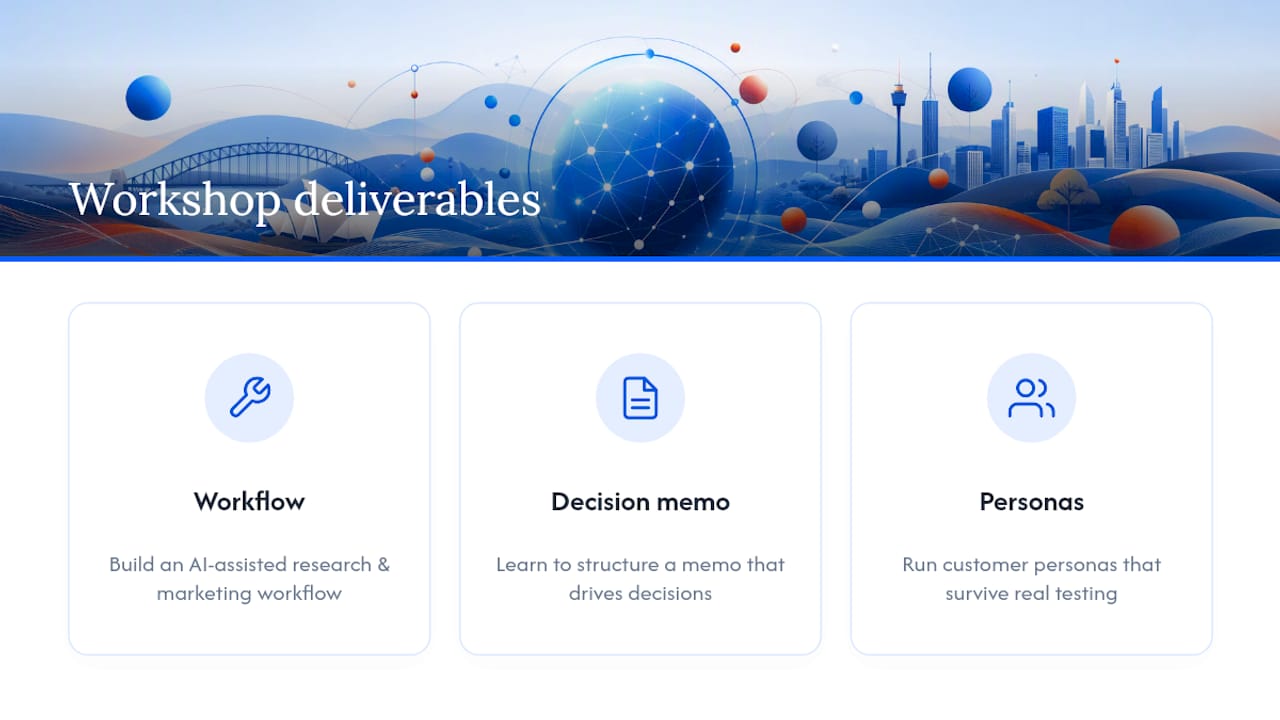
That’s the gap this type of workshop is built to close. Rather than a one-off download or a generic prompt list, workshops often walk you through building your own AI-assisted research and marketing workflow, including how to code open-text feedback, structure a decision memo, and run customer personas that hold up against real testing rather than guesswork.
This suits service-based business owners and founders who’ve tried the free tools already and want a structured way to apply them without hiring a research team. If your website or lead generation depends on getting your market read right, the Business Strategy Workshop is the natural starting point, or browse the full workshops archive to find the one that fits where your business is right now.
For deeper reading beyond this guide, Columbia Business School’s overview of generative AI in research, Harvard Business Review’s coverage of AI research tools, and Marketing Week’s reporting on AI in practice all cover the evidence base this article draws on.
No single tool wins every job. Use a synthesis-capable LLM for summarising your own sources, a real-time search tool for current data, and a dedicated social listening platform for trend tracking, then verify everything against the original evidence.
Yes, for synthesis, drafting memos, and coding open-text feedback into themes, provided you supply the source material and check its citations rather than trusting its memory alone.
It depends on the task. Real-time search engines beat general chatbots for current pricing or news, while dedicated survey and social listening platforms outperform any general-purpose model for structured fieldwork and sentiment tracking.
General-purpose research workflows and verification checklists apply here too, but financial and stock analysis carries its own regulatory and data-quality demands that sit outside the small-business research approach covered in this guide.