
A 90 day marketing plan breaks a quarter into focused stages, each with its own goals, tasks and checkpoints, so you’re never guessing what to do next. The fastest way to start is to pick one SMART goal and one priority project today, then build your first 30 days around it.
TL;DR:
- Track one KPI per goal each week, using a week one baseline; assign every task one accountable owner and give larger projects dated subtasks.
- Use the first month to establish messaging and baseline tracking, then test small campaigns one element at a time before shifting more budget toward winners.
- For service businesses, prioritize qualified inquiries over volume, strengthen trust signals early, and use the final stage to build referral and retention systems.
- Before automating email or text marketing, obtain clear consent, identify the sender, provide a working unsubscribe link, and honor withdrawals within five working days.
A 90-day marketing plan takes the big goals from your annual strategy and turns them into something you can actually act on this quarter. Instead of a vague yearly target like “grow the business”, you get three stages of specific, time-boxed work: 30 days to set foundations, 60 days to test and refine, and 90 days to scale what’s working.
This approach suits a few situations particularly well: launching a new campaign, stepping into a new marketing role and needing a fast plan, building momentum in a young business, or simply needing a sharper focus for the quarter ahead.
Business.gov.au recommends reviewing and updating your plans regularly rather than setting them once a year and forgetting them. A 90 day cycle builds that habit in, with a regular reset to help keep your plan current.
Here’s a practical breakdown you can adapt to your own business, with example owners and a simple metric for each stage.
First stage: get your foundations right
Next stage: test and refine
Days 61 to 90: scale and hand over
Pro Tip: Keep a simple running log of what you tried and what happened. It can save time when you’re planning the next quarter.
Vague goals produce vague results. Business.gov.au recommends SMART goals, Specific, Measurable, Achievable, Relevant and Time-bound, and notes that SMART goals must include a defined timeframe and measurable data, such as specific revenue targets or customer feedback metrics.
For a service business, that might look like “increase qualified leads by a defined number within 90 days” or “improve website conversion rate from its current baseline to a higher target by the end of the quarter.” Both have a defined timeframe and a clear measure of success.
Useful KPIs to track alongside your goal include:
We’ve written more on this in our guide to marketing KPIs for service businesses. Pick one KPI per goal and check it weekly, so small problems get caught before they become quarterly ones.
With a long list of possible tasks, a simple filter helps you choose what actually matters this quarter. Ask of each task:
Every task needs one accountable owner, even if other people help. Break larger projects into sub-tasks with their own deadlines, so “redo the website” becomes five smaller jobs with dates attached rather than one daunting item that never moves.
When you’re short on time, be honest about what you can do internally and what needs outside help. A quick time-budget check, how many hours does this realistically take versus how many you have, stops the plan from quietly becoming unworkable by week three.
You don’t need a complicated stack to track progress well. Business.gov.au points to a handful of tool categories worth considering: analytics, a CRM, an email system, a landing page builder with testing capability, and a social media scheduler.
At minimum, aim for:
Automation can save real time, but every automated message still needs to meet consent and unsubscribe requirements, which we cover next.
Before you switch on automated emails or SMS, a few compliance basics protect you from fines and protect your subscribers from spam. ACMA guidance on consent recommends using express consent with clear terms that explain what the marketing is for, who will use the data, and how someone can withdraw consent.
For a deeper audit of your own ad spend and compliance, the team at Google Ads Guy offers practical guides on auditing campaigns and landing pages.
A 90 day plan works best when you revisit it regularly. A light review rhythm does that without turning into another full-time job.
We’ve outlined a simple version of this in our piece on marketing sprint planning. Pro Tip: If a test isn’t moving its KPI, review the evidence and decide whether to adjust it or stop it.
Our workshops are built in three structured phases, blending hands-on templates with personal mentorship so you’re never left staring at a plan with no idea how to execute it. Participants work through step-by-step tasks, measurement templates and guided mentorship rather than piecing a quarter together alone. If you want that structure applied to your own business, our three-phase marketing plan approach offers a structured way to plan your marketing.
A common trap in any 90 day plan is chasing leads so hard that the brand underneath them gets thin and forgettable. Paid ads and lead magnets can fill your pipeline this month, but if your messaging, visuals and website don’t reinforce the same story every time, you end up acquiring clients who aren’t quite the right fit, and churning through strangers instead of building a recognisable business.
The better approach treats brand and lead generation as two speeds of the same engine, not competing priorities. Early in the plan, lock in the messaging and visual consistency that everything else will sit on top of. That’s not wasted time before the “real” marketing starts, it’s what makes every lead-generation dollar in days 31 to 90 work harder, because people recognise you across touchpoints instead of meeting a stranger each time.
Practically, that might mean your paid ads in month two use the same language and imagery you locked in during month one, so a click from a cold ad feels consistent with your website and your follow-up emails. Your welcome sequence should sound like the same business that wrote the ad, not a different voice entirely.
By month three, the brand-building groundwork should be paying off in better lead quality and lower acquisition costs. It’s worth reviewing why more leads alone won’t fix every problem if conversion from those leads still isn’t improving. The volume isn’t the issue if the story around it isn’t consistent.
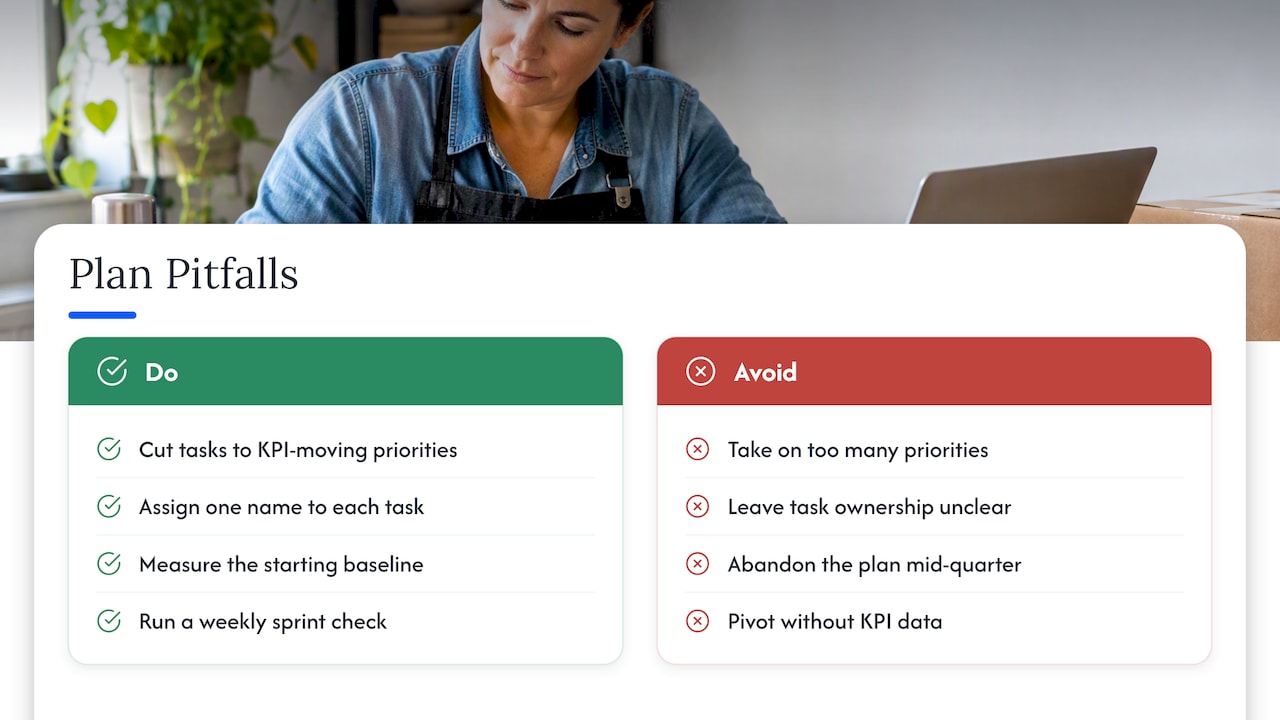
Most 90 day plans don’t fail from lack of effort, they fail from a handful of predictable mistakes that show up again and again.
Trying to do everything at once. A plan with too many priority tasks has no priorities. Cut your list to the handful of tasks that genuinely move your KPI, and park the rest for next quarter.
No single owner for each task. When three people are “sort of” responsible for something, nobody is. Assign one name to every task, even small ones.
Skipping the baseline. If you don’t measure where you started, you can’t prove the plan worked, and you’ll repeat the same debates about what to try next quarter.
Abandoning the plan partway through. Momentum dips are normal. A weekly sprint check, even a short one, catches drift before it becomes a derailed quarter.
Changing direction without evidence. It’s tempting to pivot the moment something feels slow. Give tests a fair run before judging them against your KPI data, not your gut feeling.
Treating the plan as separate from the brand. Running campaigns that don’t match your website, tone or visuals confuses the people you’re trying to convert. Every tactic in the plan should reinforce the same brand foundations, not work against them.
Addressing these early, in your week one audit, saves most of the quarter’s frustration later.
Service businesses face a different rhythm to product businesses: longer decision cycles, more trust required before someone books a call, and often a smaller number of higher-value clients rather than high-volume transactions. That changes what “winning” looks like in 90 days.
Your 30 day foundation stage matters more for service businesses because trust signals (clear messaging, a professional website, visible proof of expertise) do a lot of the convincing before someone ever enquiries. If your website isn’t converting visitors into enquiries, fixing that early in the quarter pays off through every later stage.
Lead quality should outweigh lead volume as a KPI. Enquiries from people who fit your ideal client profile are more useful than generic ones that waste your time qualifying them. Build your 60 day testing stage around refining who you’re attracting, not just how many.
Your 90 day scale stage should focus on repeatable referral and retention systems, since many service businesses grow as much from existing relationships as from new leads. Document your onboarding and follow-up process so good client experiences turn into referrals without needing a bigger ad budget.
Not every test in your 60 day stage will work, and that’s expected. What matters is having a clear way to decide what to fix, pause or cut rather than letting underperforming campaigns run on autopilot.
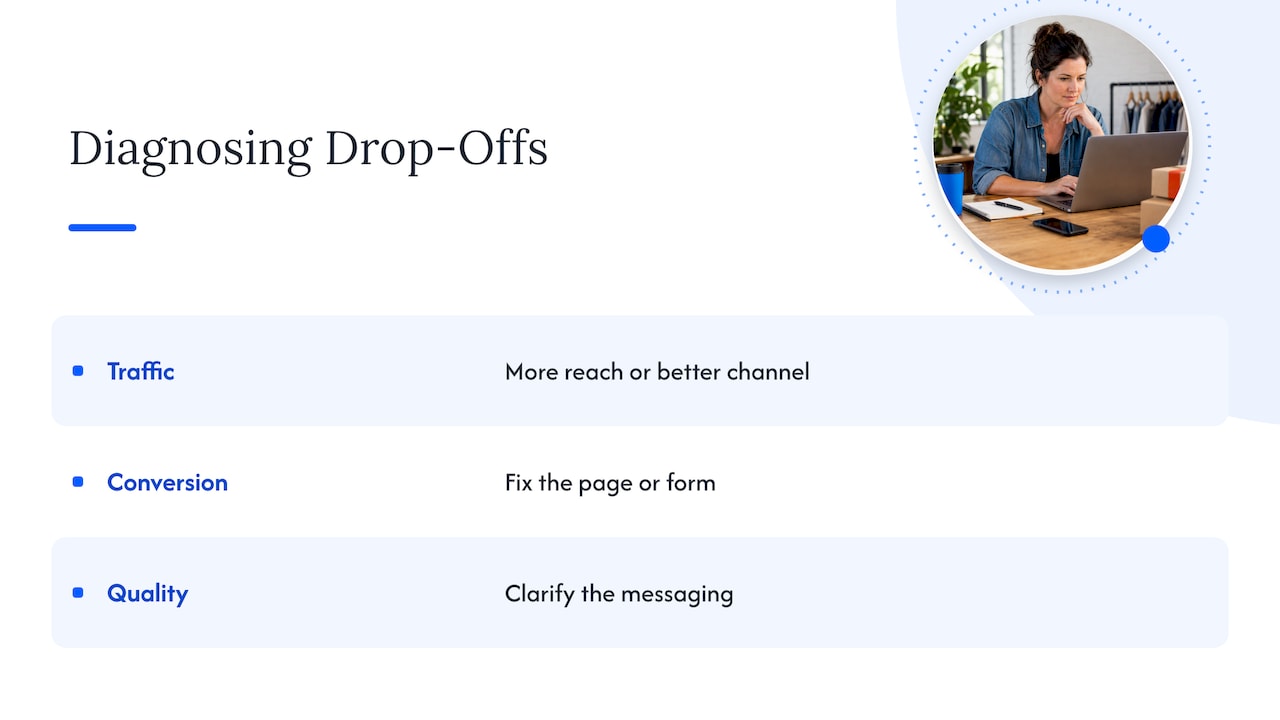
Start by isolating where the drop-off happens. Is it a traffic problem (not enough people seeing the offer), a conversion problem (people seeing it but not acting), or a quality problem (people converting but not becoming good clients)? Each has a different fix: a traffic problem needs more reach or a better channel, a conversion problem usually points to the page or form itself, and a quality problem often traces back to unclear messaging attracting the wrong audience.
Compare each underperforming element against your week one baseline, not against an assumed ideal. A landing page converting at a lower rate than last quarter’s baseline needs attention; one performing in line with your historical average might just need more time.
Give genuine underperformers a fair window before pulling the plug. Changing too many variables at once (new copy, new image, new offer, all in the same week) makes it impossible to know what actually fixed the problem. Fix one element, measure again, then decide.
AI tools can genuinely speed up parts of a 90 day plan: drafting first versions of copy, summarising weekly analytics, or generating variations to test on a landing page. Used well, they free up time for the judgement calls that actually need a human, deciding what to test, what the data means, and whether a result is worth scaling.
Where AI tools fall short is context: they don’t know your clients, your brand voice, or why last quarter’s campaign underperformed. That’s where mentorship earns its place in the plan. A second set of experienced eyes on your weekly dashboard or your draft messaging catches the kind of mistakes a tool simply can’t flag, because it doesn’t know what “off brand” looks like for your business.
The most practical setup treats AI as a drafting and reporting assistant inside your weekly sprint, and mentorship as the monthly review layer that checks direction and catches blind spots. Neither replaces having an actual strategy behind the plan. AI drafts faster, but a person still needs to decide whether what it drafted is right for your business and your clients.
We built our workshops around exactly this kind of 90 day structure: practical templates, step-by-step tasks and mentorship instead of a theory-only course. If you’d rather work through your plan with guidance than build it from scratch alone, that’s what we’re here for.

Book your spot and bring your next quarter’s plan with you.
The 3-3-3 rule isn’t a formally defined marketing standard, and definitions vary depending on who’s using it. In practice, people may use it to describe testing a mix of channels, messages or audiences before committing further budget, which is a sensible habit inside a 90 day plan’s testing stage.
A solid 90 day plan includes SMART goals with clear KPIs, a breakdown of tasks across its stages, named owners for each task, and a regular review rhythm to track progress and adjust course.
In sales, the 30-60-90 structure is typically used for onboarding, setting learning goals for the first 30 days, building skills and pipeline in the next 30, and reaching full productivity by day 90. It follows the same staged logic as a 90 day marketing plan, just applied to a role rather than a campaign.
A staged 90 day approach breaks the period into phases for setup and foundations, testing and refining, then scaling what works. It’s used across marketing, sales and new roles because it turns a long timeframe into manageable, sequential chunks.