

Three moves matter more than anything else right now: claim and properly configure your Google Business Profile, publish one focused suburb page on your website, and build a simple system to ask every happy customer for a review. The Google Business Profile and review system are fast wins, often live within a week. Suburb pages and broader local SEO take longer, usually a few months, but they compound. Both business.gov.au’s marketing tools and the government’s Digital Solutions program back this staged approach.
TL;DR:
- Claim and fully optimize your Google Business Profile, ensuring consistency in your NAP details, adding photos, and posting updates regularly to boost local visibility.
- Build one suburb-specific landing page to target your top service area, focusing on clear messaging, local proof, and a direct call-to-action.
- Establish a simple review request system by sending follow-up messages after jobs, encouraging steady review velocity to enhance reputation and local ranking.
- Test small, targeted Google Ads campaigns and track cost per lead and conversion rates to ensure effective use of paid search.
- Use offline methods like vehicle signage, flyers, and community groups to reinforce your presence locally, but always link these efforts to your online profiles for maximum impact.
Most tradies don’t need more marketing ideas. They need to know which three or four will actually put the phone on the bench ringing this week, and which ones are slow burns worth setting up anyway. Here’s a working list, roughly ordered by speed to first lead.
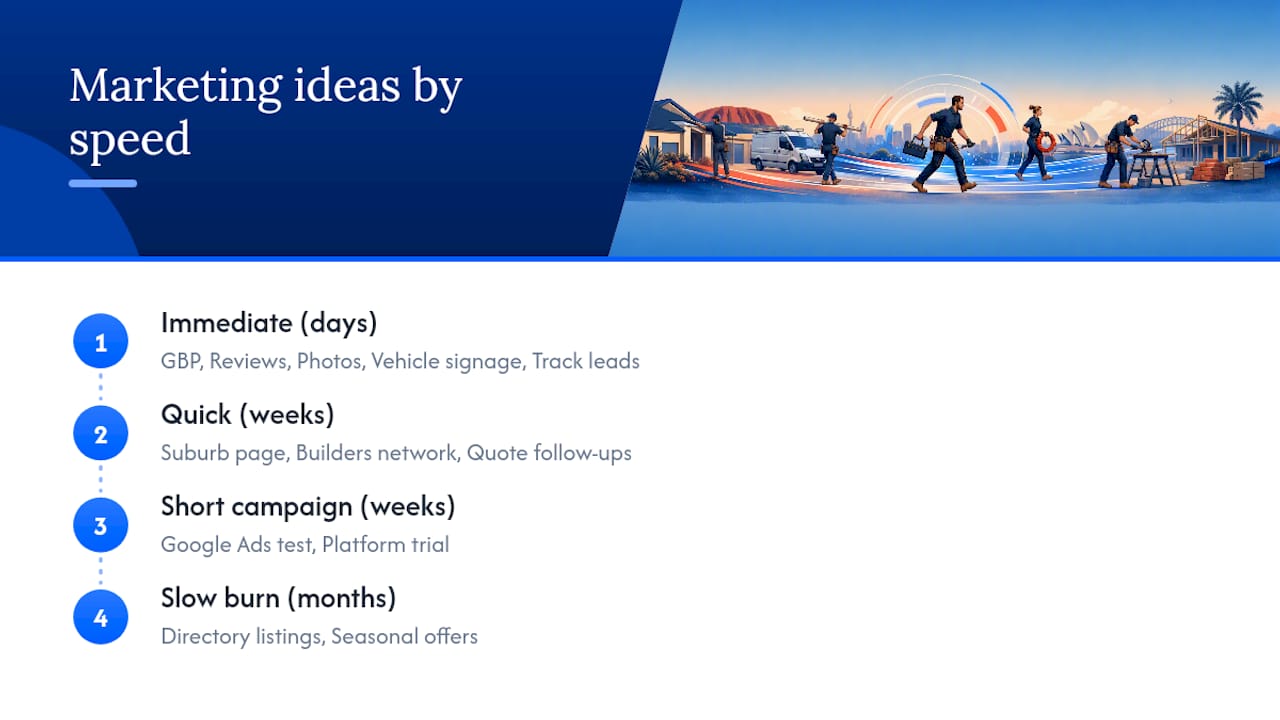
1. Claim and fully configure your Google Business Profile. This is the single highest-leverage thing a trade business can do online, and it costs nothing. First step: search your business name on Google right now and see what’s already there, wrong or missing.

2. Build one suburb-specific landing page for your top service area. A generic “areas we service” list doesn’t rank. First step: pick the suburb that sends you the most work already and write one page just for it.
3. Set up a simple, repeatable review-asking habit. Reviews are the modern word of mouth. First step: write one short text message template you’ll send after every completed job.
4. Build a photo-first portfolio, before and after shots included. Tradies who show the work win the quote. First step: take two photos (before, after) on your next three jobs, even on your phone.

5. Network directly with builders, property managers and real estate agents. These relationships hand you repeat, high-volume work without any ad spend. First step: list five local builders or agencies you’d like on your books and call one this week.
6. Test a small, tightly targeted Google Ads campaign. A narrow radius and one service keeps this cheap and measurable. First step: set a daily budget you’re comfortable losing entirely, and run it for two weeks.
7. Use job platforms selectively, not as your main channel. They can fill gaps but often mean racing on price. First step: trial one platform for a month and track your actual close rate from it.
8. Set up an SMS or email follow-up for quotes that go quiet. Most quotes aren’t rejected, they’re just forgotten. First step: draft one polite follow-up message you send 48 hours after every quote.
9. List your business accurately in relevant directories. Consistency here supports your local search visibility. First step: search your business name and fix any old address or phone number you find.
10. Put signage on your vehicle and invest in decent uniforms. Every job site becomes a rolling billboard. First step: get a quote from a local signwriter this week.
11. Run simple, seasonal offers tied to real demand. Gutter cleaning before storm season, hot water servicing before winter. First step: pick one seasonal service and plan a small offer three months ahead.
12. Track your leads in one simple spreadsheet or notebook. You can’t improve what you don’t measure. First step: create five columns today: date, source, job type, quoted, won.
None of these work in isolation forever; partnering with experts like HarbourSide Digital can help Sydney tradies execute stress-free marketing effectively. A vehicle wrap without a decent website behind it wastes the curiosity it creates. A review system without a Google Business Profile to display those reviews on wastes the trust it builds. Treat this list as a system, not a menu you pick one item from.
Get this one right and it becomes your best-performing “ad” without ever paying Google a cent. Most tradies get it half right, which is worse than not having one at all, because a sloppy profile signals low quality before a customer even calls.
Start here:
Don’t just watch star ratings. Track clicks-to-call, direction requests and booking clicks in the profile’s insights panel. Those are the actions that actually turn into jobs.
Pro Tip: Set a recurring 15-minute calendar reminder every fortnight just for your Google Business Profile: one new photo, one short post, one reply to any new review. Small, consistent effort beats one big clean-up every six months.
A single “our services” page trying to cover every suburb you drive to is a weak page for all of them. Search engines and customers both reward specificity: one page, one job, one location, done properly.
A page that converts usually includes:
Thin, duplicated suburb pages (same paragraph with the suburb name swapped) do more harm than good. Write each one properly or don’t bother. Keep the technical basics simple: mobile-first design, images that load quickly, and NAP details that match your Google Business Profile exactly. A clear structure that guides a visitor toward booking, rather than just informing them, is the difference between a page that ranks and one that also converts visitors into enquiries.
Review velocity means the steady, ongoing trickle of new reviews over time, as opposed to a rushed batch of ten in one week followed by silence for a year. Steady, scheduled review gathering tends to be both safer and more effective for local search than chasing reviews in bulk, according to TradieLink’s analysis, because it looks natural and keeps your profile looking active.
A simple system:
Pro Tip: Never offer a discount or freebie in exchange for a review. It breaches most platform policies and can get reviews removed, along with your credibility.
Google Ads makes sense once your Google Business Profile and website are solid, not before, because you’d otherwise be sending paid traffic to a weak landing experience. When you do test it, keep the setup narrow: a small daily budget, a tight suburb radius and a single high-intent service like “blocked drain repair” rather than your entire trade category. Small, targeted experiments like this are the least wasteful way for a tradie to test paid search, according to business.gov.au’s marketing guidance.
Job platforms sit differently. They can fill quiet weeks fast, but many put you in a straight price race against several other tradies. Qualify these leads quickly on the phone before quoting, and track your close rate from the platform separately so you know if it’s actually worth the subscription.
Local community groups can be genuinely useful for tradies, but only if you treat them as a place to be helpful, not a billboard. Photo-first posts, a real before-and-after shot with a short caption naming the suburb and a soft call-to-action, perform far better than text-only posts asking for work.
Done well, this builds quiet, ongoing trust in your local area without costing a cent.
Builders, property managers and suppliers each control a pipeline of work you’ll never see through Google. The people worth calling first are the ones already sending work to someone else, because that proves the demand exists.
You don’t need a marketing dashboard, you need three numbers tracked weekly: enquiries received, quotes won, and rough cost per lead by source. That’s enough to spot what’s working.
Stop anything that isn’t producing a genuine enquiry after a fair trial period, and shift that budget to whatever channel is already proving itself.
Ten tasks, roughly in order, each one small enough to fit around actual jobs:
“Done” means each task is live and checked off, not perfect. Momentum matters more than polish here.
Working through a checklist alone is doable. Doing it with structured guidance is usually faster, and less prone to the guesswork that burns time and ad spend. Mybworkshops runs a three-phase program built around exactly this: business direction and brand foundations first, then a converting website and clear copy, then lead generation and traffic that actually pairs with practical AI tools rather than replacing real strategy with them.
Pro Tip: If you’re overwhelmed by where to even start on this list, the in-person workshop format works well for tradies who learn best by doing it alongside someone, rather than reading another guide.
Most tradies chase new leads constantly while ignoring the customers already sitting in their phone. Email (or SMS, which many tradies find gets read faster) is the cheapest way to bring past customers back for repeat and seasonal work.
Keep it simple and useful, not salesy:
Retention costs a fraction of what a new lead does. A customer who had good work done and hears from you again in six months is far more likely to call you first, rather than searching Google and hoping.
Video works for tradies because it shows competence in a way photos and text can’t. A 30-second clip of you explaining a common problem, or a quick before-and-after walkthrough, builds trust faster than any amount of written copy.
You don’t need production quality, a phone camera and decent lighting is enough. What matters more is content:
For paid social ads, treat them the same way as Google Ads: small budget, narrow suburb targeting, one clear offer or service. A short video ad targeted at a five-kilometre radius around your busiest area, promoting one seasonal service, will usually outperform a broad, generic ad running everywhere at once. Track the same numbers you would for any paid channel: cost per lead and actual conversion to a booked job, not just views or likes.
A referral program formalises what already happens informally, happy customers telling their neighbours. Making it explicit just speeds it up and gives you a way to track it.
Keep the incentive simple and proportional to the job value: a small discount on their next service, a gift card, or a modest cash thank-you for any referral that converts into a paid job. Complexity kills referral programs, if a customer has to remember a code or fill in a form, most won’t bother.
Mention it naturally at the end of a job, when satisfaction is highest: “If you know anyone else who needs this done, send them my way and I’ll sort you out with [X] next time.” Follow it up in your post-job thank-you message so it’s not forgotten.
Track referrals in the same simple lead spreadsheet you’re already using, source, customer name, job won or not. Over a year, this often becomes one of the cheapest, highest-quality lead sources a trade business has, because a referred customer already half-trusts you before you’ve even called them back.
Digital channels get most of the attention, but offline marketing still works for tradies, especially because so few competitors bother doing it well anymore.
Vehicle signage is the standout. Every job puts your van in a driveway, on a street, outside a house, for hours at a time. A clean, legible design with your trade, phone number and one clear service line turns every job into passive advertising. Pair it with a decent uniform or branded shirt, small things, but they read as professionalism to a customer standing on their front step.
Flyers still work in tightly targeted local drops, particularly around a job you’ve just completed. A flyer through ten letterboxes either side of a finished job, mentioning the suburb and the work just done nearby, converts better than a generic suburb-wide drop because it carries implicit proof.
Local radio can suit trades with a genuinely broad service area and steady budget, though it’s harder to measure precisely than digital channels. It works best as a brand-awareness layer sitting alongside the measurable tactics covered earlier, not as a replacement for them.
None of these offline methods should run in isolation. A flyer or radio spot that sends someone to search your name should land on a Google Business Profile and website that are actually ready to convert that curiosity into a booking.
Reading a list like this is easy. Actually building the Google Business Profile, writing three suburb pages properly, and setting up a review system that runs itself while you’re on the tools, that’s where most tradies stall out. There are other paths: hiring a full agency, or piecing it together yourself from scattered YouTube videos and forum threads. Both come with real trade-offs, either a lot of ongoing cost or a lot of trial and error with no one checking your work.
Mybworkshops takes a different route: structured, expert-led workshops that walk you through building your own marketing engine, step by step, with templates and practical AI tools included so you’re not starting from a blank page. You keep control of your business and your budget, and you build skills that stay with you long after the workshop ends, rather than renting someone else’s expertise indefinitely. Browse the full range of workshops or head straight to Our Workshops to see which one matches where your business is right now, whether that’s brand foundations, a converting website, or a proper lead generation system.
For deeper detail, lean on business.gov.au’s marketing resources and templates, the 5 Ps of marketing framework, ASIC’s business name guidance, and the government’s Digital Solutions advisory program.
Start with a Google Business Profile and suburb-specific website pages, since most trade searches happen locally on Google. Layer in local Facebook groups, vehicle signage and a small paid ad test once those foundations are solid.
Government guidance points to mobile-friendly websites, consistent local SEO and simple email retention as the current priorities, alongside growing use of short-form video and targeted local paid ads.
The three biggest shifts are steady review velocity mattering more than one-off review pushes, video content building trust faster than static photos, and structured programs like Digital Solutions helping small businesses get low-cost, guided digital support.
Yes, if you’re trading under anything other than your own legal name, you need to register that name with ASIC before putting it on ads, signage or your website.
Ideas like digital business cards for instant reviews, subscription-style maintenance offers, and referral rewards programs all originated outside the trades but adapt well, and pairing any of them with structured guidance, such as an MYB Workshops program, helps turn a good idea into a repeatable system rather than a one-off experiment.