
Yes, you can improve your Google Map Pack ranking by focusing on three levers: a complete Google Business Profile, genuine reviews, and local prominence signals such as citations and links. Small wins like better click-to-call and direction request numbers often show up within weeks, while sustained ranking improvements usually take two to three months. Track your profile’s actions rather than chasing an exact position, since Map Pack order shifts constantly.
TL;DR:
- Use your exact legal business name, choose the closest primary category, complete services and holiday hours, and keep profile details consistent with your website.
- Ask every customer for a review through the same direct link, respond within a few business days, and never offer rewards for positive feedback.
- Correct inconsistent listings on popular directories first, then pursue industry or community mentions; genuine local links carry more value than bulk submissions.
- Compare calls and direction requests at 30, 60, and 90 days against the period before changes, rather than reading meaning into daily ranking shifts.
- Keep one accurate listing per physical location and avoid names padded with keywords or incentivized reviews, which can trigger profile suspension.
When someone searches “plumber near me” or “café open now”, Google usually shows three business listings above or beside a map, each with a name, star rating, address and action buttons. This is the Local Pack, often called the Map Pack or Local 3-Pack, and it sits in a different system to the regular blue organic links below it. It appears in both desktop search results and the Google Maps app, and it is frequently the first thing a mobile searcher taps.
For a local business, a Map Pack placement is worth chasing because it drives the actions that lead straight to revenue: phone calls, direction requests and same-day visits. According to Google’s own guidance, local results are ranked mainly on relevance, distance and prominence, and a complete, accurate Business Profile improves how you perform against all three.
A typical map listing shows:
Getting into this box means your business is visible before a searcher even scrolls, which is a meaningful advantage over sitting in the organic results further down the page.
Google has been clear that local ranking comes down to three factors working together, and understanding each one tells you exactly where to spend your effort.
Relevance is how well your Business Profile matches what someone typed. If your categories, services and business description genuinely describe what you do, Google can match you to the right searches. A plumber who lists “emergency plumber” and “hot water system repair” as services will surface for those exact searches more reliably than one who only lists the generic category.
Distance, sometimes called proximity, is about how far your business is from the location implied in the search. When a searcher doesn’t name a suburb, Google estimates their location from their device or browser, so a business genuinely closer to that searcher often has an edge, all else being equal.
Prominence covers how well known your business is, both online and off. This includes your review volume and rating, local links pointing to your website, citations across directories, and general brand recognition. Google’s guidance confirms that these three signals combine to decide local ranking, and prominence is frequently the deciding factor between businesses that are equally relevant and similarly close.
That interaction matters more than most owners realise:
One Business Profile, three levers: Google states that relevance, distance and prominence together decide local search ranking, and a complete, accurate profile is the single biggest thing you control across all three.
This is why a strategy built only around keywords, or only around chasing five-star reviews, tends to stall. The businesses that climb the Map Pack over time are the ones treating their profile, their reviews and their local reputation as parts of the same system rather than separate projects.
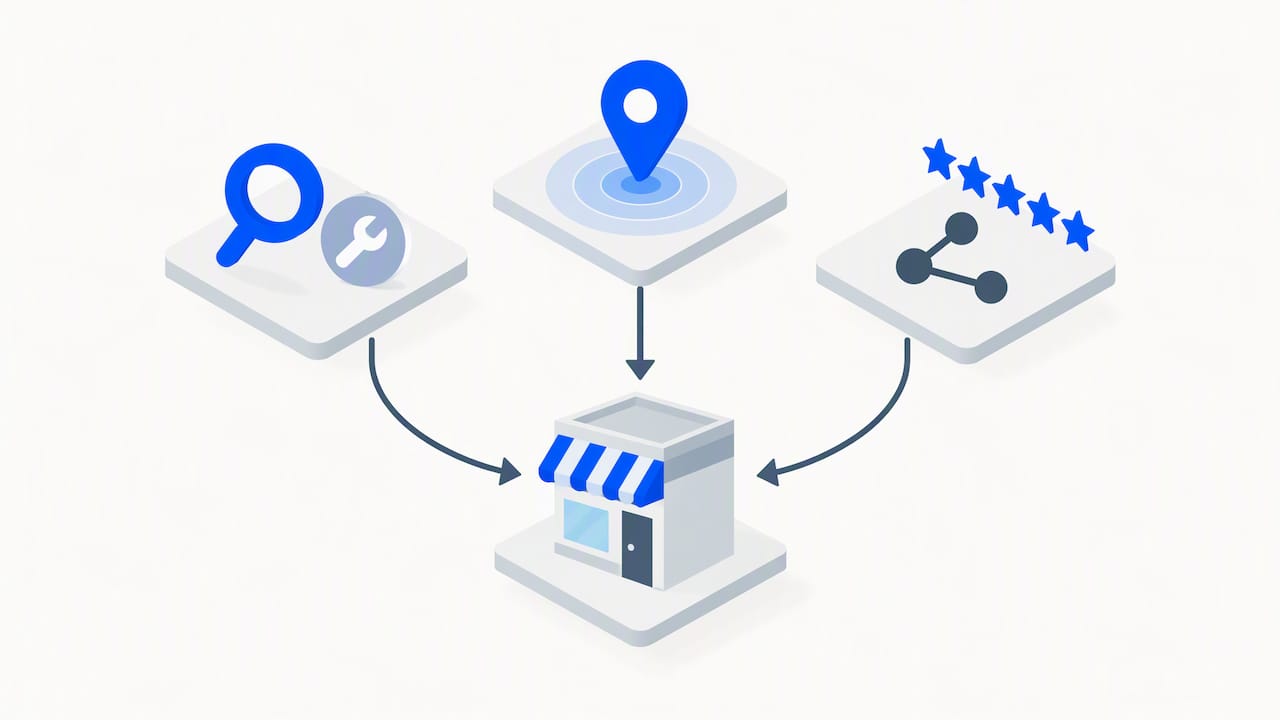
Your Google Business Profile is the single asset you have the most direct control over, and most of the ranking gains available to a small business sit here. Work through it methodically rather than fixing it once and forgetting it.
Pro Tip: Treat your Business Profile like a page on your own website, not a free directory listing you set and forget, and revisit it monthly alongside your other marketing tasks.
Practitioner analysis of local SEO failures points to the same root cause again and again: businesses treat their profile as an isolated, one-off task rather than part of a consistent system that includes their website, their reviews and their broader brand presence. A profile that contradicts your website, or a name that doesn’t match your invoices, creates exactly the kind of inconsistency that risks suspension and undermines the trust signals Google is trying to measure.
Reviews are one of the clearest prominence signals Google reads, but how you collect them matters as much as how many you have, as explained in Stop Losing Leads: Review Mining with LLMs for Service Businesses. A sustainable review workflow means asking every customer, not just the happy ones, and making it genuinely easy to leave feedback. Send a direct link to your review page shortly after the job is done or the purchase lands, while the experience is still front of mind, and keep the ask simple: “we’d appreciate a quick review if you have two minutes.”
Australian regulators take this seriously. The ACCC fined a business $39,600 in penalties after PhotobookShop failed to disclose paid influencer reviews, which shows that undisclosed incentives carry real financial consequences, not just platform penalties. The ACCC’s guidance on online reviews makes clear that offering discounts or freebies in exchange for positive reviews, or editing out negative ones, misleads consumers and breaches Australian Consumer Law. On Google’s side, the platform removes incentivised or biased reviews outright and can restrict a Business Profile that shows signs of fake engagement.
When a negative review lands, respond calmly, acknowledge the specific issue and offer to resolve it offline. That response is visible to every future searcher weighing you against a competitor, so it’s worth getting right every time.
Citations and backlinks both support prominence, but they’re different things. A citation is a mention of your business name, address and phone number on another site, usually a directory, without necessarily linking to you. A backlink is a link from another website to yours, and it carries more weight because it signals that another site considers you worth referencing.
Build a foundation of consistent citations and then layer genuine backlinks on top:
Audit your existing citations periodically by searching your business name and checking that the name, address and phone number match across every listing. Mismatches, like an old address still showing on a directory, confuse Google’s matching and dilute the prominence signal you’re trying to build. Fix the highest-traffic directories first, then work down the list.
Earning genuine local backlinks through real relationships, sponsorships or editorial coverage outperforms bulk directory submissions every time, because Google can tell the difference between a link that reflects a real connection and one that was purchased in bulk from a low-quality network.
Your website should echo and reinforce what your Business Profile says, not contradict it. Build dedicated service pages for each core service, written for the specific local intent behind that search rather than as a single generic “services” page trying to cover everything at once.
Pro Tip: If you serve five suburbs, write five short, genuinely useful service pages rather than one thin page trying to rank for all five at once.
This structure gives Google multiple consistent signals that confirm what your Business Profile is already saying, which strengthens both relevance and trust in your listing.
Forget daily rank checking. Map Pack order shifts constantly depending on who’s searching and from where, so a single snapshot tells you very little. Instead, track the metrics inside your Business Profile dashboard that reflect real customer behaviour.
Set a review cadence of 30, 60 and 90 days with a short list of KPIs you check each time, such as calls and direction requests compared with the same period before you started. That comparison tells you far more about real-world impact than any rank tracker chasing an exact Map Pack position that moves depending on who’s asking.
A realistic 90-day plan breaks the work into stages so nothing gets rushed or skipped.
Keep your toolkit simple:
None of this needs to be complicated or expensive. The businesses that make steady progress are the ones that work through this list consistently rather than treating any single tactic as a shortcut to the top.
Everything above is doable on your own, but plenty of business owners prefer structured guidance over piecing it together solo. We offer workshops in phases, progressing from strategy to brand foundations and on to marketing tactics, providing mentorship throughout rather than just a single video to apply on your own.
A few of our workshops map directly onto the work in this article. The Get Found Organically & on LLM’s workshop walks through implementing the SEO fundamentals that support your Business Profile and service pages. Our website strategy workshop helps you structure service pages that convert the extra visibility into bookings, and our lead generation workshop turns that improved visibility into an actual pipeline of enquiries.
We built this structure because local visibility only pays off when it connects to a website that converts and a follow-up system that turns enquiries into clients, which is why we treat these as one connected system rather than separate projects.
Google reads what searchers actually do with your listing as part of how it judges prominence and relevance over time. When people repeatedly click through to your website, tap to call, or request directions from your Map Pack listing, that pattern of engagement signals that your business is a genuinely useful result for that search.
This is part of why a complete profile matters so much. A listing with clear hours, service details and recent photos gives searchers enough confidence to act immediately rather than clicking through to compare you against competitors first. More calls and direction requests, measured against your impressions, suggest to Google that your listing is answering the search well.
Practically, this means every element that makes your listing easier to act on, like a working call button, accurate hours and a direct booking link, does double duty: it serves the customer in front of you and it feeds the signals Google is already reading. There’s no separate “engagement hack” here. The honest work of keeping your profile accurate and easy to use is the same work that drives these signals upward.
How often people click your Map Pack listing compared with others nearby is one of the clues Google uses to judge whether a listing deserves its position. A compelling business name, a strong photo and a high star rating all influence whether someone taps your listing over a competitor’s, and a consistently higher click-through rate reinforces your standing over time.
Once someone clicks through to your website, what happens next matters just as much. The vast majority of local searches happen on a phone, so a website that loads slowly, forces pinch-to-zoom or buries your phone number below the fold will lose that visitor before they act. A website built for mobile first, with your contact details and calls-to-action visible without scrolling, keeps that initial click from going to waste.
Treat your Map Pack click-through rate and your website’s mobile experience as two parts of the same funnel. Winning the click only pays off if the site behind it is ready to convert that visitor into a call or a booking.
The Questions and Answers feature on your Business Profile lets anyone post a question and anyone, including you, answer it publicly. Left unmanaged, this space fills with duplicate questions or sits empty, missing an easy opportunity to reinforce relevance and build trust with searchers comparing their options.
Seed your own Q&A section with the questions you’re asked most often in real life: do you offer emergency callouts, is there parking on site, do you take walk-ins. Answer them yourself, clearly and in your own voice, rather than waiting for a stranger to post something inaccurate that sits unanswered for months.
Monitor the section regularly, since anyone can post a question and incorrect answers from other users can stand uncorrected if you’re not checking in. A well-maintained Q&A section works like a mini FAQ sitting right inside the Map Pack result, answering the practical questions that would otherwise cost you a click to your website or, worse, a call you don’t get.
Google runs automated systems to detect fake engagement, keyword-stuffed business names, duplicate listings and other manipulation attempts, and a profile caught by these systems can be suspended or dropped from the Map Pack entirely. This is the enforcement side of the policies covered earlier: fake reviews, incentivised ratings and name stuffing aren’t just against Google’s guidelines, they carry a real risk of losing your listing altogether.
Common triggers include multiple listings for the same business at the same address, a business name padded with extra keywords or locations, reviews that spike suspiciously in a short window, and addresses that don’t correspond to a real, staffed location. Google’s fake engagement policy specifically covers manipulated ratings and reviews as grounds for restriction.
The safest path is also the simplest: keep one accurate listing per physical location, use your genuine legal name, and build your reviews organically through the workflow described earlier. Businesses that try to game these systems tend to get caught eventually, and the cost of rebuilding a suspended profile from scratch is far higher than doing it properly the first time.
Google updates its local search algorithm periodically, sometimes adjusting how heavily relevance, distance or prominence are weighted relative to each other. These updates can shift Map Pack order even when nothing about your own profile has changed, which is frustrating but also a useful reminder not to over-index on any single week’s position.
Because these three core factors have stayed consistent as Google’s stated framework for years even as the detail shifts, the fundamentals in this article remain the safest long-term strategy. Businesses chasing whatever the latest short-term trick is tend to see temporary gains evaporate at the next update, while those with a genuinely complete profile, real reviews and solid local prominence tend to weather algorithm changes with far less disruption.
If you do see a sudden ranking drop, check for an obvious cause first, like a policy violation notice, a review spike, or a recent profile edit, before assuming an algorithm update is to blame. Most drops trace back to something fixable rather than a sweeping change you can’t control.
Prominence isn’t only built through reviews and links. Genuine involvement in your local area, like sponsoring a community event, writing locally relevant blog content, or being featured in a regional publication, builds the kind of reputation signal that compounds over time rather than fading after one campaign.
Local content on your own website, such as a page about a community event you sponsored or a guide relevant to your specific area, gives Google more context about your genuine connection to that location while also giving local publications or community groups a reason to link back to you. This is the kind of earned mention that outperforms low-quality directory submissions, because it reflects a real relationship rather than a paid placement.
This works best as part of a broader brand and content strategy rather than a one-off tactic, since consistent, genuine local presence reinforces every other signal covered in this article: it strengthens your prominence score, gives you fresh material for your Business Profile posts, and builds the kind of reputation that shows up naturally in reviews and word of mouth over the months that follow.
If working through a Business Profile audit, a citation cleanup and a 90-day plan feels like a lot to coordinate alone, our workshops are built to walk you through exactly this kind of implementation with mentorship rather than a one-way video course. The Get Found Organically & on LLM’s workshop covers the SEO fundamentals from this article in more depth, while our full workshop line-up covers the website and lead generation side so your improved visibility actually converts into enquiries.
Our #7 Lead Generation System Workshop is a practical next step once your profile and reviews are in better shape, priced at $350 per year, since it’s built specifically to turn the extra calls and direction requests into booked work. Browse our full range of workshops or book a place to start building this out properly rather than piecing it together on your own.
Ranking on Google generally comes down to a website with clear, relevant content, a solid technical foundation and genuine backlinks from other credible sites, alongside consistent signals like accurate business information where local relevance applies. For local businesses specifically, pairing your website with a complete Google Business Profile addresses both organic and Map Pack visibility together.
Open the business listing in Google Maps or Google Search, scroll to the reviews section, and tap the star rating to open the review form. You can add a written comment and photos before submitting, and you’ll need to be signed in to your Google account to post.
Google doesn’t publish a definitive, continuously updated ranking of the most-reviewed place worldwide, and review counts change constantly, so any specific figure quickly goes out of date. What matters more for your own business is building a steady, genuine flow of reviews over time rather than comparing your count against an unverifiable global record.
RankBrain remains one of several machine learning systems Google uses to help interpret search queries and match them to relevant results, though Google has introduced additional systems alongside it over the years. For local search specifically, the clearer and more actionable guidance is Google’s own framework of relevance, distance and prominence, which is what your Business Profile work should target directly.
Small engagement wins, like more calls or direction requests, can appear within a few weeks of completing your profile and fixing obvious citation issues. Sustained ranking improvement typically takes two to three months, since prominence signals like reviews and local links build gradually rather than overnight.