

The single highest-leverage change for service page SEO is this: build one page for one commercial service, make it fully crawlable, and put a clear call to action above the fold backed by schema markup. Place your target keyword in the title, the H1 and the opening sentence, and put your primary enquiry button in the hero section, then repeat it after your proof points. Everything else, structure, local signals, technical setup and conversion design, builds on that foundation.
TL;DR:
- Building dedicated, fully crawlable service pages targeting one primary keyword with a clear call to action greatly improves search rankings and conversions.
- Use a structured layout with an outcome-led hero, local detail when appropriate, proof elements, and FAQ, all focused around a specific buyer intent.
- Proper internal linking, schema markup, and technical fundamentals like fast-loading pages and unique meta tags are essential for visibility and indexation.
- Prioritize tracking booked jobs and inquiries to measure actual business growth, and run clear A/B tests on headlines, CTAs, and form length to improve conversion rates.
- Avoid thin, duplicate, or overly broad pages, and fix schema issues to ensure search engines understand and trust your local service content.
Every service page should target one commercial keyword and speak to one buying decision. Trying to rank a single page for “plumber,” “emergency plumber” and “hot water repairs” usually means it ranks well for none of them. Split those into dedicated pages, each with its own heading structure and its own conversion path.
A practical layout that works across most service businesses looks like this:
Keep the keyword doing real work, not just sitting in a box to tick. It belongs in the title tag, the H1 and the first sentence of the opening paragraph, then you can move to natural variations for the rest of the page.
Content depth should match the decision the reader is making. A commodity service like a smoke alarm check needs a short, clear page: what’s included, what it costs, how to book. A high-consideration service like a full bathroom renovation deserves more depth, including project examples, local proof and a longer FAQ, because the reader is weighing a bigger decision and wants more reassurance before enquiring.
A few microcopy habits make a measurable difference:
This structure isn’t decoration. It mirrors what practical service-page playbooks recommend: treat technical SEO as the floor, then prioritise pages built around commercial intent over a blog-heavy publishing calendar. If your website currently buries your services under generic “solutions” pages, that’s the first thing to fix, and our guide on professional service provider websites covers the broader architecture question.
Not every service business needs a page per suburb. Build one only when there’s genuine local demand, real search interest for that area, and something authentically local to say about it. A service-area page with no local detail is a doorway page in disguise, and search engines treat it as such.
Before creating an area page, check these boxes:
A genuinely local page includes a project example from that area, notes on any local regulations or conditions that affect the work, a realistic service radius, and language that reflects how locals actually describe their problem. Swapping only the suburb name across fifty templated pages is the fastest way to get those pages filtered out of search results altogether.
Link structure matters as much as content. Build a central “services in [region]” hub page that links out to each suburb page, and have each suburb page link back to the relevant service page and its neighbouring areas. This hub-and-spoke pattern is exactly what drove the documented ranking gains in a 2026 case study, where a renovation business combined unique suburb pages, credential-based trust signals and structured internal linking to move from page two to page one for a competitive keyword.
Pro Tip: Write the suburb page as if a local customer will fact-check it, because eventually one will.
None of the above matters if search engines can’t crawl or render your page properly. Start with the basics: every service page needs a unique title tag and meta description, a clean canonical tag, and main content that’s actually in the HTML, not hidden behind a tab or loaded only after a click.
Core Web Vitals affect both ranking and conversion, particularly on mobile, where most enquiries begin. A slow-loading hero image or a layout that jumps around while loading will cost you enquiries before a visitor even reads your offer. Prioritise fast-loading hero sections, stable layouts and buttons that are easy to tap on a phone screen.
Schema markup gives search engines (and increasingly, AI-driven search features) structured facts about your business rather than asking them to infer everything from prose. For most service pages, that means:
Google’s own guidance is clear that there’s no special trick for AI-driven search features. Google’s AI optimisation guidance states there’s no dedicated schema or technical shortcut for appearing in generative AI results, visibility comes from the same combination of helpful content and solid technical foundations that Search has always rewarded.
After publishing, check Search Console for indexing status on each new page and confirm the schema validates. A page that looks perfect but isn’t indexed isn’t doing anything for you.
A service page’s job isn’t to rank, it’s to generate an enquiry. Ranking without conversion is just expensive traffic.
Social proof works best when it’s specific and honest. A short case snippet naming the job, the outcome and a rough timeframe carries more weight than a generic testimonial. If you use customer reviews on your service pages, they need to be genuine and independently sourced. The ACCC’s guidance on online reviews is explicit that publishing fake or misleading reviews can lead to enforcement action, so review authenticity is a legal matter as well as a trust signal.
Microcopy does quiet work throughout the page: state your typical response time near the form, give a price cue even if it’s just a starting range, and tell the reader exactly what happens after they click. Our piece on call to action design for service businesses goes deeper on button wording and placement testing.
Pro Tip: If you can only fix one thing this week, shorten your enquiry form. Every extra required field is a reason to leave.
Search engines and visitors both use your internal links to understand what matters most on your site. Build a central services hub page that links out to every individual service page and, where relevant, to suburb pages beneath each one. That hub should be reachable from your main navigation, not buried three clicks deep.
Review your page set every six to twelve months. Thin, overlapping pages are usually better consolidated into one stronger page; a single page trying to cover too many distinct services is usually better split apart.
Traffic is not the goal. Booked jobs are. Track these instead of watching session counts climb:
Set up call tracking, CRM event tagging and consistent UTM parameters so enquiries can actually be traced back to the page that generated them. Without that wiring, you’re guessing.
Run a simple 90-day test cadence: pick one hypothesis (a new headline, a shorter form, a repositioned CTA), change one thing, and measure the effect on enquiries and booked revenue before testing the next idea. Watch for common pitfalls: paid traffic misattributed to organic, broken forms that quietly fail for weeks, and missing event wiring that makes a page look like it’s converting at zero when it isn’t.
This checklist is exactly what our three-phase program walks business owners through, in order. Phase one, inside the Clarify Your Messages & Attract the Right Clients Workshop, sorts out who your service page should actually speak to before you write a word of it. Phase two, in the Plan a Website That Converts Workshop, structures the page itself: heading order, proof placement and the local or technical detail that belongs on it. Phase three, in the Get Found Organically & on LLM’s Workshop, covers the schema, crawlability checks and measurement setup that make the page discoverable and trackable.
Participants leave with content briefs, a schema checklist and page templates they can hand to a developer or implement themselves, built from agency-level frameworks rather than guesswork. Because the structure and technical steps are mapped out in advance, businesses typically spend less time second-guessing page layout and less ad spend testing pages that were never built to convert in the first place.
Keyword density as a fixed target is outdated thinking. Modern search systems read for meaning and context, not word counts, so stuffing a keyword into every second sentence does more harm than good, it reads awkwardly and can flag a page as low quality.
The better approach is intent-first writing. Use your primary keyword once in the title, once in the H1 and once naturally in the opening paragraph, then let the rest of the page use variations and related terms the way a person would actually speak: “hot water system repair” becomes “getting your hot water running again” or “the repair” in later sentences.
Google’s guidance on helpful content is consistent on this point: content written primarily for people, with genuine expertise and clear structure, outperforms content engineered around a keyword count. If a sentence sounds strange when you read it aloud, it’s probably been forced for SEO reasons rather than written for the reader.
A useful check: read your page as if you were the customer, not the search engine. If it answers your questions clearly and doesn’t repeat the same phrase awkwardly, the keyword balance is probably right.
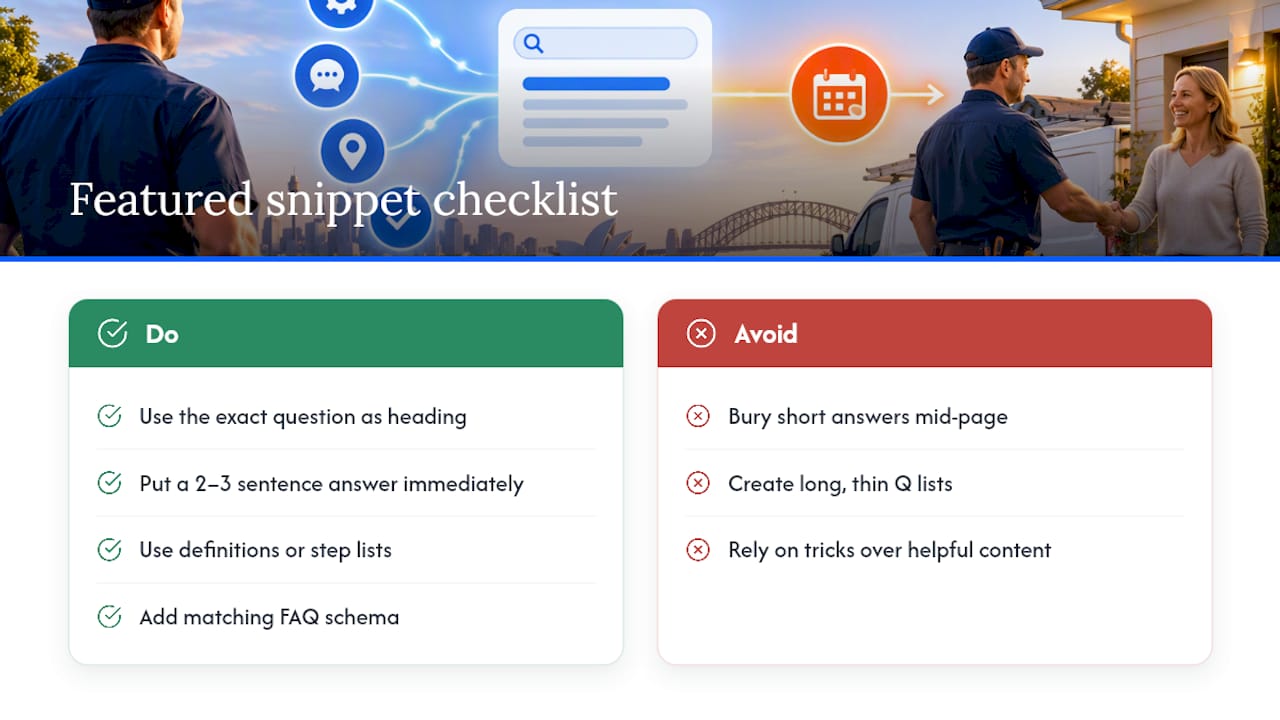
Featured snippets and AI-generated summaries reward pages that answer a specific question clearly and early. To have a realistic shot at one, structure your FAQ section with the exact question as the heading and a direct, two or three sentence answer immediately underneath it, before any extra detail.
Definitions and step lists are particularly snippet-friendly. If someone might search “how much does [your service] cost,” a short, direct pricing range answered plainly on the page has a far better chance of being lifted into a snippet than a vague paragraph buried mid-page.
Structured data helps here too. FAQ schema that matches your visible questions and answers gives search engines a clean, machine-readable version of the same content, which supports both traditional snippet features and newer AI-generated summaries. As Google’s own guidance notes, there’s no separate trick for these features, the same helpful, well-structured content that ranks normally is what gets surfaced in a summary.
Don’t chase every possible question. Answer the three or four your customers genuinely ask before booking, and answer them properly rather than padding out a long list of thin entries.
Test one variable at a time, or you won’t know what actually caused the change. A common, useful first test is CTA wording: “Get a free quote” against “Book your inspection,” measured against enquiry volume over a set period, not clicks alone.
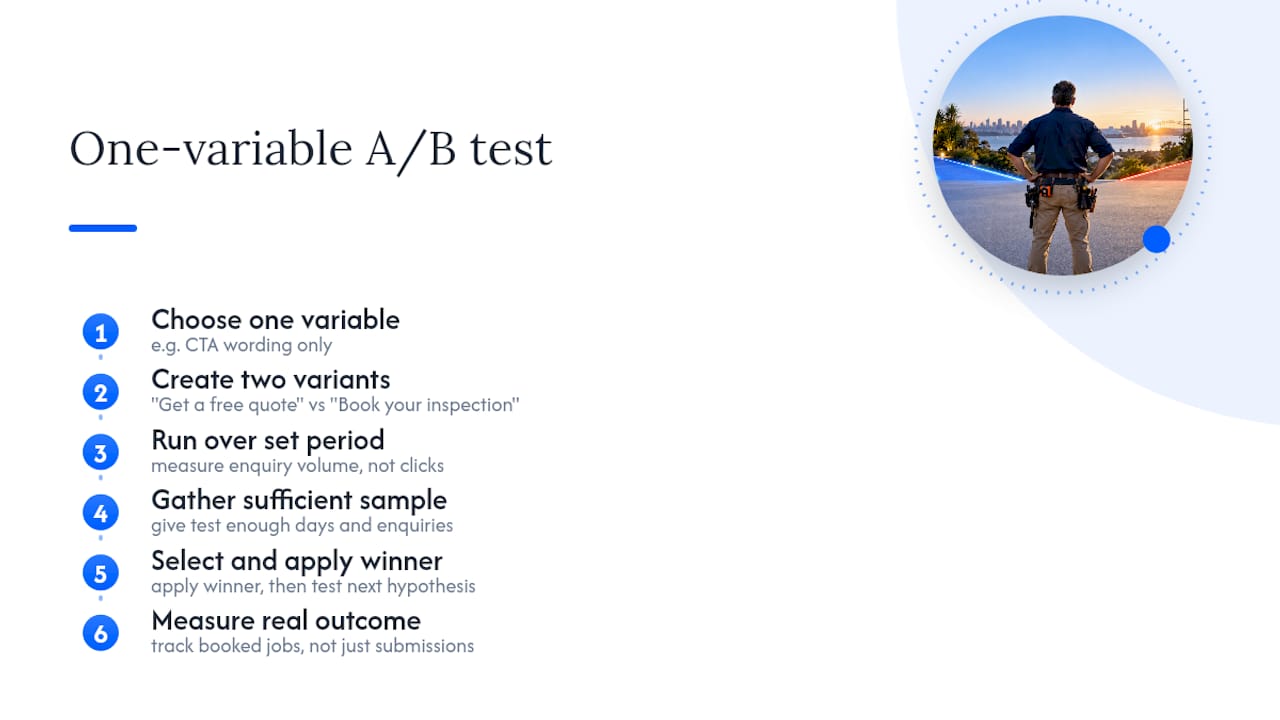
Give each test enough time to gather a meaningful sample before drawing conclusions, a few days of data on a low-traffic page tells you very little. Run the test until you have enough enquiries to compare confidently, then apply the winner and move to the next hypothesis.
Good candidates for testing include headline framing, form length, proof placement (before or after the process section) and price transparency (showing a range versus asking for enquiry). Avoid testing multiple elements simultaneously unless you have enough traffic to split it meaningfully across variants.
Track the result against booked jobs, not just form submissions, because a version that generates more low-quality enquiries isn’t actually a win. Our guide on website conversion rate optimisation walks through a simple workflow for running this kind of test without needing enterprise tools.
The most frequent mistake is one page trying to rank for several unrelated services. The fix is straightforward: split it into dedicated pages, each with its own keyword focus and CTA.
Another common problem is a CTA buried at the very bottom of a long page, or missing altogether. Add one in the hero and repeat it after your proof section.
Thin or duplicated suburb pages are a recurring issue for local service businesses. Either add genuine local detail to each one or consolidate them into a single, stronger regional page.
Missing or invalid schema is easy to overlook. Run each page through a schema validator after publishing rather than assuming it’s correct.
Finally, many businesses track sessions and rankings but never connect a page to an actual booked job. Fix this by wiring up CRM tracking and call tracking before you invest further in the page, otherwise you’re optimising blind. Our conversion killers checklist covers several of these issues in more detail if you want a fuller troubleshooting pass.
If reading this list and picturing the rewrite feels like a lot to tackle solo, that’s exactly the gap our workshops are built to close. The Plan a Website That Converts Workshop walks you through structuring your service pages step by step, and the Get Found Organically & on LLM’s Workshop covers the schema and technical checks from this guide in practical, hands-on detail.
Both sit within our structured, three-phase program, so you’re not piecing advice together from scattered sources, you’re following a sequence built for service businesses specifically.
For readers who want to verify the technical and legal points above: Google’s AI optimisation guidance and its local ranking help cover the technical and local ranking basics, the ACCC’s review guidance sets the legal standard for testimonials, and the Melbourne renovation case study shows suburb-page and accreditation strategies in practice.
No. Search engines and AI-driven search features still rely on crawlable, well-structured, genuinely helpful content to decide what to show. Google’s own guidance confirms there’s no separate shortcut for AI features, the fundamentals of good SEO still apply.
Yes, particularly for service businesses relying on local and commercial search intent to generate enquiries. A well-structured, technically sound service page with clear proof and a strong call to action remains one of the most reliable ways to generate booked work, according to practical service-page playbooks.
There’s no single official definition, but the common practical version is that a small share of your service pages, usually the ones with clear commercial intent, tend to drive most of your enquiries. Prioritising those pages for structure, schema and conversion work before spreading effort across a large blog calendar reflects this same principle.
A service page is a dedicated page on your website built around one specific service you offer, aimed at someone actively searching for that service. It typically includes a clear description of what’s included, proof of your ability to deliver it, and a direct call to action to enquire or book.