Branding Workshop Exercises: 8 Ready to Run for Australian SMEs

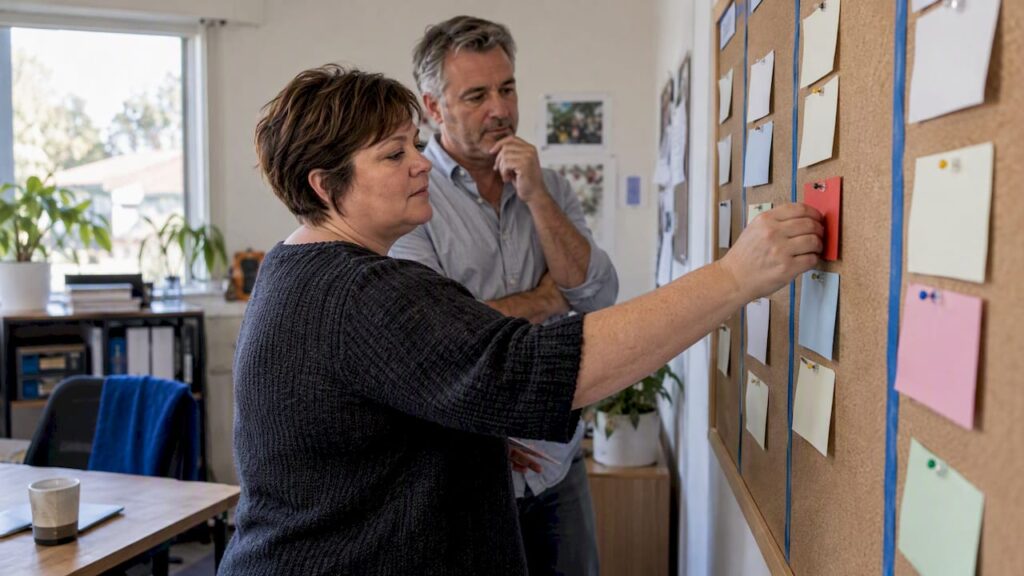
Owners comparing brand positioning in a workshop

The branding workshop exercises worth running are target-market clustering, a customer-problem and value-proposition canvas, a differentiation sprint, brand-story mapping, tone anchors, an experience audit, a promise test and a prioritisation matrix. Run well, these leave you with a priority customer, a tested value proposition, three differentiators, a one-paragraph brand story, and clear owners and deadlines for what happens next.


TL;DR:

  • A session lasting 90 minutes can cover customer clustering and a value proposition; all eight exercises, including prioritization, require a full day.
  • Remote teams can generate ideas individually in a shared document beforehand, then use live time to test them against customer evidence and choose priorities.
  • The differentiation sprint compares alternatives across product, price, place, promotion, and people, then selects three defensible differences and flags claims to avoid.
  • Afterward, align website copy, social bios, and proposals with the new language, then check it through customer interviews, homepage copy tests, or inquiry quality.

Mybworkshops
mybworkshops.com.au
Turn Brand Ideas Into Clear Marketing
MYB Workshops helps service-based business owners work through branding and marketing challenges with expert-led workshops, practical tools and personal mentorship.

Visit MYB Workshops

Table of Contents

Quick workshop plan and sample agenda

Before you book the room, decide who actually needs to be there. A workshop with the wrong mix of people produces opinions, not decisions.

  • Facilitator: keeps time, keeps the group on task and doesn’t vote on outcomes.
  • Decision owner: the person who can say yes or no to the final choices, usually the business owner.
  • Scribe: captures exact wording on the spot so nothing gets softened later.
  • Subject experts: whoever understands delivery, pricing or operations well enough to sense-check ideas.
  • Customer-evidence owner: someone who brings real enquiries, reviews or sales data into the room.

For timing, a 90 minute micro-session can cover target-market clustering and the value-proposition canvas. A half-day session adds the differentiation sprint and brand-story mapping. A full-day session fits all eight exercises plus the prioritisation matrix at the end. Before the session, collect recent customer enquiries, reviews and a short list of reasons you’ve lost sales, and prepare sticky notes, a whiteboard or a shared digital canvas depending on format.

Design principles: sequencing exercises and tying them to evidence

The exercises work best in a diverge, test, converge order. You generate options first, test them against real customer evidence, then converge on the choices you’ll commit to. Skipping the testing step is the single biggest reason workshops produce a wishlist instead of a plan.

  • Open each exercise with free generation of ideas, no judgement yet.
  • Test ideas against customer interviews, enquiry patterns, reviews and the language customers actually use.
  • Converge by voting or ranking, then write the decision down in full sentences, not fragments.

University teaching practice on experiential workshop design supports this alternating pattern: sessions that mix idea generation with testing against evidence produce stronger, more defensible outputs than pure brainstorming. For remote or hybrid groups, run divergence individually using a shared document before the live session, then use the live time for testing and converging together.

Pro Tip: Give every idea a source. If nobody can point to an enquiry, a review or an interview that supports it, park it rather than vote on it.
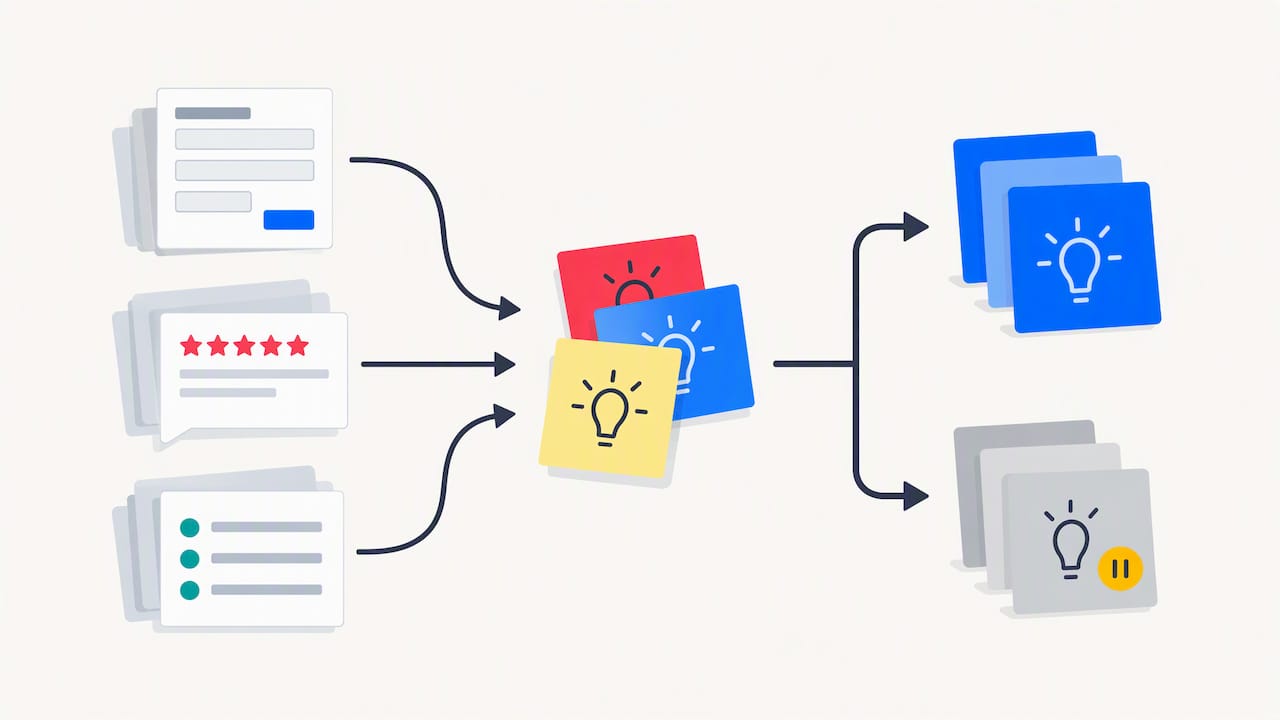
Brand ideas checked against customer evidence sources

Eight runnable exercises with facilitation notes

Each of these can run as a standalone session or back to back in a longer workshop.

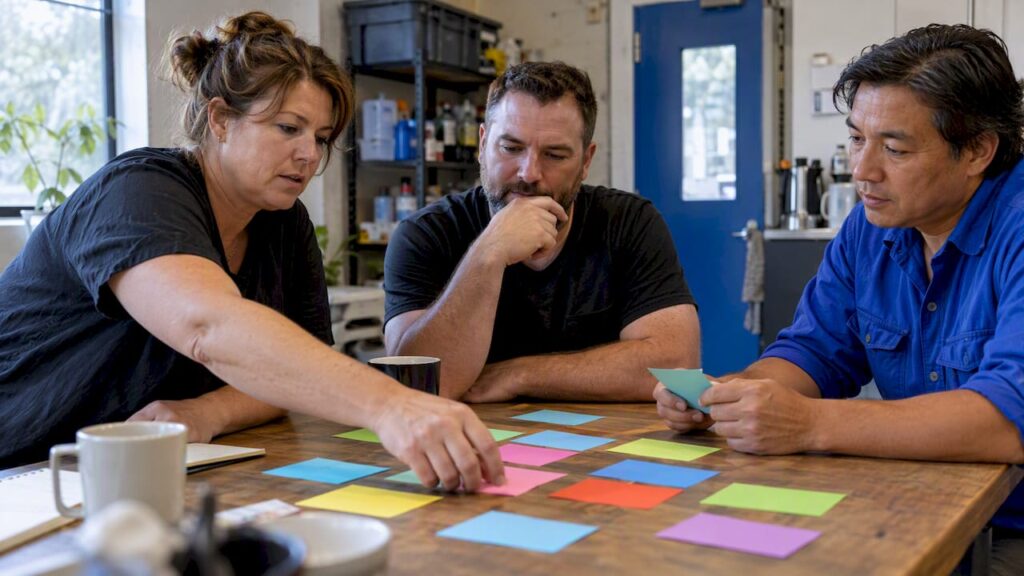
  1. Target-market clustering (30 to 45 minutes). Ask the group to list every type of customer who’s bought in the past year, their buying trigger, their problem and what nearly stopped them buying. Identify your target market recommends clustering these answers into segments, then picking the one with the strongest commercial fit. Output: one priority segment and a short written profile.
  2. Customer-problem and value-proposition canvas (45 minutes). Draw four columns: problem, promised outcome, proof and delivery capability. The marketing plan tool from business.gov.au recommends keeping every claim attached to proof, so nothing vague makes it onto the canvas. Output: one tested value proposition sentence.
  3. Differentiation sprint using the 5 Ps (30 minutes). Compare your offer against realistic alternatives, not just direct competitors, across product, price, place, promotion and people. The 5 Ps of marketing framework helps surface three to five differences you can actually defend. Output: three differentiators and a short list of claims to avoid making.
  4. Brand-story mapping (30 to 40 minutes). Map the customer’s situation before, during and after working with you, following the structure used in storytelling for business training. Output: a one-paragraph narrative with three proof points and a clear next action.
  5. Tone and voice anchors (20 minutes). Pick three adjectives that describe how you want to sound, then turn each into a behavioural rule with a written example and a non-example. Output: a one-page tone guide.
  6. Experience audit quick-win (30 minutes). List the touchpoints a customer moves through from discovery to delivery, mark the two or three with the biggest gaps, and assign an owner and deadline to each.
  7. Brand promise test (20 minutes). For every promise in your messaging, list the evidence that backs it up. Any promise without evidence gets rewritten or dropped.
  8. Prioritisation matrix (30 minutes). Plot every idea from the day against effort and impact, then commit to three immediate actions, each with a named owner and a deadline.

Facilitation tips and common pitfalls to avoid

Workshops fail quietly, usually by producing agreement in the room that evaporates the next week. A few habits protect against that.

  • Set roles and timeboxes before the session starts, and stick to them even when discussion is good.
  • Treat customer evidence, not the loudest opinion, as the final word on disputed points.
  • Use silent ideation or small breakout groups to stop one or two voices dominating the output.
  • Write down an owner, a deadline and a first task for every decision before the session ends.

Pro Tip: If a decision doesn’t have an owner’s name next to it by the time the workshop ends, it won’t happen.

Deliverables, follow-up and how to convert outputs into a plan

A workshop earns its time when it produces a short, specific set of deliverables rather than a long list of notes.

  • A priority customer profile with buying triggers and language.
  • A tested value proposition sentence.
  • Three differentiators and a list of claims to avoid.
  • A one-paragraph brand story with proof points.
  • Owners and deadlines attached to every decision.

Once the workshop ends, hand these outputs to a short checklist: update website copy, social bios and proposal templates to match the new language, then set one simple way to check it’s working, such as three follow-up customer interviews, a quick copy test on your homepage, or tracking enquiry quality on your landing page, with expert guidance from eCommerce Marketing Workshops to help implement and optimise. As business.gov.au notes, a new direction without aligned messaging and experience across every touchpoint creates more work, not more clarity, so the hand-off step matters as much as the workshop itself.

How MYB Workshops can run and operationalise these exercises for your business

Running these exercises well takes a facilitator who keeps the room honest, templates that save you from starting from a blank page, and a realistic hand-off plan so the outputs actually get used. That’s the gap our workshops are built to close.
Mybworkshops

Our #2 Clarify Your Messages & Attract the Right Clients Workshop works through the value proposition and differentiation exercises with you directly, while our #3 Build a Stand-Out Brand Identity & Guidelines Workshop takes your brand story and tone anchors through to usable guidelines.

  • A facilitator who keeps evidence, not opinion, driving every decision.
  • Ready-made worksheets and templates so you’re not building a canvas from scratch.
  • Twelve months of access, live Q&A and a supportive community to help you operationalise outputs.

If your business needs direction before messaging, our #1 Business Strategy Workshop sets the priorities these exercises depend on. Browse the full line-up on our workshops page and book the session that matches where you’re stuck.

FAQ

How long should a branding workshop take?

A focused session on one or two exercises, such as target-market clustering and the value proposition canvas, can run in 90 minutes. A full set of eight exercises, including the prioritisation matrix, typically needs a full day.

Who should attend a brand strategy workshop?

Include a facilitator, the decision owner, a scribe, one or two subject experts on delivery or operations, and someone who can bring real customer evidence such as enquiries or reviews into the room. Keeping the group small and focused tends to produce clearer decisions than a large, mixed audience.

What outputs should a branding workshop produce?

The minimum useful outputs are a priority customer profile, a tested value proposition, three defensible differentiators, a one-paragraph brand story and a named owner with a deadline for each decision. Without these, a workshop risks becoming a discussion rather than a plan.

How do I adapt these exercises for a remote team?

Run the idea-generation step individually beforehand using a shared document, then use the live session for testing ideas against evidence and converging on decisions. This keeps remote sessions focused and avoids the energy drop that long virtual brainstorms often bring.

What if the workshop ends with disagreement on direction?

Go back to customer evidence rather than opinion: enquiries, reviews, lost-sale reasons and interview notes usually settle the argument. If evidence is thin, assign someone to gather three to five quick customer conversations before the decision is finalised.


Sources

Hi There, I'm Peggy

I’m the brains (& the energy) behind MYB Workshops.

For 20+ years, I’ve helped business owners ditch the confusion, clarify their message, and build brands that attract the right clients. No fluff, no overwhelm, just proven strategies that work.

If you want to build a brand that feels right and actually brings in business, you’re in the right place!

Hi There, I'm Peggy!

For more than 20 years, I’ve helped businesses grow with better marketing systems that support long-term plans.

Everything inside MYB Workshops is built from the same strategies, frameworks and practices we use in our agency. These aren’t theories or quick fixes. They’re proven approaches shaped by real-world results and applied across hundreds of businesses.

MYB Workshops was created to make those tools and insights accessible to business owners who want greater clarity and confidence in their business.

I’m glad you’re here in the Blog, explore some of the hot topics our clients ask us about. I hope to see you in the workshops, real soon!

Build Your Business

If your business isn’t attracting and converting the right customers, something needs to change.

In MYB Workshops, you get proven strategies, expert guidance, and a clear plan that actually works. 

Start building a marketing system that works, today!

Stop Losing Sales

Brand confusion costs sales. Learn how to position, market, and sell with confidence inside MYB Workshops.

FREEBIES
FREE Brand Clarity Workshop

Crafting Your Brand Identity 

An on-demand workshop to help you create a brand identity that attracts the right clients, builds trust, and drives real results, without the guesswork.

PLUS Grab your FREE workbook to implement everything instantly!

6 Strategies to Build a Website That Converts

3 seconds. That’s all it takes for a visitor to decide if they’ll stay or leave your website.

Download this FREE guide to learn 6 proven strategies to keep visitors engaged and turn them into paying clients.

FREE Branding Guide

Your brand is more than a logo. It’s the foundation of your entire business.

If you skip this step, you risk wasting time and money on marketing that doesn’t convert.

Download this FREE guide and discover 5 key steps to build a brand that attracts, connects and drives long-term success.

Related Blog Articles