
A winning service proposal does one job: it sells a measurable outcome and makes saying yes effortless. Everything else, the design, the tone, the case studies, exists to support that single goal. Get your executive summary, your deliverables and your pricing right, and the rest of the document has somewhere to hang.
TL;DR:
- Focus on proposing outcomes anchored to clear, measurable results rather than hourly rates to simplify client decision-making.
- Use a structured template that emphasizes the problem, solution, scope, timeline, pricing, and acceptance to increase win rates and reduce confusion.
- Present tiered pricing options in a straightforward, visual format, and avoid discounts by offering scoped-down versions for tight budgets.
- Attach legal terms separately in plain language, covering payment, ownership, liability, confidentiality, and scope changes, to maintain proposal clarity.
- Tailor proposals to client industry and language, highlighting relevant outcomes and process details, while using discovery conversations to customize effectively.
Every service proposal that wins business follows a version of the same skeleton. The order matters because it mirrors how a buyer actually reads: they want to know who this is for, what problem it solves, what they get, and what it costs, roughly in that sequence. Xero’s guidance on writing a business proposal frames this as three core elements: the customer’s problem, your solution tied to outcomes, and transparent pricing with options. That’s the backbone. Here’s how to flesh it out.
Proposals built on that framework tend to restate the client’s problem clearly, define scope without ambiguity, and make tiered pricing feel like an easy decision rather than a negotiation, a pattern echoed across expert guidance on writing service proposals that close deals. Miss any one of these sections and you’re asking the buyer to fill in the gaps themselves, which is exactly the moment they start comparing you to someone else.
Decision-makers skim. They don’t read your proposal top to bottom in one sitting, they scan headings, bold text and bullet points looking for the outcome and the price. OpenAsset’s research on common business proposal writing mistakes points to formatting and active voice as genuine persuasion signals, not just cosmetic choices. A proposal that’s hard to skim gets set aside, and a set-aside proposal rarely gets picked back up.
A few practical rules make the difference:
Pro Tip: Read your draft out loud before sending it. If you stumble over a sentence or lose the thread, your client will too, and they won’t tell you why they said no.
Price the outcome, not the hours. A client paying for “20 hours of consulting” is comparing your rate to every other consultant’s rate. A client paying for “a lead generation system that fills your pipeline” is comparing the outcome to the cost of not having it, which is a much easier sale.
Three tiers also make comparison work for you instead of against you: instead of a client mentally weighing your quote against a competitor’s, they’re weighing your own options against each other. That’s a far easier conversation, and it usually ends with them picking the tier you hoped they would.
Keep the front-end proposal warm and easy to read, then attach the legal detail separately. Sprintlaw’s contractor proposal guidance recommends exactly this two-part approach: a plain-language commercial proposal paired with formal terms, because dense legal language sitting inside your pitch can kill momentum right when the client was ready to say yes.
The terms document, whether it’s a short terms sheet or a full service agreement, should cover:
Add an explicit acceptance mechanism, a signature block or an e-signature link, and state how long the offer stands. For a website refresh worth a few thousand dollars, a solid terms sheet is usually enough. For a larger, multi-month contract, it’s worth having a solicitor review the agreement before you send it. Repeat clients benefit from a standing master services agreement, so future proposals only need a short statement of work rather than a full contract each time.
A one-page proposal works for straightforward jobs, an audit, a website update, a short consulting engagement. Here’s the structure, line by line:
For a bigger engagement, expand the same skeleton into a multi-page document: give deliverables their own section with acceptance criteria for each, break the timeline into a milestone table, and attach your terms and conditions as a separate page rather than folding them into the pitch.
Here’s how that one-pager might read for a website update:
That’s the whole proposal. No filler, no padding, just the five things the client needs to make a decision.
Run through this before every proposal leaves your outbox:
The mistakes that sink otherwise solid proposals tend to repeat: a weak executive summary that reads like a cover letter, generic language that could apply to any client, fees that surface later instead of upfront, scope so loose it invites disputes, and no clear call to action at the end. ProposalCraft’s analysis of consulting proposal mistakes flags exactly this pattern: proposals that list qualifications instead of offering a solution lose to competitors who simply answered the brief better.
The best proposal writers don’t reinvent the document every time, they run a repeatable process and let the template do the heavy lifting. That’s the model Mybworkshops teaches inside its structured workshop program for service business owners:
This is less about writing skill and more about having a system you trust every time you sit down to quote a job.
The structure stays the same across every proposal, but the emphasis shifts depending on who’s reading it. A sole trader deciding whether to hire you for a one-off job cares most about price and turnaround, so keep that proposal short and put the investment section near the top of the reader’s attention, even if it stays lower on the page.

A corporate buyer or procurement team wants evidence of process and risk management, so lean harder on your methodology, your terms and conditions, and any relevant compliance detail. If you’re responding to a formal request for proposal, follow their required structure exactly, even if it duplicates information you’d normally present differently, because a proposal that ignores the brief’s own format reads as a proposal that didn’t read the brief.
Industry matters too. A tradesperson proposing a renovation needs a scope section detailed enough to prevent disputes over materials and variations. A marketing consultant proposing a lead generation project should lean on measurable outcomes, leads generated, conversion rate improvement, because that audience thinks in metrics. A wellness or personal services provider often benefits from a warmer, more conversational tone throughout, since the buying decision is more personal than commercial.
Whatever the industry, resist the urge to write one generic proposal and swap out the logo. The client’s own language from your discovery conversation is the fastest way to make a proposal feel written specifically for them, and it costs you nothing but attention.
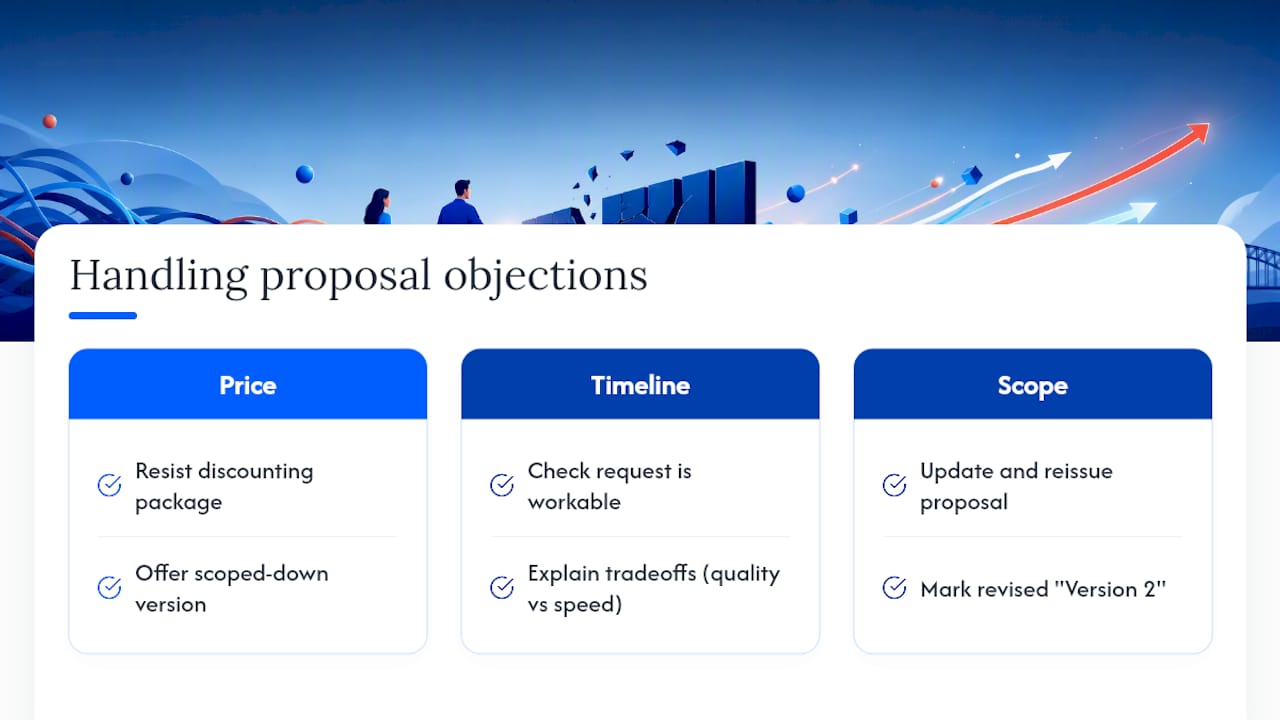
Most proposals don’t get a straight yes or no, they get a question or a pushback, usually about price, timeline or scope. Treat this as a normal part of the process rather than a sign the proposal failed.
If the objection is about price, resist discounting your existing package. Offer a scoped-down version instead, the same approach recommended for tight budgets, so the client still gets a clear outcome at a price that fits, without training them to expect a lower rate on your full offer next time.
If the objection is about timeline, check whether the request is genuinely workable before agreeing. A rushed deadline that compromises quality helps no one, and it’s better to explain the tradeoff than to promise something you can’t deliver.
If the client asks for scope changes after you’ve sent the proposal, update the document and reissue it rather than agreeing verbally and hoping it works out. A revised proposal with a clear “version 2” note protects both sides and keeps your terms and pricing aligned with what’s actually being delivered.
Where you genuinely don’t know the answer, say so and follow up rather than guessing under pressure. A client who asks a hard question deserves a considered answer, not an improvised one that creates a problem down the track.
Templates and checklists get you most of the way there, but the proposals that consistently win business come from owners who’ve nailed their discovery process, their pricing structure and their positioning long before they open a blank document. That’s the gap Mybworkshops’ workshops are built to close.

Inside the structured program, you’ll work through how to run a proper discovery conversation, structure deliverables so clients understand exactly what they’re paying for, price your services around outcomes instead of hours, and build a proposal template you can reuse and refine with every real client outcome. You’ll get practical templates, peer feedback from other service business owners working through the same challenges, and takeaways you can apply to the very next proposal you send. If you’re ready to stop rebuilding your proposal from scratch every time, explore the current workshop lineup and pick the one that matches where your business is right now.
Every proposal needs an executive summary, a clear problem statement, the proposed solution with deliverables, transparent pricing with options, and an explicit acceptance mechanism such as a signature block.
Definitions vary, but a common version centres on clarity, being easy to read and skim; the customer, framing everything around their problem and outcome; and cost, presenting pricing transparently with clear options.
A one-page website update proposal typically states the problem (dropping enquiries, high bounce rate), the solution (redesigned homepage, faster load time), a three-week timeline, a total investment with a deposit, and a next step to accept by a set date.
AI tools are genuinely useful for grammar checks, compliance reviews and pulling up past case examples, but they shouldn’t replace real discovery conversations or your own judgement on pricing and scope, according to OpenAsset’s guidance on proposal writing.