

A signature service offer is one repeatable, packaged programme built around a unique method that delivers a clear before-and-after result for a defined client. Your immediate next step: write one sentence naming the transformation you want to be known for. That single sentence is the foundation everything else builds on.
Three signals tell you an offer qualifies as a true signature service: it produces a packaged outcome rather than open-ended work, it follows a named and repeatable method, and it can be delivered consistently without reinventing the process each time.
A signature service offer is the single most clarifying move a service business can make: one repeatable, packaged transformation that anchors your marketing, justifies your price, and gives clients something specific to recommend.
| Point | Details |
|---|---|
| Define the transformation first | Write one sentence naming the specific result you deliver, for whom, and in what timeframe. |
| Name your mechanism | Give your delivery process a descriptive name — it improves referrals and buyer confidence. |
| Build from promise to name | Lock in the big promise, scope, and pricing before you choose an offer name. |
| Pilot before you scale | Test with 3–5 clients, measure outcomes, and refine before a full launch. |
| Mybworkshops accelerates the build | The three-phase workshop programme guides you from strategy to packaged offer to pilot-ready plan. |
A signature service offer is a branded programme or productised service that combines a specific transformation, a defined timeframe, a named delivery method, and a fixed scope. It is not a menu of options. It is not an hourly rate dressed up with a title. Packaging a service converts open-ended hourly work into a fixed-scope product with a clear promise, defined deliverables, and a set price — and that shift is what reduces buyer risk and prevents your work from being commoditised.
The simplest way to understand it is through contrast:
| Format | How it works | Buyer experience |
|---|---|---|
| Hourly / retainer | You bill for time; scope is open | Buyer carries the risk; hard to budget |
| Ad-hoc packages | Bundled tasks, no fixed outcome | Feels like a menu, not a solution |
| Signature service | Fixed scope, named method, clear result | Buyer knows exactly what they get |
Three realistic formats a signature service can take:
A strong signature service passes a simple self-assessment. Run your current offer against this checklist:
The named mechanism deserves particular attention. Naming the unique mechanism that explains how results are delivered improves buyer confidence and gives clients the language to refer you. “She helped me with my marketing” is forgettable. “She put me through her Brand Clarity Sprint” is referrable.
On consistency: document your delivery process before you scale it. A signature service that lives only in your head is fragile. Write the steps, the client touchpoints, and the milestones into a simple operating document — even a one-page outline is enough to start.

Pro Tip: Name your mechanism before you name your offer. The mechanism is the ‘how’; the offer name is the wrapper. Get the ‘how’ right first.
Identifying a signature service helps business owners make stronger decisions about where to spend time and which projects to prioritise. That clarity alone is worth the work of building one. Beyond focus, the business benefits are concrete:
Building your brand around one standout offer also makes marketing simpler — your signature service becomes the headline for all communications, and the business becomes easier to recommend.
These six models cover the most common forms a signature service takes across service businesses. None of these are tied to a specific provider; they are category descriptions you can adapt.
Single-session diagnosis + fix: a 90-minute paid consultation that ends with a written action plan. Suits specialists (accountants, copywriters, strategists) whose clients need direction more than ongoing support. Outcome: clarity and a prioritised next step.
30–90 day transformation programme: a structured engagement with weekly touchpoints, defined milestones, and a clear end-state. Suits coaches, consultants, and service providers whose results take time to embed. Outcome: a measurable before-and-after the client can articulate.
Group programme: the same transformation delivered to a cohort of 6–20 clients simultaneously. Suits educators and trainers. Outcome: community accountability plus a shared result, at a lower per-client cost to deliver.
Subscription-based productised service: a recurring monthly deliverable (e.g. monthly SEO report, monthly content calendar) at a fixed price. Suits providers whose clients need ongoing output rather than a one-time result. Outcome: predictable revenue for the provider, predictable output for the client.
Done-for-you fixed-scope deliverable: the provider completes a defined piece of work (e.g. a five-page website, a brand identity kit) to a set brief, at a set price, with no scope creep. Suits designers, developers, and writers. Outcome: a finished asset delivered to spec.
Hybrid coaching + implementation: the provider both advises and does. Suits business owners who want a thinking partner and execution support. Outcome: strategy plus a tangible deliverable, typically over 60–90 days.
Build from the promise down. Decide the big transformation first, then map the mechanism, scope, pricing, and finally the name. Here is the sequence:
Pick the transformation and ideal client. Write one sentence: “I help [specific client] achieve [specific result] in [timeframe].” Do not move to step two until this sentence is specific enough that a stranger could tell you whether they qualify.
Map your delivery process and name your mechanism. List every step you take to produce the result. Group related steps into phases (typically 3–5). Give the overall process a descriptive name — something that signals how you work, not just what you do.
Define scope, deliverables, and client responsibilities. Write down what is included, what is not included, and what the client must bring or do for the engagement to work. This protects both parties and prevents scope creep.
Set a price-band hypothesis. Price for the outcome, not the hours. A useful starting point: estimate the value of the result to the client, then price at a fraction of that value. Choose one of three tiers (entry, core, premium) and test the core tier first.
Run a pilot with a small cohort. Recruit 3–5 clients at a discounted pilot rate. Set clear success criteria before you start: what does a successful outcome look like for each client? What will you measure?
Capture proof and refine. After the pilot, collect outcome data, testimonials, and honest feedback. Use it to tighten the scope, adjust the price, and sharpen the messaging before the full launch.
Pro Tip: High-converting offers state the problem, show the exact outcome, explain the process, include proof, and present simple pricing. A client should understand your offer in 30 seconds. Test this by reading your offer description aloud to someone outside your industry.
Pilot checklist:
Pricing rules worth following:
A practical packaging framework contains six layers: big promise, unique mechanism, scope and deliverables, pricing and tiers, risk reversal, and name. Build from the promise down and name the offer last.
Packaging checklist:
Illustrative price bands (examples only — not market rates):
| Tier label | Typical format | What it usually includes |
|---|---|---|
| Entry | Single session or short audit | One deliverable, limited support, fixed scope |
| Core | 30–60 day programme | Multiple sessions, deliverables, email support |
| Premium | 90-day full implementation | All core inclusions plus done-for-you elements and priority access |
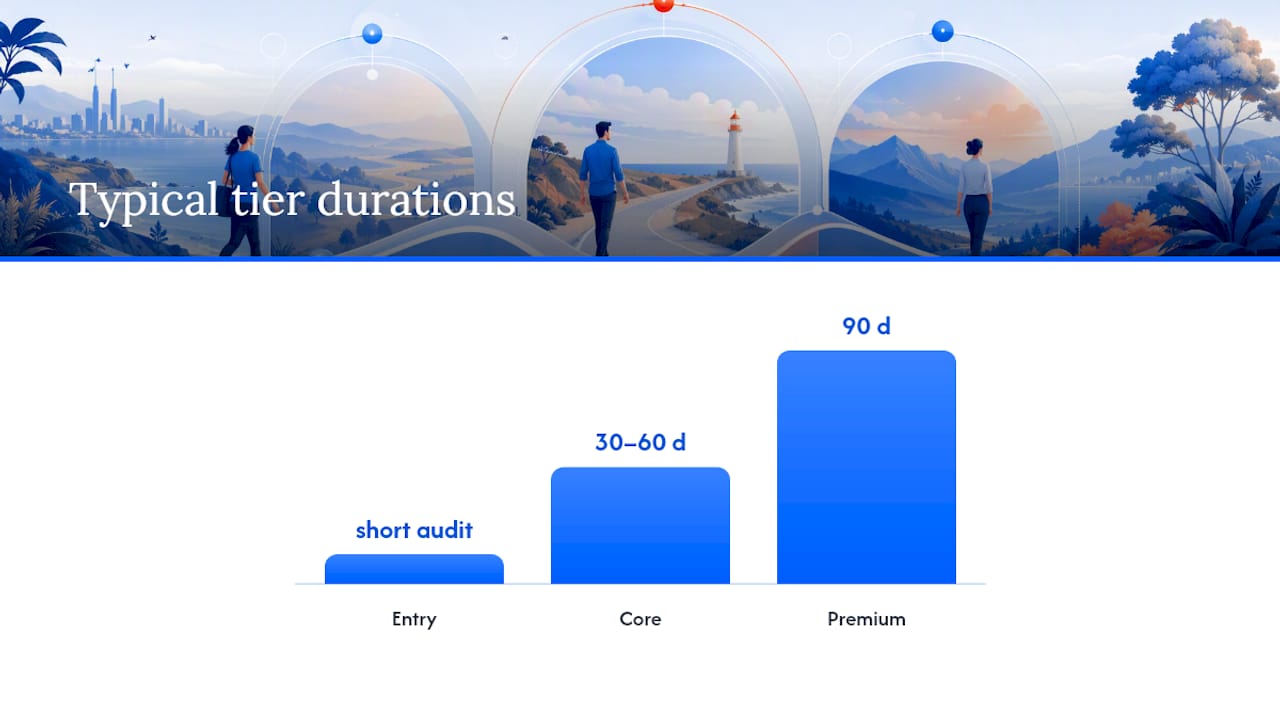
These bands are illustrative. Your actual pricing depends on your market, your client’s perceived value of the outcome, and your cost of delivery.
Your offer headline should communicate the outcome, the timeframe, and the ideal client — in that order. Name the offer last; promise first.
Headline templates you can adapt:
Short scripts for sales conversations:
Naming advice: avoid jargon, acronyms, and abstract words. The best offer names are descriptive enough that a potential client can guess what they get. Leading with a single, well-packaged offer makes marketing easier because your signature service becomes the headline for all communications — so the name needs to carry weight on its own.
For help turning your offer headline into persuasive website copy, the product and service description workshop at Mybworkshops walks you through the exact copywriting process.
A 4–8 week pilot is the fastest path to a sellable offer. Here is a simple timeline:
Simple sales flow:
Best launch channels for service businesses:
KPIs worth tracking from day one of your pilot:
Realistic timeline: expect a meaningful pilot signal within 1–3 months of your first cohort completing. Repeatable, documented evidence — the kind you can use in marketing — typically takes 6–12 months of consistent delivery. Collect client outcome data during and immediately after each engagement, not weeks later when the detail has faded.
The most common errors, and how to fix them quickly:
Mistakes to avoid:
Signs your pilot is failing early:
If any of these appear in week two or three, pause and tighten the scope document before continuing. A pivot at week three costs far less than a failed cohort.
Mybworkshops runs a structured, three-phase workshop programme designed specifically for service-based business owners who want to build repeatable, high-converting offers. The phases move from strategy to packaging to pilot-testing, so you leave with a real offer rather than a plan to make one.
Programme highlights:
Outcome signals from participants include higher conversion rates and reduced wasted ad spend. See how previous participants applied the workshop process to their own businesses.
Building a signature service is one of the highest-leverage moves a service business can make — and the difference between a strong offer and a weak one usually comes down to structure, not effort.
Mybworkshops workshops give you a clear, step-by-step process to define your transformation, package your offer, and pilot it with real clients — without the guesswork that comes from figuring it out alone.
Three reasons service business owners join:
Browse the available workshops and find the session that fits where you are right now.
A signature service is a branded, repeatable programme built around a unique delivery method that produces a specific, named result for a defined client. It differs from general service offerings because it has a fixed scope, a clear outcome, and a consistent process.
A complete signature service offer includes a named outcome, a unique mechanism, defined scope and deliverables, clear pricing, and a risk-reversal element such as a satisfaction checkpoint. Packaging is what separates it from a loose collection of services.
Start by writing one sentence that names the transformation, the ideal client, and the timeframe. Then map your delivery process, name the mechanism, define the scope, set a price, and run a small pilot cohort before a full launch.
A unique selling proposition (USP) is the single reason a buyer should choose you over alternatives. A signature service offer is the practical expression of that USP: it packages your USP into a specific, buyable programme with a defined outcome and process.
A pilot cohort typically produces meaningful feedback within 1–3 months. Consistent, documented evidence suitable for marketing usually takes 6–12 months of repeatable delivery.