

How to position your service business online effectively

Woman reviewing customer personas at home workspace

Effective online positioning for a service business means occupying a clear, specific place in your ideal client’s mind before they ever contact you. It is the difference between being found by the right people and being ignored by everyone. To position your service business online effectively, you need three things working together: a sharp understanding of who you serve, a digital presence built to convert, and consistent marketing that builds trust over time. The Mybworkshops framework is built around exactly this sequence, helping Australian service business owners move from invisible to in-demand.

How to identify and focus on your ideal service customer online

Clear customer focus is the foundation of every effective online positioning strategy. Without it, your website speaks to no one, your content attracts the wrong enquiries, and your marketing budget disappears without results.

Start by building a detailed client persona. This is not a vague demographic sketch. It is a specific profile that includes the problems your ideal client is trying to solve, the language they use to describe those problems, and the places they search for help. A bookkeeper targeting tradies, for example, will use completely different language and channels than one targeting professional services firms.

Research methods that work for Australian service businesses include:

  • Google Search Console: Review the actual search queries bringing people to your site. These reveal the words your clients use, not the words you assume they use.
  • Review mining: Read your own Google reviews and those of businesses in your category. The specific phrases clients use to describe value are gold for messaging.
  • Direct client interviews: Ask your three best clients what they were searching for before they found you. Their answers will reshape your homepage copy.
  • Forum and community research: Facebook groups, Reddit, and industry forums show the real questions your audience is asking right now.

Once you know your ideal client, craft messaging that speaks directly to their situation. A cleaning business targeting busy families in Brisbane’s inner suburbs needs different copy than one targeting commercial property managers. Niche specificity is not limiting. It is what makes you the obvious choice for the right people.

Pro Tip: Resist the urge to appeal to everyone. The more specific your positioning, the less competition you face. A service business that creates an ideal customer profile before building its website consistently outperforms one that tries to serve all comers.

How to optimise your website and Google Business Profile for visibility

Local SEO success requires a solid foundation before any technical work delivers results. Ranking alone is insufficient without proper conversion architecture and messaging tailored to local customers. This means your website and Google Business Profile must work as a system, not as separate assets.

Man explaining SEO strategy on whiteboard in meeting room

Building service pages that convert

Follow these steps to build pages that rank and generate enquiries:

  1. Create a dedicated page for each core service. One page for “bathroom renovations” and a separate page for “kitchen renovations” outperforms a single generic “services” page every time.
  2. Add location modifiers to page titles and headings. “Electrician in Parramatta” targets a specific search with commercial intent. Generic titles like “Our Services” do not.
  3. Implement local business schema. Structured data and local schema help search engines understand your business category, location, and services. This directly improves how you appear in search results.
  4. Write for commercial intent, not just traffic. A page titled “How much does a plumber cost in Melbourne?” attracts buyers, not browsers. Generic blog posts about plumbing history attract neither.
  5. Include clear calls-to-action on every service page. A phone number, contact form, and booking link should be visible without scrolling.

Optimising your Google Business Profile

Google Business Profile optimisation is critical for local service businesses, influencing rankings through categories, service areas, and review management. A neglected profile costs you map pack visibility and the trust signals that convert searchers into callers.

Key actions for your profile:

  • Set your primary category precisely. “Plumber” outperforms “Home Services” for plumbing searches. Choose the most specific category available.
  • Define your service area correctly. Service-area businesses can hide their physical address in Google Business Profile and use defined service areas instead. This is essential for tradies and mobile service providers working from home.
  • Maintain NAP consistency. Your business name, address, and phone number must be identical across your website, Google Business Profile, and every directory listing. Inconsistency confuses search engines and erodes trust.
  • Collect and respond to reviews. Reviews, rating recency, and active profile engagement have a measurable impact on local rankings and conversion. A structured process for requesting reviews after each job builds this asset steadily.
  • Post updates and photos regularly. Active profiles signal relevance. Add photos of completed work, post seasonal offers, and answer questions publicly.

Pro Tip: Build a dedicated landing page for each suburb or service area you target. A page titled “Landscaping in Geelong” with local references and a Google map embed will outrank a generic contact page for that search term.

How can AI help you market your service business online?

AI adoption among Australian service businesses is growing fast, but unevenly. 64%–84% of Australian SMBs use AI, yet only 5% have fully integrated it into their marketing and lead generation systems. That gap represents a real opportunity for service businesses willing to go one step further than basic use.

Practical AI applications that improve online positioning include:

  • AI chatbots for lead capture: AI chatbots handle up to 80% of routine customer queries autonomously, providing 24/7 support and capturing leads outside business hours. For a service business, this means enquiries from a Sunday evening search are not lost by Monday morning.
  • Content creation support: AI tools help you produce service page copy, FAQ content, and social posts faster. The key is using AI to accelerate your own expertise, not to replace your voice or your strategy.
  • Email automation: Automated follow-up sequences nurture enquiries that are not ready to book immediately. A prospect who downloads your pricing guide can receive a series of helpful emails that keep you front of mind.
  • Ad targeting and optimisation: AI-assisted ad platforms analyse performance data and adjust targeting in real time, reducing wasted spend on audiences unlikely to convert.

“AI maturity closely correlates with SMB profitability. Businesses that fully integrate AI into their marketing systems see up to a 111% uplift in profitability compared to those using AI only for isolated tasks.”

One practical consideration: over 100,000 Australian small businesses face increased Privacy Act obligations from 2026 reforms. Any AI tool that collects or stores customer data must comply with these requirements. Check your data handling practices before deploying new automation.

Pro Tip: Start AI with your single biggest repetitive marketing task. For most service businesses, that is following up on enquiries. Automate that one process first, measure the result, and then expand. You can find practical AI uses for business owners to help you prioritise.

Building trust and authority through consistent brand messaging

Consistent brand messaging is what turns a first-time website visitor into a paying client. Without it, even a well-ranked website fails to convert. Your messaging must align with your niche, reflect your ideal client’s language, and stay consistent across every channel.

Content marketing builds this trust over time, but only when it targets the right intent. Commercial-intent pages with local modifiers outperform generic blog posts for lead generation. A page answering “How much does a bathroom renovation cost in Sydney?” generates enquiries. A post titled “The history of bathroom design” does not.

Key trust-building practices for service businesses:

  • Integrate testimonials into service pages, not just a standalone reviews page. A quote from a happy client placed next to your call-to-action removes doubt at the moment of decision.
  • Use before-and-after photos and case studies. Specific results build credibility faster than any amount of descriptive copy.
  • Update your website regularly. Search engines and clients both notice stale content. A blog post dated 2021 on a 2026 website signals neglect.
  • Keep your brand visuals consistent. The same logo, colours, and tone across your website, Google Business Profile, and social media creates recognition and trust.

Pro Tip: Ask every new client how they found you and what made them choose you. Their answers reveal which parts of your online presence are actually working, and which parts you can stop spending time on.

How do you track whether your online positioning is working?

Tracking is what separates businesses that grow from those that stay stuck. Without measurement, you cannot tell whether your positioning is attracting the right clients or simply generating noise.
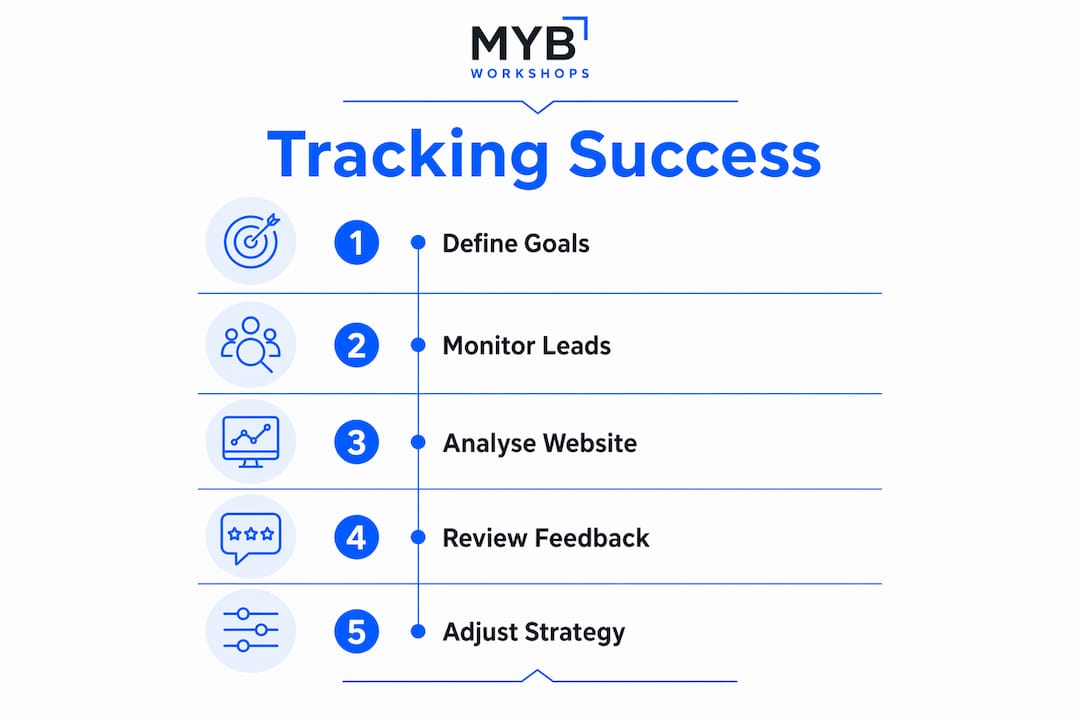
Infographic outlining steps to track online positioning success

Call tracking and analytics are the most direct way to measure true conversion rates from your online presence. Impressions and website visits are vanity metrics. Leads and booked jobs are what matter.

Use this process to track and adapt:

  1. Set up Google Analytics 4 on your website. Track which pages generate the most enquiry form submissions and phone call clicks.
  2. Review your Google Business Profile insights monthly. Profile views, direction requests, and call clicks show whether your local SEO is generating real interest.
  3. Use call tracking software. Assign unique phone numbers to different channels, such as your website, Google Business Profile, and any paid ads. This shows exactly which source is generating calls.
  4. Monitor your lead-to-conversion rate. Getting 50 enquiries a month means nothing if only 2 convert. More leads do not fix every business problem. Conversion quality matters as much as volume.
  5. Review and update quarterly. Local SEO is a long-term investment. Sustained local SEO must be matched with your business capacity to respond to increased leads. Growing enquiries faster than you can service them damages your reputation.

Pro Tip: Concentrate your marketing budget on the one or two channels generating your highest-quality leads. Most service businesses spread too thin across social media, SEO, and paid ads simultaneously. Pick the channel that converts best and go deeper before adding more.

Key takeaways

Positioning your service business online effectively requires customer clarity, a conversion-ready digital presence, and consistent measurement to sustain growth.

Point Details
Customer clarity comes first Define your ideal client before building or updating any digital asset.
Google Business Profile drives local leads Optimise categories, service areas, reviews, and posts to rank in the map pack.
AI fills the gaps in your marketing system Use AI for lead capture, follow-up, and content to work efficiently without adding headcount.
Trust is built through consistency Align messaging, visuals, and content across every channel to convert visitors into clients.
Measure what converts, not what impresses Track leads and booked jobs, not just website traffic or social media reach.

Mybworkshops can help you build a stronger online presence

If your service business is generating traffic but not enquiries, or enquiries but not bookings, the issue is almost always positioning. Mybworkshops runs structured, expert-led workshops designed specifically for service business owners who want a clear marketing system, not a collection of tactics.
https://mybworkshops.com.au

The Mybworkshops programme covers everything from brand foundations and website conversion to lead generation systems and paid advertising. Real business owners have used these workshops to increase conversions and reduce wasted ad spend, with results backed by practical frameworks rather than theory. You can browse the full range of available workshops or explore the dedicated lead generation system workshop to build a sales funnel that works for your specific service business.

FAQ

What does it mean to position a service business online?

Online positioning means defining a clear, specific place for your business in the minds of your ideal clients, so they choose you over alternatives when they search for your service.

How important is Google Business Profile for service businesses?

Google Business Profile is critical for local visibility. Optimised categories, service areas, and active review management directly influence map pack rankings and client conversions.

How do I know if my online positioning is working?

Track leads and booked jobs, not just website traffic. Use Google Analytics 4, Google Business Profile insights, and call tracking to measure which channels generate real enquiries.

Can AI improve my service business marketing?

Yes. AI chatbots, email automation, and content tools help service businesses capture leads and nurture prospects efficiently. Start with your most repetitive marketing task and automate that first.

How long does local SEO take to show results?

Local SEO is a long-term investment. Most service businesses see meaningful movement in three to six months, provided their website, Google Business Profile, and content strategy are all aligned.


Hi There, I'm Peggy

I’m the brains (& the energy) behind MYB Workshops.

For 20+ years, I’ve helped business owners ditch the confusion, clarify their message, and build brands that attract the right clients. No fluff, no overwhelm, just proven strategies that work.

If you want to build a brand that feels right and actually brings in business, you’re in the right place!

Hi There, I'm Peggy!

For more than 20 years, I’ve helped businesses grow with better marketing systems that support long-term plans.

Everything inside MYB Workshops is built from the same strategies, frameworks and practices we use in our agency. These aren’t theories or quick fixes. They’re proven approaches shaped by real-world results and applied across hundreds of businesses.

MYB Workshops was created to make those tools and insights accessible to business owners who want greater clarity and confidence in their business.

I’m glad you’re here in the Blog, explore some of the hot topics our clients ask us about. I hope to see you in the workshops, real soon!

Build Your Business

If your business isn’t attracting and converting the right customers, something needs to change.

In MYB Workshops, you get proven strategies, expert guidance, and a clear plan that actually works. 

Start building a marketing system that works, today!

Stop Losing Sales

Brand confusion costs sales. Learn how to position, market, and sell with confidence inside MYB Workshops.

FREEBIES
FREE Brand Clarity Workshop

Crafting Your Brand Identity 

An on-demand workshop to help you create a brand identity that attracts the right clients, builds trust, and drives real results, without the guesswork.

PLUS Grab your FREE workbook to implement everything instantly!

6 Strategies to Build a Website That Converts

3 seconds. That’s all it takes for a visitor to decide if they’ll stay or leave your website.

Download this FREE guide to learn 6 proven strategies to keep visitors engaged and turn them into paying clients.

FREE Branding Guide

Your brand is more than a logo. It’s the foundation of your entire business.

If you skip this step, you risk wasting time and money on marketing that doesn’t convert.

Download this FREE guide and discover 5 key steps to build a brand that attracts, connects and drives long-term success.

Related Blog Articles