

More leads are not the solution to every business problem. That claim runs counter to what most business owners hear, but 42% of companies failed to meet their revenue targets in 2025, and only 12% of B2B marketing-generated leads converted to actual revenue. Those numbers point to a system problem, not a volume problem. When the underlying sales process, website experience, or offer positioning is broken, adding more leads simply adds more waste. Understanding why more leads won’t fix every business problem is the first step toward fixing what actually matters.
Lead generation myths are costing business owners real money. The most damaging myth is that more leads automatically means more revenue. Volume feels like progress because it is measurable and visible. The reality is that lead quantity tells you almost nothing about business health.
73% of B2B leads are not ready to purchase at first contact. That means nearly three quarters of the leads you generate today need nurturing before they will ever consider buying. Chasing more of those leads without a nurturing system in place is like filling a leaking bucket.
There is also a critical difference between lead generation and demand generation. Lead generation is reactive. It captures people who are already looking. Demand generation is proactive and builds trust with buyers before they are ready to raise their hand. Businesses that focus only on lead capture miss the earlier, more influential stage of the buyer’s journey entirely.
Pro Tip: Before you spend another dollar on ads or lead magnets, check your current lead-to-client conversion rate. If it is below 20%, you have a conversion problem, not a lead volume problem.
Low-quality leads do not just fail to convert. They actively drain your time, budget, and team energy. Every unqualified enquiry your team follows up on is time stolen from a genuine prospect. This is one of the most overlooked business growth challenges facing service-based businesses.

Speed-to-lead is a concrete example of where broken systems cost real revenue. 78% of deals go to the first responder, and conversion drops by 80% if response time exceeds 10 minutes. Most small business owners are not set up to respond that fast. The lead arrives, sits in an inbox, and by the time someone follows up, the prospect has already moved on.
Poor positioning compounds the problem. Only 4% of executives report having a clearly understood value proposition. When a prospect lands on your website or reads your proposal and cannot immediately understand why you are the right choice, they leave. More leads sent to a confusing offer produces more confusion, not more clients.
Common website conversion killers include slow page load times, unclear calls-to-action, and no social proof. These issues exist independently of how many people visit your site. Fixing them lifts revenue from your existing traffic before you spend a cent on new lead generation.
| Conversion path issue | Business impact |
|---|---|
| Response time over 10 minutes | 80% drop in conversion likelihood |
| Unclear value proposition | Prospects self-disqualify before enquiring |
| No lead nurturing sequence | 73% of leads lost before they are ready to buy |
| Poor website experience | High bounce rates from warm traffic |
Pro Tip: Audit your enquiry response time this week. If you cannot respond within 10 minutes during business hours, set up an automated acknowledgement that confirms receipt and sets expectations. That one change can recover lost revenue immediately.
Doubling your lead volume without fixing your response infrastructure doubles your wasted spend. If your current system misses 50% of leads, generating twice as many leads means twice the wasted ad spend, not twice the revenue. This is the operational trap that catches business owners who treat lead generation as the answer to every growth problem.
The systemic issues that surface when lead volume increases without system improvements follow a predictable pattern:
The fix is not to slow down lead generation permanently. The fix is to build the operational foundation that can actually handle and convert leads before you scale volume. Sustainable growth requires that the system works before you pour more fuel into it.
Diagnosing your real growth constraint starts with mapping your funnel and identifying where prospects drop off. This is not complicated. You are looking for the stage where the largest percentage of potential clients disappear. That stage is your priority fix, not lead volume.
Optimising the weakest funnel stage yields compounding results that outperform simply increasing volume. A 10% improvement in conversion at each of three funnel stages produces a 33% overall revenue lift without a single additional lead. That is the maths of fixing the system versus chasing more contacts.
Efficiency gains from cost discipline and automation fund growth initiatives sustainably. BCG research confirms that businesses building a culture of operational excellence create the financial headroom to invest in genuine growth. That means fixing what is broken first, then scaling what works.
The diagnostic framework for business owners looks like this:
| Constraint area | Diagnostic question | Fix priority |
|---|---|---|
| Speed-to-lead | Can you respond within 10 minutes? | High |
| Value proposition clarity | Can a stranger explain your offer in one sentence? | High |
| Lead qualification | Do you have a written qualification process? | Medium |
| Nurturing sequence | Do leads receive follow-up if they do not buy immediately? | Medium |
| Retention and pricing | Are existing clients buying again or referring others? | Medium |
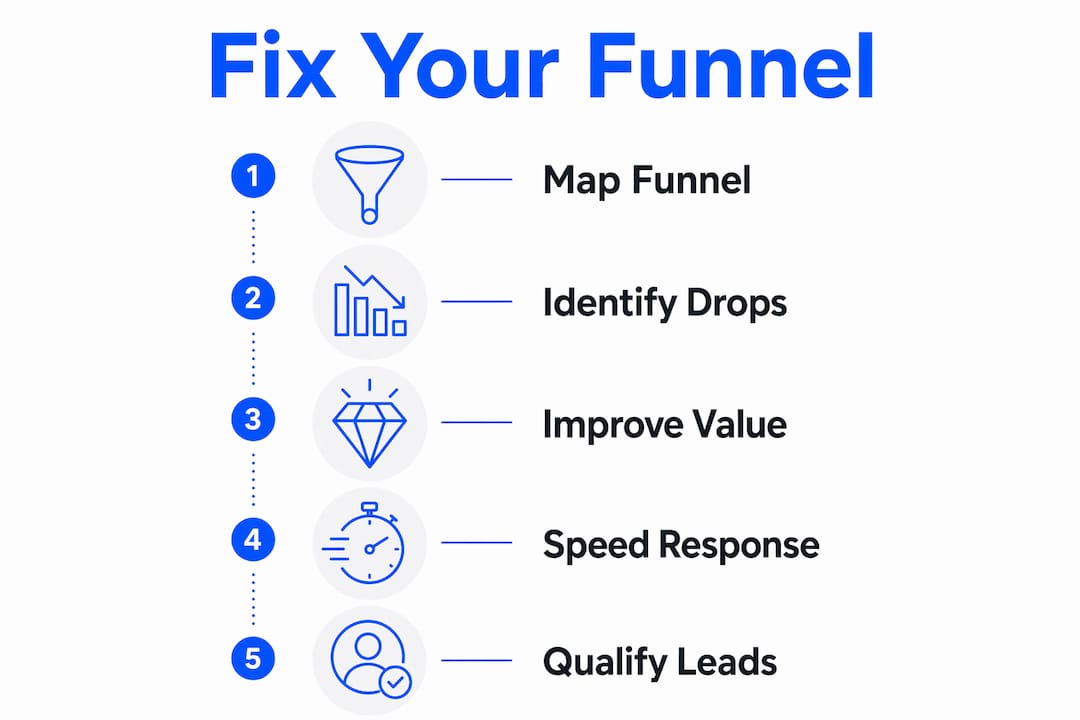
Start with the two high-priority items. A clear value proposition and fast response time address the most common reasons leads do not convert. Once those are working, move to qualification and nurturing. Retention and pricing improvements often fund the next round of lead generation investment without requiring additional ad spend.
Pro Tip: Talk to three clients who chose not to proceed with you. Ask them directly what stopped them. Their answers will identify your real constraint faster than any analytics dashboard.
Effective lead strategies shift focus from volume to fit. The goal is to attract prospects who are already aligned with your offer, your price point, and your way of working. That requires building trust before the enquiry arrives, not just after.
Demand generation builds brand trust early, shortening sales cycles and improving conversion at every later stage. Consistent content, clear positioning, and visible social proof all contribute to this. When a prospect arrives already trusting your brand, the sales conversation is shorter and the close rate is higher.
Practical shifts that improve lead quality and conversion include:
The businesses that grow sustainably are not the ones generating the most leads. They are the ones converting the highest percentage of the right leads, retaining clients longer, and building referral systems that reduce their dependence on paid acquisition over time.
Mybworkshops is built for service-based business owners who are ready to stop chasing volume and start building a system that actually converts.
The Mybworkshops programme covers the full picture: from clarifying your value proposition and fixing your website conversion to building a lead generation system that attracts the right clients. Each workshop is practical, expert-led, and designed to produce results you can implement immediately. If you have been generating leads without seeing the revenue growth to match, the free masterclass is the right starting point. It walks you through the core framework and helps you identify exactly where your business system needs attention first.
More leads without a working conversion system produce more waste, not more revenue. Fixing the system first is the only path to sustainable growth.
| Point | Details |
|---|---|
| Lead volume is not the problem | 42% of companies missed revenue targets despite generating leads. |
| Most leads are not ready to buy | 73% of B2B leads need nurturing before they will consider purchasing. |
| Speed-to-lead is critical | Conversion drops 80% if response time exceeds 10 minutes. |
| Fix the weakest funnel stage first | Improving conversion at each stage compounds results without extra lead spend. |
| Demand generation builds trust early | Proactive brand-building shortens sales cycles and improves close rates. |
More leads amplify whatever system you already have. If your conversion process is broken, more leads produce more wasted time and spend, not more revenue.
Lead generation captures people already searching. Demand generation builds awareness and trust before buyers are ready, so more of the right people enter your funnel over time.
78% of deals go to the first responder, and conversion drops 80% after a 10-minute delay. Aim to respond or send an automated acknowledgement within minutes of every enquiry.
Prioritise your value proposition clarity, response speed, and lead qualification process. These three areas produce the highest conversion lift before you invest in more volume.
Track your lead-to-client conversion rate. If it is consistently below 20%, the issue is your conversion process, not the number of leads you are generating.