

Random marketing, known in the industry as “random acts of marketing,” is the practice of running disconnected, inconsistent campaigns without a clear strategy or target audience. It is one of the most common and costly mistakes business owners make. Random acts of marketing can waste 60–80% of total marketing resources due to lack of consistency and strategic direction. That figure alone should stop you in your tracks. Without a structured approach, every dollar you spend is working against itself.
The industry term for this pattern is “random acts of marketing.” It describes what happens when a business posts on social media one week, runs a Google ad the next, sends a one-off email, and then goes quiet for a month. Each activity feels productive in the moment. None of them build on each other.
Marketing only compounds when it is consistent. Marketing strategist Michael Brenner puts it plainly: consistency compounds while gimmicks do not. A business that shows up for its audience in the same place, with the same message, over and over builds recognition and trust. A business that chops and changes confuses people and loses momentum.
The deeper problem is structural. Random marketing results from missing structure, and frequent changes to inputs prevent learning and scalable success. Without a system, you cannot measure what works. Without measurement, you cannot improve. You end up repeating the same cycle of activity without results.
Scattered marketing does not just feel inefficient. It is measurably expensive. 30–40% of marketing spend is wasted due to poor optimisation timing caused by premature campaign changes. That means for every $1,000 you spend, up to $400 may be producing nothing.

The reason this happens is momentum. Marketing channels, whether paid ads, content, or email, require time and volume to build traction. When you pull the plug too early or switch direction mid-campaign, you reset the clock. You never give any single channel enough runway to show you what it can do.
Here is what scattered marketing typically looks like in practice:
Pro Tip: Audit every marketing activity you are currently running. List each channel, note the last time you measured its performance, and cut anything that has no clear metric attached to it. A true marketing audit involves listing every channel, evaluating metrics regularly, and cutting inactive or unproductive activities.
The audit is not about doing less. It is about concentrating your resources where they can actually build something.
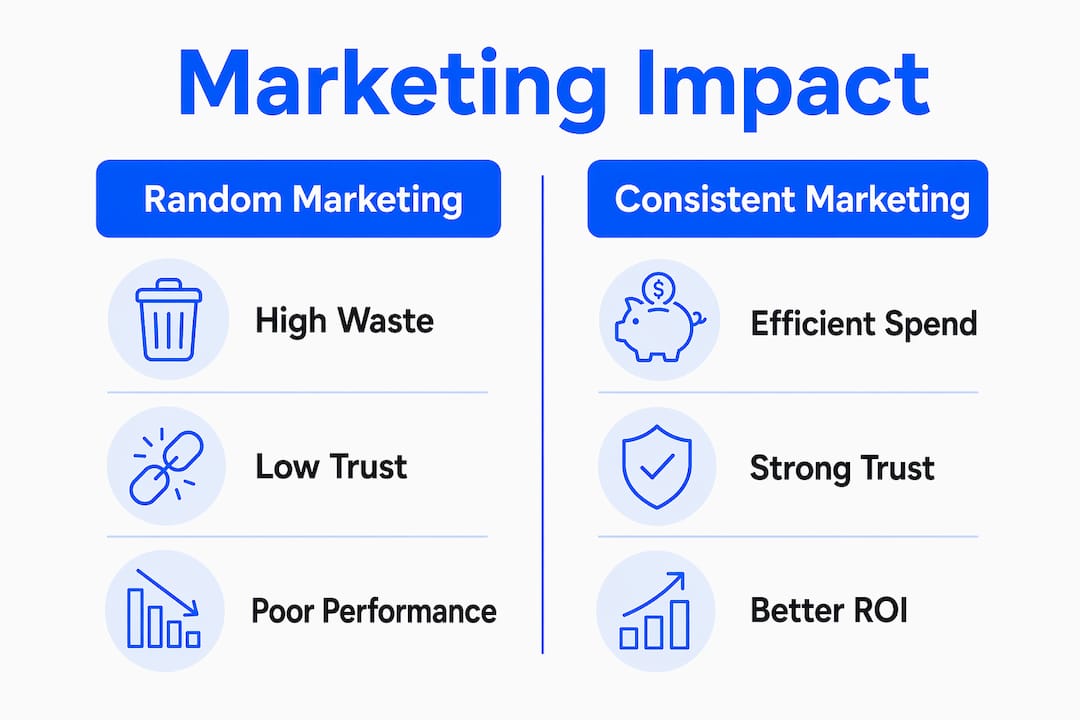
Shifting your message, offer, or audience too frequently does more than confuse potential clients. It erodes trust. When someone sees your brand twice and gets a different impression each time, they cannot form a clear picture of who you are or what you do. That uncertainty kills conversions.
Inconsistent messaging creates internal friction too. When marketing sends one message and sales follows up with another, the disconnect undermines confidence on both sides. Sales teams begin to distrust the leads marketing generates. Marketing struggles to justify its budget. The whole system breaks down.
The data on targeted messaging is striking. Segmented email campaigns can increase revenue by up to 760% by targeting predisposed audiences. That is not a small improvement. It reflects what happens when the right message reaches the right person at the right time, consistently.
The most common messaging mistakes in random marketing include:
Pro Tip: Write down your one core audience profile and your one key message. Pin it somewhere visible. Every piece of content, every ad, every email should pass through that filter before it goes out. Consistent audience targeting is the foundation of every campaign that converts.
Digital advertising platforms do not reward randomness. Google Ads and Meta both rely on machine learning to optimise who sees your ads and when. That learning requires consistent, high-volume data over time. Frequent campaign changes reset algorithm learning and reduce efficiency. Every time you pause a campaign, change the audience, or rewrite the creative, the platform starts its learning phase again from scratch.
This is one of the most expensive mistakes business owners make with paid advertising. You pay full price for the learning phase, then pull out before the algorithm has enough data to perform. The next campaign starts the same cycle over again.
The contrast between focused and scattered digital campaigns is significant. Data-driven pay-per-click campaigns lower cost-per-click by approximately 50% compared to broad-match campaigns. That cost reduction comes directly from giving the algorithm enough consistent data to find your best audience.
Top-performing campaigns also feed qualified lead data back into the platform. Synchronising lead quality data with ad platforms enables continuous feedback and optimisation. This creates a compounding effect: better data produces better targeting, which produces better leads, which produces better data.
| Factor | Consistent campaigns | Random campaigns |
|---|---|---|
| Algorithm learning | Builds over time, improves targeting | Resets with every change |
| Cost per click | Reduces as optimisation improves | Stays high or increases |
| Audience data | Accumulates and refines | Fragmented and incomplete |
| Lead quality | Improves with feedback loops | Unpredictable |
| Budget efficiency | Increases with each cycle | Drains without compounding |
The table above shows why random campaigns cost more and deliver less. The platform never gets the chance to work for you.
A marketing strategy is not a plan you write once and file away. It is a filter you use every day. A good marketing strategy clarifies which ideas to pursue and which to decline, preventing random spending before it starts. When an opportunity comes up, the strategy tells you whether it fits. If it does not fit, you say no.
This is the mindset shift that separates businesses with growing marketing results from those stuck in the cycle of activity without outcomes. Focused effort on one audience, one channel, and one metric at a time produces learning. Learning produces improvement. Improvement produces results you can scale.
Here is a practical framework for building consistent, targeted marketing:
Pro Tip: Resist the urge to add a new channel until your current one is producing consistent results. Adding complexity too early is one of the most reliable ways to end up back in the random marketing cycle.
The businesses that grow steadily are not the ones with the most creative campaigns. They are the ones that show up consistently for the right audience with the right message, long enough for it to compound.
Targeted, consistent marketing outperforms random acts of marketing because it builds algorithm learning, audience trust, and measurable momentum over time.
| Point | Details |
|---|---|
| Random marketing wastes resources | 60–80% of marketing resources are wasted without strategic direction and consistency. |
| Inconsistent messaging breaks trust | Shifting messages and audiences confuses potential clients and undermines sales alignment. |
| Algorithm learning requires consistency | Frequent campaign changes reset platform learning and increase advertising costs. |
| Segmentation drives revenue | Targeted, segmented campaigns can increase revenue by up to 760% compared to generic outreach. |
| Strategy acts as a filter | A clear strategy tells you which opportunities to pursue and which to decline, preventing waste. |
If you recognise the pattern of random marketing in your own business, you are not alone. Most service-based business owners reach a point where activity feels high but results feel flat. The answer is not more effort. It is more focus.
Mybworkshops offers practical, expert-led workshops built specifically for business owners who want to replace scattered marketing with a system that produces consistent results. The workshops cover strategy, audience targeting, digital advertising, and content, all structured around the three-phase Mybworkshops framework. You will leave with a clear plan, not just ideas. If you are ready to build a marketing foundation that compounds, explore the full range of workshops and find the one that fits where you are right now.
Random acts of marketing are disconnected, inconsistent marketing efforts that lack a clear strategy, target audience, or measurable goal. They waste resources because no single activity builds on another.
Random marketing can waste 60–80% of total marketing resources due to lack of consistency and strategic direction. Poor optimisation timing from premature campaign changes accounts for a further 30–40% of spend.
Ad platforms like Google Ads and Meta use machine learning to optimise campaign delivery. Frequent changes reset the algorithm’s learning phase, which increases costs and reduces targeting accuracy.
Segmented, targeted campaigns can increase revenue by up to 760% compared to generic outreach. Focused pay-per-click campaigns also lower cost-per-click by approximately 50% compared to broad-match approaches.
Start with an audit of every current marketing activity. Cut anything with no measurable metric. Then commit to one audience, one channel, and one goal for a minimum of 90 days before making changes.