

Early marketing strategy is the deliberate process of validating your customer, your message, and your channels before you commit serious money to growth. Companies with a documented go-to-market strategy have a 3.4x higher chance of a successful launch than those without one. That single statistic reframes the question entirely. The issue is not whether you can afford to start marketing early. The issue is whether you can afford not to.
Most service-based business owners treat marketing as something that happens after the business is ready. They build the offer, set up the website, then wonder why clients are not coming. The reality is that the businesses that grow consistently are the ones that treat early marketing as a learning phase, not a launch phase. Getting your message, audience, and channels right from the start is what separates sustainable growth from expensive guesswork.
The data on early strategic planning in marketing is clear. 72% of companies lack a formal GTM strategy, and those businesses face costly struggles late in the game when fixing foundational errors is far more expensive. That figure means the majority of businesses are flying blind at the moment they need direction most.

Multi-channel acquisition also outperforms single-channel approaches over time. Organic channels compound over time, while early reliance on paid channels alone can push up your blended cost per acquisition within just two quarters. This matters for service businesses because your margins are often tighter than product businesses, and wasted ad spend hits harder.
The benefits of early strategy show up in speed as well as cost. Early customer conversations and pre-launch marketing reduce time-to-first-customer and validate demand before you start selling. Simple actions like registering your domain, setting up a holding page, and talking to potential clients before your service is fully ready all contribute to a faster, more confident launch.
| Approach | Outcome |
|---|---|
| Documented early strategy | 3.4x higher launch success rate |
| No formal GTM strategy | Costly late-stage corrections |
| Multi-channel acquisition | Lower blended cost per acquisition over time |
| Paid-only acquisition | Rising costs within two quarters |
| Pre-launch customer conversations | Faster time-to-first-customer |
“The businesses that grow consistently treat early marketing as a learning phase, not a launch phase.”
Pre-seed marketing is low-cost experimentation focused on learning who your buyer is, what language resonates with them, and which channels reach them efficiently. The goal is not to generate demand immediately. The goal is to gather enough real-world signal to make your eventual scaling decisions far less risky.
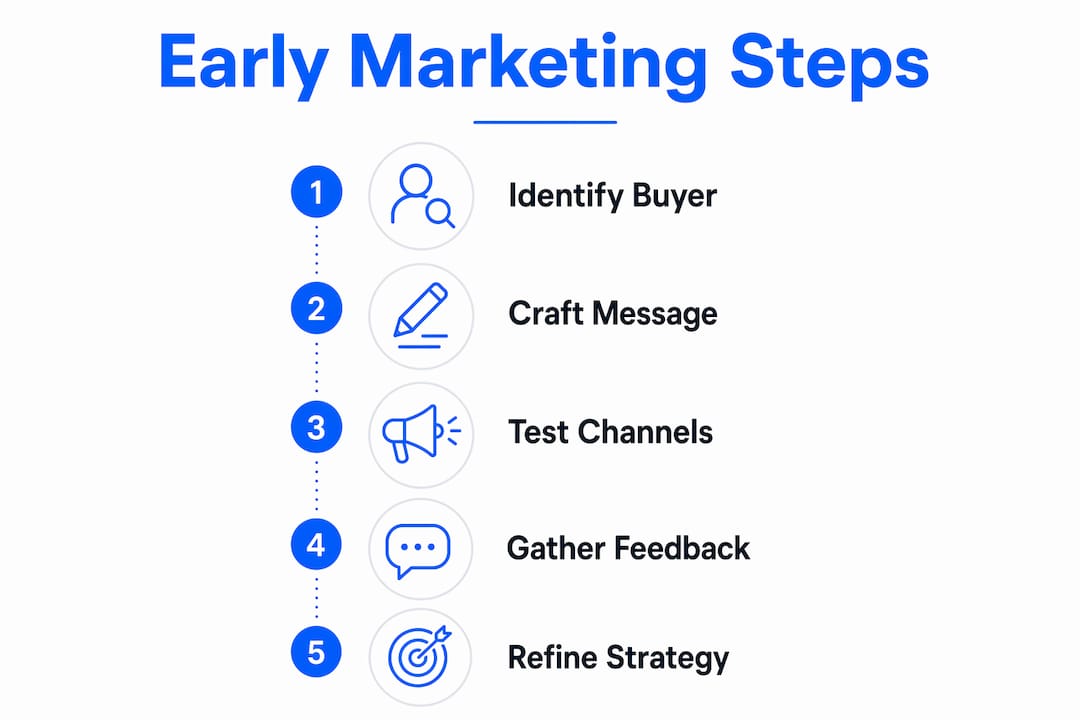
The sequencing principle here is critical. You discover first, then scale. You do not build a full SEO content plan or run paid ads until you have validated your ideal client profile and your core message. Validating your ICP and messaging before scaling channels like SEO and paid ads is the recommended sequence for early-stage businesses. Skipping this step is one of the most common and costly mistakes service business owners make.
Here is a practical sequence to follow in your early marketing phase:
Pro Tip: Keep a running document of the exact words and phrases your potential clients use when describing their problem. This language belongs in your website copy, your social posts, and your ads. Borrowed language from real buyers outperforms marketing copy written in isolation every time.
Startups that scale untested assumptions across channels waste significant budget repeating the same messaging mistakes at higher cost. Testing your buyer’s buying triggers and language early is the single most cost-effective thing you can do before committing to a channel strategy.
Emergent strategy enables adaptability during uncertain early phases, while deliberate strategy supports scale once maturity is reached. Understanding the difference helps you avoid two common traps: planning too rigidly before you have real data, or staying too flexible for too long and never committing to a direction.
An emergent approach means you set a broad direction, take action, observe what the market tells you, and adjust. For a service business in its first year, this is the right posture. You do not yet know which client type will be your most profitable, which service will generate the most referrals, or which message will resonate most clearly. Emergent strategy lets you find out without betting everything on one assumption.
A deliberate strategy becomes the right tool once you have that clarity. When you know your best client, your strongest offer, and your most effective channel, you commit resources and build systems around what works. The transition from emergent to deliberate is not a failure of planning. It is the natural progression of a business that has done its learning properly.
Key markers that signal you are ready to shift from emergent to deliberate strategy:
Brand marketing is a compounding advantage from day one. It builds credibility and trust that makes your later performance marketing far more efficient. Deferring brand building forces you into expensive outbound sales reliance, which is exhausting and unsustainable for most service businesses.
The numbers behind this are striking. Only 5% of B2B buyers are currently in-market. The remaining 95% are future buyers who are not ready to purchase today but will be at some point. If your brand is not visible and credible when they are ready, you will not be on their shortlist. This is why starting brand marketing early is not optional. It is the foundation your future demand generation sits on.
The research points to a 60/40 split between brand building and demand generation as the balance that maximises long-term growth. Most small businesses do the opposite, spending almost everything on short-term sales activation and almost nothing on brand. The result is a business that constantly chases new clients rather than attracting them.
| Focus | Short-term result | Long-term result |
|---|---|---|
| Brand building (60%) | Slower direct response | Compounding credibility and trust |
| Demand generation (40%) | Faster lead flow | Diminishing returns without brand support |
| Sales activation only | Quick wins | Expensive, unsustainable client acquisition |
| Brand only | Slow early traction | Strong inbound pipeline over time |
Pro Tip: If you are just starting out, spend the first 90 days building brand recognition in one specific community or channel before you invest in paid demand generation. The brand foundation you build in that period will make every future marketing dollar work harder.
You can build a brand from scratch without a large budget. What you need is consistency, clarity about who you serve, and the discipline to show up in the same places with the same message over time. That consistency is what creates the memory structures that bring future buyers back to you when they are ready.
Knowing that early strategy matters is one thing. Knowing exactly what to do in your specific business is another.
Mybworkshops offers structured, expert-led workshops built specifically for service-based business owners who want to stop guessing and start growing with a clear plan. The business strategy and marketing workshops cover the full process: validating your message, identifying your ideal client, choosing the right channels, and building a marketing system that compounds over time. Each session blends practical frameworks with personal mentorship, so you leave with a plan that fits your business, not a generic template. If you are ready to put a real foundation under your marketing, the free masterclass is a practical starting point.
Early marketing strategy is the single highest-leverage investment a service-based business owner can make before scaling, because it validates your message, client, and channels before you commit serious budget.
| Point | Details |
|---|---|
| Document your strategy early | Businesses with a documented go-to-market strategy are 3.4x more likely to launch successfully. |
| Validate before you scale | Test your message and ideal client profile before investing in SEO or paid ads. |
| Use multi-channel acquisition | Organic channels compound over time and reduce your cost per acquisition compared to paid-only approaches. |
| Start brand building from day one | 95% of buyers are not yet in-market, so brand visibility now creates your future client pipeline. |
| Match strategy type to your stage | Use an emergent approach early to learn, then shift to deliberate strategy once you have repeatable traction. |
An early marketing strategy is the process of validating your buyer, message, and channels before you scale your marketing spend. It focuses on low-cost experimentation and real customer conversations rather than immediate demand generation.
Pre-launch marketing reduces time-to-first-customer and validates demand before you invest in delivery. Simple steps like customer conversations and a holding page give you real signal about whether your offer resonates.
Testing your messaging and buyer language before committing to paid channels means you scale what works rather than amplifying untested assumptions. Businesses that skip this step often repeat the same costly messaging mistakes at higher volume.
Emergent strategy means adapting your direction based on real market feedback, which suits early-stage businesses operating under uncertainty. Deliberate strategy means committing fully to a proven direction, which suits businesses that have already validated their model.
Research points to a 60/40 split favouring brand building over demand generation as the balance that supports long-term growth. Most small businesses invert this ratio and pay the price in high, unsustainable client acquisition costs.