

A DIY marketing strategy is a deliberate, owner-run system where you set clear goals, choose focused channels, and execute marketing tasks on a consistent weekly schedule without relying on outside agencies. The industry term for this approach is “self-directed marketing,” but most business owners know it as DIY marketing. Tools like Canva, Mailchimp, and Google Analytics make this approach genuinely accessible for service-based businesses. The real advantage is not just cost savings. It is the control you gain over your message, your audience, and your results.
Most business owners assume marketing requires complex campaigns or a big budget. It does not. Consistency and clear communication matter far more than either. A well-run DIY marketing system can build real visibility and generate steady leads when you treat it as a weekly business habit rather than a one-off effort. This guide breaks down exactly how to build that system, from the core components to the tools and tactics that make it work for service-based business growth.
A DIY marketing strategy is built on four core components: clear goals, focused channels, a content rhythm, and a measurement habit. Miss any one of these and the whole system loses traction. Most business owners who struggle with marketing are not lacking creativity. They are lacking a clear, simple roadmap that links their business goals to daily marketing tasks.
The four building blocks of a self-directed marketing system:
Pro Tip: Start with your tool stack before you start creating content. Set up Canva, Mailchimp, and Google Analytics in week one. Having the infrastructure in place removes friction and makes it far easier to stay consistent.
The goal is not to do everything. It is to do the right things repeatedly. A focused 90-day execution plan built around one or two channels gives you enough time to see real results before adjusting course.
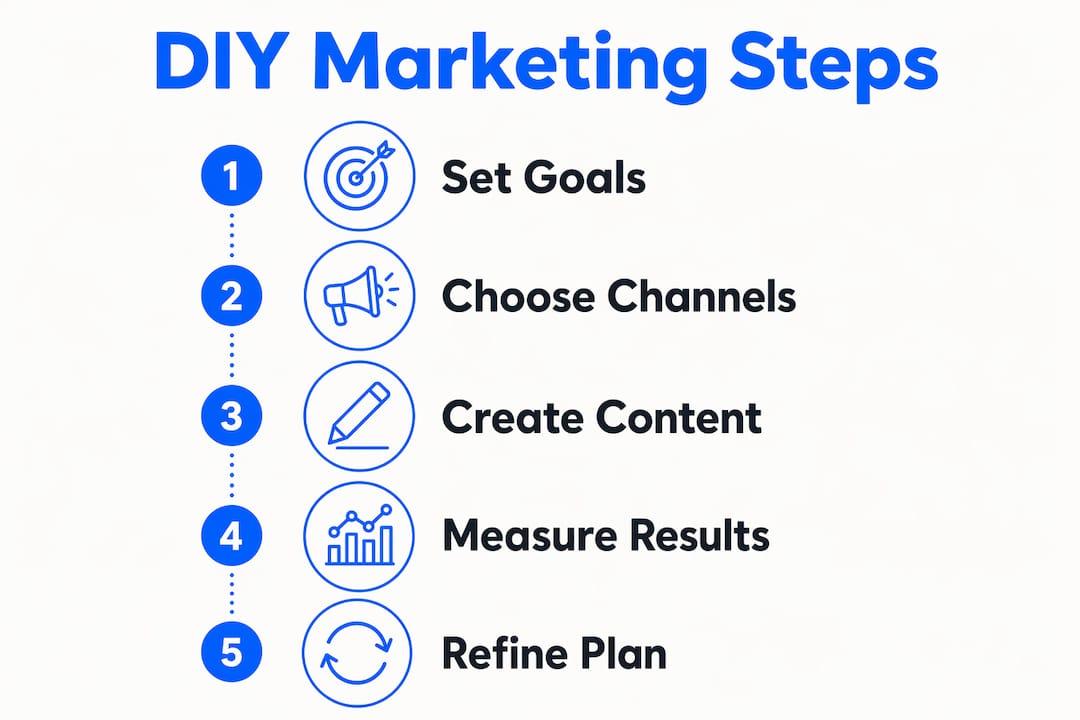
The biggest differentiator between business owners who see results from DIY marketing and those who do not is not skill or budget. It is treating marketing as a weekly operating system rather than something you do when business is slow. Reactive marketing, the kind you scramble to produce when enquiries dry up, rarely works. It lacks consistency, and audiences notice.
Experts recommend dividing five focused weekly hours across three categories:
“Marketing as a weekly chore leads to better outcomes than irregular bursts. This is the biggest differentiator for success.” — Searchlab DIY Marketing Playbook, 2026
A practical weekly content rotation for a service business might look like this: week one is a service spotlight post, week two is a behind-the-scenes look at how you work, week three is a client question answered in depth, and week four is a customer success story. This rotation keeps content fresh without requiring you to reinvent the wheel each week.
Pro Tip: Block your five marketing hours in your calendar at the start of each week, the same way you would a client appointment. Treat it as non-negotiable. Business owners who schedule marketing time are far more likely to follow through than those who fit it in when they can.

The rhythm builds momentum over time. Each piece of content adds to your credibility. Each week of consistency compounds into a body of work that attracts and converts clients long after you publish it. That is how content marketing works as a long-term asset, not a short-term campaign.
Effective self-marketing ideas for service businesses start with language, not design. The most common mistake is writing about your services in technical terms only you understand. Marketing works better when your message reflects your own voice and focuses on solving the specific problems your clients face. Write the way you speak to a client in a first meeting.
Here are the most practical beginner marketing tactics you can apply immediately:
The grassroots marketing principle applies here too. Grassroots marketing means building visibility from the ground up through genuine community connection and word-of-mouth, rather than paid advertising. For service businesses, this looks like showing up consistently in local Facebook groups, answering questions on LinkedIn, or contributing to industry forums. It costs nothing but time and builds real relationships.
Tracking the right numbers is what separates a marketing system from a marketing guess. Vanity metrics like follower counts and post likes feel good but do not pay the bills. Tracking leads and meaningful conversions is what tells you whether your marketing is actually working.
The metrics worth watching for a service business are enquiries received, website contact form submissions, email click-through rates, and direct messages that lead to a sales conversation. Google Analytics shows you which pages drive the most traffic and where visitors drop off. Instagram Insights shows which posts generate saves and profile visits, both stronger signals than likes. Mailchimp reports show open rates and click rates, which tell you whether your email subject lines and content are landing.
| Metric | What it tells you | Tool to use |
|---|---|---|
| Website enquiries | Whether your site converts visitors | Google Analytics |
| Email click-through rate | Whether your content drives action | Mailchimp |
| Social post saves | Whether content is genuinely useful | Instagram Insights |
| Direct messages | Whether your audience is warming up | Platform native tools |
| Referrals received | Whether clients recommend you | Simple tracking spreadsheet |
Set a monthly review point. Spend 30 minutes comparing your results against the goals you set at the start of the month. Ask two questions: which channel drove the most enquiries, and which content type got the best response. Adjust your next month’s plan based on those answers, not on gut feeling.
Pro Tip: Build a one-page marketing scorecard in a Google Sheet. List your five key metrics down the left side and the weeks of the month across the top. Update it every Friday. Seeing the numbers in one place each week makes it far easier to spot patterns and act on them early.
Quarterly reviews are where you make bigger decisions. If a channel has produced no enquiries after three months of consistent effort, it is worth reconsidering. If one type of content consistently outperforms others, do more of it. Staying on top of your content schedule and reviewing results regularly is what turns a DIY marketing strategy into a growth engine.
A DIY marketing strategy works when you treat it as a weekly operating system built on clear goals, focused channels, and consistent measurement rather than sporadic campaigns.
| Point | Details |
|---|---|
| Define the system first | Link every marketing task to a specific business goal before choosing tools or channels. |
| Focus on one or two channels | Spreading across too many platforms reduces quality and results; master one channel first. |
| Commit to five hours per week | Divide weekly time across SEO, planning, and content production for sustainable output. |
| Repurpose content across formats | Turn one piece of content into multiple formats to extend reach without extra creation time. |
| Track leads, not likes | Measure enquiries, click-through rates, and contact form submissions to gauge real performance. |
Knowing the theory behind a self-directed marketing strategy is one thing. Putting it into practice without losing hours to trial and error is another. Mybworkshops offers structured, expert-led workshops built specifically for service-based business owners who want a marketing system that generates real leads and converts them into clients.

The workshops cover everything from lead generation systems to brand clarity and website performance, each delivered in a practical, step-by-step format you can apply immediately. Whether you are starting from scratch or refining what you already have, the Mybworkshops programme gives you the structure, tools, and mentorship to stop guessing and start building a marketing engine that works consistently. Browse the full workshop catalogue and find the right starting point for your business.
A DIY marketing strategy is a planned, owner-run system where you manage your own marketing using clear goals, chosen platforms, and a consistent weekly routine. It replaces the need for an outside agency by giving you a repeatable process you control.
Experts recommend five focused hours per week, divided across SEO and measurement, planning and tracking, and content production. This is enough to maintain a consistent presence and generate steady results without burning out.
The core tool stack for most service businesses includes Canva for design, Mailchimp for email marketing, Hootsuite for social scheduling, and Google Analytics for website tracking. These tools are affordable and cover the main functions of a self-directed marketing system.
Grassroots marketing means building visibility through genuine community connection and word-of-mouth rather than paid advertising. It is a natural part of a DIY marketing approach, particularly for service businesses building local or niche audiences.
Track leads, enquiries, and contact form submissions rather than follower counts or post likes. Review these numbers monthly against your goals, and adjust your channel focus or content type based on what is actually driving client conversations.