

Effective growth strategies for small businesses are planned efforts that connect marketing, operational systems, and customer retention into one cohesive approach. Without that connection, most owners end up chasing tactics that deliver short bursts of activity but no lasting results. The difference between businesses that scale confidently and those that stall comes down to one thing: a stage-appropriate plan built on solid foundations. This guide walks you through the four business maturity stages, how to choose the right marketing channels, why systems must come before scale, and how to keep the customers you already have.
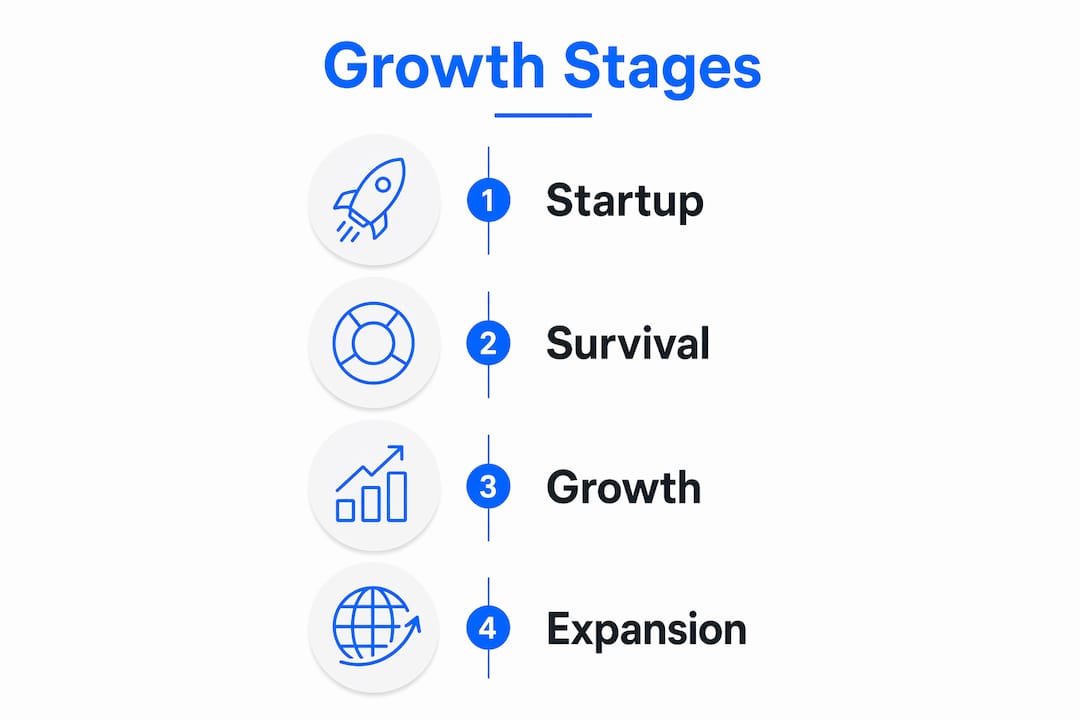
Business maturity follows four stages: Startup, Survival, Growth, and Expansion. Each stage has different revenue thresholds, priorities, and the right tools to match. Trying to run Expansion-stage tactics when you are still in Survival mode is one of the fastest ways to burn out.
The Startup stage covers revenue from $0 to $100,000. Your focus here is product-market fit. You are testing whether your offer actually solves a real problem for a specific group of people. Marketing at this stage should be low-cost and direct, think local SEO, referrals, and one-on-one conversations with potential clients.
The Survival stage sits between $100,000 and $500,000. This is where you shift from doing everything manually to building repeatable processes. Standard operating procedures (SOPs), a basic CRM system, and consistent follow-up workflows become your priorities. Many owners skip this stage and pay for it later with chaos.
The Growth stage spans $500,000 to $2,000,000. Here you are scaling infrastructure. Paid advertising through Google Ads or Meta, content marketing, and team development all become relevant. The Expansion stage begins above $2,000,000 and focuses on new markets, new products, and deeper operational investment.

Pro Tip: Before you add a new marketing channel or hire your first team member, ask yourself honestly: which stage are you actually in? Your answer should drive every decision you make this quarter.
| Stage | Revenue range | Primary focus | Key tools |
|---|---|---|---|
| Startup | $0 – $100k | Product-market fit | Local SEO, referrals, direct outreach |
| Survival | $100k – $500k | Process systemisation | SOPs, CRM, email automation |
| Growth | $500k – $2M | Scaling infrastructure | Paid ads, content marketing, team systems |
| Expansion | $2M+ | New markets and products | Advanced CRM, partnerships, new channels |
The most effective small business growth tactic is committing to 2–3 marketing channels where your ideal clients actually spend time. Spreading effort across six platforms at once produces weak results on all of them. Consistency over at least six months is required before you can fairly evaluate whether a channel is working.
Channel hopping is one of the most expensive mistakes a small business owner can make. Switching from Facebook Ads to TikTok to email to SEO every few months means you never build enough data or audience familiarity to see results. Pick your channels based on where your ideal customer is, not where you feel comfortable or where you saw someone else succeed.
For paid channels like Facebook Ads and Google Ads, narrow targeting and creative testing drive results. Running broad campaigns and measuring success by impressions is a waste of budget. Measure conversions, not clicks, and test at least two or three creative variations before drawing conclusions.
Here are the most common channel options and what suits each stage:
Pro Tip: Before you spend a dollar on paid advertising, make sure your website can actually convert the traffic you send to it. A great ad pointing to a weak page is money wasted.
Premature scaling causes operational stress and customer dissatisfaction. Many small businesses burn out by expanding their marketing before they have documented SOPs and consistent service delivery in place. More customers through the door is only good news if your business can actually handle them well.
The distinction between a tactic and a system matters here. A tactic is a single campaign or one-off effort. A system is a repeatable process that runs with or without your direct involvement. CRM-driven lead follow-up is a system. Sending a manual email to every new enquiry is a tactic. Systems scale. Tactics exhaust you.
“Systems outperform isolated tactics by providing scalable, reliable customer acquisition workflows.” — Nimble Blog
Automation is the practical tool that turns tactics into systems. Tasks that are well-suited to automation include:
Automation frees small business owners from repetitive tasks so they can focus on decisions that actually require their judgement. Tools like Mailchimp, ActiveCampaign, and HubSpot all offer automation features suited to small business budgets. Choosing the right email marketing provider makes this far easier to implement from day one.
Acquiring a new customer costs up to five times more than retaining an existing one. That single fact should shift how you allocate your time and budget. Retention is not a passive outcome of good service. It is an active strategy that requires deliberate effort.
Upselling and cross-selling are the fastest ways to grow revenue without finding new clients. A bookkeeper who offers a quarterly review add-on, or a personal trainer who sells a nutrition programme alongside sessions, is applying this principle directly. The client already trusts you. The sale is easier and the margin is better.
Referral programmes deserve more attention than most small businesses give them. A structured referral programme functions as a measurable acquisition channel, just like paid ads or SEO. The difference is that referred clients arrive with pre-built trust and convert at a higher rate. Set a clear incentive, communicate it to existing clients, and track results the same way you would any other channel.
Here are the most practical retention and revenue tactics, ranked by ease of implementation:
| Tactic | Best for | Effort required |
|---|---|---|
| Upselling and cross-selling | Service businesses with multiple offers | Low |
| Referral programme | Any stage, any industry | Low to medium |
| Segmented email campaigns | Growth and Expansion stages | Medium |
| Loyalty or membership model | Repeat-purchase businesses | Medium to high |
| Recurring retainer model | Service businesses | Medium |
A lightweight business plan that defines your ideal customer, value proposition, revenue targets, and operational capacity reduces chaos and supports confident decision-making. You do not need a 40-page document. You need clarity on five things, written down and reviewed regularly.
Growth without direction leads to reactive decisions. When you have a clear plan, you can evaluate every new opportunity against it. Does this new channel fit your stage? Does this new offer serve your ideal client? Does this hire support your revenue goal? Without a plan, every shiny object looks like a good idea.
Your growth plan should cover these core elements:
Review your plan every quarter. Markets shift, offers evolve, and what worked in the Survival stage may not serve you in the Growth stage. The plan is a living document, not a one-time exercise. Mybworkshops has a dedicated set of growth planning resources that walk you through this process step by step, tailored to where your business is right now.
Stagnant growth is rarely a marketing problem. It is usually a systems and strategy problem. Mybworkshops runs expert-led workshops designed specifically for service-based business owners who are tired of guessing and ready to build a marketing engine that works consistently.
Whether you are in the Survival stage trying to get your systems right, or in the Growth stage ready to scale your marketing, there is a workshop built for where you are. The Mybworkshops programme covers business strategy, marketing execution, paid advertising, and brand direction. Each session blends practical frameworks with real mentorship so you leave with a plan you can act on immediately. If you are not sure where to start, the free masterclass is the right first step.
Sustainable growth for small businesses requires matching your strategy to your current stage, committing to a small number of marketing channels, and building repeatable systems before you scale customer acquisition.
| Point | Details |
|---|---|
| Match strategy to stage | Startup, Survival, Growth, and Expansion each require different priorities and tools. |
| Commit to 2–3 channels | Consistency over six months beats spreading effort across many platforms. |
| Build systems before scaling | SOPs, CRM, and automation must be in place before you increase customer volume. |
| Retention drives profit | Retaining existing clients costs far less than acquiring new ones; upselling and referrals maximise revenue. |
| Plan with five clear elements | Define your ideal client, value proposition, revenue goal, channels, and operational capacity. |
Growth strategies for small businesses are planned approaches that combine marketing, operational systems, and customer retention to increase revenue sustainably. They differ from one-off tactics because they are repeatable and stage-appropriate.
Your current revenue range is the clearest indicator. Startup is $0–$100,000, Survival is $100,000–$500,000, Growth is $500,000–$2,000,000, and Expansion is above $2,000,000. Each stage requires a different strategic focus.
Scaling customer acquisition before your systems and delivery processes are documented leads to quality drops and owner burnout. Stability in operations and consistent client satisfaction must come before growth.
Commit to 2–3 channels where your ideal clients are present and stay consistent for at least six months before evaluating results. Channel hopping wastes resources and prevents you from building meaningful audience data.
Acquiring a new customer costs up to five times more than retaining an existing one. Upselling, cross-selling, referral programmes, and loyalty models all generate revenue from relationships you have already built.