

A service business offer is a formal proposal that defines what services you will deliver, at what cost, and under what terms. It is the primary tool you use to convert a prospect into a paying client. In Australian service businesses, a well-structured offer does more than describe your work. It sets expectations, reduces misunderstandings, and can become a legally binding contract the moment a client accepts it. Whether you run a bookkeeping practice, a design studio, or a coaching business, your offer is the foundation of every client relationship you build.
A service business offer is a structured document or communication that outlines the scope of your services, your pricing, your timeline, and the terms under which you will deliver the work. The industry term for this is a “commercial offer,” though you will also hear it called a proposal, a quote, or a statement of work depending on the context.
Service businesses sell intangible things: expertise, skills, and outcomes. Unlike a product, you cannot hand a client something physical to inspect before they buy. Your offer fills that gap. It gives the client something concrete to evaluate, and it gives you a clear record of what was agreed.
A strong offer also does something most business owners overlook. It frames your service around outcomes the client actually wants, not just the tasks you perform. A bookkeeper who offers “monthly reconciliation and BAS lodgement” is describing a task. A bookkeeper who offers “clean books and stress-free tax time, every quarter” is describing an outcome. The second version converts better because it speaks to what the client is trying to achieve.
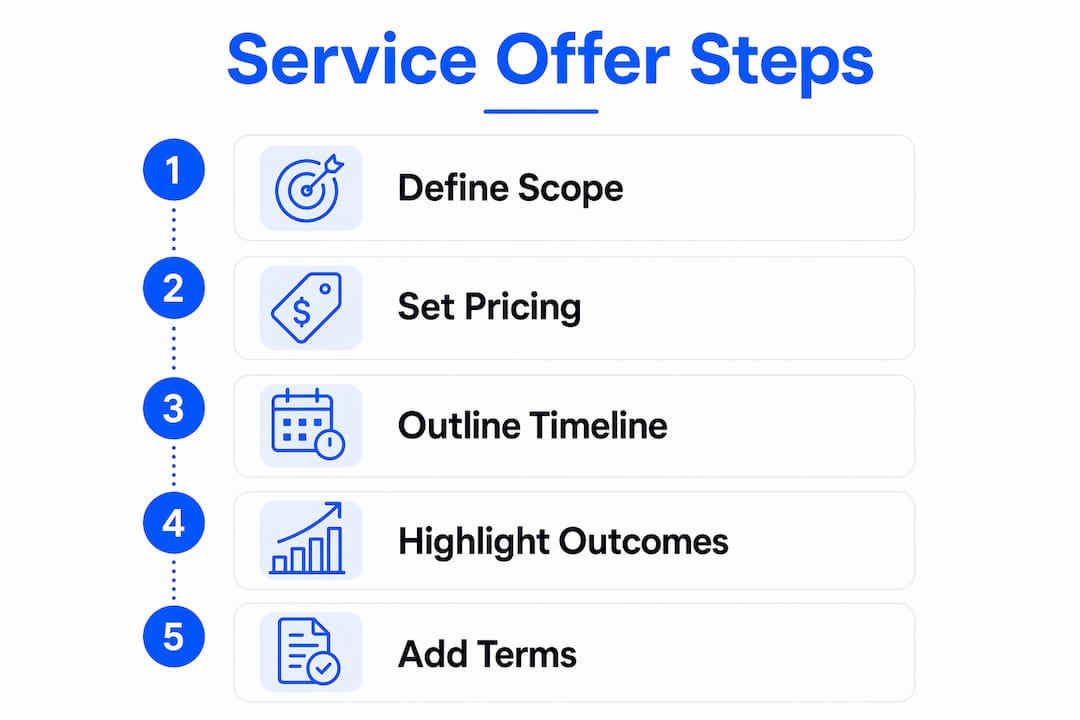
Every effective service offer contains the same core elements, regardless of industry or business size. Missing even one of these can create confusion, disputes, or lost revenue.
The trade-off between a detailed offer and a concise one depends on the size and complexity of the engagement. A $500 website audit needs a one-page summary. A $50,000 brand and website project needs a full proposal with milestones, payment schedules, and a formal acceptance clause.
Pro Tip: Write your offer headline as if the client is telling a friend what they bought. “I hired someone to sort out my cash flow” is a headline. “I engaged a bookkeeper for monthly reconciliation services” is not.

Service offers come in several forms, and choosing the right one depends on your client, your industry, and the complexity of the work.
| Offer type | Best used when | Key characteristic |
|---|---|---|
| Quote | Work is straightforward and price-driven | Fixed price, short scope, legally binding on acceptance |
| Proposal | Work is complex or relationship-based | Detailed scope, methodology, and value justification |
| Statement of work | Ongoing or project-based engagements | Milestone-driven, often attached to a master agreement |
| Packaged offer | Services are standardised across clients | Fixed deliverables, fixed price, easy to compare |
| Retainer agreement | Ongoing support or advisory services | Monthly fee, defined hours or outputs, rolling terms |
Australian service businesses in sectors like accounting, legal, consulting, and trades most commonly use quotes and proposals. Packaged offers work well for coaches, designers, and marketing professionals who deliver the same core service repeatedly.
The most important factor in choosing your offer type is the buyer’s situation. A client who has never used your type of service before needs a proposal that explains your process and builds confidence. A repeat client who knows exactly what they want needs a clean quote they can approve quickly. Matching the offer format to the buyer’s situation improves conversion and reduces the back-and-forth that delays decisions.
Fixed-price offers give clients certainty and are easier to approve. Hourly models suit unpredictable or exploratory work but require more trust. Retainers work best when the client needs consistent access to your expertise over time.
A compelling service offer starts with the client’s problem, not your credentials. Here is a practical framework for building one.
Pro Tip: If your offer page or document does not answer “why should I choose you over doing nothing?” you have not finished writing it yet.
Building landing pages that convert requires the same discipline as writing a strong offer. The principles are identical: clear outcome, specific CTA, and minimal friction.
A service offer carries real legal weight in Australia. Understanding this protects you from disputes and scope creep.
Australian Government procurement principles reinforce this thinking. Value for money in professional services is assessed on whole-of-life costs, risk management, and supplier experience, not just the lowest price. Framing your offer to address these factors positions you more competitively, particularly when bidding for government or corporate contracts.
Most service offers fail for predictable reasons. Recognising these patterns early saves you time and lost revenue.
Pro Tip: Before you send any offer, read it from the client’s perspective and ask: “Do I understand exactly what I am getting, what it costs, and what I need to do next?” If the answer is no, revise it.
An early marketing strategy that defines your offer clearly from the start shapes every other marketing decision you make, from your website copy to your lead generation approach.
Crafting a service offer that actually converts takes more than a template. It requires a clear understanding of your client, your positioning, and how your services fit into a broader business system.
Mybworkshops runs expert-led workshops designed specifically for service-based business owners who want to build stronger foundations, not just fix surface-level problems. The Business Strategy Workshop walks you through defining your services, structuring your offers, and building a client acquisition system that works consistently. If you are ready to move from guesswork to a clear, repeatable process, the full workshops programme covers everything from offer creation to lead generation and brand positioning. Real business owners. Real results. Practical tools you can use immediately.
A service business offer is a formal proposal that details the services you will deliver, the price, the timeline, and the terms of the engagement. It is the primary document used to convert a prospect into a paying client.
Yes. In Australia, a commercial offer becomes legally binding once a client accepts it, including acceptance by email or by commencing work. Always confirm acceptance in writing.
A quote is a fixed-price offer for straightforward work and is legally binding on acceptance. A proposal is a more detailed document used for complex or relationship-based engagements, typically including methodology, value justification, and scope.
Contact forms with 3–6 fields produce better lead capture results on service websites. Fewer fields reduce friction and make it easier for prospects to take the first step.
Every service offer should include the scope of services, pricing and payment terms, a timeline, an exclusions clause, and a clear expiry date. These elements protect you legally and give the client everything they need to make a decision.
A service business offer is the single most important document in your client acquisition process, and its quality directly determines your conversion rate.
| Point | Details |
|---|---|
| Define scope and exclusions | Always state what is and is not included to prevent scope creep and protect your time. |
| Lead with client outcomes | Frame your offer around the result the client wants, not the tasks you perform. |
| Offers are legally binding | In Australia, an accepted offer forms a contract, so clarity around price, scope, and expiry is non-negotiable. |
| Match offer type to buyer situation | Use quotes for simple work, proposals for complex engagements, and packaged offers for standardised services. |
| Use specific calls to action | Replace vague prompts with concrete next steps to reduce friction and improve response rates. |