

An elevator pitch is a 30 to 60 second, outcome-led introduction that tells someone who you help, how, and why it matters. Its job isn’t to close a sale. It’s to earn a second conversation. Get that one sentence right and every example below becomes a template you can adapt, not a script you have to memorise.
TL;DR:
- An effective elevator pitch should focus on outcomes, specifying the industry and measurable results to filter ideal clients efficiently.
- Writing multiple versions of the outcome statement before finalizing helps clarify the most compelling and specific message.
- Tailoring the pitch’s tone and invitation depending on the setting enhances engagement, whether networking, interviews, or sales calls.
- Practice delivery by slowing down, making eye contact, and pausing to ensure the pitch sounds natural and conversational.
- Building your pitch on clear brand messaging and proven results ensures consistency and authenticity across all communication channels.
Most pitches fail for the same reason: they describe a job title instead of an outcome. “I’m a graphic designer” tells a stranger nothing about why they’d care. “I help tradies win bigger jobs by making their quotes look as professional as their work” tells them exactly who you help and what changes for them.
The strongest pitch structure follows four beats: hook, outcome, who you help, invitation. You open with something that earns attention (a problem, a stat, or a plain statement of what you do), state the result you deliver, name the audience so the right person self-identifies, then close with a low-pressure question rather than a hard sell.
The “I help [who] achieve [outcome] without [pain]” template does the heavy lifting here. It forces specificity, and specificity is what filters ideal clients from tyre-kickers faster than any amount of feature talk. Compare these two openers:
The second version does three jobs the first can’t: it names an industry, states a measurable outcome (filled appointment books), and removes a common objection (daily posting fatigue) before it’s even raised. That’s the difference between a pitch that gets a polite nod and one that gets a business card.
An effective elevator pitch runs 30 to 60 seconds and lands around 50 to 200 words, long enough to be specific, short enough to respect the other person’s time.
Building a pitch from scratch is easier when you treat it as a five-step exercise rather than trying to write a polished paragraph in one go.
This mirrors the sample format career services teams recommend: introduce yourself, say what you do, then say what you’re looking for. It’s blunt, but it works because it respects how little time you actually have.
Pro Tip: Write three versions of step two, your outcome line, before you settle on one. The first version you write is almost always the vaguest one your brain reaches for.
Once you’ve got a draft, run it through this checklist:
These examples cover a range of roles and tones. Swap in your own audience, outcome and proof point, and you’ve got a working pitch inside five minutes.
Full 30-second examples:
Short one-liners for bios and quick intros:
Before → after rewrites:
| Before (vague) | After (outcome-led) |
|---|---|
| — | “I help local trades businesses get found on Google without spending a fortune on ads.” |
| “I’m a business coach.” | “I help overwhelmed solo operators build a business that doesn’t fall apart when they take a week off.” |
| “I make websites.” | “I build websites for service businesses that turn visitors into enquiries, not just page views.” |
Each rewrite adds the two things the original was missing: a named audience and a measurable, felt outcome. That single change is what separates a forgettable pitch from one people remember.
The same person needs a different pitch depending on where they’re standing. The outcome stays constant, but the opener, tone and CTA shift.
Save the full 60-second version, the one with a short story or case study, for interviews and one-on-one client meetings where you’ve already got someone’s full attention. At a networking event or in a two-line bio, the 15-second version is almost always the better call.
A well-written pitch still falls flat if it’s delivered like a script being read off a cue card. Slow down. Pause after your outcome line. Make eye contact on the invitation, that’s the part you actually want a reaction to.
Practise using these drills:
This kind of rehearsal, connecting your speech to natural breathing rather than a memorised script, is what makes a pitch sound like conversation instead of performance.
The pitch itself is only the opening move. Send a personalised follow-up message within 24 to 48 hours of meeting someone, referencing something specific they said. Then keep a light, value-first cadence going, sharing something useful every couple of months rather than only reaching out when you need something. Our sales follow-up templates are a good starting point if you’re not sure what that first message should say.
Pro Tip: Never end a pitch on a statement. End on a question. Statements invite a nod; questions invite an answer, and answers are where real conversations start.
A great elevator pitch doesn’t exist in isolation, it’s one output of a much bigger job: knowing exactly who you serve and what outcome you promise them. That’s the work we focus on inside the Mybworkshops three-phase program.
Instead of guessing at a script, participants work through:
If your pitch keeps changing depending on who asks, that’s usually a sign your brand foundations need work before your wording does. Our brand messaging workshop is built for exactly that gap, and you can see the full lineup on our workshops page.
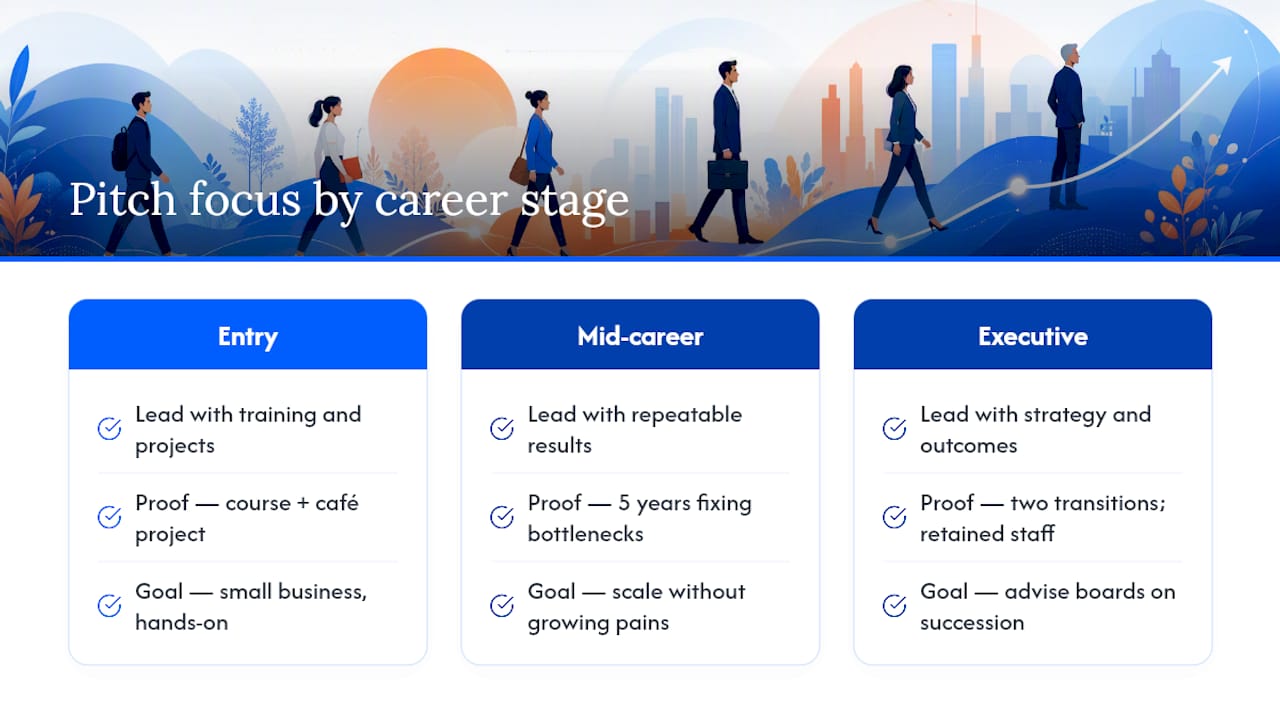
Your pitch should sound different depending on how much runway you’ve got behind you. What counts as proof at entry-level isn’t what counts as proof at executive level, and pretending otherwise makes either version sound off.
Entry-level: Lean on training, projects and enthusiasm rather than years of results. “I’ve just finished a digital marketing course and spent six months running social content for a local café, growing their following by real, engaged followers rather than just numbers. I’m looking to bring that hands-on experience to a small business that wants consistent content without hiring a full-time hire yet.”
Mid-career: Lead with a specific, repeatable result. “I’m an operations manager who’s spent the last five years fixing supply chain bottlenecks for mid-size retailers, most recently cutting delivery delays by improving how warehouse and freight teams communicate. I’m looking for a business ready to scale without the growing pains.”
Executive: Speak in terms of strategy and outcomes at the business level, not day-to-day tasks. “I’m a former general manager who’s taken two service businesses through ownership transitions without losing key staff or client relationships. I now advise boards on succession planning, and I’m looking for organisations navigating that same shift.”
Notice none of these lean on job titles as the hook. Each one leads with a result, then lets the title fill in the detail.
The timing, structure and follow-up advice in this article draw on a handful of reliable sources worth bookmarking.
A good example names a specific audience, states a clear outcome, and ends with an invitation, such as: “I help physio clinics fill their books without daily social posting. Is that something you’re dealing with?”
The strongest pitches, whether for a business, a job, or an idea, follow the same shape: hook, outcome, who it’s for, and a low-pressure next step, rather than a full explanation of every detail.
Definitions vary across sources, but a common version focuses on being clear (easy to follow), concise (30 to 60 seconds), and compelling (built around a real outcome rather than a job title).
Start with your name and a specific outcome you deliver, not your job title, then name who you help before moving into the how and your invitation to continue the conversation.