

A business plan is defined as a written document that outlines your business goals, the strategies you will use to reach them, your target market, and your financial forecasts. Knowing how to construct a business plan is one of the most practical skills you can develop as an entrepreneur. Strategic planning enhances long-term viability and management decision-making, which means a well-built plan does not just help you raise money. It helps you run a better business. A traditional comprehensive plan runs 15–20 pages and is the standard requirement for bank loans and investor funding.
A business plan is made up of several key sections, and each one serves a specific purpose. Skipping any of them weakens your case with investors and leaves gaps in your own thinking. The good news is that no single rigid format exists. Successful plans prioritise the sections most relevant to their business model.
The standard sections are:
Pro Tip: Your mission statement should fit in one sentence. If you cannot explain what your business does and who it serves in under 20 words, keep refining it.
| Section | Primary purpose |
|---|---|
| Executive summary | Gives investors a fast overview of the entire plan |
| Market analysis | Proves there is a real, sizeable demand for your offer |
| Financial plan | Demonstrates the business can generate profit and repay debt |
| Marketing strategy | Shows you know how to reach and convert your customers |
| Operational plan | Confirms you have the systems and team to deliver |
Preparation is what separates a credible plan from a wishful one. Before you write a single word, you need solid research and clear data to back up your claims.
| Plan type | Best for | Typical length |
|---|---|---|
| Lean startup plan | Concept testing, early validation | One page |
| Traditional plan | Bank loans, investor funding | 15–20 pages |
Pro Tip: Before you start writing, spend one hour mapping out your customer’s biggest problem and the specific way your business solves it. Every section of your plan flows from that single insight.

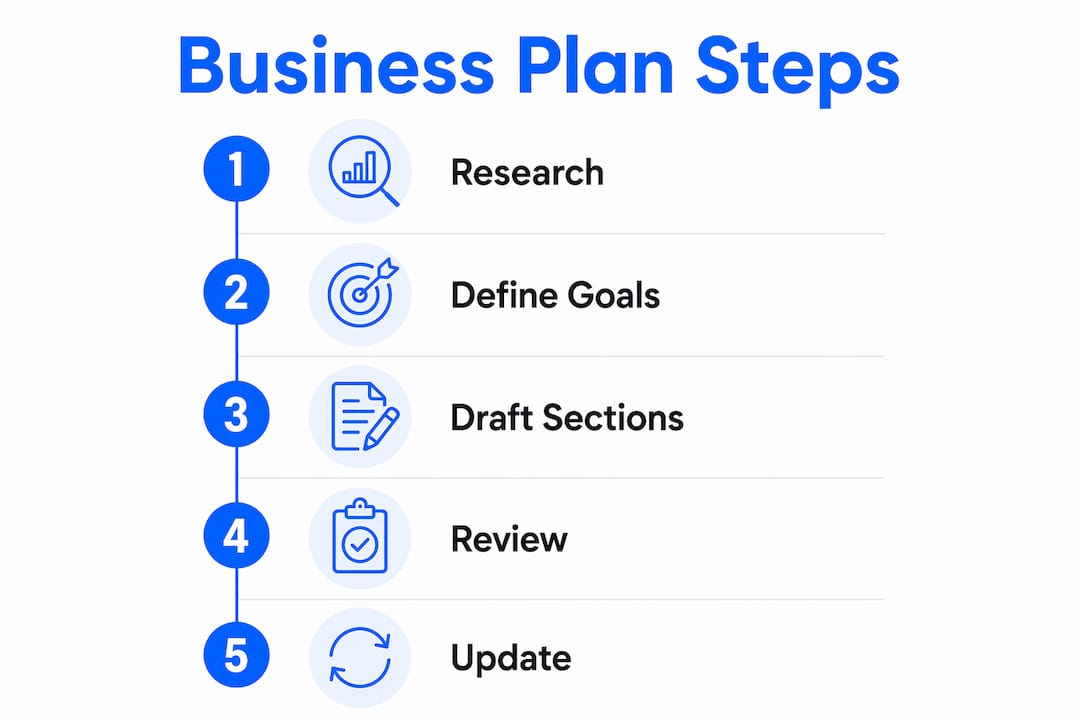
Writing a business plan works best when you follow a clear sequence. Start with the sections that require the most research, and write the executive summary last.
Start with market analysis. This is the foundation. Define your target customer in detail: their age, income, location, buying behaviour, and the specific problem they need solved. Use real data, not assumptions. A well-written plan identifies opportunities and challenges, which means your market research should surface both the opportunity and the risks.
Define your products and services. Write a clear description of what you offer. Explain the benefit to the customer, not just the feature. “We offer a 90-minute brand workshop” is a feature. “You leave with a clear brand message you can use across every channel” is a benefit.
Write your mission and vision statements. Your mission covers what you do today. Your vision covers where you are going. Both should be specific and free of corporate language. “We help small business owners build brands that attract the right clients” is clear. “We empower stakeholders through synergistic solutions” is not.
Build your marketing and sales strategy. Describe the channels you will use (social media, email, referrals, paid ads), your messaging, and your sales process. Be specific about how a lead moves from first contact to paying client. For service businesses, growth strategies that focus on positioning and referrals often outperform broad advertising campaigns.
Write your operational plan. Cover your team structure, key roles, suppliers, and the tools or systems you rely on. If you are a solo operator, be honest about that and explain how you will manage capacity as the business grows.
Build your financial projections. Create a 12-month revenue forecast, a monthly expense budget, and a cash flow statement. Investors look for logical, defendable projections rather than perfect formatting. Every number needs a clear assumption behind it. For example: “We project 10 clients per month at $500 each, based on our current waitlist of 30 people.”
Write the executive summary last. Investors often read only the executive summary initially, which means it carries enormous weight. Writing it last means it accurately reflects the full plan rather than a rough early guess.
Pro Tip: Read your plan aloud before you submit it. If a sentence sounds confusing when spoken, it will confuse a reader too. Plain language always wins.
The most common mistake is spending more time on design than on substance. A beautifully formatted plan with weak financial projections will not impress any lender or investor.
“A business plan that functions as both an internal roadmap and an external communication tool gives entrepreneurs a real advantage. It forces clarity on the business model and gives investors the confidence they need to say yes.”
Putting a business plan together is one thing. Knowing how to execute the strategies inside it is another.

Mybworkshops runs expert-led workshops designed specifically for service-based business owners who want to build businesses that grow sustainably. The programmes cover brand foundations, marketing strategy, lead generation, and the practical skills you need to turn your plan into results. Whether you are writing your first plan or refining an existing one, the Mybworkshops programme catalogue gives you structured, mentor-supported learning at every stage. You can also access a free masterclass to get a feel for the approach before committing to a full workshop.
A business plan is a written document that outlines your business goals, strategies, market analysis, and financial forecasts. It serves as both an internal guide and an external tool for securing funding from banks and investors.
A traditional business plan used for bank or investor funding is typically 15–20 pages. A lean startup plan designed for early concept testing can fit on a single page.
The executive summary covers your business name, what you do, your market opportunity, and your funding request. Write it last so it accurately reflects the completed plan.
Update your business plan at least quarterly. Markets change, costs shift, and your assumptions will need revising as you gather real data from running the business.
Yes. A business plan clarifies your direction, identifies risks, and gives you a framework for making decisions. Even a one-page lean plan is more useful than no plan at all.
A business plan is the single most effective tool for proving your business is viable, both to yourself and to the people whose support you need.
| Point | Details |
|---|---|
| Write the executive summary last | It should reflect the completed plan accurately, not your early assumptions. |
| Match the plan format to your purpose | Use a lean one-page plan for concept testing and a 15–20 page plan for funding. |
| Base financial projections on real assumptions | Every number needs a clear, logical reason behind it to satisfy lenders. |
| Update the plan at least quarterly | Markets and costs change, and your plan must keep pace with reality. |
| Write for a reader who knows nothing | Define every term, explain every assumption, and avoid industry jargon. |