

Branding for new businesses is the strategic process of creating distinctive assets and experiences that make your company recognisable, trusted, and preferred in its market category. It is not a logo exercise or a post-launch task. The role of branding for new businesses shapes every customer perception from the first point of contact, and brand recognition typically requires 18–36 months of consistent effort to build. Founders who treat branding as a day-one priority reduce long-term marketing costs, attract better-fit clients, and avoid expensive repositioning later.
Branding is the sum of perceptions, feelings, and expectations your customers hold about your business. It includes your name, visual identity, tone of voice, and the experience you deliver at every touchpoint. A logo is one small piece of that system, not the whole thing.
Founders commonly make two costly mistakes. The first is treating branding as something to sort out after launch. The second is confusing branding with a logo, missing the broader strategic system involving name, voice, colour, and design. Both mistakes lead to rebranding costs within the first two years.
Branding at the startup stage precedes and informs every marketing and design decision you make. Your brand positioning tells you which customers to target, what to say to them, and how to say it. Without that foundation, your website copy, social media posts, and ad campaigns all pull in different directions.
Pro Tip: Write a one-paragraph brand brief before you design anything. Define who you serve, what problem you solve, and what makes you different. Every visual and written asset should reflect that brief.
Trust is the primary driver of purchasing decisions, and branding is the primary driver of trust. 80% of consumers trust brands they use more than they trust media, government, or NGOs. That level of trust directly influences 68% of customers to pay more for products from brands they believe in.
“A strong brand functions as the mental shortcut customers use when the business is not present, reducing effort needed for sales and building pricing power.”
This mental shortcut concept, known as mental availability, is now central to how branding works. When a customer needs a solution in your category, your brand either comes to mind or it does not. Brands grow by being easy to buy, not necessarily easy to love. Emotional storytelling has its place, but distinctiveness and recall drive actual purchasing behaviour.
A strong brand reduces persuasion burden. You spend less time explaining yourself, offering discounts, or competing on price. Customers who already recognise and trust your brand convert faster and stay longer. That is the compounding benefit of building brand identity early.
Consistent brand experience also creates psychological switching costs. When customers know exactly what to expect from you, and that experience is positive, the effort of switching to an unknown alternative feels too high. Small businesses achieve this through consistency and quality of every interaction rather than heavy media spend.
Effective branding for startups rests on three pillars: distinctive assets, clear positioning, and market alignment. Each one supports the others, and neglecting any one of them creates gaps that competitors can exploit.
Distinctive assets are the visual and verbal elements that make your brand instantly recognisable. They include your logo, colour palette, typography, tagline, and overall visual style. At the MVP stage, a lean visual identity with a custom wordmark and a limited colour palette is cost-effective and scalable, avoiding confusion and costly redesigns later.

The goal is not beauty. The goal is recognition. Your assets need to be different enough from competitors in your category that customers can identify you without reading your name.
Positioning defines who you serve, what problem you solve, and why your solution is better or different. A clear positioning statement answers all three questions in two or three sentences. Without it, your marketing messages become generic and forgettable.
Strategically linking brand positioning with specific category-entry points ensures your marketing reaches the right audience at the right buying moment. A category-entry point is the situation or trigger that causes a customer to start looking for a solution. If your brand is not associated with those triggers, you are invisible at the most important moment.
Your brand foundation needs to support your digital presence from day one. 68% of online experiences start with a search engine. That means your brand name, domain, and content strategy must work together to build early digital authority.
Pro Tip: Reserve your domain name and matching social media handles before you finalise your brand name. Inconsistent handles across platforms fragment your brand presence and confuse potential customers.
| Branding component | What it does for your business |
|---|---|
| Distinctive visual assets | Creates instant recognition without relying on your name alone |
| Positioning statement | Focuses all marketing messages on a single clear value |
| Category-entry points | Connects your brand to the moments customers are ready to buy |
| SEO-aligned brand name | Builds digital discoverability from the first day you go live |
| Consistent tone of voice | Builds familiarity and trust across every customer interaction |
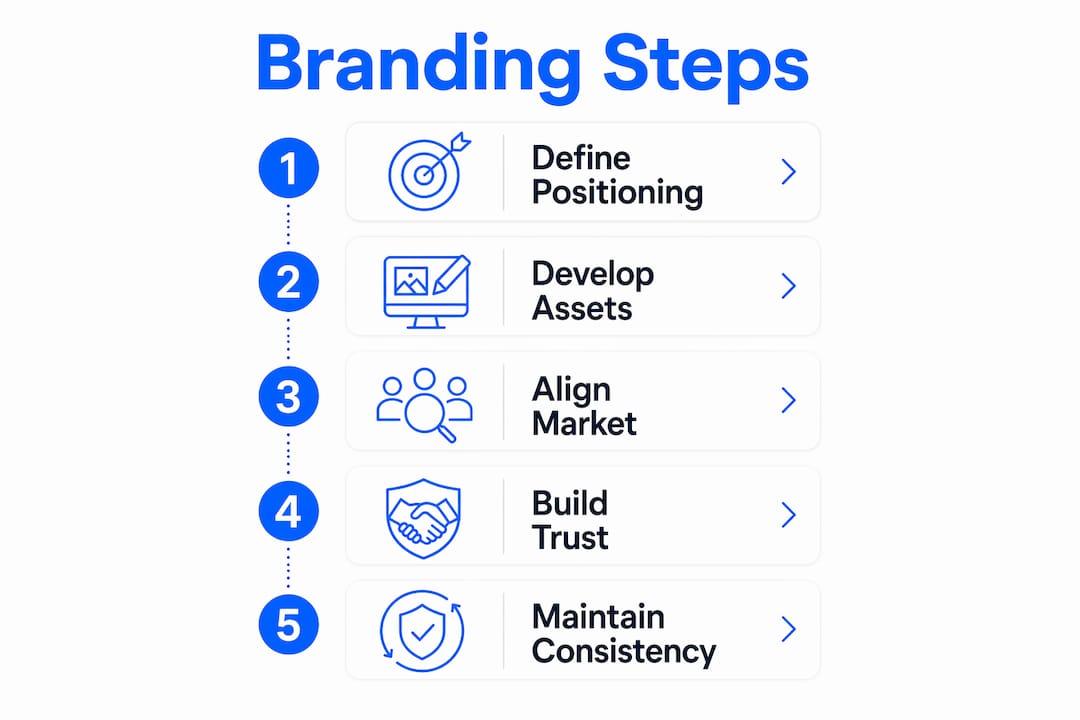
Building a strong brand does not require a large budget. It requires a clear plan and disciplined execution. The following steps give you a practical framework to follow before and after launch.
A few additional points worth building into your process from the beginning:
Most branding mistakes come from treating branding as a cosmetic exercise rather than a strategic one. Knowing what to avoid saves you time, money, and the disruption of a rebrand.
Pro Tip: If you are unsure whether a branding decision is strategic or cosmetic, ask yourself: “Does this change what customers think, feel, or expect about my business?” If the answer is no, it is cosmetic.
Startups typically allocate 10–15% of seed or Series A funding to branding and identity systems. That investment reduces long-term acquisition costs by building recognition that compounds over time. Founders who skip this investment often spend more on marketing later to compensate for a weak brand foundation.
Building a brand from scratch is one of the most important things you will do as a founder. Mybworkshops runs structured, expert-led sessions designed specifically for service-based business owners who want to get their brand foundations right from the start.
The brand-building workshops walk you through positioning, visual identity, and consistent messaging in a practical, step-by-step format. You also get access to brand building freebies and a free masterclass to help you move forward with confidence. If you are ready to build a brand that attracts the right clients and supports sustainable growth, Mybworkshops gives you the framework to do it properly.
Branding establishes how customers perceive, recognise, and trust a new business from the first interaction. It shapes purchasing decisions, supports premium pricing, and reduces the cost of acquiring new clients over time.
Brand recognition typically requires 18–36 months of consistent effort. Consistency across all customer touchpoints, not media spend, is the primary driver of recognition for small businesses.
A startup brand identity should include a positioning statement, a logo or wordmark, a colour palette, a primary typeface, and a defined tone of voice. These elements should be documented in a simple brand guide and applied consistently.
A strong brand reduces the persuasion required to close a sale. Customers who recognise and trust a brand convert faster, require fewer discounts, and are more likely to return and refer others.
Branding should begin before launch, ideally before any marketing or design work starts. Foundational brand strategy, including positioning and distinctive assets, takes 4–8 weeks when prioritised early by founders.