

Your website conversion rate is the percentage of visitors who complete a desired action on your site, calculated as (Conversions ÷ Visitors) × 100. That single number tells you more about your website’s performance than traffic figures ever will. Australian service-based businesses typically target a 2%–3% conversion rate, with top performers reaching 4%–6%. If you are sending traffic to a site that does not convert, you are paying for visitors who leave without becoming clients. Understanding your conversion rate is the first step toward fixing that.
Website conversion rate measures the percentage of visitors who complete a desired action, such as submitting a form, making a booking, or completing a purchase. The formula is straightforward: divide total conversions by total visitors, then multiply by 100. A site that receives 1,000 visitors and generates 30 enquiries has a 3% conversion rate.
The term “conversion rate” is the recognised industry standard. You will also hear “website conversion optimisation” or CRO (conversion rate optimisation) used to describe the process of improving that number over time.
Not all conversions are equal. Macro-conversions are your primary goals: a sale, a booked consultation, or a completed contact form. Micro-conversions are smaller steps that signal intent: a visitor downloading a resource, watching a video, or clicking your phone number. Tracking both gives you a fuller picture of how visitors move through your site.

Measurement errors are more common than most business owners realise. The three most frequent problems are:
Pro Tip: Set up Google Analytics 4 conversion events for each macro-conversion on your site before you analyse any data. Without clean tracking, every decision you make is based on guesswork.
Benchmarks give you a reference point, not a target to chase blindly. Context matters more than the raw number.
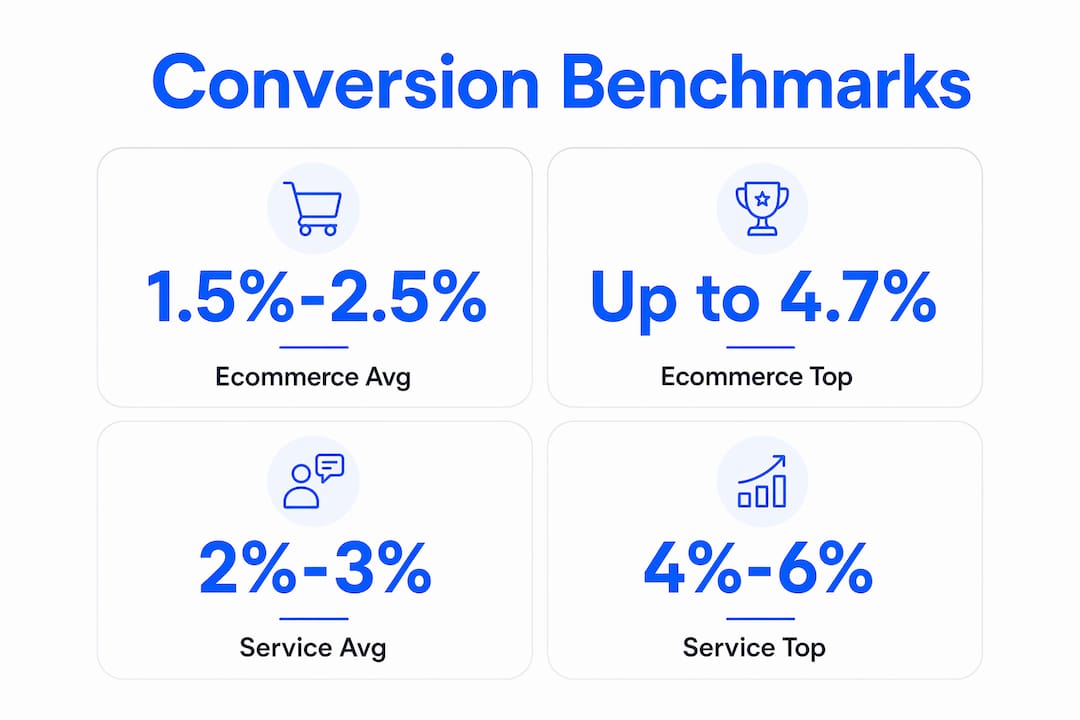
Australian ecommerce businesses average 1.5%–2.5% conversion rates, with high-performing categories reaching up to 4.7%. Service-based businesses typically sit between 2%–3%, while lead generation pages can reach 2%–8% depending on offer clarity and audience fit.
| Business type | Average rate | Top performers |
|---|---|---|
| Ecommerce | 1.5%–2.5% | Up to 4.7% |
| Service-based | 2%–3% | 4%–6% |
| Lead generation pages | 2%–5% | Up to 8% |
Traffic source also shifts these numbers significantly. Referral traffic converts at 3.47%, organic social at 2.8%, and paid search at 1.86%, while email marketing sits around 0.23% in Australia and New Zealand. Referral traffic converts well because it arrives with a recommendation already attached. Email’s low rate reflects the fact that many email clicks go to content pages rather than conversion pages.
The device split is equally telling. Mobile traffic converts 70%–80% lower than desktop in Australia. That gap is not a minor detail. If most of your traffic arrives on mobile and your site is not built for it, you are losing the majority of your potential leads before they even read your offer.
Key factors that shift where you sit within these ranges:
Most conversion problems emerge from content and page structure before the visitor ever reaches the conversion point. Fixing the form is rarely enough if the page around it does not build confidence first.
A visitor who cannot find what they need within seconds will leave. Clear navigation, a strong headline above the fold, and an obvious next step are the foundations of a converting page. The Mybworkshops framework treats website navigation and structure as core to conversion, not an afterthought.
Page speed matters too. A slow-loading page loses visitors before they read a single word. This is especially true on mobile, where patience is shorter and connections are less reliable.
Australian visitors respond strongly to local trust signals: testimonials from Australian clients, industry credentials recognised in Australia, and clear contact details including a local phone number and physical address. Generic five-star reviews from unnamed sources do not carry the same weight. Specific, named testimonials from real clients in recognisable industries build far more confidence.
Building Australian-specific trust is often overlooked, yet it is one of the highest-return changes a service business can make to its site.
Placing simplified lead capture forms near your key benefits and proof points, rather than burying them at the bottom of long pages, significantly increases completions. Every additional field in a form reduces the likelihood of submission. Ask only for what you genuinely need at that stage of the relationship.
Offer relevance is equally critical. If your page headline promises one thing and your form asks for something unrelated, visitors feel misled and leave. Alignment between your traffic source, your page message, and your conversion ask is what separates a 1% rate from a 4% rate.
Pro Tip: Before redesigning your page, read your own site as a first-time visitor. Ask: “Do I know within five seconds what this business does, who it helps, and what I should do next?” If the answer is no, start there.
CRO is an iterative process that uses qualitative data like heatmaps and session recordings to incrementally improve page clarity, trust signals, and form length. It is not a one-time fix. Businesses that treat it as a project rather than a practice see short-term gains that fade.
The practical list of improvements worth prioritising:
Your overall sitewide conversion rate is the least useful number on your dashboard. It averages together very different visitor types, pages, and intentions. Segmenting that data is where the real insights live.
“Focusing on your overall conversion rate is like judging a restaurant by its average meal. The number hides whether the problem is the entrée, the dessert, or the wait time. Segment first, then act.”
Low traffic pages with under 1,000 monthly visitors struggle with traditional A/B testing because reaching statistical significance takes too long. For these pages, qualitative research methods carry more weight. Session recordings show you exactly where visitors hesitate or drop off. Heatmaps reveal which content gets read and which gets ignored. These tools give you direction without needing thousands of data points.
Successful CRO uses both quantitative and qualitative data to identify true visitor behaviours and barriers. The businesses that improve fastest are those that combine their analytics data with direct observation of how real visitors use their site. You can find common website conversion killers by auditing your pages against these segmented benchmarks.
Understanding your conversion rate is one thing. Knowing what to do about it is another.

Mybworkshops offers expert-led workshops built specifically for service-based business owners who want a website that works as a genuine lead generation tool. The website strategy and conversion workshops cover everything from page structure and trust signals to lead generation systems and traffic that converts. You will leave with a clear plan, not just theory. Improving conversion from 1% to 3% triples your leads without spending another dollar on ads. That is exactly the kind of result the Mybworkshops programme is built to help you achieve. Browse the full workshop catalogue and find the right starting point for your business.
Your website conversion rate is the single most important performance metric for any business that relies on its site to generate leads or sales.
| Point | Details |
|---|---|
| Core formula | Divide total conversions by total visitors, then multiply by 100 to get your rate. |
| Australian benchmarks | Service businesses target 2%–3%; ecommerce averages 1.5%–2.5% in 2026. |
| Traffic source matters | Referral traffic converts at 3.47% versus paid search at 1.86% in Australia. |
| Segment before acting | Split data by device, source, and page type to find the real problem. |
| Trust drives conversions | Local testimonials, credentials, and clear contact details lift rates more than design changes. |
A good conversion rate for Australian service-based businesses is 2%–3%, with top performers reaching 4%–6%. Ecommerce sites average 1.5%–2.5%, with some categories reaching up to 4.7%.
Divide the number of completed conversions by your total visitors, then multiply by 100. Set up conversion tracking in Google Analytics 4 to capture this data accurately across different traffic sources and devices.
High traffic with low conversions usually signals a mismatch between what visitors expect and what your page delivers. Common causes include unclear headlines, weak trust signals, slow page speed, and forms that ask for too much too soon.
Mobile traffic converts 70%–80% lower than desktop in Australia. If you have not audited your site’s mobile experience recently, that gap is likely costing you a significant number of leads every month.
Website conversion optimisation, or CRO, is the ongoing process of improving your site to increase the percentage of visitors who take a desired action. It uses qualitative tools like heatmaps and session recordings alongside analytics data to make evidence-based improvements.