

A brand positioning statement is a single sentence that tells your team who you serve, the category in which you compete, how you are different, and why customers should believe you, guiding every stage of your full-funnel marketing strategy like those offered by Evolve Commerce. It follows a simple formula built from five elements and works as an internal reference for marketing and strategic decisions, not a public slogan. Get this one sentence right and every brochure, webpage and sales conversation becomes easier to write.
TL;DR:
- The target should be specific and outcome-focused, identifying who needs the result and why, rather than relying on demographics alone.
- The category must be the frame of reference customers already compare when evaluating options, even if it is broader than desired.
- Differentiation should focus on one or two genuinely important benefits backed by measurable proof to ensure credibility.
- A positioning statement should be tested with a small group and refined based on feedback from both internal stakeholders and customers.
- Most large firms lack a clear, actionable positioning statement, making it essential to narrow and support claims rather than broadening vague promises.
Brand positioning is the organising principle behind your messaging and strategic choices, according to the American Marketing Association, which describes it as the process of defining where your business sits relative to competitors so that communication and long-term decisions stay consistent.
A widely used formula, outlined in this positioning statement reading from the OER Collective, runs like this: “To [target audience], [Brand] is the only [category] that [differentiation] because [reasons to believe].”
Each slot has a job to do:
Write a rough answer for each slot before you worry about making the sentence sound polished. The polish comes later.
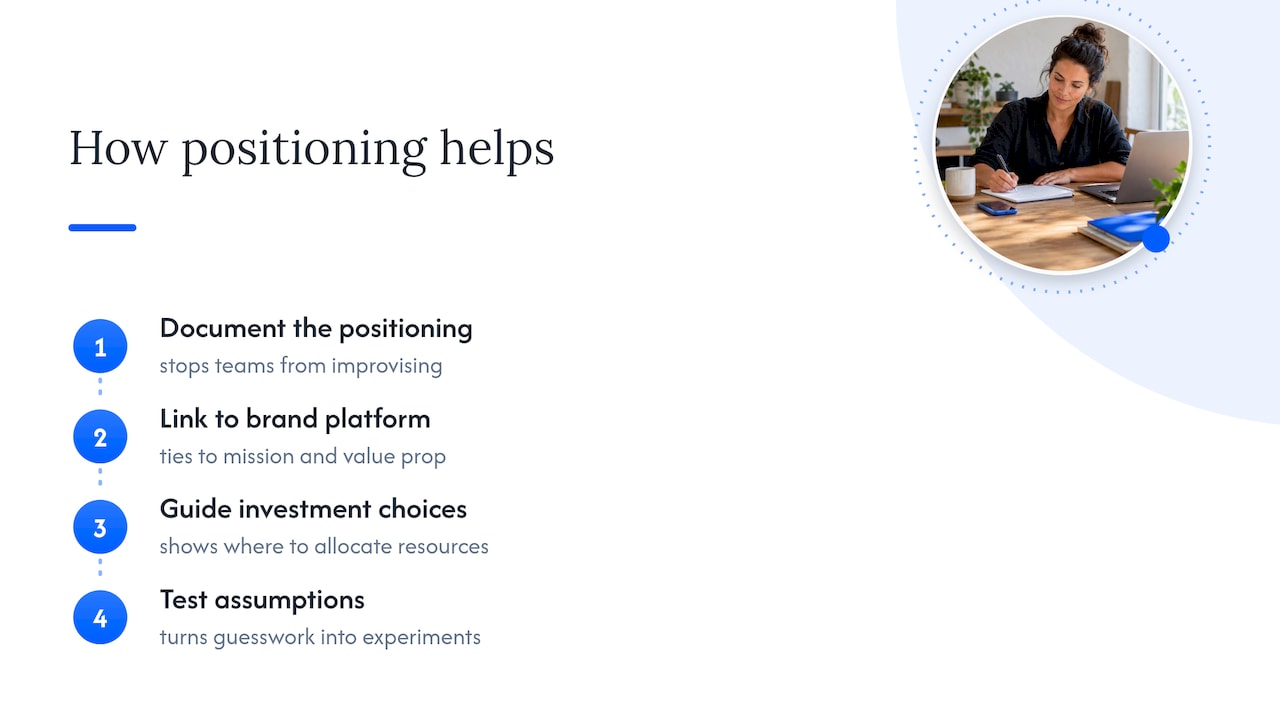
Without a documented positioning statement, teams improvise. One person writes copy that leads with price, another leads with speed, and the brand ends up saying something different everywhere it appears.
A clear statement connects to your broader brand platform, including your mission and value proposition, and it helps you decide where to invest. UNSW BusinessThink notes that many organisations lack a formal, actionable value proposition at all, which leaves positioning as guesswork dressed up as strategy. A written statement forces the guesswork out into the open, where you can test it.
You do not need weeks of workshops to produce a workable draft. Set aside a focused hour, work through these steps in order, and you will leave with something you can test.
Working through these five steps mirrors the testing approach UNSW BusinessThink recommends: co-creating and checking benefit claims with real customers rather than guessing what will land, and aiming for a resonating focus on the few things that matter most rather than a long list of minor differences.
Pro Tip: Write five rough drafts before you judge any of them. The first version almost always sounds like a mission statement, not a positioning statement, and you need the volume to find the sharper one.
Seeing the formula in a finished sentence makes the abstract parts click.
Now the two that fail: “We are a leading provider of innovative solutions for businesses” names no target, no category and nothing believable. “Our app helps you manage your business better” is vague enough to describe almost any software on the market. Both need a named audience, a specific category and a benefit someone could actually check.
Run any existing statement against the checklist the OER Collective reading sets out: it should be tailored to a specific target, simple enough to repeat from memory, distinctive against the category you named, deliverable without stretching the truth, and genuinely useful for marketing decisions.
Three quick ways to test it:
Fewer than 10% of large firms have a useful, actionable written value proposition, according to UNSW BusinessThink, which means most positioning work happens informally or not at all. If your statement fails the checklist, narrow it first rather than broadening it. A narrower, provable claim beats a broad one you cannot back up. Set a review date, usually every 12 months or after a major service change, and give one person ownership of keeping the statement current.
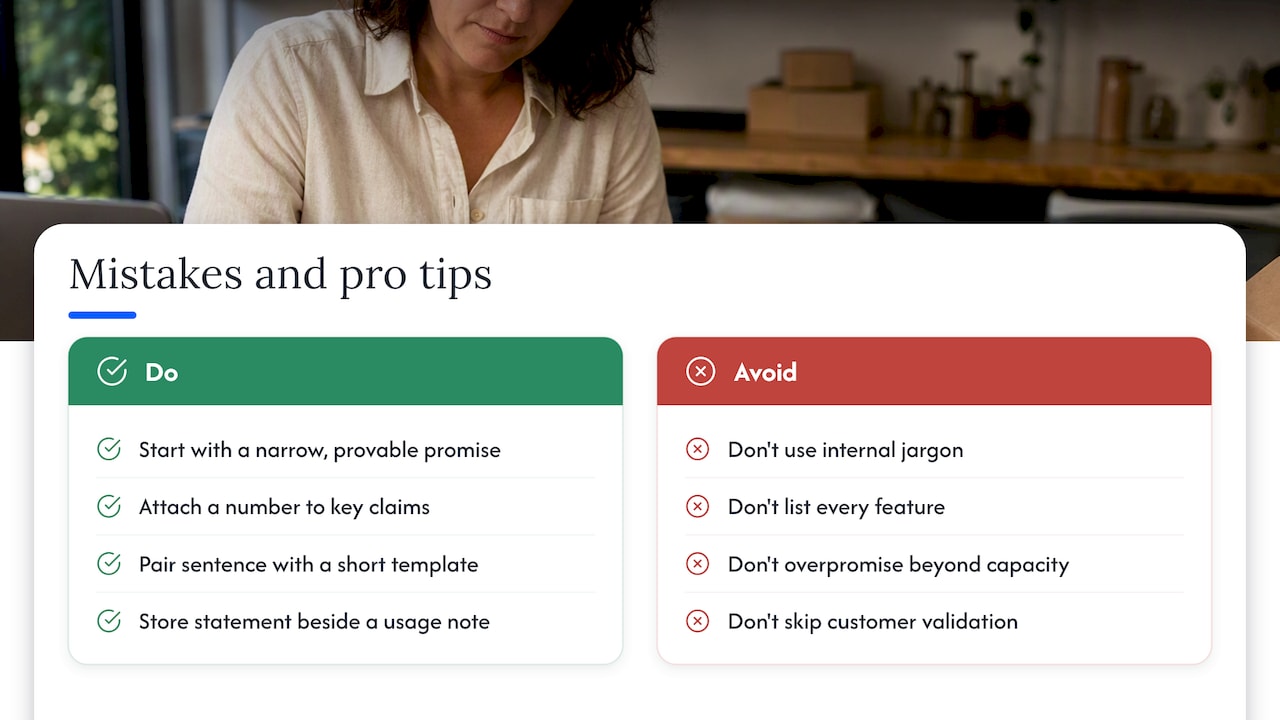
The most frequent mistakes are predictable: writing in internal jargon customers never use, listing every feature instead of the one or two that matter, promising something the business cannot consistently deliver, and skipping the step of checking the claim against what customers actually value.
A few things that genuinely help: start with a narrow, provable promise and only broaden it once you can support the wider claim, attach a number wherever you can rather than relying on adjectives, and pair your one-sentence positioning with a short brand messaging template explaining who uses the statement and where, so it does not get forgotten in a slide deck.
Pro Tip: Store the finished statement next to a one-paragraph usage note in your brand playbook. The sentence alone gets misquoted; the note keeps everyone using it the same way.
If you would rather work through this with guidance than draft it alone, our Clarify Your Messages & Attract the Right Clients Workshop and our #3 Build a Stand-Out Brand Identity & Guidelines Workshop are built around exactly this kind of session.
We walk you through the same five steps covered above, but with direct feedback on your draft rather than guesswork. In a typical session you can expect:
If you are weighing up whether a guided workshop is the right format for you, our overview of what a marketing workshop involves explains what to expect before you commit. When you are ready, our #1 Business Strategy Workshop is the place to start building the broader strategy your positioning statement sits inside.
A positioning statement example follows the formula: target, brand name, category, differentiation and reasons to believe, combined into one sentence such as “To growing accounting firms struggling with manual reporting, LedgerFlow is the only reporting platform that cuts month-end close from five days to one because it syncs directly with the three most common accounting systems.” The strength comes from naming a specific target and a provable claim rather than general language.
Coca-Cola does not publish a single official positioning statement in the five-element format covered here. Rather than guessing at a specific wording, it is more useful to apply the formula to your own business using a named target, category and provable differentiation.
Nike has not published an official positioning statement in the standard five-element format used in marketing frameworks. Large global brands often work from broader brand platforms rather than the kind of single-sentence, testable statement this article walks through for individual businesses.
Apple has not published an official positioning statement in the formal five-element format. As with other large global brands, their public messaging reflects a broader brand platform rather than the specific, testable sentence structure recommended for small and service-based businesses.
A positioning statement is the internal sentence describing target, category, differentiation and proof, while a value proposition focuses on the specific value a customer calculates from using your offer in practice. The two work together: your value proposition informs the differentiation and reasons to believe inside your positioning statement, as outlined by UNSW BusinessThink.