

Brand differentiation is the reason customers choose you instead of someone cheaper. Get it right and you protect your margins, attract clients who value what you do, and build loyalty that compounds over time. Get it wrong and every sale becomes a price negotiation.
The commercial payoff is direct: clear differentiation lifts conversion rates, reduces customer acquisition cost (CAC), and gives you the confidence to hold your price. Two things drive it:
Pro Tip: Before you write a single word of copy, ask yourself: “Could my three closest competitors say exactly the same thing?” If yes, you don’t have a differentiator yet — you have a category description.
Brand differentiation is the single most direct lever for protecting your margin, attracting better clients, and reducing the cost of every sale you make.
| Point | Details |
|---|---|
| Differentiation protects margin | Clear positioning shifts buyer decisions away from price, letting you hold your rate. |
| Four elements drive it | State who you serve, the problem you solve, where you operate, and why you’re the expert. |
| Measure it with six KPIs | Track conversion rate, CAC, AOV, retention, NPS, and brand awareness monthly. |
| Results take 90 days minimum | Early signals appear in 4 weeks; full impact on retention and referrals takes at least six months. |
| Mybworkshops accelerates the process | The What Makes You Different workshop delivers a validated CVP and messaging templates in one session. |
Brand differentiation is the clear, credible reason a specific audience chooses you over realistic alternatives. It is not your logo, your colour palette, or your tagline. Those are branding elements. Differentiation is the commercial substance underneath them.
The Queensland Government’s small business guidance draws a useful line here: branding is what your business is, and marketing is what you do. Differentiation sits at the intersection — it is the specific claim that makes your brand worth choosing and your marketing worth believing.
Here is how the three concepts differ in practice:
A practical example: a Sydney bookkeeper might have a clean logo and run Google Ads (branding + marketing), but their differentiator is that they specialise exclusively in e-commerce businesses and turn around monthly reports in 48 hours. That specificity is what attracts the right clients and justifies a higher fee. Read more about what defines your brand before you start building your messaging.
Differentiation lets you compete without lowering prices by shifting the buyer’s decision away from cost and onto value. That shift has a direct impact on margin.
The commercial benefits stack up quickly:
Reduced price pressure — when customers understand exactly why you’re different, price becomes one factor among several rather than the deciding one.
Higher conversion rates — clear positioning makes your business easier to understand and easier to sell, which shortens the sales cycle.
Stronger retention — clients who chose you for a specific reason tend to stay longer and refer more often.
Lower CAC — targeted messaging attracts better-fit leads, so you spend less convincing the wrong people.
Price premium — a well-positioned service business can charge more because the value is obvious, not assumed.
SmartCompany notes that in an era of AI-generated content, successful brands doubled down on distinct human perspective, voice, and real-world expertise. Brand became a measurable commercial moat, with boards tracking brand lift and willingness to pay alongside traditional marketing ROI metrics.
For service businesses specifically, Shopify Australia’s service branding guide frames branding as a trust-building system. Because services are intangible, reputation and clear signalling do the heavy lifting that a physical product cannot. A well-differentiated service brand compensates for that intangibility with consistent proof points — case studies, process clarity, and specialist credentials.
The good news: you do not need a large budget to differentiate effectively. Westpac’s small business advice highlights niche focus, better customer service, and community involvement as practical, low-cost starting points that any service business can act on today.
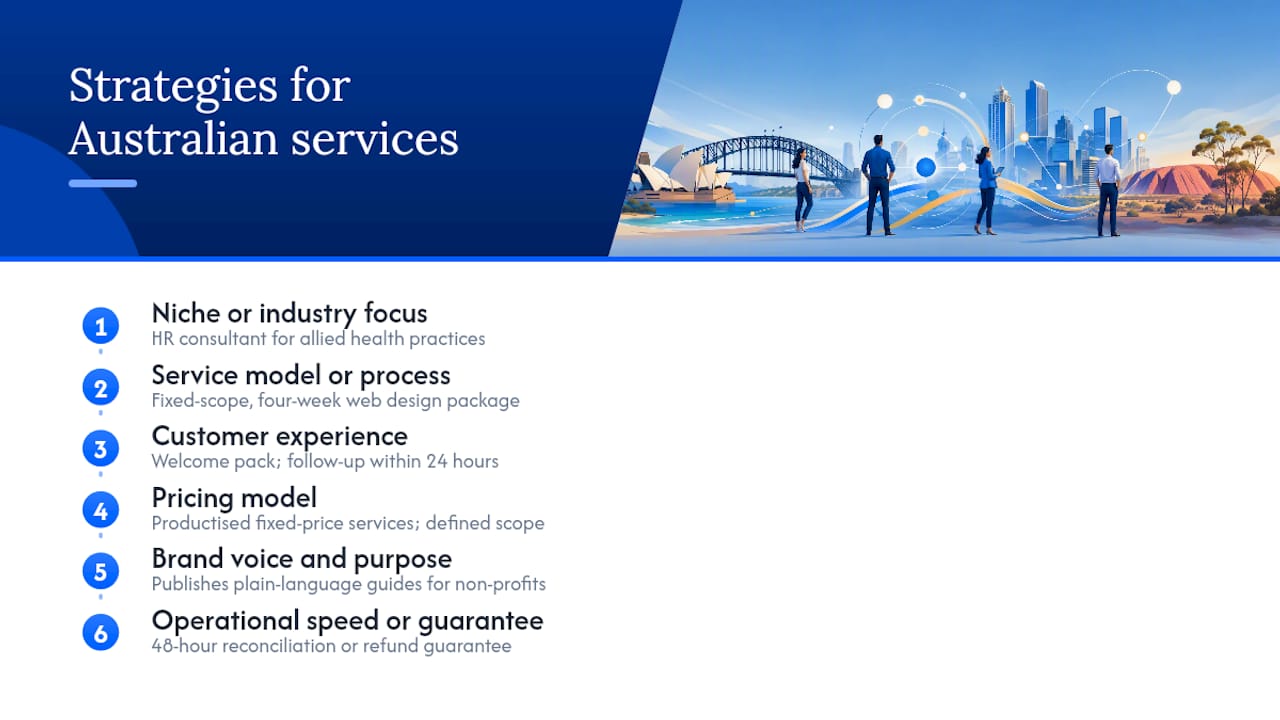
Here are the main strategy types, with service-led examples:
1. Niche or industry focus
A Melbourne HR consultant who works exclusively with allied health practices can speak their language, understand their compliance requirements, and charge accordingly. Narrowing your audience feels counterintuitive but almost always increases conversion.
2. Service model or process
A web designer who offers a fixed-scope, four-week delivery package removes the uncertainty clients dread. The process itself becomes the differentiator — not just the output.
3. Customer experience
A Brisbane financial planner who sends a welcome pack before the first meeting, follows up within 24 hours, and provides a written summary after every call stands out in a sector where communication is notoriously poor.
4. Pricing model
Productised services (fixed price, defined scope, predictable outcome) attract clients who have been burned by open-ended hourly billing. The pricing model signals professionalism and reduces friction.
5. Brand voice and purpose
A Perth copywriter who publishes plain-language guides for non-profit organisations builds a reputation and a community simultaneously. Voice and purpose attract clients who share the same values.
6. Operational speed or guarantee
A bookkeeper who guarantees reconciliation within 48 hours or refunds the month’s fee turns a process into a promise. Operational commitments are among the most defensible differentiators because they are hard to copy without changing how the business runs.
Pro Tip: The strongest differentiation usually combines two strategies — for example, niche focus plus a defined process. One strategy is easy to copy; two working together are much harder to replicate.
Inside Small Business recommends being explicit about four core elements: who you serve, the exact commercial problem you solve, where you operate, and why you are the expert. Businesses that state these clearly attract ideal clients and avoid competing on price.
Here is how to turn those four elements into a working customer value proposition (CVP):
Research your best clients. Pull your last 12 months of work and identify which clients were most profitable, easiest to work with, and most likely to refer. Those patterns reveal your natural differentiator — use history, not theory.
Identify the specific problem you solve. Not “I help businesses grow” but “I help e-commerce founders reduce their monthly bookkeeping time from six hours to under one.” Specificity is what makes a claim credible.
Test your messaging before you invest in visuals. Write three versions of your positioning statement and use them in conversations, email signatures, or a LinkedIn headline for two weeks. Watch which version generates the most questions or responses.
Convert your best-performing message into a CVP and landing copy. Once you know what resonates, build it into your homepage headline, your email pitch, and your service descriptions.
CVP template: “I help [specific audience] achieve [specific outcome] by [your method or differentiator], without [the common frustration they want to avoid].”
Example: “I help allied health practices in Queensland stay compliant and reduce admin time by 30% through a fixed-fee HR retainer, without the confusion of open-ended consulting fees.”
The Western Australian Small Business guide recommends building an elevator pitch and reviewing it regularly as market conditions change. Your CVP is that elevator pitch in written form.
Pro Tip: Run your CVP past a client who fits your ideal profile. If they say “that’s exactly what I needed when I found you,” you’ve got it right. If they look confused, simplify.
For a structured workshop to develop your brand messages that attract ideal clients, Mybworkshops has a dedicated session built around this exact process.
Differentiation is not a feeling — it is measurable. Track these KPIs from the moment you update your positioning:
| KPI | What to measure | Frequency | Benchmark note |
|---|---|---|---|
| Brand awareness | Direct search volume, social mentions, referral source data | Monthly | Upward trend over 3–6 months signals recognition |
| Conversion rate | Enquiries to paid clients | Monthly | Improvement after messaging update is a direct signal |
| CAC | Total marketing spend ÷ new clients | Quarterly | Should decrease as positioning sharpens |
| Average order value | Revenue per client or per project | Quarterly | Rising AOV suggests price premium is holding |
| Retention / churn | % of clients who return or renew | Quarterly | High retention confirms the promise matches delivery |
| NPS / referral rate | Net Promoter Score or referral count | Every 6 months | Strong NPS (above 50) indicates differentiation is felt |
Early signals to trust: a rise in inbound enquiries that use your own language back at you, fewer price objections in discovery calls, and clients who arrive already knowing what you do. These appear within four to eight weeks of a messaging update.
Clear positioning improves marketing efficiency because it makes the business easier to understand. Weak positioning, by contrast, forces reactive growth — you chase every lead and discount to close.
Most differentiation problems are not strategic failures — they are execution gaps. Here are the ones that appear most often, and what to do about them:
Vague positioning. “We provide quality service” is not a differentiator. Every competitor says it. Fix: replace adjectives with specifics (turnaround time, industry focus, process steps).
Overpromising. Claiming outcomes you cannot consistently deliver destroys trust faster than any competitor can. Fix: only promise what your operations can back up every single time.
Inconsistent delivery. Your website says one thing; your onboarding experience says another. Harvard Business Review argues that distinctiveness must run across the whole company — operational choices should reinforce brand differences, not contradict them. Fix: map your client journey and check every touchpoint against your CVP.
Copying competitors. Matching a competitor’s positioning puts you in a race you cannot win because they got there first. Fix: identify what they do not do or do not say, and own that space.
Ignoring staff alignment. If your team does not understand or believe the brand promise, clients will feel the gap. Fix: share your CVP in team meetings and tie it to specific behaviours (response times, communication standards, handover processes).
Expecting overnight results. Positioning takes time to compound. Fix: commit to a 90-day minimum before evaluating whether the message is working.
Pro Tip: A simple brand friction audit: ask three recent clients to describe what you do in one sentence. If their answers differ significantly from your CVP, your message is not landing — and the gap is usually in delivery, not copy.
For an Australian small service business, the investment depends on how much you already know about your ideal client and how much of the work you do yourself.
Quick wins (weeks 1–4, low cost)
Updating your homepage headline, LinkedIn summary, and email signature to reflect a sharpened CVP costs nothing but time. These changes can produce measurable enquiry improvements within a month. Westpac’s guidance supports starting with low-cost tactics and reviewing regularly.
Guided workshop and templates (1–3 months, $300–$1,500)
A structured workshop session covering positioning, CVP development, and messaging gives you a framework and accountability. Templates for service descriptions, homepage copy, and email sequences reduce the time to implement. This is the most cost-effective path for most service businesses at the $500K–$2M revenue stage.
Full rebrand with operational changes (6–12 months, $5,000+)
A complete rebrand that includes new visual identity, website rebuild, updated service packaging, and staff training is appropriate when the business has outgrown its original positioning. This scope requires professional input and a clear brief.
For practical growth strategies that sit alongside differentiation work, Mybworkshops covers the broader system in detail.
Australian customers respond well to directness and scepticism of overblown claims. A brand that promises “the best service in Australia” without evidence reads as marketing noise. A brand that says “we specialise in aged care HR compliance for Queensland providers” reads as credible.
The Queensland Government’s branding guidance makes the authenticity point clearly:
Practically, this means your brand promise must be backed by your operations. If you claim fast turnaround, your systems need to deliver it consistently. If you claim specialist expertise, your team needs to demonstrate it at every client touchpoint.
From a compliance perspective, the Australian Consumer Law (administered by the ACCC) prohibits misleading or deceptive conduct in trade. Any claim you make in your branding — “Australia’s leading,” “guaranteed results,” “fastest in the industry” — must be substantiated. Unsubstantiated superlatives are not just weak marketing; they carry legal risk.
Forbes notes that credibility follows from consistent delivery, not just messaging. Australian small businesses that build differentiation on operational reality rather than aspirational copy tend to hold their position longer.
This plan mirrors the hands-on approach used in Mybworkshops’ sessions. Each week produces a concrete output you can use immediately.
Week 1 — Research. Pull your last 12 months of client data. Identify your three most profitable, most enjoyable, and most referral-active clients. Write down what they have in common. Deliverable: one-page ideal client profile.
Week 2 — Draft your CVP. Use the template from Section 5. Write three versions targeting slightly different pain points. Deliverable: three CVP drafts.
Week 3 — Test your messaging. Use your best CVP in five real conversations (discovery calls, networking, email replies). Note which version generates the most engagement or questions. Deliverable: one validated CVP.
Week 4 — Fix one operational gap. Identify one place where your delivery does not match your brand promise (response time, onboarding clarity, follow-up process) and fix it. Deliverable: one documented process improvement.
Week 5 — Update your site copy. Rewrite your homepage headline and your primary service description using your validated CVP. Deliverable: updated homepage and one service page.
Week 6 — Measure early results. Check enquiry volume, conversion rate, and the language prospects use when they contact you. Compare to your Week 1 baseline. Deliverable: a simple one-page results summary.
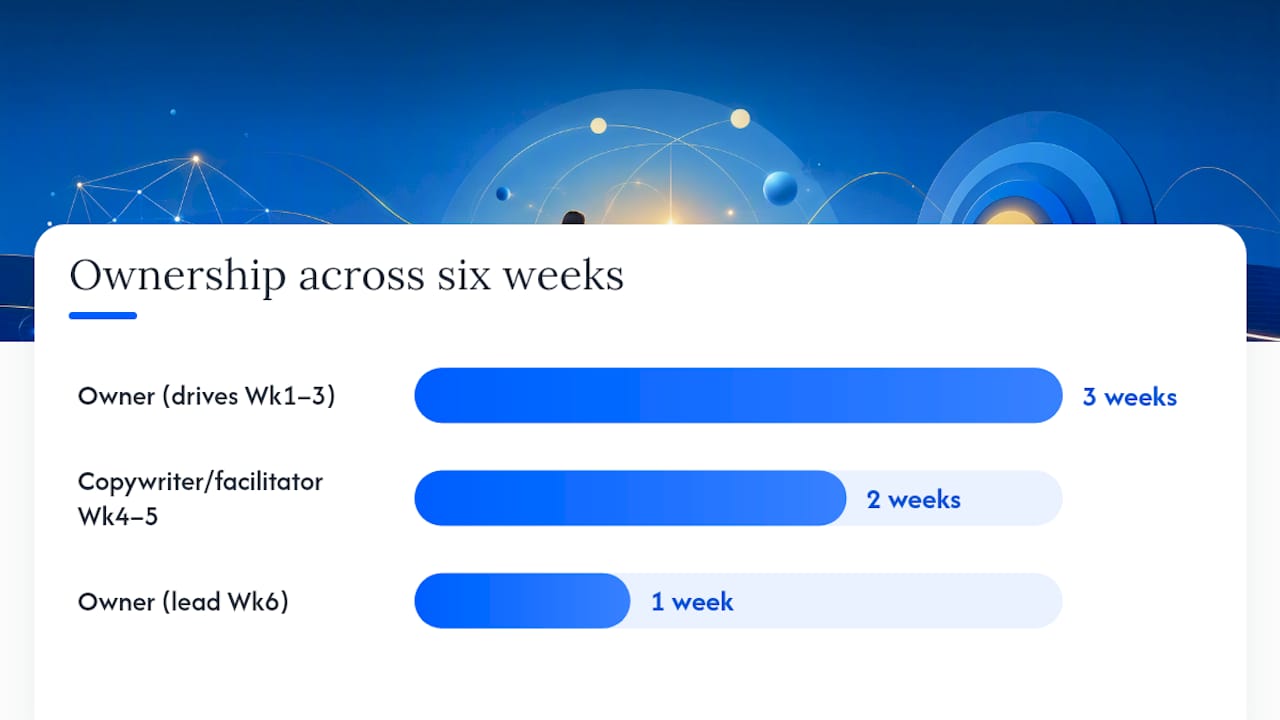
Ownership: the business owner drives Weeks 1–3; a copywriter or workshop facilitator can assist with Weeks 4–5; Week 6 is owner-led.
Pro Tip: Before you spend anything on design or ads, run a $50 social post using your new CVP headline and measure click-through rate. A cheap, fast experiment like this tells you more in 48 hours than a month of internal debate.
Most service businesses know they need to stand out. The hard part is translating that intention into a CVP that converts, copy that resonates, and operations that back the promise up.
Mybworkshops offers expert-led online workshops built specifically for service-based business owners at exactly this stage. The What Makes You Different workshop walks you through the four positioning elements, helps you draft and test your CVP, and gives you messaging templates you can use on your website the same week. For owners who want a broader system, the three-phase program covers brand strategy, website conversion, and lead generation in sequence — so each piece reinforces the next.
Participants leave with a validated CVP, updated homepage copy, and a clear 90-day action plan. Browse the full workshop range to find the session that fits where you are right now.
Differentiation gives customers a specific, credible reason to choose you over alternatives, which reduces price pressure and builds loyalty. Without it, buyers default to comparing on price alone.
Effective positioning requires being explicit about who you serve, the exact commercial problem you solve, where you operate, and why you are the expert — as outlined by Inside Small Business.
The 3-second rule suggests it takes roughly three seconds to form a first impression. Definitions vary, but the underlying principle — that consistent, repeated exposure compounds brand recognition — aligns with the operational alignment advice throughout this article.
Visual consistency reinforces recognition at every touchpoint, making your brand easier to recall and trust. It works best when the visuals reflect a genuine differentiator rather than just a style preference.
Early signals — fewer price objections, better-fit enquiries, prospects using your own language — typically appear within four to eight weeks of updating your messaging. Retention and referral improvements take at least six months of consistent delivery to show up in the numbers.