

You can cut your advertising budget and maintain or improve results — but only if you treat marketing as a portfolio and reallocate deliberately, rather than simply slash spending across the board. The evidence from the Ehrenberg-Bass Institute, Binet & Field, and McKinsey’s research on marketing resilience is consistent: blanket cuts destroy long-term brand health, but targeted reallocation can improve efficiency without sacrificing growth.
Here are three things you can do right now:
Pro Tip: The safest first move is not cutting a channel — it is finding the 20–30% of spend within existing channels that is producing the least return. That is where most businesses find their savings without touching results.
Cutting your advertising budget increases results when you audit for waste first, protect brand channels that compound over time, and reallocate deliberately to higher-return activities.
| Point | Details |
|---|---|
| Audit before you cut | Map every campaign by CPA, CAC, and decay profile before touching a single budget line. |
| Protect brand channels | Roughly 80% of recession cutters had not regained pre-recession levels within three years — brand spend is not a safe first cut. |
| Test before large cuts | Use geo or audience holdouts for 4–12 weeks to confirm a channel is safe to reduce. |
| Reallocate to retention first | Email, CRM, and SEO deliver the highest LTV multiplier at the lowest incremental cost. |
| Mybworkshops builds the skills | The Ads That Convert workshop gives you templates and a 30–90 day action plan to reduce wasted spend and lift results. |
The instinct to cut brand advertising first makes sense on paper. Brand campaigns are harder to attribute, their results take longer to show, and performance channels feel more controllable. The problem is that brand investment compounds over time, while its decay is slow and largely invisible until it is too late.
Binet & Field’s research across hundreds of campaigns established that brand-building activity drives long-term sales growth, while short-term activation drives immediate conversions. The two work together: brand priming increases the conversion yield of your performance channels. When you cut brand spend, you do not just lose brand awareness. You gradually reduce the effectiveness of your paid search and social campaigns too, because fewer people recognise or trust you when they see your ads.
Australian data presented at Mumbrella360 showed that cinema, radio and free-to-air TV — channels with the strongest long-term brand-building evidence — received the largest cuts in 2025 compared with 2024, while social and search investment rose. This is a textbook example of “shorting the long”: optimising for short-term attribution at the expense of the channels that build durable demand.
The long-term cost is measurable. Research tracking recession cutters found that a large majority of companies that reduced marketing costs had not regained pre-recession levels within three years. That is not a temporary dip. For many businesses, it represents a permanent loss of market position.
Consider a home builder or property developer in Australia, where buyers research for 18–26 months before making a decision. If you go dark for 12 months to save on brand advertising, you are invisible to every buyer who entered the research phase during that period. By the time you return, those buyers have already formed preferences around competitors who stayed present. You cannot buy your way back into their consideration set quickly — the purchase cycle is simply too long.
Key risks of cutting brand channels prematurely:
McKinsey recommends moving away from blanket cuts toward a portfolio approach that protects long-term growth while improving short-term efficiency. In practice, that means classifying every channel and campaign into one of three buckets before you touch a single budget line.
Protect: Brand and compounding channels where decay is slow but recovery is expensive. These include brand awareness campaigns, content SEO, email list growth, and any channel where the payoff extends beyond 90 days. Cut these last, and only partially.
Optimise: High-ROI channels with room to improve efficiency without reducing scale. Paid search with strong conversion data, remarketing to warm audiences, and CRM automations typically sit here. You can often reduce spend by 15–25% through tighter targeting and creative rotation without losing volume.
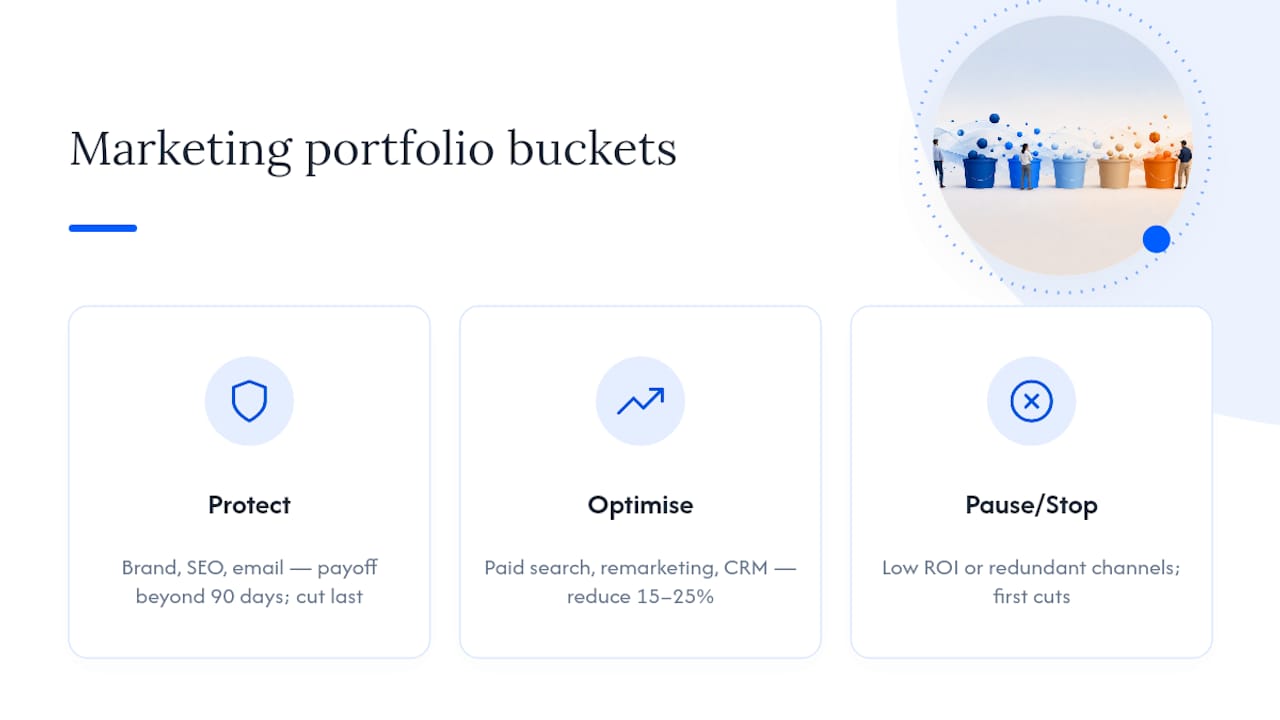
Pause or stop: Low-ROI campaigns, redundant tools, and channels with no clear attribution or measurable incrementality. These are your first cuts.
Before moving a campaign into any bucket, evaluate it against these criteria:
Australian benchmarks suggest a balanced split across channels: search 30–40%, paid social and video 20–30%, content 10–15%, and CRM/retention 10–15%. If your current allocation is heavily skewed toward one channel, that concentration risk is worth addressing before you cut anything.
For small businesses, practical guidance recommends a primary channel receiving 50–60% of your channel budget, with two secondary channels at 10–15% each. This structure prevents overextension and makes it easier to identify which channel is actually driving results.
Pro Tip: When you reallocate, move dollars to retention, CRM, email, and SEO before you consider any new paid channel. These have the highest LTV multiplier and the lowest incremental cost per result.
Cutting waste is not the same as cutting results. Most businesses carry 20–30% of ad spend in low-performing placements, exhausted creative, and poorly targeted audiences. Here is where to look first.
Pausing underperforming creative is one of the fastest ways to drive the right traffic and get clicks that convert without spending more. Rotate fresh creative every 3–4 weeks to prevent frequency fatigue, and repurpose your highest-performing assets across channels rather than producing new material from scratch.
Every dollar you save on CRO compounds across your entire paid spend. A landing page that converts at 4% instead of 2% effectively halves your CPA without touching your bids. Prioritise A/B tests on your highest-traffic landing pages, align ad copy with landing page messaging, and reduce friction in your checkout or enquiry process. Your website conversion rate optimisation workflow is often the highest-return investment available to a small business.
Email, SMS, and CRM automations cost a fraction of paid acquisition and multiply LTV. A re-engagement sequence for lapsed customers, a post-purchase nurture flow, or a simple loyalty nudge can recover revenue that would otherwise require paid spend to replace.
30-day sprint sequence:
Cutting spend without a measurement plan is how businesses discover the damage months after it has happened. The right approach is to build your measurement architecture before you make any changes.
Track these metrics at the campaign and channel level, not just in aggregate:
Last-click attribution will tell you which channel got credit. Incrementality testing tells you which channel actually caused the conversion. For most small businesses, a simple holdout test works well: pause a channel for one audience segment or geography while maintaining it for another, then compare conversion rates.
Data-driven marketing programmes can deliver meaningful uplifts in sales or efficiency, but only when the measurement is clean enough to distinguish real effects from attribution noise.
| Test type | Best KPI | Minimum test length (short cycle) | Minimum test length (long cycle) |
|---|---|---|---|
| A/B landing page test | Conversion rate, CPA | 2 weeks | 4 weeks |
| Geo holdout test | CAC, revenue by region | 4 weeks | 8–12 weeks |
| Budget reallocation experiment | Marginal ROAS, LTV:CAC | 4 weeks | 8–12 weeks |
| Channel pause test | Branded search, direct traffic | 6 weeks | 12 weeks |
Use last-click data as a tactical readout for daily optimisation, but base your budget decisions on incrementality results and cohort LTV. The two will often tell different stories, and the incrementality data is the one worth trusting.
The lag between a spend change and a visible business impact depends almost entirely on your purchase cycle. Getting this wrong is why businesses declare a cut “safe” after four weeks, only to see the damage arrive in month six.
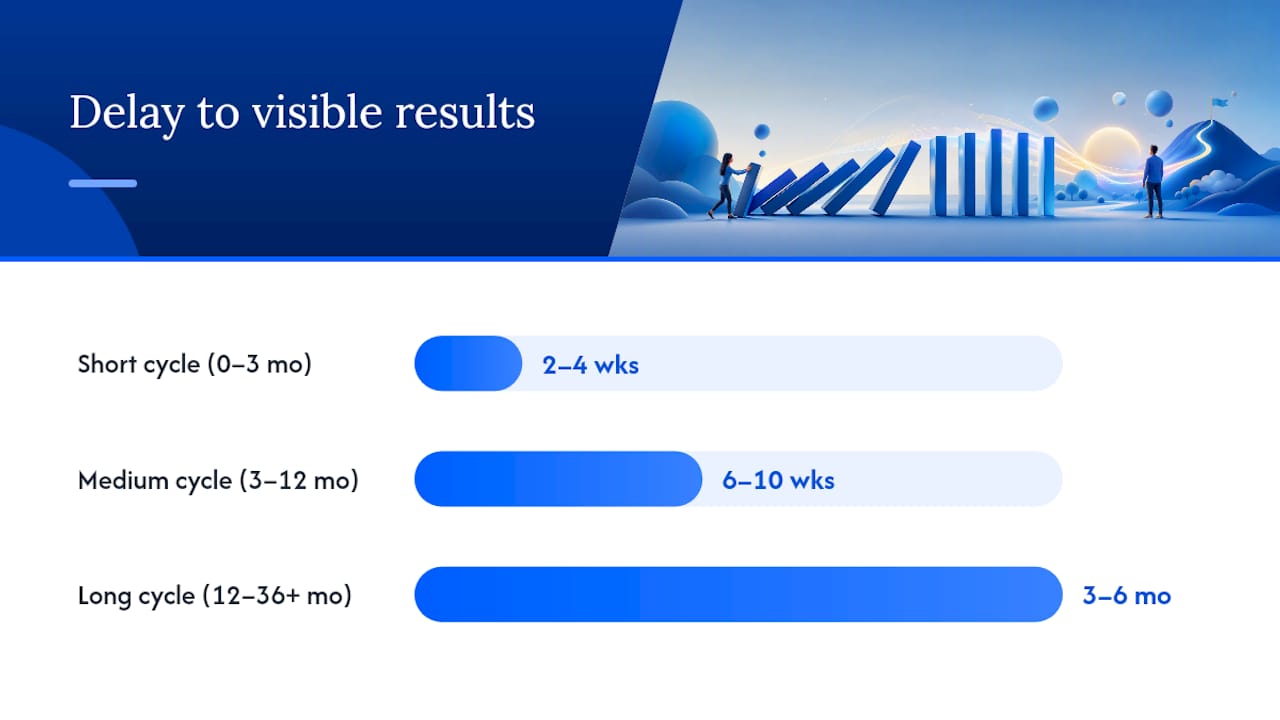
Short purchase cycle (0–3 months): DTC e-commerce, food delivery, event bookings. Effects of a cut appear within 2–6 weeks. Recovery is relatively fast if you restore spend promptly. These categories can tolerate more aggressive optimisation.
Medium purchase cycle (3–12 months): Professional services, B2B software, home services. Effects of a cut take 2–4 months to show in pipeline and revenue. Recovery takes a similar period. Brand channels matter more here because buyers are comparing options over several months.
Long purchase cycle (12–36+ months): Property, home building, financial planning, major capital purchases. This is where the 18-week amnesia effect is most dangerous. Brand absence causes slow memory decay, and the multi-month recovery cost can far exceed the savings from the original cut. Buyers who entered the research phase while you were dark may never return to your consideration set.
One Australian DTC case illustrates the upside of the opposite approach: steady paid social and search investment through a slowdown produced a 35% reduction in cost per new customer and a 9.1x ROAS over 36 months. When competitors retreated, the brand’s share of voice grew cheaply, and that compounded into market-share gains during recovery.
| Action | Short cycle (0–3 months) | Medium cycle (3–12 months) | Long cycle (12–36+ months) |
|---|---|---|---|
| Pause low-ROI campaigns | Results visible in 2–4 weeks | Results visible in 6–10 weeks | Results visible in 3–6 months |
| Reduce brand spend | Low risk short-term | Moderate risk; monitor share of voice | High risk; avoid unless critical |
| Reallocate to retention/CRM | Uplift in 2–4 weeks | Uplift in 4–8 weeks | Uplift in 2–4 months |
| Increase CRO investment | Uplift in 2–3 weeks | Uplift in 4–6 weeks | Uplift in 6–12 weeks |
Most budget cuts that damage businesses share the same handful of errors. Knowing them in advance is the difference between a clean optimisation and a slow-motion revenue problem.
Top pitfalls:
Red flags to watch during any cut:
If you see two or more of these signals together, pause new cuts immediately. Restore a small brand presence, expand your testing scope, and review your attribution model before proceeding.
This sequence is designed for a small team. Each step has a clear owner, a deliverable, and a decision point.
Quick audit (48–72 hours). Map every channel by spend, CPA, CAC, estimated LTV contribution, and decay profile. The owner is whoever controls the ad accounts. The deliverable is a single spreadsheet with every campaign classified as protect, optimise, or stop.
Segment and cap (Week 1). Move campaigns into their portfolio buckets. Set temporary spend caps on “optimise” campaigns and pause “stop” campaigns. Do not touch “protect” campaigns yet.
Design 2–3 incrementality tests (Week 1–2). Choose a geo holdout or audience holdout for your two highest-spend “optimise” channels. Define KPIs, sample sizes, and test length before you start. A minimum of 4 weeks for short-cycle businesses; 8–12 weeks for medium or long cycles.
Reallocate to retention and owned channels (Week 2–3). Take 20–30% of the budget freed from paused campaigns and direct it to email sequences, CRM automations, and SEO for lead generation. These have the highest LTV multiplier and the fastest payback for most service businesses. Method Marketing recommends starting with roughly 6–10% of revenue as your total marketing budget floor before making further cuts.
Monitor weekly, review at 30/60/90 days. Track your core KPIs weekly. At each 30-day checkpoint, apply a simple decision rule: if CAC is stable or falling and LTV:CAC is above 3:1, continue. If CAC is rising and conversion rate is falling, roll back the most recent cut and investigate before proceeding.
Document and update your budget cadence. Record what you tested, what you learned, and what you changed. Update your regular budget review process to include incrementality data alongside last-click reporting. This is how a one-off sprint becomes a permanent improvement in how you allocate spend.
Pro Tip: Set a rollback trigger before you start: define the exact CAC or conversion-rate threshold that will automatically pause new cuts. Having the rule in writing before the pressure hits makes it far easier to act on it.
Knowing the framework is one thing. Implementing it confidently, with the right templates and a clear plan, is where most small business owners get stuck.

Mybworkshops offers practical, expert-led workshops built specifically for service-based business owners who want to stop wasting ad spend and start building a marketing system that compounds over time. The Ads That Convert workshop walks you through audience targeting, creative testing, bidding strategy, and landing page optimisation — the exact levers covered in this article — with templates and AI prompts you can apply within 30–90 days. You will leave with a concrete action plan, not a theory.
Every workshop is supported by a community of business owners working through the same challenges, plus optional live consulting sessions if you want direct feedback on your specific situation. Browse the full workshop archive to find the session that fits where you are right now, and take the first step toward a leaner, higher-performing marketing engine.
Yes, when cuts target waste rather than compounding channels. Auditing for low-ROI campaigns, tightening audience targeting, and reallocating to retention and CRO typically reduces spend while holding or improving results.
The 70/20/10 rule allocates the majority of budget to proven channels, with smaller portions to emerging or experimental channels and high-risk, high-reward tests. It is a useful starting framework, though Australian benchmarks suggest adjusting the split based on your purchase cycle and channel maturity.
Sustained presence when competitors retreat tends to lower your cost per impression and build share of voice cheaply. The DNM Digital case study showed that holding investment through a slowdown produced a 35% reduction in cost per new customer and a 9.1x ROAS over 36 months, partly because competitors pulled back.
For short purchase-cycle businesses (under three months), effects appear within 2–6 weeks. For medium cycles (3–12 months), expect 2–4 months. For long-cycle categories like property or financial planning, the 18-week amnesia effect means brand damage can take 12–18 months to become visible in revenue.
Pause the bottom 20% of campaigns by CPA first, before touching any brand or awareness channels. Then tighten audience targeting and creative rotation within your remaining campaigns. This approach typically frees 15–25% of budget without any measurable impact on results.