

An effective approach to LinkedIn lead generation combines a conversion-focused profile, content that prepares your audience, and small, personalised outreach sequences sent to a prioritised list. This mix builds trust before you send a message, leading to more qualified conversations and fewer cold rejections. Start today by rewriting your headline or publishing one short how-to post.
TL;DR:
- Make your headline name the audience and outcome, then use the About section to show proof and offer one clear next step.
- Publish three useful posts weekly, add two engagement moves, and share one deeper guide or checklist to maintain a manageable content cadence.
- Define prospects by role, industry, and location or company size; free LinkedIn search supports these filters, while Sales Navigator adds lead lists and account alerts.
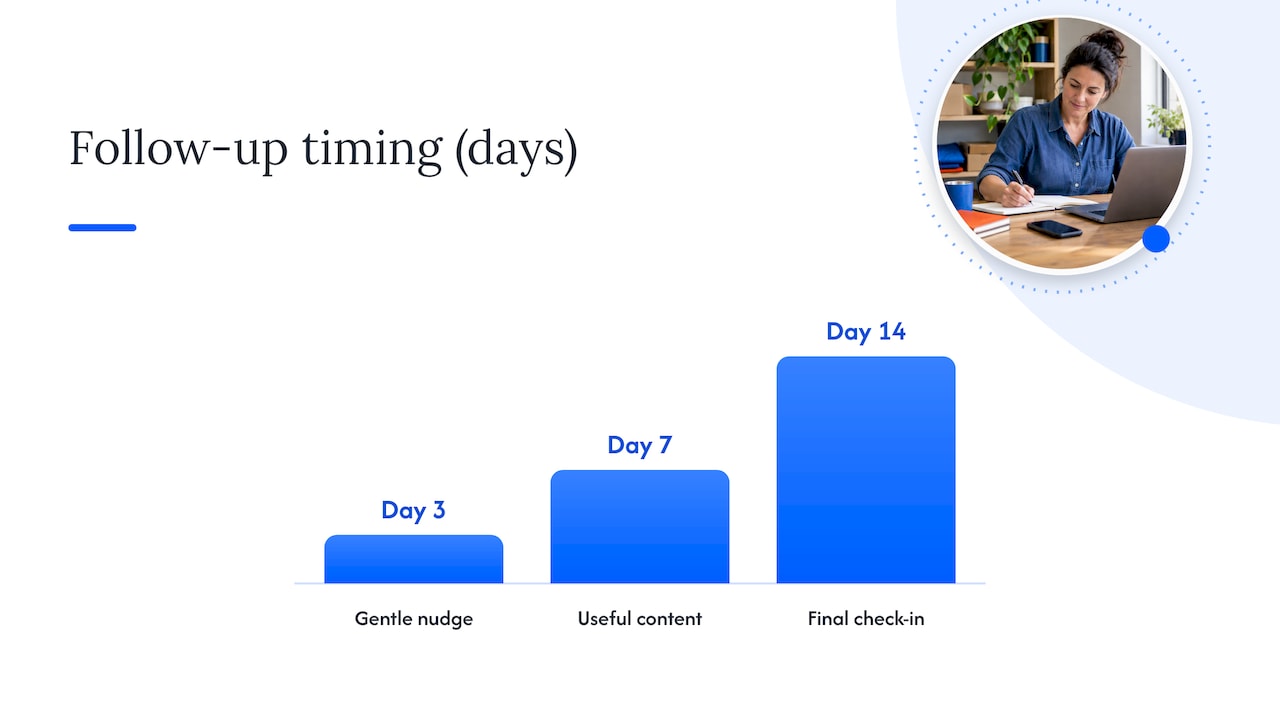
- Use a three touch follow up on days 3, 7, and 14; identify your business, offer an easy opt out, and secure consent where required.
- Track acceptance, reply, booking, and lead magnet conversion rates; test one variable at a time and scale after consistent outperformance, not one good day.
Your profile is a landing page, and most service business owners treat it like a resume. That’s the first thing to fix.
Your headline should name who you help and the outcome you deliver, not your job title. “Helping bookkeepers cut month-end close time in half” works harder than “Bookkeeper | Finance Professional”. Your subheadline (the line under your name) is prime real estate too; use it to add a credibility marker or a specific niche.
The About section should open with the outcome you create, not your career history. Lead with the problem you solve, add one or two proof points, and close with a clear next step, whether that’s a link, a lead magnet or an invitation to message you.
A few other elements carry weight:
None of this needs to be flashy. It needs to answer one question fast: why should this person keep reading or reach out?
Content does the warming up that cold messages can’t. When a prospect has already seen your thinking, your message lands as a continuation of a conversation, not an interruption. Content marketing that attracts clients works the same way on LinkedIn as it does on your website: it builds familiarity before the ask.
Three formats carry most of the weight:
A simple cadence keeps this manageable: three useful posts a week, two engagement moves (commenting thoughtfully on prospects’ posts or resharing relevant content with your own take), and one deeper asset such as a short guide or checklist that captures real interest.
Comments are an underused outreach trigger. When someone engages meaningfully with your post, that’s your cue for a warm, personalised message rather than a cold one.
Pro Tip: Keep a simple list of everyone who comments on your posts each week. That list is your warmest prospect pool, and it costs nothing to build.
Outreach only works when it reaches the right person, so define your ideal client profile (ICP) before you send a single message: role, industry, and either location or company size.
LinkedIn’s standard search lets you filter by these three criteria for free, and saved searches will keep surfacing new matches as people update their profiles or change roles.
The strongest opening message follows a simple formula: state the outcome you help with, add a light proof point, then offer something low-friction, never a hard pitch.
A warm approach (someone who’s engaged with your content) might read: “Thanks for your comment on my post about onboarding delays. I’ve helped a few service businesses cut that process down significantly. Would a quick checklist on what we changed be useful?”
A cold approach to a well-matched prospect could be: “I noticed you’re scaling your team at [Company]. We’ve worked with a few businesses in similar growth stages on exactly that challenge. Happy to share what’s worked if it’s useful.”
Follow-ups matter more than the first message. A simple three-touch sequence works well:
Day 3: a gentle nudge referencing the original offer, no new pitch.
Day 7: share one piece of useful content relevant to their situation.
Day 14: a final, low-pressure check-in that leaves the door open without chasing.
Personalise at scale by pulling one specific detail from their recent activity or a common challenge in their industry, rather than writing a fully custom message each time.
Pro Tip: Space your outreach and avoid identical message templates sent in bulk. LinkedIn restricts accounts that send high volumes of near-identical messages, so variation protects your account as much as your reply rate.
A lead magnet gives prospects a reason to say yes before they’re ready to buy. For service businesses, the formats that convert best are a short audit, a one-page case study, a practical checklist, or a 20-minute discovery call.
Deliver the magnet in whatever way removes the most friction: a gated PDF, a direct calendar link, or simply sending the resource via message once someone responds. Collect only what you genuinely need (name and email is usually enough) and avoid long forms that kill momentum.
CTA wording matters as much as the offer itself.
Track a handful of numbers consistently rather than everything available. The metrics that matter are connection acceptance rate, reply rate, meeting or booking rate, and lead magnet conversion rate.
A spreadsheet is enough to start: log each outreach send, the response, and the outcome. As volume grows, move this into a CRM so you can see which messages, content pieces or lead magnets are actually producing booked calls, not just likes.
Our lead generation sales flow and nurture system workshop covers this kind of tracking in more depth if you want a structured way to build it out.
Commercial outreach on LinkedIn still falls under Australian privacy and spam rules, even though the platform feels more casual than email marketing.
Under the Australian Privacy Principles, organisations must not use personal information for direct marketing unless an exception applies or the individual has consented. The ACMA’s consent guidance recommends express consent with clear terms and an easy unsubscribe option whenever you’re running e-marketing, and warns against assuming consent from implied or purchased contact lists.
Practical steps to stay compliant:
Everything above works best as a repeatable system, not a one-off campaign. That’s the gap a structured workshop might address, walking through how to build a funnel like this: profile, content cadence, outreach sequences and lead magnets, all mapped to a workflow you can run yourself.
Participants work through structured, step-by-step phases with templates and mentorship, rather than generic advice, so you’re applying the framework to your own business as you go. Live Q&A sessions mean you get feedback on your actual messages and content, not hypothetical examples.
If you’re not ready for guided support, start small: rewrite your headline this week, publish one how-to post, and track your reply rate for a fortnight. When you want a structured path through the rest, that’s where a workshop earns its place.
Lead generation on LinkedIn fails fastest when it’s treated as a messaging numbers game. Relationships built through genuine engagement convert at a far higher rate than cold volume ever will.
Commenting thoughtfully on a prospect’s posts, before you ever message them, signals that you’ve paid attention to their work, not just their job title. A specific comment that adds to the conversation (rather than a generic “great post!”) is far more likely to get noticed and remembered.
Endorsements and recommendations work both ways: endorsing a genuine skill for a past client or collaborator often prompts reciprocity, and a specific written recommendation carries more weight than a skill tap.
Messaging etiquette matters just as much as timing. Keep early messages short, avoid asking for anything beyond a reply, and never pitch in the first message to someone who hasn’t engaged with you yet. Respect silence too; if someone doesn’t respond after your follow-up sequence, let it rest rather than escalating frequency.
The businesses that do best on LinkedIn tend to treat it as an ongoing relationship channel rather than a sales funnel with a start and end date. That shift in mindset, treating connections as a long-term network rather than a one-time target list, tends to produce steadier results over months rather than spikes followed by silence.
LinkedIn groups give you access to a concentrated pool of people who’ve already identified as interested in your topic area, which makes them useful for visibility if you use them properly.
The mistake most business owners make is joining a group and immediately posting a pitch. That gets ignored or removed. Instead, spend the first few weeks commenting genuinely on other members’ posts and answering questions where you have real expertise.
Once you’ve established a presence, sharing a useful post (not a sales pitch) tends to generate far more engagement than a cold join-and-post approach. Group members who respond to your content are warmer prospects than a stranger pulled from a general search, because they’ve self-selected into a topic you’re already positioned around.
Smaller, niche groups tend to outperform large general ones for lead quality, even though they have fewer members. A group of 500 people in your exact industry will usually produce better conversations than one with 50,000 members across unrelated sectors.
Treat groups as another content and relationship channel rather than a separate outreach list; the same principles from your main feed apply here.
LinkedIn activity becomes far more useful once it’s connected to wherever you track the rest of your sales process. Without that link, you end up with warm conversations in your LinkedIn inbox and no record of who followed up, when, or what happened next.
A simple setup works for most service businesses: log each new LinkedIn conversation as a lead in your CRM at the point someone replies or books a call, not before. This keeps your pipeline accurate and avoids cluttering it with cold sends that never progressed.
Many CRMs allow manual or semi-automated logging of LinkedIn conversations, tagging the source so you can see later which channel, content piece or outreach sequence actually produced booked calls. That attribution step is what makes your measurement efforts in the earlier section meaningful over time.
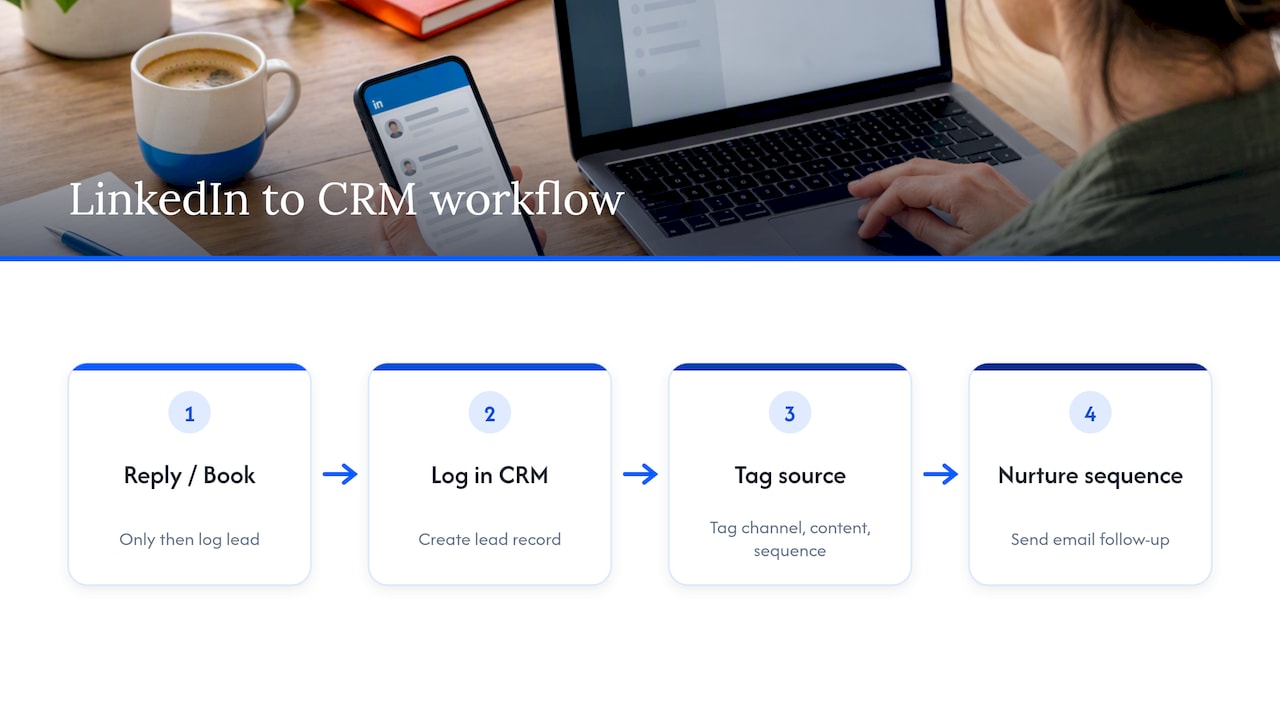
Once a lead magnet captures an email address, a simple nurture sequence should pick up where LinkedIn left off. Our welcome email sequence guide covers what that follow-up should contain so the relationship keeps building after someone leaves LinkedIn.
LinkedIn’s advertising platform lets you reach decision-makers by job title, industry and company size with more precision than most other channels, which makes it worth considering once your organic approach is already working.
Lead gen forms, a native ad format, let prospects submit their details without leaving LinkedIn, pre-filled with their profile information. This reduces friction significantly compared with sending traffic to an external landing page, though the ad spend itself is not free: LinkedIn charges for the campaign regardless of which ad format you choose.
Ads work best as an amplifier for content that’s already proving itself organically, not as a replacement for the content and outreach work described earlier. Boosting a post that’s already getting genuine engagement, or promoting a lead magnet that’s already converting through organic reach, tends to produce better results than cold ad creative built from scratch.
Start with a narrow audience and a modest budget, and watch your cost per lead against the KPIs you’re already tracking elsewhere in your funnel. If organic efforts are converting at a reasonable rate, structured content planning before you spend on ads tends to produce a stronger return than boosting posts with no underlying strategy.
Reading about a framework and running it under real deadlines are different things, which is why many service business owners find a guided workshop speeds up implementation considerably.
Our #7 Lead Generation System Workshop walks you through building exactly the system covered in this article: profile, content, outreach and lead magnets, using templates and direct mentorship rather than theory alone. It’s priced as stated on the workshop page and booked directly through our Lead Generation System Workshop page.
If you want to see what else is available first, our full workshops page lists everything from content strategy to website conversion.
The most reliable approach combines a profile written to convert visitors, regular content that builds familiarity with your ideal client, and small, personalised outreach sequences sent to a well-targeted list. Lead magnets and simple tracking round out the system so you can see what’s actually converting.
LinkedIn works particularly well for B2B service businesses because it reaches a high proportion of decision-makers, even though fewer small businesses use it for marketing compared with other platforms, according to ACMA research. Its value comes from the quality of the audience rather than sheer volume.
It’s a simple weekly content cadence: three useful posts, two engagement moves such as thoughtful comments or reshares, and one deeper asset like a guide or checklist that captures genuine interest. The structure keeps content consistent without becoming overwhelming to maintain.
Lead gen forms themselves are a free feature within LinkedIn’s advertising tools, but running the ad campaign that uses them is not free; you still pay LinkedIn’s standard advertising costs. The form simply reduces friction for the prospect by pre-filling their details rather than sending them to an external page.