

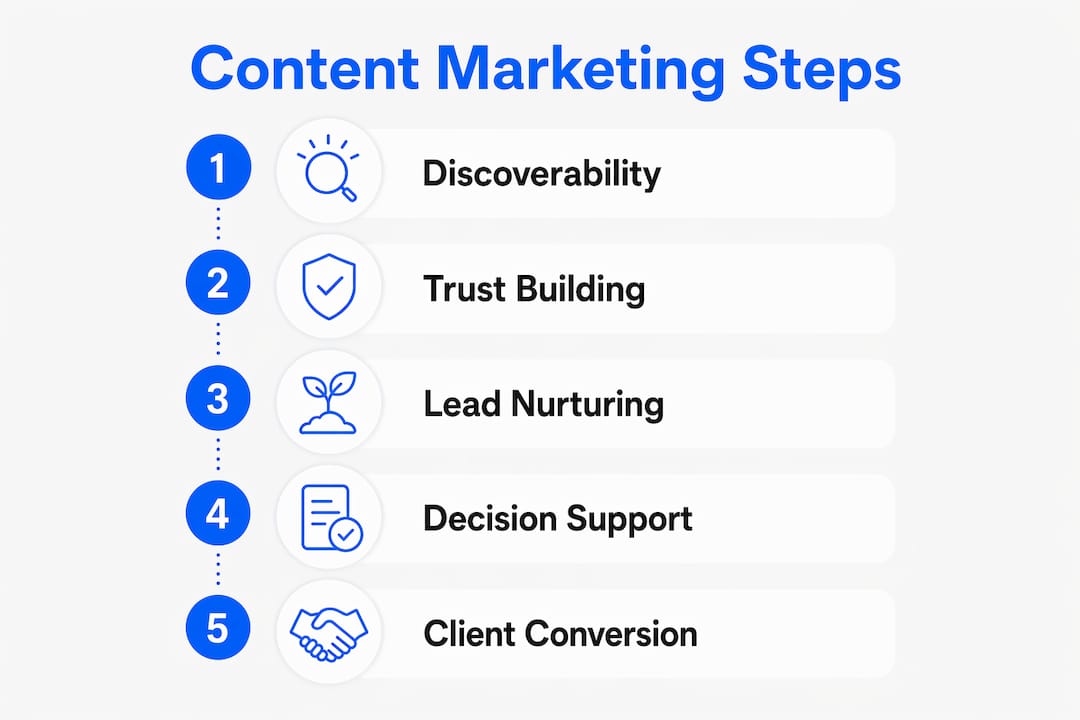
Content marketing attracts clients by making your business findable, building genuine trust, and guiding interested prospects to a clear next step. Two mechanisms do most of the work: discoverability (your content appears when potential clients search Google, LinkedIn, or even AI tools like ChatGPT) and trust and education (case studies, process explainers, and FAQs answer the questions buyers carry before they ever contact you).
Australian buyers research solutions thoroughly before contacting providers. If your business has no content that speaks to their questions, a competitor who does will get the call. The Content Marketing Institute has documented this pattern for years, and it holds just as firmly for a Sydney bookkeeper or a Melbourne trades business as it does for a global brand.
The path from “never heard of you” to “booked a call” follows a predictable chain. Understanding each link helps you put the right content in the right place.
Discoverability (impressions and clicks). A plumber in Brisbane publishes a guide on “what to do when your hot water system fails.” Someone searches that phrase at 7pm on a Tuesday. The guide appears. That is the first moment of contact, and it cost nothing beyond the time to write it. Organic search and referrals from other sites are the two primary discoverability channels; getting found organically also now includes visibility inside large language models.
Trust-building (time on page, return visits). Once a visitor lands, your content either builds confidence or loses it. A web designer who publishes a detailed “what our process looks like” page gives a prospect something to evaluate. A case study showing a before-and-after result does even more. Prospects compare portfolios and read case studies before contacting service providers.
Capture (form submissions, gated downloads, email sign-ups). Trust alone does not generate revenue. You need a mechanism to collect contact details or prompt a next step. A free checklist, a quote estimator, or a simple “book a free call” button converts a reader into a lead. Measure this by tracking form submissions and new email subscribers.
Nurture and conversion (booked calls, proposals requested). Most prospects are not ready to buy the first time they read your content. An email sequence, a LinkedIn follow-up, or a well-timed case study sent after an initial enquiry keeps your business front of mind until they are ready. Track booked calls and close rates by content source to see what is actually working.
Content marketing’s benefits are often described in vague marketing terms. Here is what they mean in practice for a service business.
Improved findability. Every useful article or guide you publish is a new entry point into your business. Australian SMEs that invest consistently in blogging and SEO can see marked traffic and enquiry improvements over time.
Qualification before contact. When a prospect has read your process page, your pricing guide, and two case studies, they arrive at the enquiry stage already sold on your approach. You spend less time explaining and more time closing.
Lower cost per lead over time. Paid advertising stops the moment you stop paying. A well-written evergreen article can drive enquiries for months or years with no ongoing cost. The economics improve significantly after the first 12 months.
Compounding returns. Unlike ads, content compounds. A pillar page that ranks on page one of Google in month six keeps generating traffic in month 24. This is the single biggest financial argument for content over paid channels.
Better close rates from informed prospects. Buyers who have consumed your content understand your value before the sales conversation starts. They ask better questions and push back less on price.
Shareable proof that earns referrals. A strong case study or a genuinely useful guide gets shared. That earned distribution extends your reach without extra effort.
A note on timelines: SEO-based content typically needs 3–6 months to generate consistent leads. Email and LinkedIn can produce leads within weeks. Plan for both.
Australian buyers research thoroughly before they contact a provider. Mapping your content to their stage means you are present at every point in that research, not just at the end.
At this stage, a prospect knows they have a problem but may not know you exist. The goal is to be found and to be useful. A financial planner might publish “how to know if you need a financial planner” or “what superannuation contributions actually mean for your retirement.” A trades business might write “signs your roof needs replacing before summer.” Success at this stage looks like organic traffic growth and new email subscribers.
The prospect is now comparing options. They want to understand your process, your credentials, and what working with you looks like. This is where process explainers, detailed service pages, and comparison guides earn their keep. An accountant might publish “what to expect in your first tax planning session” or a business coach might share “how our 90-day programme works.” Most businesses underinvest in this stage, producing plenty of awareness content but very little proof content that helps a buyer choose.

The prospect is close to contacting someone. They need reassurance. Case studies, testimonials, pricing guides, and FAQs that address final objections are the right tools here. A clear call-to-action on every decision-stage page, whether that is “book a free discovery call” or “get a quote,” removes the last point of friction. On-page design and clear CTAs matter as much as the content itself at this stage.
Not all content formats deliver equally. These are the ones that consistently attract and convert clients for service businesses.
Case studies and results pages. The most underused asset in Australian small business marketing. A well-structured case study shows capability, provides social proof, and lets a prospect see themselves in the client’s situation.
Pro Tip: Include a before/after metric in every case study, even a simple one. “Enquiries increased from two per week to nine” is more persuasive than any amount of descriptive copy.
How-to and process explainers. These answer the questions your ideal clients are already typing into Google. A solar installer might publish “how to get three comparable solar quotes” or a consultant might write “what our strategy engagement looks like week by week.”
Pro Tip: End every how-to page with a single, specific next step. “Download our checklist” or “book a 15-minute call” converts readers who are ready to move.
Pricing and what-to-expect pages. Transparency builds trust faster than almost anything else. A “what does a website redesign cost?” page for a web designer, or an “engagement timeline” for a management consultant, pre-qualifies leads and reduces time wasted on poor-fit enquiries.
FAQs. FAQs reduce friction at the decision stage and improve SEO by matching the exact language buyers use. They also reduce repetitive pre-sale questions, freeing your time.
Interactive tools (calculators and estimators). A solar savings estimator, a bookkeeping fee calculator, or a “how much should I spend on marketing?” tool generates leads while providing genuine value. These are high-leverage assets for lead quality and link acquisition.
Long-form pillar pages. A 2,000-word guide that thoroughly addresses a topic your ideal clients search for will, in most Australian markets, outrank shorter posts that skim the surface. These pages become the anchor for your content strategy.
Short video snippets for LinkedIn. A 60-second clip explaining a common client mistake or walking through a process step performs well for B2B service businesses. Repurpose pillar content into a series of short posts; one blog post can generate four to six LinkedIn posts with minimal extra effort.
Email sequences for nurture. A prospect who downloads your checklist is not yet a client. A five-email sequence that shares relevant case studies, answers common objections, and ends with a clear invitation to book a call converts warm leads into paying clients. Learn more about building email conversion rates that actually move people to act.
Publishing without a plan produces noise. A simple framework keeps your effort connected to real business outcomes.
Define your ideal customer profile (ICP). Who are you writing for? A mortgage broker writing for “everyone” will convert no one. Writing for “self-employed business owners buying their second property in 2026” speaks directly to a real person with a real problem. Your ICP shapes every content decision that follows.
Choose 3–5 content pillars. Top-performing small businesses centre their content on a handful of pillars aligned to revenue goals. For a business coach, pillars might be: lead generation, pricing strategy, team building, client retention, and mindset. For a trades business: seasonal maintenance, cost guides, how-to explainers, case studies, and local area guides. Read more about choosing your content pillars before you publish a single word.
Map content to buyer stages. For each pillar, plan at least one awareness piece, one consideration piece, and one decision piece. Most businesses have awareness content and almost nothing at the decision stage. Fix that imbalance first.
Build a simple editorial calendar. A practical cadence for an Australian service business is one cornerstone pillar piece every 4–6 weeks, repurposed into emails, LinkedIn posts, and FAQs. That is manageable for a founder or a small team without burning out.
Plan distribution before you publish. Content that no one sees does nothing. For every piece, decide: where will it live, how will you share it in the first week, and how will search give it a long tail? Email your list, post on LinkedIn, and consider a small paid boost for decision-stage content.
Measure business outcomes, not vanity metrics. Track enquiries, booked calls, and close rates by content source, not just page views. If a pillar page generates traffic but no enquiries, the problem is usually the call-to-action or the page design, not the content itself.
On resource allocation: a founder can own strategy and one pillar piece per month. A part-time contractor or a skilled virtual assistant can handle repurposing and distribution. You do not need a full marketing team to make this work; you need a clear plan and consistent execution.
Setting realistic expectations is the difference between staying the course and abandoning a strategy that was about to work.

| Timeline | Typical signal | Suggested metric |
|---|---|---|
| 1–3 months | Email and LinkedIn leads from new content | New subscribers, booked calls from social |
| 3–6 months | Early SEO traction, local search visibility | Organic impressions, keyword rankings |
| 6–12 months | Consistent organic enquiries | Organic leads per month, form submissions |
| 12+ months | Compounding traffic, lower cost per lead | Pipeline value influenced by content, CPL trend |
SEO-based content typically needs 3–6 months to generate consistent leads; email and LinkedIn can produce results within weeks. Plan your first 90 days around short-term channels while your SEO foundation builds.
A simple ROI check: if one new client from content is worth $3,000 to your business, and you spend $600 on a pillar page and its distribution, you need that page to generate one client every five months to break even. Most well-targeted pillar pages do considerably better than that over a 12-month horizon.
Metrics checklist:
Two anonymised examples from Australian service businesses show what the mechanics look like when they work.
Case study 1: Professional services firm, Sydney. A small accounting practice published a detailed guide on tax planning for small business owners, plus three case studies showing specific client outcomes (tax saved, time freed, compliance issues resolved). Within six months, enquiries from organic search had grown noticeably, and the close rate on those enquiries was higher than from referrals because prospects arrived already familiar with the firm’s process. The practice attributed the improvement to two things: the case studies answered the “can they actually help someone like me?” question, and the process explainer removed the anxiety of not knowing what to expect.
What to replicate:
Case study 2: Trades business, Melbourne. A residential electrician published a series of short how-to guides on common electrical questions (safety switch testing, what to do before a renovation, understanding your switchboard). The guides ranked locally within four months and began generating enquiries from homeowners who had read the content and already trusted the business before calling. The owner noted that callers rarely questioned the quote because they had already formed a view of the business’s expertise.
What to replicate:
You can see examples of businesses built through workshops that follow a similar content-led approach.
You do not need to do everything at once. This checklist gives you a clear sequence.
Week 1: Define your ICP and choose one content pillar. Write a one-paragraph description of your ideal client: their role, their problem, and the outcome they want. Pick the one pillar where you have the most authority and the most questions to answer.
Weeks 2–4: Publish your first pillar piece. Write a 1,500–2,000 word guide that thoroughly answers a question your ideal client is searching for. Include a clear call-to-action at the end (a free download, a booking link, or a contact form).
Day 30: Distribute and capture. Email your list, post on LinkedIn, and share in any relevant online communities. Set up a simple lead capture (email opt-in or booking link) so you can measure who responds.
Days 30–90: Repurpose and repeat. Turn your pillar piece into four LinkedIn posts, one email to your list, and a short FAQ page. Publish your second pillar piece. Start tracking organic impressions in Google Search Console.
Day 90: Measure and adjust. Review your metrics: organic impressions, form submissions, booked calls. Which piece generated the most engagement? Double down on that topic and format for the next quarter.
Days 90–180: Add proof content. Publish at least one case study and one “what to expect” process page. These are the two content types most likely to improve your close rate with warm leads.
Pro Tip: Turn one pillar piece into five assets: the original article, two LinkedIn posts (one insight, one story), one email to your list, and one FAQ entry on your website. Same research, five times the reach.
Content marketing attracts clients because it makes your business findable, builds trust before first contact, and guides prospects through a clear path to enquiry.
| Point | Details |
|---|---|
| Discoverability drives first contact | Useful content indexed by Google puts your business in front of buyers actively searching for what you do. |
| Trust converts interest into enquiries | Case studies, process pages, and FAQs answer objections before a prospect contacts you, improving close rates. |
| Map content to buyer stages | Awareness, consideration, and decision content each serve a different purpose; most businesses underinvest in decision-stage proof content. |
| Realistic timeline: 3–6 months for SEO | Email and LinkedIn can generate leads within weeks; organic search typically takes 3–6 months to show consistent results. |
| Mybworkshops provides guided implementation | Mybworkshops workshops give service business owners a structured framework, templates, and live support to build a content strategy that generates real enquiries. |
Building a content strategy from scratch takes time, and most business owners get stuck deciding where to start. Mybworkshops offers expert-led online workshops built specifically for service-based business owners who want a practical, structured path rather than a pile of generic advice.
The workshops cover the full content and marketing system: defining your ICP and content pillars, writing copy that converts visitors into enquiries, building a lead generation flow, and getting found organically in search and AI tools. You work through real templates and AI prompts, leave with a 90-day action plan, and have access to a community of business owners doing the same work.
Attendees typically leave with:
Browse the full workshop programme to find the session that fits where you are right now.
Content marketing attracts clients by making your business visible when they search for solutions, then building enough trust through case studies, process pages, and FAQs that they choose to contact you. Each piece of content serves a stage in the buyer’s journey, from awareness through to the decision to enquire.
Email and LinkedIn can produce leads within weeks; SEO-based content typically takes 3–6 months to generate consistent organic enquiries. Plan for both channels from the start so you see short-term results while your long-term foundation builds.
The primary benefits are improved organic findability, better-qualified leads who arrive pre-educated, lower cost per lead over time as evergreen content compounds, and higher close rates because prospects already understand your value before the first conversation.
Case studies, process explainers, pricing guides, FAQs, and long-form pillar pages consistently outperform short social posts for service businesses because they answer the specific questions buyers have before committing. Decision-stage content, particularly case studies, is the most underused and highest-converting format.
Start with one content pillar, one well-researched pillar piece per month, and a simple repurposing plan: turn each article into two LinkedIn posts, one email, and one FAQ entry. Mybworkshops workshops give you the templates and framework to do this without guesswork or wasted effort.