

Customer personas are research-backed profiles that represent real customer segments and guide concrete decisions in marketing, sales, and service delivery. The question of whether customer personas are worth creating comes down to one thing: do they change what you do next? If a persona sits in a slide deck and never influences a campaign brief, a sales script, or a pricing decision, it has no practical value. When built correctly, personas are one of the most useful tools a service-based business owner can use to stop wasting ad spend and start attracting the right clients.
Customer personas are worth creating when they drive real decisions, not just describe your ideal client. A persona that changes your messaging, your offer structure, or the channels you advertise on is a decision tool. A persona that lists someone’s age, job title, and favourite coffee is a biography.
The industry term for what most business owners call a “customer persona” is a buyer persona. Both terms refer to the same thing: a semi-fictional profile built from real customer research that represents a meaningful segment of your audience. The distinction matters because the word “buyer” keeps the focus on decisions and purchasing behaviour, which is exactly where personas deliver value.
For service-based businesses, the importance of customer personas is especially high. You are not selling a product off a shelf. You are asking someone to trust you with a problem, a goal, or a significant investment. Understanding what triggers that decision, what makes them hesitate, and what proof they need to say yes is the foundation of effective marketing for services.

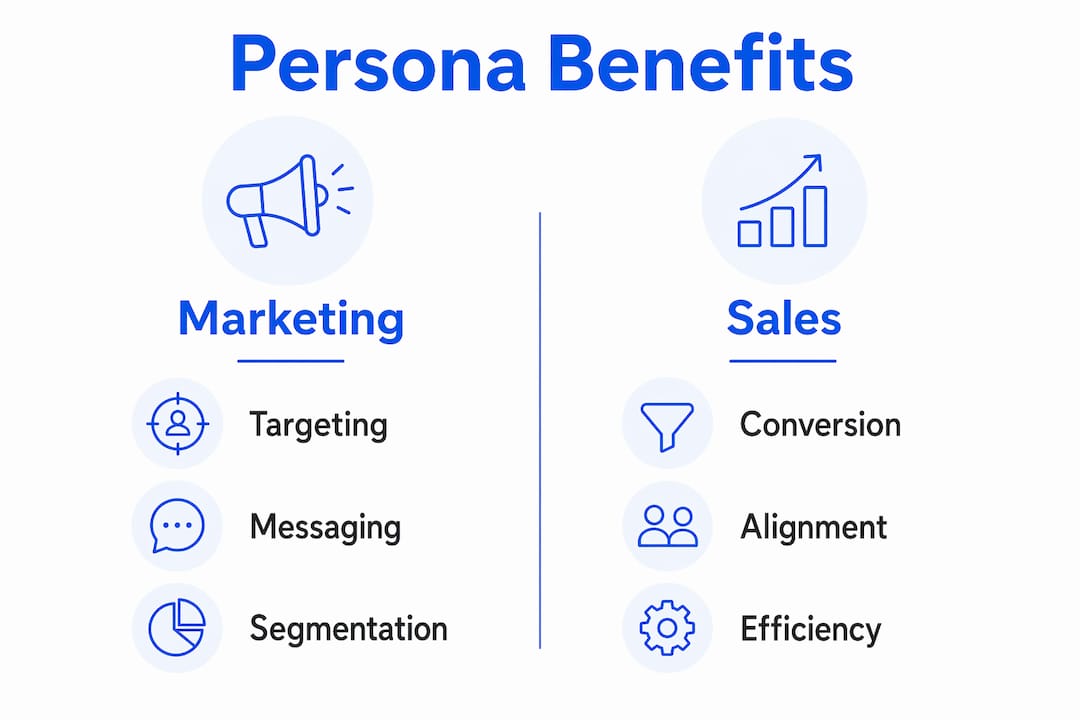
Personas support relevant messaging and campaign segmentation, which improves ad spend efficiency and aligns marketing with sales. When your team knows exactly who they are talking to, every piece of content, every ad, and every email becomes more focused.
The business impact of persona-driven segmentation is measurable. In one documented mid-market SaaS example, demo conversions rose from 14% to 22% and sales cycles shortened by 33% after a persona rollout. That is not a marginal improvement. It reflects what happens when your messaging speaks directly to the decision your client is already trying to make.
Here is what well-built personas do for your marketing and sales:
Successful teams treat personas as routing logic for decisions, mapping decision drivers into campaign briefs and sales scripts. The persona does not sit in a folder. It shows up in the language you use on your website, the objections you address in your proposals, and the proof points you lead with in discovery calls.
The main reason personas fail is that they become static and disconnected from actual customer decision-making. A persona built from assumptions in a one-off workshop will drift further from reality every month. When teams try to use it six months later, it no longer reflects how clients actually think or behave.
The other common failure is building personas that are full of irrelevant detail. Knowing that your ideal client drives a particular car or watches a certain TV programme does not help you write a better proposal. Personas fail when they answer questions nobody in your business is actually asking.
Watch out for these specific traps:
Personas also fail when teams abandon them because they cannot answer urgent new questions. If your persona cannot tell you how to respond to a new competitor or a shift in client priorities, it has become historical documentation rather than a live decision tool.
Pro Tip: After writing each line of your persona, ask “therefore we will do what?” If you cannot answer that question with a specific marketing or sales action, cut the line.
Not everyone agrees that detailed buyer personas are the best way to segment an audience. Ehrenberg-Bass Institute research challenges the ideal customer persona approach, recommending that businesses focus on category entry points instead. Category entry points are the situations or moments that prompt someone to consider buying a solution like yours, regardless of their demographic profile.
The critique has merit. Buyer segments often overlap more than ideal personas assume, and there is no single peer-reviewed study definitively proving personas improve marketing results across all contexts. Broader segmentation approaches can work well for product businesses with large, diverse audiences.
For service-based businesses, however, detailed personas tend to outperform broader segments. Your clients are making high-consideration decisions. They are not impulse-buying. The specificity of a well-built persona, including the trigger event, the purchase anxiety, and the proof they need, gives you a real advantage in how you communicate.
| Factor | Customer personas | Broader buyer segments | Category entry points |
|---|---|---|---|
| Best for | High-consideration services | Large product audiences | Brand awareness campaigns |
| Depth of insight | High | Medium | Low |
| Time to build | Medium | Low | Low |
| Ongoing maintenance | Required | Occasional | Minimal |
| Impact on messaging | Direct and specific | General | Situational |
| Risk of assumptions | High if not validated | Medium | Low |
The right approach depends on your business model. For most service-based business owners with a defined client base, a small set of well-validated personas will outperform a broad segment every time. The key is building them from real data, not guesswork.
Creating effective customer personas starts with choosing the right segments to focus on. Identify your one to three most valuable client types based on revenue, referrals, or fit with your services. Do not try to build a persona for every type of client you have ever worked with.
Follow these steps to build personas that actually drive decisions:
For service businesses, framing personas around jobs, anxieties, and alternatives is more effective than heavy demographic traits. Your client’s job to be done, the trigger that made them act, and the real alternatives they were weighing will tell you far more than their postcode or income bracket.
Pro Tip: Build your persona around the question “what does this person need to believe before they say yes?” Every line of your persona should help you answer that question more clearly.
Customer personas are worth creating when they function as live decision tools, not static profiles, and when they are built from real behavioural research rather than assumptions.
| Point | Details |
|---|---|
| Personas must drive decisions | A persona only has value if it changes your messaging, offers, channels, or sales approach. |
| Decision process beats demographics | Capture triggers, anxieties, and proof needs rather than age, income, or lifestyle details. |
| Keep personas to two or three | More personas dilute focus. Two or three well-validated profiles deliver better results. |
| Validate with real data | Use interviews and surveys to test your assumptions before building campaigns around them. |
| Refresh regularly | Personas degrade over time. Review and update them every six to twelve months to stay relevant. |
If you have tried building customer personas before and found they never quite made it off the page, you are not alone. Most service-based business owners build personas once and then watch them gather dust. The problem is usually not the concept. It is the process.
Mybworkshops offers practical, expert-led workshops for service businesses that cover customer understanding, marketing strategy, and brand positioning as a connected system. You will learn how to build personas grounded in real client behaviour, translate them into marketing tools, and use them to attract better clients with less wasted effort. The workshops are structured, hands-on, and built for business owners who want results, not theory. If you are ready to build a marketing approach that actually reflects who your best clients are, Mybworkshops is a practical place to start.
A customer persona is a research-backed profile representing a key segment of your audience, built around their decision triggers, anxieties, and proof needs rather than just demographic traits.
Yes. For service businesses, personas are especially useful because clients make high-consideration decisions. A well-built persona helps you speak directly to what your client needs to believe before they say yes.
Most service businesses need two to three distinct personas. More than that spreads your focus too thin and makes it harder to create specific, effective marketing.
Review and update your personas every six to twelve months. Use recent sales conversations, client interviews, and analytics to keep them grounded in current behaviour rather than past assumptions.
Personas become ineffective when they are built from assumptions, filled with irrelevant demographic detail, or never updated. A persona that cannot answer a real marketing or sales question has no practical value.