

Price anchoring works by giving customers a reference point before they see your real price, and it shapes how fair or generous that price feels. The most effective anchor types are strikethrough (was/now) pricing, tiered pricing, decoy pricing, bundle anchoring, and per-unit reframing. Each exploits the same cognitive bias uncovered by Kahneman and Tversky: the first number a person sees quietly sets the scale for every number that follows. Below you’ll find copy-ready examples, the psychology behind them, and a simple way to test which one works for your business.
TL;DR:
- Effective price anchors rely on real, documented reference points like actual past prices, component breakdowns, or verifiable competitor prices to maintain credibility.
- Using formats such as strikethrough pricing, tiered options, bundles, decoy plans, and per-unit reframing can significantly influence perceived value and drive sales.
- Anchors work best when they leverage contrast, compromise effects, or external comparisons, but they must be honest to avoid damaging trust or legal risks.
- Testing different anchoring tactics through proper A/B experiments with clear metrics can help optimize your pricing based on actual customer behavior.
- Cultural differences and target customer demographics impact which anchoring technique performs best, requiring tailored approaches for B2C and B2B markets.
You don’t need a psychology degree to use anchoring well. You need a handful of proven formats and the discipline to apply them honestly. Here are the examples that show up most often in strong-performing pricing pages, emails and proposals.
Retailers lean hardest on strikethrough, tiered and bundle formats because they’re visually simple and easy to justify, and Competera’s research on ecommerce pricing confirms these three drive the clearest lift in perceived savings.
Pro Tip: Never anchor with a number you can’t back up. If a customer asks “was that price ever real?” and you can’t answer honestly, drop the anchor. Credibility is worth more than one extra sale.
Anchoring isn’t a single trick, it’s a family of techniques, and each one leans on a slightly different part of how people judge value. Understanding the mechanics helps you pick the right one instead of copying a tactic that doesn’t fit your offer.
Anchor precision matters. Research on anchoring shows a precise figure like $7,995 tends to pull final estimates closer than a round figure like $8,000, because precise numbers read as calculated rather than guessed. That’s worth testing on your own product pages.
The St Louis Fed’s review of anchoring research points to the Northcraft and Neale real estate study as some of the strongest evidence that anchoring works: professional appraisers, not just casual shoppers, adjusted their property valuations based on the listing price they were shown, even when they insisted they’d ignored it. If trained experts can’t fully resist an anchor, the average customer certainly won’t. The Nielsen Norman Group adds an important nuance here: anchors keep working even when people consciously know they’re being influenced, because a clear anchor reduces the mental effort of figuring out whether a price is fair.
Anchoring works differently when you’re selling expertise rather than a product off a shelf, because there’s no shelf price to compare against. You have to build the anchor yourself, and it has to hold up to scrutiny.
The most credible anchors for service businesses are your own previously published price, the cost of the problem the customer is currently living with, or a sum-of-components breakdown that shows what each part of your service would cost separately.
Badges like “Best Value” or “Most Popular” aren’t just decoration. They’re a visual anchor that tells a browsing visitor where to focus their attention before they’ve read a word of the description.
Pro Tip: Never let an anchor stand alone. Pair the price with a reason: “includes four live sessions and lifetime access to templates” does more anchoring work than the number by itself.
Anchoring only earns its keep when it sits inside a proper pricing strategy built for the stage your business is at, not as a bolt-on trick used to disguise weak positioning.
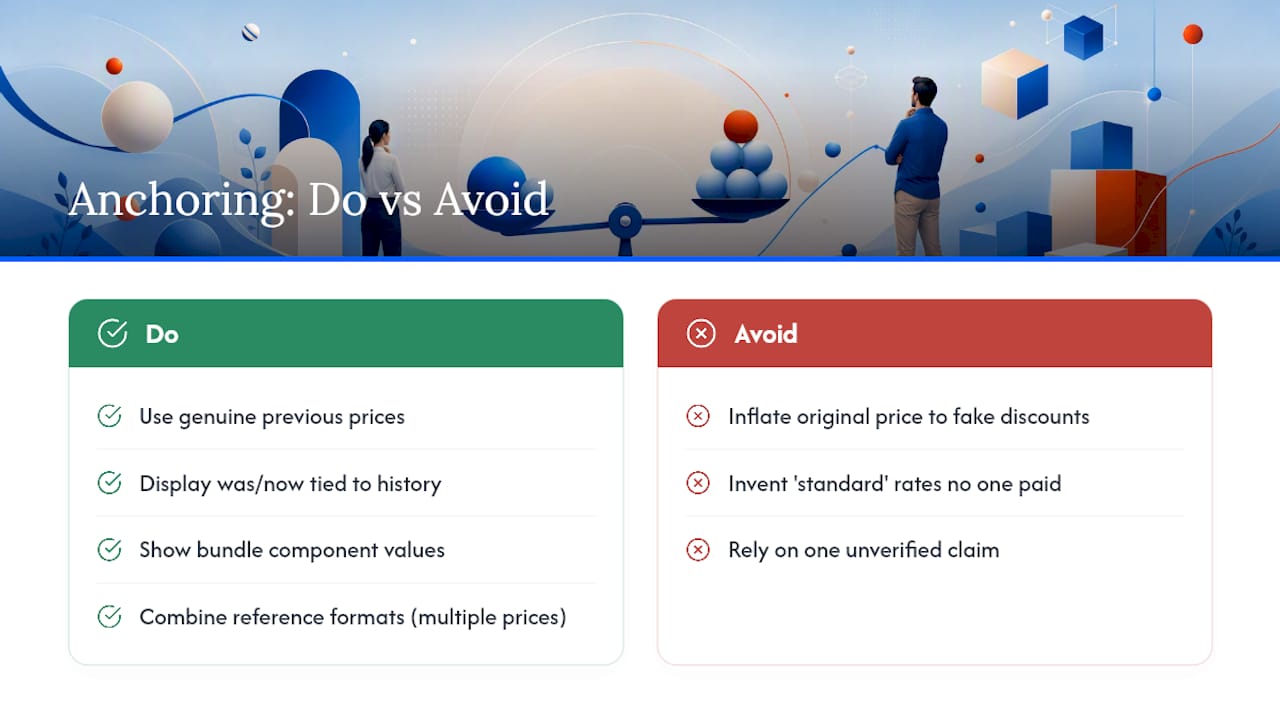
An anchor that isn’t true is a liability, not a tactic. Inflating a “was” price you never actually charged, inventing a fake RRP, or quoting a competitor price you can’t verify all expose you to consumer law risk and, sooner or later, a customer who calls it out publicly.
Trust-based anchors, ones you can document and defend, protect your brand’s long-term value far better than a short-term inflated discount ever will.
You don’t need a data science team to prove an anchor is working. You need a clean test, a clear metric, and the patience to let it run long enough to mean something.
| What to track | Best suited to | Why it matters |
|---|---|---|
| Conversion rate | Ecommerce products | Shows whether the anchor moved people to buy |
| Average order value | Ecommerce, bundles | Shows whether anchoring lifted spend per transaction |
| Revenue per visitor | Higher-ticket services | Balances conversion and price sensitivity together |
| Quote-acceptance rate | Consulting, workshops, quoted services | Shows whether the anchor helped close deals, not just generate interest |
Pro Tip: Run a five-minute follow-up survey with a handful of customers after the test closes. A number can tell you conversion went up; only a conversation tells you whether people felt misled.
For a wider look at testing discipline before you spend another dollar chasing traffic, this guide on cutting wasted ad spend covers the same measure-before-you-scale principle.
Before you publish anything, run it against a short checklist: is the higher-priced anchor visually close to the real price (proximity), does the eye land on the anchor first (hierarchy), and does colour or size draw attention to the saving without looking like a shouty banner ad?
Limiting how often you run discounts protects the anchor’s credibility. If “was $179, now $129” runs every single week, customers stop believing $179 was ever the real price, and the anchor loses its power entirely.
Test one anchor type at a time rather than changing five things on your pricing page at once. You won’t know which change actually moved the needle otherwise. A tiered service page built on this logic is a good place to see the layout in practice on the Business Strategy Workshop page.
Retailers who anchor with genuine sale history tend to see the clearest wins. A “was/now” display tied to an actual previous price, sitting next to a bundle that lists its component value, gives shoppers two reasons to believe the deal is real rather than one shaky claim. Voucherify’s review of retail anchoring tactics notes that combining formats, such as Amazon’s habit of showing multiple reference prices on one listing, tends to reinforce rather than dilute the effect.
The failures follow a familiar pattern. A retailer sets an artificially high “original” price purely to manufacture a bigger-looking discount, a shopper checks the price history on a browser extension, and the story spreads. The anchor didn’t just fail, it actively damaged trust in every future sale from that business. The same risk applies to service businesses that quote an inflated “standard rate” nobody has ever actually paid, just to make a “special offer” rate look generous.
The lesson sits in the gap between the two outcomes: anchoring succeeds when the reference point is real and documented, and it fails, sometimes badly, when it’s invented for effect. The tactic is neutral. Honesty is what decides whether it builds a customer relationship or burns one.
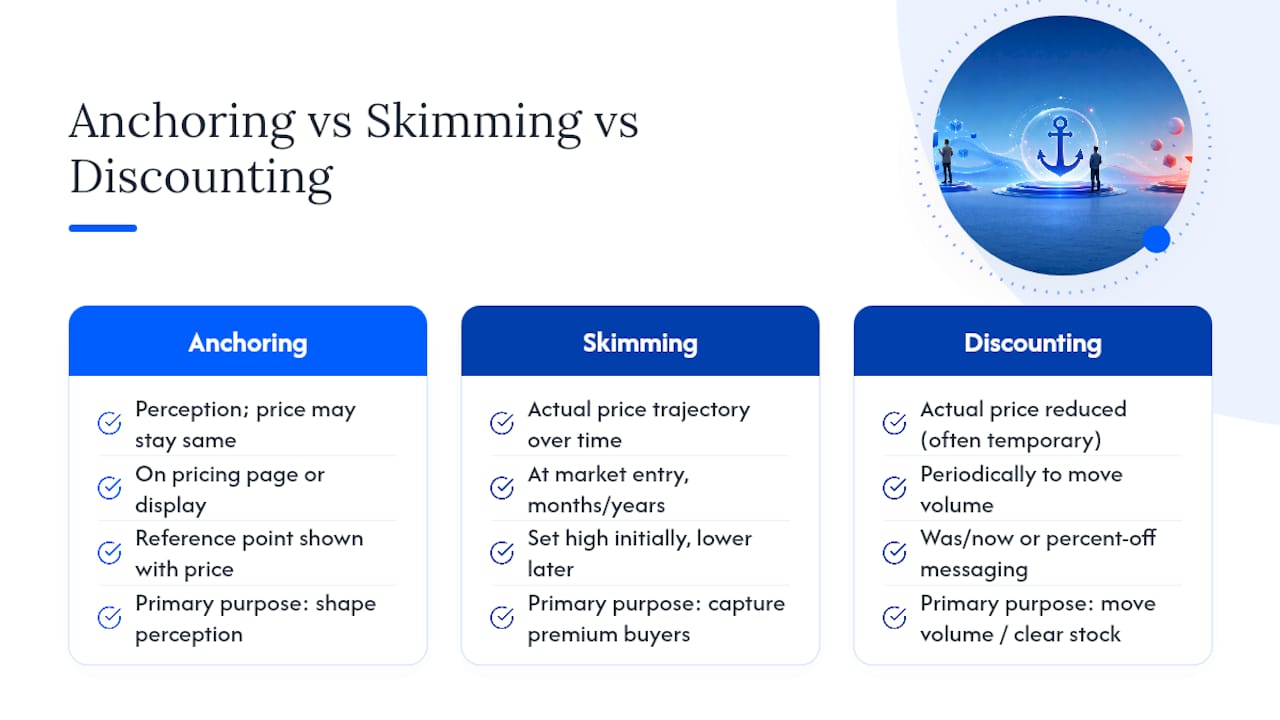
These three get lumped together constantly, and mixing them up leads to muddled pricing pages.
Price anchoring is a presentation technique: it shapes how a price is perceived by giving the customer a reference point before or alongside the actual price. It doesn’t necessarily change what you charge, only how that number lands.
Price skimming is a market-entry strategy: you launch a new product at a high price to capture customers who’ll pay a premium first, then lower the price over time as demand from that segment is exhausted. It’s a pricing trajectory over months or years, not a display trick on a single page.
Discounting is a straightforward price reduction, often temporary, aimed at moving volume or clearing stock. Discounting can use anchoring (a was/now display) to communicate the discount more effectively, but the discount itself is the substance and the anchor is just the framing.
The practical takeaway: you can skim your prices over time, discount periodically, and anchor on every single pricing page, all at once, because they solve different problems. Confusing them usually means a business either discounts too often (eroding perceived value) or anchors without ever actually adjusting a strategy that needed to change.
An anchor that converts brilliantly in one market can fall flat in another, because how people relate to price display isn’t universal. Shoppers used to heavy discount culture (frequent sales, loyalty apps, comparison browser extensions) tend to be more sceptical of strikethrough pricing and quicker to check whether the “was” price was ever real.
Price sensitivity also shifts by demographic and by category. A per-day reframing (“$3.20 a cup”) lands well with younger, subscription-comfortable customers weighing a monthly spend against other small daily costs, but it can feel gimmicky to a buyer evaluating a large one-off purchase, where the total figure matters more than the daily slice.
B2B buyers respond differently again. A decoy tier that works on a consumer SaaS pricing page can look transparently manipulative to a procurement manager comparing three vendor quotes side by side, because they’re actively trained to spot the tactic. For B2B and higher-ticket service audiences, a sum-of-components anchor (showing exactly what’s included and its standalone value) tends to outperform a flashier strikethrough display, because it gives a detail-oriented buyer something concrete to justify the decision internally.
The practical rule: know who’s reading your price before you choose the anchor format, not just what you’re selling.
The behavioural foundations here trace back to Kahneman and Tversky’s original 1974 research on judgment heuristics, still the reference point every later anchoring study builds on. The St Louis Fed’s summary of anchoring research covers the Northcraft and Neale real estate experiments in plain language. The Nielsen Norman Group offers the clearest UX-specific explanation of why anchors keep working even on aware customers.
For tactical application, Competera, ConversionStudio and Voucherify each break down the format choices retailers use day to day. If you want to see anchoring applied to service pricing pages rather than product listings, the Our Workshops page shows tiered packages built on the credible-anchor principles covered above, and the MYB Workshops Marketing Foundations resources go further into building a pricing structure that holds up over the long term rather than relying on one clever display trick.
If you’d like a structured way to work through your own pricing pages, tier labels and offer copy with a mentor rather than guessing your way through it, the Workshops catalogue at Mybworkshops covers pricing, positioning and conversion as part of a complete marketing system, not a one-off hack.
Common examples include strikethrough “was/now” pricing, a premium tier placed beside a mid-tier option to make it look reasonable, and a bundle price shown next to the sum of its individual components.
A workshop priced at $895 positioned as “$32 a day for four weeks” is a price positioning example: the same price, reframed against a smaller daily figure to feel more manageable.
Five common approaches are cost-plus pricing (adding a margin to production cost), value-based pricing (charging based on customer-perceived value), competitive pricing (matching or undercutting rivals), penetration pricing (launching low to gain market share), and price skimming (launching high, then lowering over time). Anchoring is a presentation technique that can support any of these, rather than a pricing strategy on its own.
Definitions vary across sources, but a commonly cited version covers Company (your costs and goals), Customers (perceived value and willingness to pay), Competitors (market rates), Channels (how the product reaches the buyer), and Climate (broader economic and market conditions).
Price anchoring itself is a legitimate presentation technique, but showing a fake “was” price or an invented recommended retail price you never charged can breach consumer protection law, so every anchor should be backed by real evidence you could show a regulator if asked.