

Topical authority means being the site Google and searchers trust most for a specific subject, built by covering every angle of a topic in genuine depth rather than chasing single keywords. For a service business, it translates directly into better-qualified enquiries and steadier rankings, because you stop competing on isolated pages and start owning a whole conversation your ideal clients are already having.
TL;DR:
- Focusing on creating interconnected, in-depth content about your core topics boosts Google’s trust and helps your business rank for dozens of related queries.
- Building a logical internal linking structure and using real client language increases your pages’ visibility and conversion rates, especially for local searches.
- Consistently tracking page indexes, keyword rankings, and conversion metrics ensures your topical authority grows steadily over months, not weeks.
- Avoid copying competitors’ pages or producing thin content; instead, merge similar pages and add unique insights to stand out in search results.
- Regularly audit and optimize your content, internal links, and metadata to maintain relevance and authority without needing large budgets or technical skills.
Topical authority isn’t about ranking one page for one keyword. It’s about becoming the site Google recognises as genuinely knowledgeable across an entire subject, built through interconnected content that covers the topic from every angle a real customer would ask about.
Picture a plumbing business writing a single page titled “hot water system repairs.” That page might rank for a while. But a plumbing business that also covers hot water system costs, common failure signs, gas versus electric comparisons, and maintenance schedules, all linked together, tells Google (and the reader) that this business actually understands hot water systems. That’s the difference between one page and a body of work.
Topical authority combines two things:
This is different from domain authority, which is a general measure of a whole site’s trustworthiness built through age, backlinks and reputation. You can have a newer site with modest domain authority that still ranks strongly for a tight cluster of service queries, because search engines reward focused expertise on a specific topic more than they reward general size. For a service business with limited time and no agency budget, that’s genuinely good news: you don’t need to out muscle a national brand, you need to out cover them on your own patch of expertise.
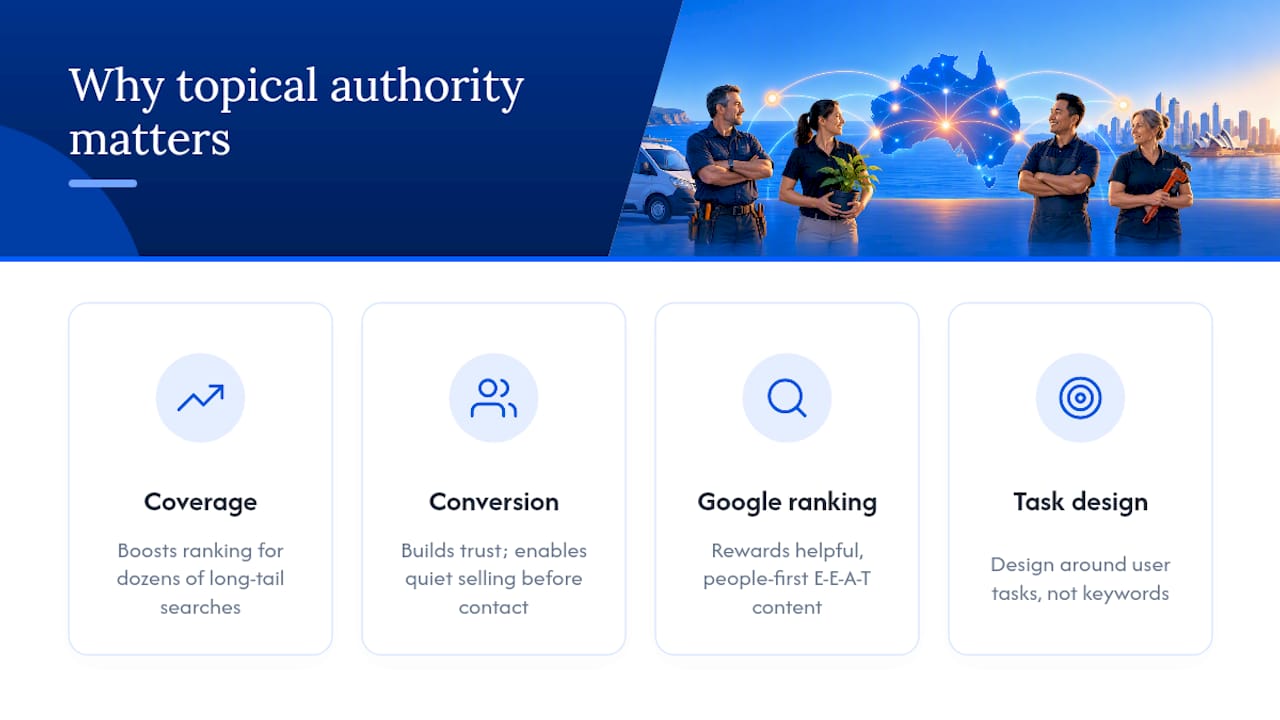
Coverage compounds. Every well-built page inside a topic cluster increases your odds of ranking for dozens of related, long-tail searches you’d never think to target individually, because search engines increasingly match intent across a cluster rather than judging pages in isolation.
There’s a conversion angle too, and it’s often overlooked. A visitor who lands on a service page that sits inside a clearly organised cluster, surrounded by links to pricing detail, process explanations and related services, trusts that business faster than one who lands on an orphaned page with nowhere else to go. That structure does quiet selling before your enquiry form ever loads.
Google’s own ranking guidance rewards this directly: its systems favour helpful, people-first content that demonstrates real expertise, experience, authoritativeness and trustworthiness, rather than content built to game a keyword. Businesses that build for the reader first tend to build topical authority almost as a side effect.
Most search queries themselves are short and task-based, which is exactly why the Australian Government Style Manual recommends designing content around what someone is trying to achieve, not around a phrase you want to rank for. Get that right across a cluster and you’re not chasing keywords, you’re answering questions your clients already have.
Google doesn’t have a single “topical authority score” it hands out. It infers authority from a mix of content signals, technical structure and demonstrated expertise, and most of these are things a service business can directly influence without any technical background.
There’s a newer layer worth understanding too: AI-generated summaries. When large language models summarise search results, they tend to flatten distinct businesses into the same generic answer unless your content carries something genuinely yours, your own terminology, your own framing, your own examples. Content built to blend in with the top ten results risks disappearing into that sameness entirely.
This is the sequence Mybworkshops walks service businesses through, and it works whether you’re a solo tradesperson or running a small team, because none of it depends on agency budgets or technical wizardry.
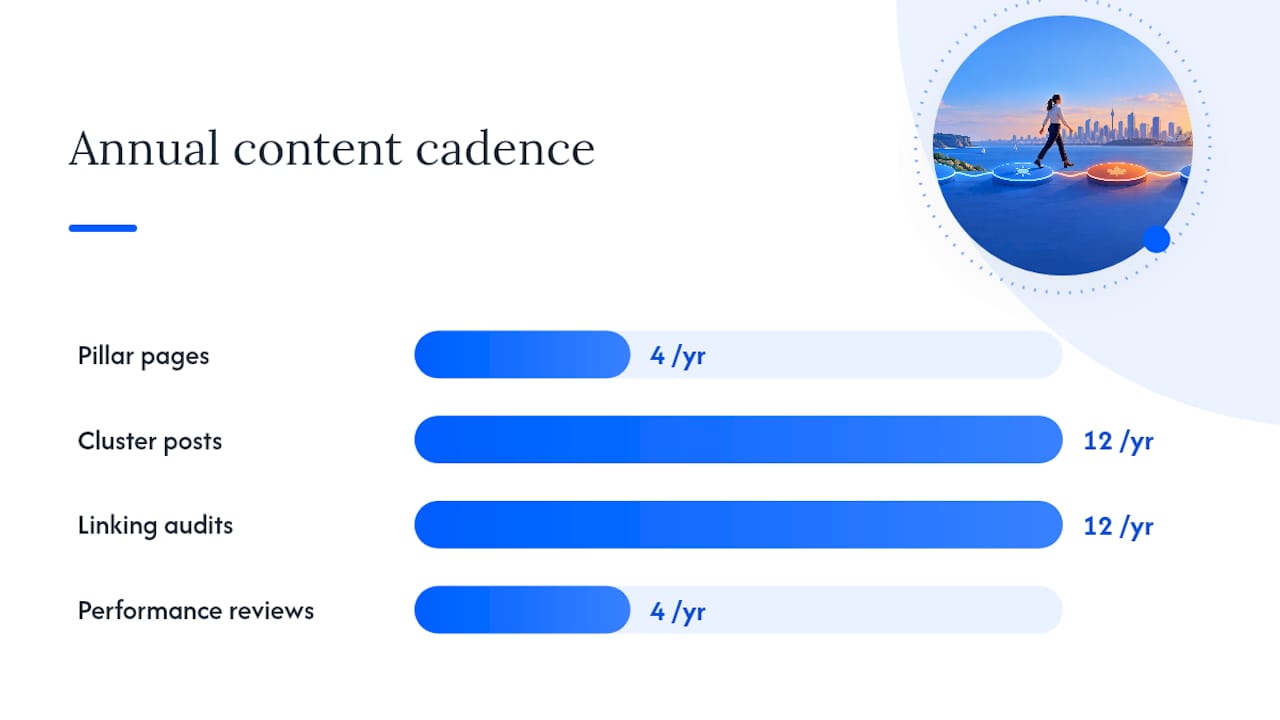
For a small team, a realistic editorial cadence is one pillar page per core topic each quarter, supported by monthly cluster posts, with a monthly internal-linking audit and a quarterly performance review. That’s sustainable without hiring anyone new.
Pro Tip: Before you write a single word, draft your H2 and H3 skeleton first and map each heading to one real customer question. It stops scope creep and keeps every page focused on a single task.
If you want a template rather than a blank page, a ready-made SEO content brief with an H2/H3 skeleton built for service businesses will save you the guesswork on structure.
Vanity metrics won’t tell you whether your cluster is working. Track these instead, and check them monthly rather than daily, because topical authority builds over months, not days.
Search Console is the free workhorse for most of this: it shows impressions, clicks, average position and the exact queries triggering each page. Pair it with whatever analytics tool tracks your site’s conversions, and you have everything you need without paying for enterprise software.
Run this as a loop: publish, monitor for four to six weeks, then iterate based on what the data shows, rather than rewriting everything after two weeks of impatience. If you want a structured way to plan that cadence rather than reacting page by page, planning SEO work ahead of time makes the whole cycle far less chaotic.
The most common failure is copying what already ranks. If your competitor’s page is the model for your own, you’ve built a slightly worse version of something that already exists, and research on AI-driven search summaries shows this kind of mimicry actively hurts visibility now, because generative summaries flatten near-identical content into a single generic answer with no reason to feature your business specifically.
The second failure is mass publishing thin pages to look comprehensive, often leaning too heavily on automated content with no real expertise behind it. Quantity without depth reads as noise, both to readers and to ranking systems.
Quick fixes that make an immediate difference:
Building topical authority properly takes structure, and that’s exactly what the Mybworkshops #8 Get Found Organically & on LLM’s – Implement SEO That Works Workshop walks you through, alongside conversion-focused work like the #6 Write Winning Product & Service Pages Workshop.
Each session maps directly onto the steps above:
If you’d rather start with the fundamentals of your business direction before building content clusters, the #1 Business Strategy Workshop provides 12 months of access, live Q&A, and a guided community, supporting your content strategy with a solid business foundation.
Topical authority is the trust a search engine places in your site as the best source on a specific subject, built by covering that subject in genuine depth rather than targeting single keywords. It’s earned through interlinked, expert content, not through any one page alone.
Yes, SEO remains central to how service businesses get found, though it now overlaps with how AI tools summarise search results. Content built around genuine expertise and people-first quality tends to perform well in both traditional rankings and AI-generated answers.
The main categories are on-page SEO (content, headings, metadata), technical SEO (site speed, structured data, crawlability), off-page SEO (links and citations), and local SEO (location-based visibility for service areas). A strong topical authority strategy touches all four, rather than relying on just one.
Yes, particularly the content and structural work covered in this guide, like task mapping, pillar pages and internal linking, which don’t require technical expertise to start. Guided training helps most business owners move faster and avoid the common mistakes covered above, without needing to hire an agency.