

Yes, you should use AI for ad copy, but only as a drafting tool, never as your final word. AI can generate headlines, variants and rough drafts in minutes, which saves genuine time. The rule that keeps this safe: every claim gets checked against fact, every draft gets a human edit, and nothing publishes without sign-off from a real person who understands your business.
TL;DR:
- Use AI to generate initial ad copy ideas, but always have a person check facts, tone, and claims before publishing.
- Prioritize privacy controls when selecting AI tools, and avoid inputting sensitive customer data into public platforms.
- Conduct thorough review and editing of AI drafts to ensure every claim is verifiable and aligns with your brand voice, especially for legal compliance.
- Test multiple AI-generated variants against each other, and refine based on performance data rather than instinct.
- Remember that AI accelerates drafting but does not replace the need for human expertise in verifying claims and maintaining brand authenticity.
AI ad copy tools are built to produce short, structured text fast. They’re trained on patterns from thousands of ads, so they’re good at mimicking formats you already recognise: the punchy headline, the benefit-led description line, the urgent call-to-action.
Here’s what these tools typically generate:
Where AI genuinely helps is speed and volume. If you need ten headline options to test against each other, a tool can produce them before you’ve finished your coffee. It’s also useful for scaffolding tone: ask for “friendly and direct” versus “formal and reassuring” and you’ll get a workable starting point for each.
Where it falls short is anywhere accuracy or nuance matters. AI tools don’t know your actual guarantee terms, your real turnaround times or what your customers genuinely value about working with you. Left unchecked, they’ll invent specifics that sound plausible but aren’t true, which is a real risk under Australian advertising law, something we’ll get into shortly. They also tend to flatten brand voice into a generic, upbeat register that could belong to any business in your category.
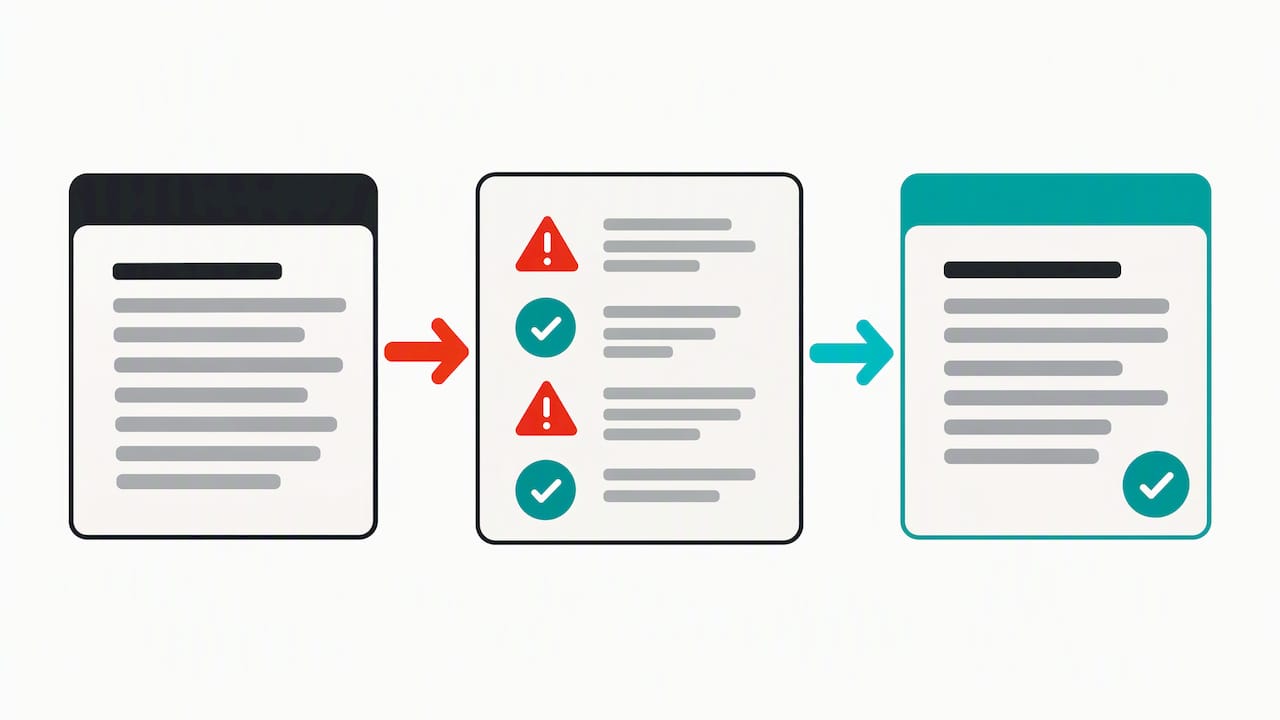
The practical rule: use AI when you need ideas fast or want to test several angles quickly. Rely on a human, ideally one who knows your offer inside out, for anything involving specific claims, pricing, guarantees or the final polish that makes copy sound like you rather than a template.
Not all AI writing tools are built the same way, and the differences matter more than most marketers realise. Before you commit to one, run it through these checks.
A comparison of privacy versus capability trade-offs in AI writing tools is worth reading before you sign up for anything. The more powerful tools aren’t always the most careful with your data.
Pro Tip: Before entering any customer detail or case study into an AI tool, ask yourself whether you’d be comfortable if that exact text appeared in someone else’s output. If not, strip it out first.
A reliable workflow turns AI from a gimmick into a genuine time-saver. Here’s the sequence that works.
The review step deserves extra attention because it’s where most AI-assisted ads go wrong. AI models are confident writers, they’ll state something as fact even when they’ve invented it. Your checklist here should include:
A collection of before-and-after AI ad copy edits shows how small changes at this stage make the difference between copy that’s legally safe and copy that isn’t. If you want a deeper look at editing copy that actually converts, the workshop on writing compelling copy that turns visitors into enquiries walks through the same discipline in more depth.
There’s no special exemption for AI. The Australian Consumer Law applies to advertising regardless of how it was written, and a false or misleading claim is just as unlawful coming from a chatbot as from a copywriter. Ad Standards has made the same point directly: its guidance on AI-generated advertising confirms that existing codes are media-neutral, meaning AI content is judged by exactly the same standards as anything else you’d publish.
A few practical obligations follow from this:
Community sentiment reinforces this: Ad Standards’ community sentiment tracker found that Australians are wary of AI-generated ads that lean on shock value, unproven claims or misleading imagery. Simple, accurate messaging tends to perform better and draw fewer complaints than anything that oversells.
A good prompt gives the model boundaries, not just a topic. Here are four starting templates you can adapt.
The editing work is where the real skill sits. A typical AI draft might read: “Our proven system guarantees incredible results for every client.” That’s an overclaim on two fronts: “proven” and “guarantees” are absolute words with no evidence behind them, and “every client” is a claim you almost certainly can’t back up. A tightened version: “Our structured approach has helped clients reduce wasted ad spend, see the workshop for details.” Specific, honest and still persuasive.
Pro Tip: Read every AI draft out loud. If a sentence doesn’t sound like something you’d say to a client over coffee, rewrite it.
The training includes using AI prompts as a starting point, then applying a structured editing process that keeps claims accurate and voice consistent, rather than publishing whatever the tool hands back.
Match your primary metric to your goal: click-through rate tells you if the copy earns attention, conversion rate tells you if it earns action, and cost per acquisition tells you if that action was worth the spend.
A workflow for optimising website conversion covers how ad performance connects to what happens after the click, which matters just as much as the copy itself.
If you’d rather learn this with guidance than work it out alone, a structured, three-phase programme blends personal mentorship with practical AI prompts and ready-made templates.

This suits owners who want accountability and a tested system rather than trial-and-error with a free AI tool. The #9 Drive Traffic & Get Clicks That Count – Ads That Convert Workshop covers ad copy and campaign strategy in detail, or browse the full range of workshops to find the right starting point for your business.
There’s no single best tool, the right choice depends on your priorities around privacy, cost and output control. Compare how each vendor handles your data before comparing writing quality, since a tool that trains on your inputs can create bigger problems than one that writes slightly less polished copy.
Yes, several AI tools are designed specifically for tightening grammar, tone and clarity rather than generating new copy from scratch. Treat their suggestions as a first pass and still review every factual claim yourself before publishing.
Yes, using AI to draft ads is legal, but the resulting ad must still comply with the Australian Consumer Law and advertising codes, which apply the same way regardless of how the content was created. You remain responsible for every claim the ad makes, whether a person or a tool wrote it.
Not for the work that actually matters most: understanding a business, verifying claims and shaping a message that sounds authentically like a brand. AI speeds up drafting and variant generation, but the review, fact-checking and final judgement still need a person who knows the business and the legal boundaries it must work within.