

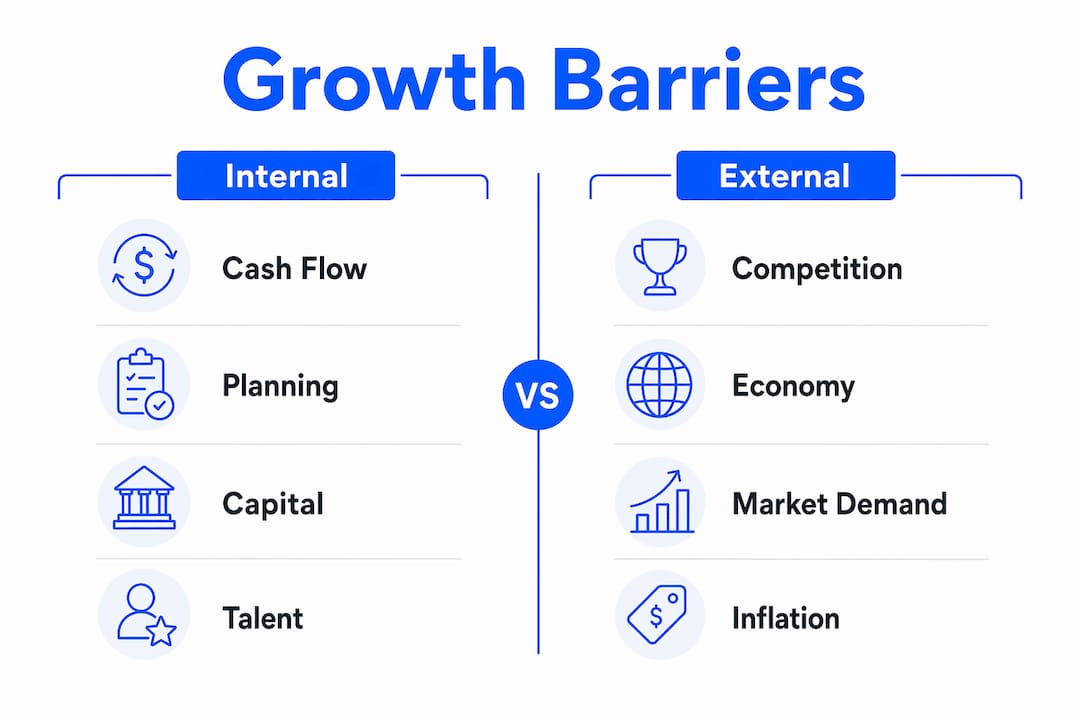
Internal challenges, not external forces, are the primary reason most small businesses struggle to grow. Poor cash flow management is directly linked to 82% of business failures, making it the single most damaging obstacle owners face. Alongside cash flow, insufficient market demand, undercapitalisation, and weak planning consistently derail growth before it gains momentum. Understanding these patterns is the first step toward doing something about them.
Growth stalls when the fundamentals are broken. Most owners assume slow growth is caused by competition or a tough economy. The data tells a different story.

Inflation concerns affect 53% of small businesses across 17 consecutive quarters. That sustained pressure compounds existing internal weaknesses, turning manageable problems into business-ending ones. External conditions do matter, but they expose cracks that were already there.
Professional services businesses report weaker growth outlooks than manufacturing or retail sectors. This matters because most service-based owners assume their challenges are unique to their clients or niche. The reality is that sector-wide structural issues, particularly around planning and capital, drive the pattern.
Cash flow is the movement of money in and out of your business at any given time. When outgoings consistently outpace income, growth becomes impossible regardless of revenue on paper.
82% of small business failures are linked to poor cash flow management. That figure is not about businesses that earned too little. Many failed businesses had strong sales but could not manage the timing between earning and spending.
Several patterns make cash flow worse over time:
The practical signs are clear: you are consistently paying suppliers late, you cannot afford to hire when you need to, or you are drawing less from the business than you need to live on.
Pro Tip: Track your cash flow weekly, not monthly. Use a simple spreadsheet or accounting software like Xero or MYOB to map your expected inflows and outflows four weeks ahead. Catching a shortfall early gives you time to act.
A business without a plan is guessing at every decision. Guessing is expensive.
42% of small businesses fail because there is not enough market demand for what they sell. Most of those businesses never validated demand before launch. They built a product or service they believed in, then hoped customers would agree.
78% of failed businesses lacked a well-developed business plan or market research before starting. That is not a coincidence. Planning forces you to test assumptions before they cost you money.
The table below shows the difference in outcomes between businesses that research and plan versus those that do not.
| Factor | With research and planning | Without research and planning |
|---|---|---|
| Market fit | Validated before launch | Assumed and often wrong |
| Pricing | Based on customer willingness to pay | Based on guesswork or competitor copying |
| Revenue forecasting | Grounded in real data | Optimistic and unreliable |
| Marketing spend | Targeted to known audience | Scattered and wasteful |
| Growth timeline | Realistic and measurable | Vague or overly ambitious |
The pattern is consistent. Businesses that skip research and planning spend money solving problems they could have avoided. Those that do the groundwork spend money accelerating what already works.
Understanding your ideal customer before you build your marketing is one of the highest-return activities a small business owner can do.
Starting with too little money is one of the most common and most underestimated barriers to growth.
79% of failing businesses started with insufficient capital. Insufficient capital does not just mean running out of money. It means never having enough to invest in the things that create growth: marketing, hiring, systems, and infrastructure.
Relying on informal financing such as personal loans or family contributions limits employment growth and long-term scaling ability. Personal loans carry personal risk. They also cap the amount available, which means owners make conservative decisions when bold ones are needed.
Capital constraints show up in specific, damaging ways:
Pro Tip: Before you launch or scale, calculate your true monthly operating costs and multiply by six. That is your minimum capital buffer. If you cannot fund six months of operations without revenue, your growth plan carries significant risk.
A business grows at the speed of its team. When the team is thin, absent, or poorly led, growth stalls regardless of demand or capital.
32% of business owners report job openings they cannot fill, exceeding historical averages. That hiring gap is not just an inconvenience. Unfilled roles mean existing staff carry more than they should, quality drops, and owners get pulled back into day-to-day tasks instead of building the business.
Operational weaknesses that consistently limit growth include:
The insurance point deserves attention. Owners who wait until they hit a revenue threshold before taking out liability or cyber cover are gambling with the capital they have already built. One claim, one data breach, or one lawsuit can wipe out years of growth.
Growth barriers are solvable. The businesses that break through them do not have better luck. They have better systems.
The table below gives you a practical framework for assessing where your business stands and what to address first.
| Growth barrier | Warning sign | First action |
|---|---|---|
| Cash flow problems | Paying suppliers late, no reserve | Build a 4-week cash flow forecast |
| No market demand | Low conversion, high churn | Conduct customer interviews before changing your offer |
| Undercapitalisation | Cannot hire or invest in marketing | Calculate a 6-month capital buffer and close the gap |
| Weak planning | Decisions made reactively | Write a one-page business plan with 90-day milestones |
| Talent and team gaps | Owner doing everything | Document one core process per week and delegate |
| Operational risk | No insurance, no data systems | Review cover and set up basic reporting this quarter |
The most important shift is moving from reactive to deliberate. Reactive owners respond to problems. Deliberate owners build systems that prevent them.
Targeted marketing strategies address one of the most common growth barriers directly: spending money on marketing that does not convert. When your marketing is built on a clear understanding of your customer and a consistent message, it stops being a cost and starts being a growth engine.
Small businesses in the professional services sector face a specific challenge with data. Fragmented internal data makes it harder to use tools like AI effectively for content and marketing. Fixing your data foundations is not a technology project. It is a business discipline that pays off across every function.
Most small businesses struggle to grow because of internal failures in cash flow, planning, capital, and team capacity, not because of external market conditions alone.
| Point | Details |
|---|---|
| Cash flow is the top killer | 82% of business failures link to poor cash flow management, not low revenue. |
| Demand must be validated | 42% of businesses fail because no real market demand existed for their offer. |
| Planning prevents waste | 78% of failed businesses skipped proper planning or market research before launch. |
| Capital gaps limit scale | 79% of failing businesses started undercapitalised, restricting hiring and marketing. |
| Systems beat effort | Owner-dependent businesses cannot scale; documented processes and delegation are required. |
If you recognise these patterns in your own business, you are not alone. The good news is that every barrier covered here is addressable with the right knowledge and structure.

Mybworkshops offers expert-led workshops built specifically for service-based business owners who are tired of guessing. From business strategy to lead generation and marketing that converts, each workshop gives you a practical framework you can apply immediately. The full workshop programme covers the exact challenges this article addresses: planning, marketing, lead generation, and sustainable growth. If you are ready to stop reacting and start building, this is where to start.
Poor cash flow management is directly linked to 82% of small business failures. It is the most common and most damaging internal challenge owners face.
42% of small businesses fail because there is not enough demand for what they sell. Validating demand through customer research before launch is the most reliable way to avoid this outcome.
79% of failing businesses started with too little capital. Without adequate funding, owners cannot invest in marketing, hiring, or systems, which are the three things that drive sustainable growth.
Yes. 78% of failed businesses lacked a proper business plan or market research. A plan forces you to test assumptions, set realistic targets, and make decisions based on evidence rather than optimism.
Start by documenting your core processes so that roles can be filled and trained quickly. Address owner dependency by delegating defined tasks, and review your risk cover so that a single incident does not undo your progress.