
A website sales funnel is a structured, multi-stage system that guides visitors from their first contact with your business through to a specific conversion goal, such as a purchase, booking, or enquiry. The industry term is “sales funnel” or “conversion funnel,” and it describes a deliberate architecture, not just a collection of web pages. Unlike a traditional website that acts as a broad information brochure, a funnel focuses each page on one clear action and removes distractions that pull visitors off course. For small business owners, understanding this distinction is the first step toward building a website that actually generates revenue rather than just traffic.
A sales funnel is called a funnel because more people enter at the top than exit as customers at the bottom. The shape reflects reality: not every visitor is ready to buy, and a well-designed funnel moves the right people forward while qualifying out those who are not a fit. This matters because a website without a funnel structure leaves conversion to chance. Visitors arrive, browse without direction, and leave without taking action.
The practical difference is significant. A traditional website might have a homepage, an about page, a services page, and a contact form, all connected by a navigation menu. A sales funnel website strips away that open navigation on key pages and replaces it with a single, clear path. Each page has one job. That focus is what drives conversions.

For service-based businesses in particular, the importance of sales funnels comes down to predictability. A funnel gives you a repeatable system for turning strangers into enquiries and enquiries into paying clients. Without one, your marketing spend produces inconsistent results because there is no system catching and converting the traffic you generate.
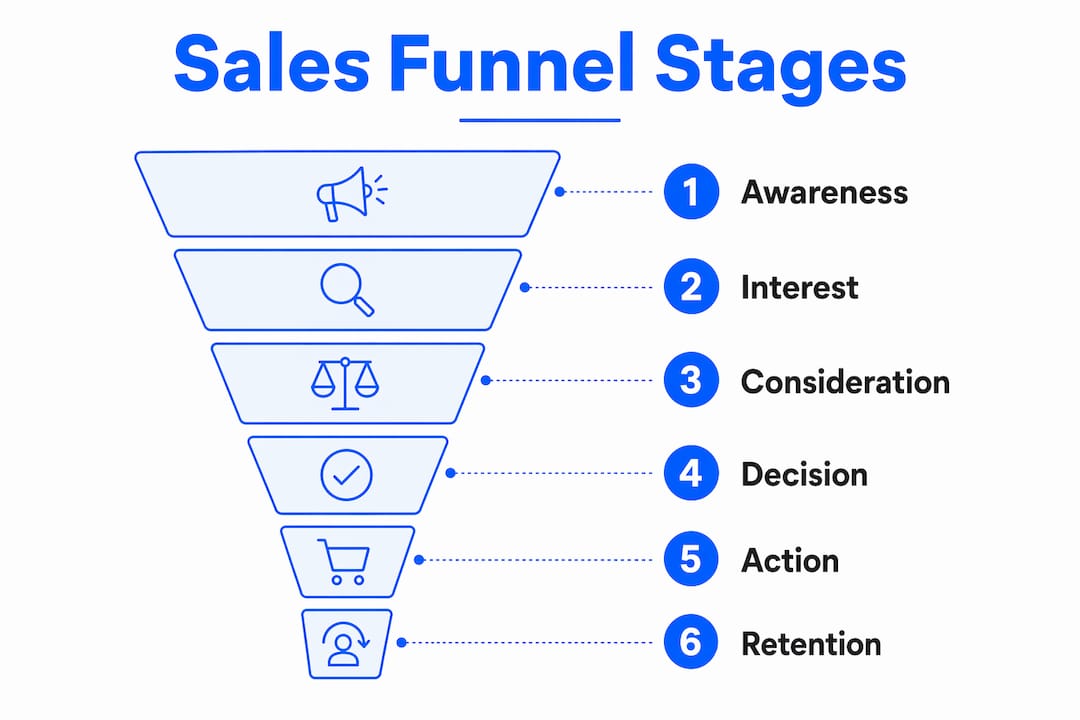
The most widely used funnel model covers five stages: Awareness, Interest, Consideration, Decision, and Action. Some businesses add a sixth stage, Retention, to account for post-purchase behaviour. Each stage reflects where a visitor is in their thinking and what they need from you to move forward.
The table below maps each stage to visitor mindset and the content types that work best.
| Stage | Visitor mindset | Content that works |
|---|---|---|
| Awareness | “I have a problem” | Blog posts, social content, SEO landing pages |
| Interest | “Tell me more” | Lead magnets, email opt-ins, explainer pages |
| Consideration | “Is this right for me?” | Case studies, comparison guides, testimonials |
| Decision | “I’m almost ready” | Sales pages, free consultations, limited offers |
| Action | “I’m buying” | Checkout pages, booking forms, confirmation pages |
| Retention | “What’s next?” | Onboarding emails, loyalty offers, referral prompts |
Content alignment at each stage is what separates a funnel that converts from one that frustrates. A visitor who has just discovered your business does not want to be sent straight to a sales page. They need benefit-led headlines and useful information first. A visitor who has read three of your blog posts and downloaded a free guide is ready for a more direct offer. Matching your message to visitor readiness is the core discipline of funnel design.
The Retention stage is often overlooked by small business owners, yet it is where significant value lives. Turning a one-time buyer into a repeat customer costs far less than acquiring a new one. Post-purchase follow-up is the mechanism that makes this happen, and it belongs inside your funnel system, not as an afterthought.
Building a funnel that converts starts with clarity on two things: who you are trying to reach and what single action you want them to take. Without that clarity, every design decision becomes a guess.
Follow these five steps to build a funnel with intention:
Define your ideal customer. Write down the specific person you are building this funnel for. Their problem, their language, their hesitations. One audience per funnel path produces far better results than trying to speak to everyone.
Map the customer journey. Sketch out the stages your customer moves through before they buy. Where do they first hear about you? What questions do they ask? What objections do they have? This map becomes your funnel blueprint.
Create focused landing pages. Each page in your funnel should have one call-to-action. No competing links, no full navigation menu, no sidebar distractions. High-converting landing pages follow this rule without exception. The goal of each page is to earn the next click, not to showcase everything you offer.
Automate your nurture sequence. Once a visitor opts in, an automated email sequence keeps the conversation going. A well-structured nurture sequence delivers value, builds trust, and moves subscribers toward a buying decision without requiring you to be present for every interaction.
Track performance from day one. Set up analytics before you launch. Know your conversion rate at each stage, where visitors drop off, and how long they spend on key pages. This data tells you where to improve.
Pro Tip: Reduce friction at every step by asking for the smallest reasonable commitment first. Capture an email address before asking for a phone number. Offer a free resource before pitching a paid service. Each small “yes” builds trust and makes the next step easier.
Good copywriting matters as much as page design. Use plain language. Lead with the benefit to the reader, not a description of your service. Write your calls-to-action as outcomes: “Get my free guide” converts better than “Submit.”
Tracking funnel performance replaces guesswork with clear direction. Analytics visibility is one of the primary benefits of a funnel approach because it shows you exactly where visitors leave and what stops them from converting.
The metrics that matter most for small business funnels are:
Zero-party data capture adds another layer of insight. This is information visitors actively share with you, such as answers to a quiz or a survey, which tells you their specific situation and lets you route them to the most relevant part of your funnel. It produces far more useful data than passive tracking alone.
Review your funnel metrics monthly. Small, consistent improvements compound over time and produce meaningful gains in conversion without requiring a complete rebuild.
Most funnel problems come from a small set of repeatable errors. Recognising them early saves significant time and money.
Pro Tip: Audit your existing website against these five mistakes before building anything new. You may find that fixing one or two issues on your current site produces a meaningful lift in conversions without a full rebuild. The website conversion killers resource from Mybworkshops is a practical starting point for this audit.
Once your core funnel is working, these three strategies extend its effectiveness and increase the value of every lead you generate.
Segment by behaviour, not just demographics. Visitors who download a specific guide, visit your pricing page, or click a particular email link are telling you something about their readiness and interests. Use that behaviour to route them into a more relevant follow-up sequence. A visitor who reads your pricing page three times is far closer to buying than one who only read a blog post. Treat them differently.
Build automated email sequences for each segment. Automating nurture sequences means your funnel works around the clock without manual effort. Each sequence should deliver value first, address common objections, and then present a clear offer. A well-built sequence of five to seven emails can move a cold lead to a booked consultation without a single manual follow-up.
Use small commitments to reduce friction. Asking for minor information first builds trust before major requests. Start with an email address in exchange for a free resource. Then ask for a name and phone number when they book a call. Then ask for payment when they are ready to buy. Each step earns the right to ask for more.
Integrate a CRM to qualify and route leads. A customer relationship management tool connected to your funnel captures lead data and tells you which leads are most likely to convert. This lets you prioritise follow-up and personalise your outreach based on what each lead has already told you about themselves.
Optimise continuously, not just at launch. The most effective funnels are not built once and left alone. Review your data monthly, test one change at a time, and measure the result. Small improvements to your opt-in rate, your email click rate, or your sales page headline compound into significant gains over a year.
A lead generation system workshop can accelerate this process by giving you a structured framework to apply these strategies to your specific business rather than working it out from scratch.
Mybworkshops runs expert-led workshops built specifically for service-based business owners who want a marketing system that generates consistent leads and converts them into clients.
The Lead Generation System Workshop walks you through building a complete sales funnel tailored to your business, from defining your ideal customer to setting up automated nurture sequences. The full workshop range covers website strategy, conversion design, and traffic generation, giving you a connected system rather than isolated tactics. If you are ready to stop relying on referrals alone and build a repeatable client acquisition system, the Mybworkshops programme is a practical next step.
A website sales funnel is the most direct path from website traffic to paying clients, and building one requires clear stages, focused pages, and consistent follow-up.
| Point | Details |
|---|---|
| Define the funnel stages | Map your visitor journey across Awareness, Interest, Consideration, Decision, and Action before building anything. |
| One call-to-action per page | Remove competing links and navigation from funnel pages to reduce decision fatigue and increase conversions. |
| Match content to readiness | Cold visitors need value first; warm leads are ready for a direct offer. Mismatching these kills conversion rates. |
| Track drop-offs monthly | Identify which funnel stage loses the most visitors and fix that page before changing anything else. |
| Automate nurture sequences | Automated email follow-up keeps leads moving through the funnel without requiring manual effort for every contact. |
A website sales funnel is a series of web pages and follow-up steps designed to guide visitors from first contact to a specific action, such as a purchase or booking. Each step moves the visitor closer to that goal.
A regular website presents information across many pages with open navigation. A sales funnel focuses each page on one action and removes distractions, making it far more effective at converting visitors into leads or clients.
Most sales funnels use five stages: Awareness, Interest, Consideration, Decision, and Action. Many businesses add a sixth stage, Retention, to manage post-purchase follow-up and repeat business.
Track your conversion rate at each stage and identify where visitors drop off. If most visitors leave on your landing page, the problem is your headline or offer. If they drop off after opting in, the problem is your nurture sequence.
A sales funnel gives small businesses a repeatable system for converting website traffic into clients. Without one, results depend on timing and luck rather than a consistent process.