

DIY websites commonly underperform because they lack the technical foundations, SEO structure, and conversion strategy that turn visitors into paying clients. For Australian small business owners, this gap is costly. A site that looks presentable but loads slowly, ranks poorly in local search, and fails to guide visitors toward action is not a business tool. It is a digital brochure that nobody reads.
The core reasons DIY sites struggle come down to a handful of consistent problems:
These issues combine to produce low search visibility, high bounce rates, and weak business growth. Google’s Core Web Vitals standards measure exactly the performance areas where DIY sites consistently fall short. Mybworkshops works with service-based business owners to address these gaps through structured, strategy-led guidance.
Most DIY website problems are not random. They follow a predictable pattern, and once you know what to look for, they are hard to unsee.
DIY builders generate code automatically, and that code is rarely clean. The result is large DOM sizes, render-blocking scripts, and pages that take far too long to load. Excessive plugins and scripts slow sites down and create conflicts that compound over time. Google uses page speed as a ranking signal, and pages that exceed three seconds are flagged as slow. Every extra second costs you visitors.

DIY platforms often handle meta tags, URL structures, and sitemaps automatically, but that automation is rarely accurate. DIY sites lack foundational SEO elements like proper schema markup and local signals, which means your business may be invisible in the local search results that matter most. If someone in your suburb searches for the service you offer, your site needs structured data and location-specific content to appear. Most DIY builds have neither.
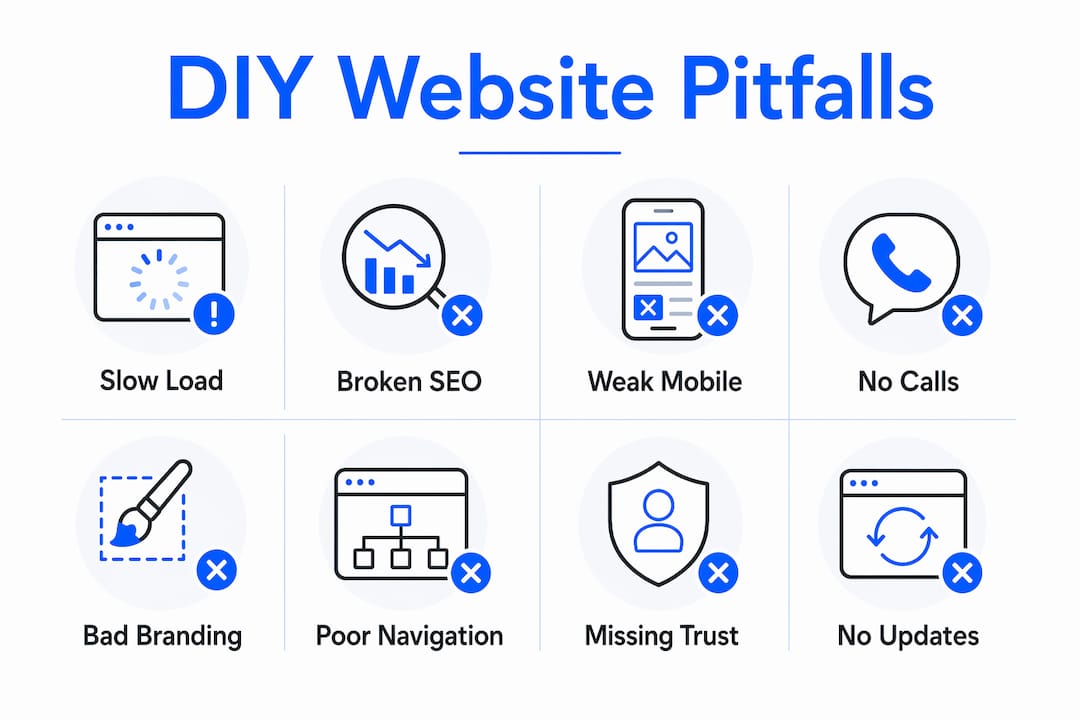
More than half of your visitors arrive on a phone. Many DIY sites are built on a desktop and then assumed to work on mobile, but buttons are too small, forms are frustrating, and text requires zooming. Each small friction point nudges a visitor closer to leaving. A mobile-first approach is not optional in 2026.

Visitors need to be guided. Without prominent, well-placed calls-to-action, even genuinely interested people leave without making contact. Small business owners often build sites that are visually acceptable but lack the conversion architecture that turns browsers into enquiries. This is one of the most common website conversion killers and one of the easiest to fix with the right guidance.
When your website looks different from your social media, your emails, and your printed materials, trust erodes. DIY templates make it tempting to pick a design that looks good rather than one that reflects your brand. The result is a site that feels generic, forgettable, and disconnected from the business you have worked to build.
If visitors cannot find what they need within a few clicks, they leave. DIY sites often have too many menu items, unclear page hierarchies, or content buried where no one will find it. Good navigation is not just about aesthetics. It directly affects how long people stay and whether they convert.
People do not enquire from websites they do not trust. Missing reviews, no testimonials, vague service descriptions, and stock photography all weaken credibility. A professionally built site incorporates trust signals deliberately. On a DIY site, they are usually an afterthought.
A site built and forgotten is a site in slow decline. Search algorithms reward fresh, relevant content. Without regular updates, your rankings slip, your content becomes outdated, and security vulnerabilities go unpatched. This is one of the quieter reasons DIY websites fail over time.
The appeal of a DIY website is the upfront saving. The reality is that the costs show up later, and they are harder to see.
Time is the biggest one. Building a site from scratch takes a significant investment of hours. That is time not spent on client work, sales, or the parts of your business that actually generate revenue. The opportunity cost is real, even if it does not appear on an invoice.
Beyond time, DIY platforms come with structural limitations that grow more painful as your business does:
The cheapest website almost always costs the most in the long run. Rebuilds, lost leads, and missed opportunities accumulate quietly until the cost becomes undeniable.
The difference between a DIY site and a professionally guided one is not just aesthetics. It is strategy, structure, and ongoing attention.
Mybworkshops uses a structured, three-phase approach that combines strategy, expert guidance, and ongoing management to help service-based business owners build websites that perform. The focus is not on making something that looks nice. It is on building a site that ranks, converts, and grows with the business.
Businesses that rebuild on a professional platform with proper SEO foundations see rapid improvement in local search rankings and increased conversions within weeks of launch. That kind of result does not happen by accident. It comes from getting the technical foundations right, writing copy that speaks to the right audience, and setting up a conversion flow that guides visitors toward action.
The key improvements a strategic approach delivers include:
A website is not a one-off project. It is a business tool that needs the same ongoing attention as any other part of your marketing. Without regular updates, technical monitoring, and a clear content strategy, even a well-built site will gradually lose ground to competitors who treat theirs as a living asset.
Pro Tip: Before you invest in ads or social media, audit your website first. If the site cannot convert a warm visitor, paid traffic will only amplify the problem. Fix the foundation before you build on top of it.
Viewing your website as a dynamic part of your business system, rather than a one-time task to tick off, is the shift that separates businesses that grow from those that plateau. For practical guidance on turning visitors into clients, the strategy matters as much as the design.
If your website is not bringing in enquiries, you are not alone. Most service-based business owners in Australia reach a point where the DIY approach has run its course, and the gap between what the site looks like and what it actually delivers becomes impossible to ignore.

Mybworkshops offers expert-led workshops for small business owners who are ready to stop guessing and start building a website and marketing system that works. The structured programme covers strategy, design thinking, SEO fundamentals, and conversion, giving you the knowledge and tools to make real improvements without handing everything over to an agency. Real clients have seen increased conversions and reduced wasted ad spend after working through the Mybworkshops framework. If you are ready to treat your website as the business asset it should be, browse the available workshops and find the right starting point for where you are now.
DIY websites typically lack clean code, proper SEO structure, and a conversion strategy, which means they look acceptable but fail to rank in search or turn visitors into clients. Platform lock-in, security risks, and limited customisation add to the long-term cost.
Slow websites are usually caused by bloated code from DIY builders, too many plugins, unoptimised images, and cheap shared hosting. These factors combine to push load times past the point where visitors stay, and Google penalises slow pages in its rankings.
Most small business websites fail because they were built without a clear purpose, lack local SEO, have no trust signals, and are never updated after launch. A site that is not actively managed gradually becomes slow, irrelevant, and invisible in search results.
Poor design goes beyond aesthetics. It includes unclear navigation, missing calls-to-action, inconsistent branding, weak mobile experience, and copy that does not speak to the visitor’s needs. Any one of these issues reduces conversions; most DIY sites have several at once.
Yes. Mybworkshops runs structured workshops that help service-based business owners identify what is holding their website back and build a strategy to fix it, covering SEO, conversion, and ongoing management as part of a broader business system.
DIY websites underperform because they lack the technical SEO, conversion strategy, and ongoing management that turn a site into a genuine business asset.
| Point | Details |
|---|---|
| Technical SEO gaps | Missing schema markup, poor URL structures, and weak local signals make DIY sites invisible in search. |
| Speed and performance | Bloated code and excessive plugins slow load times, hurting both rankings and visitor retention. |
| No conversion strategy | Without clear calls-to-action and trust signals, visitors leave without enquiring, regardless of traffic volume. |
| Hidden long-term costs | Platform lock-in, security vulnerabilities, and the time cost of DIY builds outweigh the initial savings. |
| Mybworkshops approach | Mybworkshops’ structured, three-phase workshops help service-based business owners build sites that rank, convert, and scale. |