

Why solopreneurs need a niche to earn more, market less

Woman organizing colorful folders on desk

Solopreneurs need a niche because it creates pricing power, clearer marketing and faster client decisions. Without one, you’re competing on price against everyone and convincing no one quickly.

  • Clarity: narrower focus means sharper messaging and fewer decisions to make each week.
  • Pricing power: specialists charge more and negotiate less, because they solve a specific, urgent problem.
  • Cheaper growth: niche marketing pulls in warmer traffic, so you spend less to win the same client.

A bookkeeper who serves “small businesses” competes with thousands of others on price. A bookkeeper who serves “registered NDIS providers” gets referred by word of mouth, charges a premium, and rarely discounts.

Key Takeaways

Solopreneurs who commit to a specific niche gain pricing power, clearer marketing and lower customer acquisition costs compared with those who stay generalist.

Point Details
Niching creates pricing power Specialists command higher fees and face less negotiation than generalists.
Test before committing Use Google Trends, marketplace listings and landing pages to validate demand cheaply.
Score ideas objectively Weight demand, margin, fit, compliance and differentiation before shortlisting.
Myths usually don’t hold up “Too narrow” and “niching means never pivot” are rarely true once tested.
Mybworkshops supports validation Its workshops provide scorecard templates and a community to test niche ideas properly.

Table of Contents

Why niching changes a solopreneur’s profit and sustainability profile

Every decision gets easier once you know exactly who you serve. Fewer options means faster copywriting, quicker sales calls, and a website that speaks to one person instead of everyone. That clarity alone removes a huge chunk of the friction that keeps solopreneurs stuck.

Then there’s the money. Specialists can charge more because they solve a specific, urgent problem rather than a general one. Niching often shortens sales cycles and increases rates, because a prospect with a specific pain point trusts a specialist faster than a generalist. A copywriter who writes “for businesses” might quote $800 and get haggled to $500. A copywriter who writes exclusively for allied health clinics can quote $1,500 with no negotiation, because the clinic owner sees an obvious fit.

Marketing efficiency follows the same pattern. Broad search terms attract browsers; narrow, intent-rich phrases attract buyers, which means less wasted ad spend and higher conversion for the same traffic.

  • Sharper messaging speeds up decision-making for both you and your buyer.
  • Specialist positioning supports higher fees with less resistance.
  • Intent-rich search terms convert better than broad category terms.

Pro Tip: Write your next piece of marketing copy for one named client, not “small business owners.” If you can’t picture their face, your niche isn’t specific enough yet.

What tangible benefits come from picking the right niche?

A well-chosen niche shows up in numbers, not just confidence. A weighted scorecard approach that scores demand, margin and differentiation tends to surface ideas that convert better once tested, because the trade-offs get forced early rather than discovered the hard way.

  • Higher conversion: a landing page written for “wedding photographers who need Instagram content” will usually outconvert one written for “small businesses who need social media help.”
  • Higher average order value: bundling a niche service (say, website copy plus product descriptions for online furniture sellers) lifts order value because the offer matches a specific workflow.
  • Lower customer acquisition cost: intent-rich searches and targeted outreach cost less per lead than broad campaigns chasing everyone.
  • Stronger referrals: clients refer specialists more readily than generalists, because the referral carries less risk for the person making it.

None of these benefits show up overnight. They compound as your reputation in a specific space builds.

What are the biggest myths and mistakes about niching?

Most solopreneurs avoid niching because of three fears, and all three are usually wrong in practice.

  • Myth: “Too narrow means too small.” Reality: narrow positioning is what creates defensible expertise that protects margins. Corrective action: test the niche with real searches or listings before assuming it’s too small. If Google Trends or a marketplace shows steady interest, it’s probably viable.
  • Myth: “Just follow your passion.” Reality: passion without demand is a hobby, not a business. Corrective action: cross-check your interest against actual buyer searches and existing marketplace sales.
  • Myth: “Niching locks you in forever.” Reality: staged niching lets you start narrow and expand into adjacent segments once you’ve proven demand. Corrective action: pick a first niche you can leave in six months if it doesn’t work.

How do you choose the right niche step by step?

Picking a niche works best as a structured exercise, not a lightning bolt of inspiration. This process borrows from the scored, staged approach that treats niche selection as testable, not guessed.

  1. Generate ideas. List 20 to 40 possibilities using prompts like “who do I already understand,” “what complaint do I hear repeatedly,” and “what do I do faster than most people.” Cross-reference against your ideal customer rather than a vague market.
  2. Quick triage. Cut anything with obvious compliance issues, thin margins, or logistics you can’t handle solo.
  3. Score what’s left. Weight each surviving idea on demand, margin, effort or shipping fit, compliance, and differentiation, similar to the weighting used in product-niche scorecards: roughly 30% demand, 30% margin, 20% fit, 10% compliance, 10% differentiation.
  4. Shortlist three. Pick your top three scores and plan a first test for each, with a metric you’ll actually measure, not just a gut feeling.

How do you validate a niche before committing?

Testing beats guessing, every time. Build a simple scorecard, run cheap experiments, and set pass or fail gates before you spend real money.

Set your gates before you start: a landing page under 2% conversion, or a marketplace listing with zero enquiries after a fortnight, is a fail signal. Checking freight costs, marketplace fees and compliance requirements early stops cash getting trapped in an idea that looked good on paper.

  • Run tests in parallel where possible, not one after another.
  • Kill ideas that fail two gates rather than hoping the third test saves them.
  • Keep a spreadsheet of every test result, so patterns become visible over time.

When should you broaden your niche or pivot away from it?

Sustained demand, repeat purchases and operations you can scale without burning out are signals to broaden. Failed tests, thin margins after costs, or regulatory blocks are signals to pivot.

  • Broaden when: demand holds steady for months, clients keep coming back, and you could serve more of them without working more hours.
  • Pivot when: two or three tests fail the same gate, margins evaporate once real costs are included, or compliance rules make the niche too risky.
  • Expand safely through adjacency: serve a related audience, add a complementary offer, or open a new geographic segment gradually rather than all at once.

What do good solopreneur niches actually look like?

A few examples make the pattern obvious.

  • A bookkeeper for registered NDIS providers works because compliance is complex and providers pay to reduce risk.
  • A copywriter for allied health clinics works because the buyer job (patient-friendly, compliant copy) is specific and searchable.
  • A 4WD accessory seller focused on dual-cab canopies works because narrow product searches convert far better than generic category terms, and bundling fitment guides with the product lifts average order value.
  • A virtual assistant for allied health practices works because the workflow (bookings, Medicare claims) is repeatable and teachable.

Each example pairs real demand with a margin that survives at low volume, not just a market the founder finds interesting.

Your 30-day plan to move from idea to test

  1. Day 1: Run your niche ideas through Google Trends and check two or three marketplaces for existing listings and pricing.
  2. Week 1: Score and shortlist three ideas using the demand, margin, fit and compliance framework, then plan your first test.
  3. Week 3: Launch the first marketplace listing or landing page test and track clicks, sign-ups or enquiries.
  4. Day 30: Compare results against your pass or fail gates and decide whether to commit, adjust, or drop the idea.

How Mybworkshops helps you find and validate a niche

Choosing a niche on gut feeling alone is how most solopreneurs waste months of ad spend and energy. Mybworkshops gives you a structured way to test niche ideas against real demand and margin data, instead of guessing and hoping a market shows up.
Mybworkshops

Inside the workshop program, you’ll work through scorecard templates for scoring demand and margin, a hands-on plan for running your first low-cost test, and feedback from a community of other service-based business owners doing the same work. It’s built around the same three-phase structure Mybworkshops uses across its programs: clear strategy first, then practical tools, then support to put it into action. Once your niche is validated, the next logical step is sharpening your positioning and messaging so your marketing actually reflects it. Have a look at Mybworkshops’ full range of workshops and book the one that matches where you’re at right now.

Sources

FAQ

What are the pros and cons of being a solopreneur?

The main pros are full control, lower overheads and faster decisions; the main cons are limited capacity, no shared workload and higher personal risk if the business relies entirely on you. Choosing a niche helps offset the capacity limit by making your marketing and sales process far more efficient.

Man plugging phone charger into power strip

What are the top niches for solopreneurs?

There’s no single fixed list, but strong candidates share three traits: clear buyer demand, workable margins at low volume, and a specific problem you can solve better than a generalist. Test any idea with real search and marketplace data before assuming it’s a “top” niche.
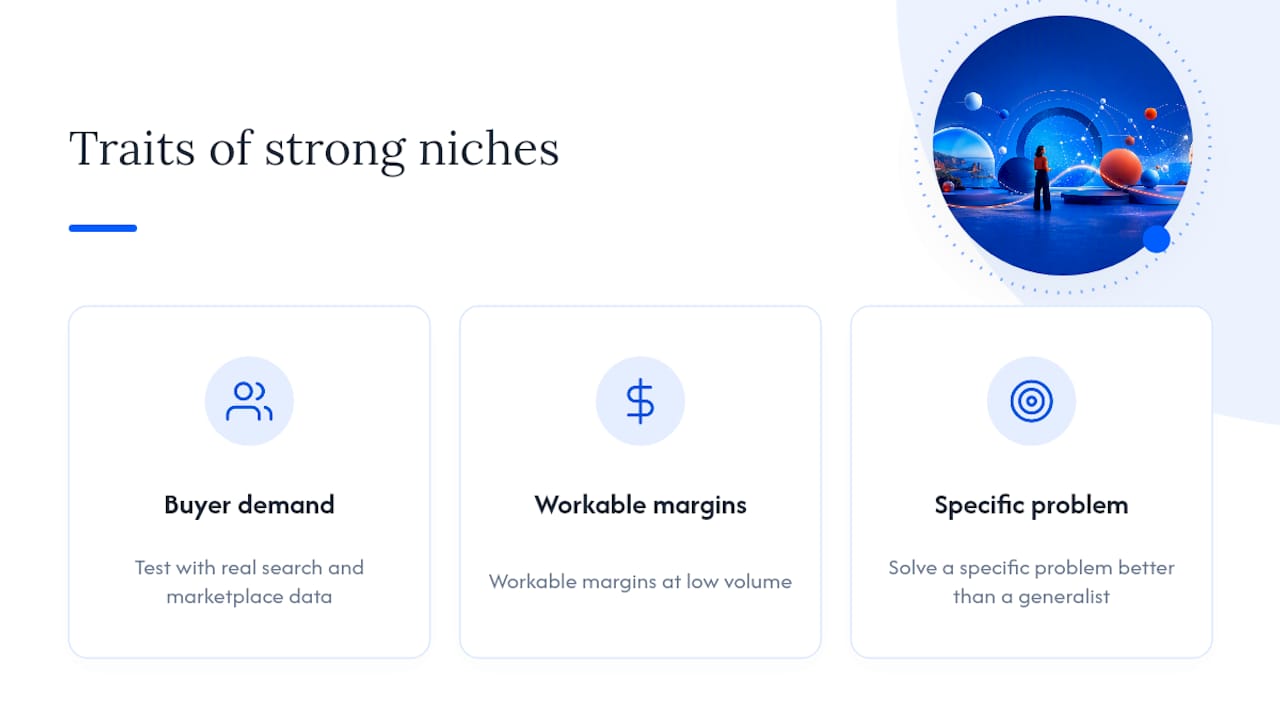
Diagram of top niche traits for solopreneurs

Can a solopreneur be a CEO?

Yes. A solopreneur runs every function of the business alone, which technically makes them CEO, marketer and operator at once. Many use titles like “founder” or “director” instead, since “CEO” can sound mismatched for a one-person operation.

What’s the difference between a solopreneur and an entrepreneur?

A solopreneur runs the business alone by choice and typically has no plans to hire staff, while an entrepreneur often builds a team and scales beyond themselves. Niching matters more for solopreneurs specifically because they can’t outcompete on volume, only on focus and expertise.

Do I need a niche if I already have some clients?

Having clients doesn’t mean you have a niche. If your current clients span unrelated industries with different problems, narrowing your focus usually still improves referrals, pricing and marketing efficiency.


Hi There, I'm Peggy

I’m the brains (& the energy) behind MYB Workshops.

For 20+ years, I’ve helped business owners ditch the confusion, clarify their message, and build brands that attract the right clients. No fluff, no overwhelm, just proven strategies that work.

If you want to build a brand that feels right and actually brings in business, you’re in the right place!

Hi There, I'm Peggy!

For more than 20 years, I’ve helped businesses grow with better marketing systems that support long-term plans.

Everything inside MYB Workshops is built from the same strategies, frameworks and practices we use in our agency. These aren’t theories or quick fixes. They’re proven approaches shaped by real-world results and applied across hundreds of businesses.

MYB Workshops was created to make those tools and insights accessible to business owners who want greater clarity and confidence in their business.

I’m glad you’re here in the Blog, explore some of the hot topics our clients ask us about. I hope to see you in the workshops, real soon!

Build Your Business

If your business isn’t attracting and converting the right customers, something needs to change.

In MYB Workshops, you get proven strategies, expert guidance, and a clear plan that actually works. 

Start building a marketing system that works, today!

Stop Losing Sales

Brand confusion costs sales. Learn how to position, market, and sell with confidence inside MYB Workshops.

FREEBIES
FREE Brand Clarity Workshop

Crafting Your Brand Identity 

An on-demand workshop to help you create a brand identity that attracts the right clients, builds trust, and drives real results, without the guesswork.

PLUS Grab your FREE workbook to implement everything instantly!

6 Strategies to Build a Website That Converts

3 seconds. That’s all it takes for a visitor to decide if they’ll stay or leave your website.

Download this FREE guide to learn 6 proven strategies to keep visitors engaged and turn them into paying clients.

FREE Branding Guide

Your brand is more than a logo. It’s the foundation of your entire business.

If you skip this step, you risk wasting time and money on marketing that doesn’t convert.

Download this FREE guide and discover 5 key steps to build a brand that attracts, connects and drives long-term success.

Related Blog Articles