

A lead is anyone who has shown a flicker of interest but hasn’t been checked against your business yet. A prospect is a lead you’ve qualified: they fit your ideal customer profile, and there’s been genuine back and forth. That’s the whole distinction in one sentence, and it’s the one most small business owners get backwards.
Three things to do right now:
The rest of this article walks through the definitions properly, gives you a repeatable qualification framework, and hands you a checklist you can use on your very next discovery call.
A prospect is a qualified lead who has engaged and matched your ideal customer profile, while an opportunity has confirmed budget, timeline, and decision-making authority.
| Point | Details |
|---|---|
| Lead vs prospect | A lead is unqualified interest; a prospect has engaged and matches your ideal customer profile. |
| Use the three-level framework | Check organisation fit, opportunity need, and stakeholder authority separately before calling a lead qualified. |
| Match effort to stage | Nurture leads lightly, give prospects personalised attention, and push opportunities to a clear decision. |
| Track stage-specific KPIs | Measure lead-to-prospect rate, average time in stage, and opportunity win rate separately. |
| Build the system, don’t just learn it | Mybworkshops’ lead generation workshop helps you turn this checklist into a working intake and follow-up system. |
A lead is an unqualified contact who has shown some initial interest, whether that’s downloading a guide, filling in a contact form, or handing over a business card at a networking event. According to Crunchbase’s breakdown of the sales funnel, a lead hasn’t been vetted for fit yet. They might be perfect for your services, or they might be a student researching a school project. You genuinely don’t know.
A prospect is a lead that’s been checked against your ideal customer profile and has engaged with you directly. That engagement is the dividing line. A lead that opened three of your emails is still a lead. A lead who replied to ask about pricing, or booked a call, has crossed into prospect territory because there’s now two-way contact and some evidence of fit.

A sales opportunity sits one step further along again. This is a prospect who is actively considering buying, with real signals attached: a budget range, a rough timeline, and someone in the conversation who can actually approve the spend, as Crunchbase and Salesforce both note in their funnel definitions.
Here’s how that looks for a typical service business:
Once you separate these three stages clearly, qualification stops feeling like guesswork and starts feeling like a process.
| Aspect | Lead | Prospect | Sales opportunity |
|---|---|---|---|
| Definition / qualification status | Unqualified, initial interest only | Qualified for fit, has engaged | Actively considering a purchase |
| Pipeline stage | Top of funnel | Middle of funnel | Bottom of funnel |
| Typical sales/marketing action | Automated nurture, educational content | Personalised outreach, discovery call | Proposal, negotiation, closing |
| Conversion likelihood | Low, largely unknown | Moderate, improving with each touch | High, if the deal is handled well |
| Key qualification signals | Filled a form, downloaded a resource | Replied, asked questions, matched ICP | Confirmed budget, timeline, decision-maker involved |
In your CRM, tag these consistently: an entry-level lead becomes a marketing-qualified lead once basic fit is confirmed, then a sales-qualified lead or prospect once there’s engagement, then an opportunity once buying signals appear. Keep a handful of fields honest and current rather than a dozen you never update.
Treating every contact the same way is one of the most common (and expensive) habits in small service businesses. Adobe’s research on sales terminology points out that confusing these categories doesn’t just create messy spreadsheets, it actively lowers performance because marketing and sales end up chasing different definitions of “ready.”
The practical damage looks like this:
A landscaper we’ve seen this play out with spent weeks personally following up every quote-form submission, most of which were homeowners three suburbs outside their service area. Consistent definitions and a quick qualification step would have saved that time for actual prospects.
The most reliable method is a three-level qualification framework: organisation, opportunity, and stakeholder. HubSpot’s research on upgrading leads recommends checking these three levels separately rather than trying to assess everything in one messy conversation.
A short follow-up email does a lot of this work for you. Something like: “Thanks for reaching out about [service]. To make sure I point you in the right direction, could you tell me a bit about your timeline and whether you’ve got budget set aside for this yet? Happy to jump on a quick call if that’s easier.”
Watch for these signals that a lead has genuinely become a prospect:
Pro Tip: Simple scoring beats complicated scoring every time for a small team. If a lead answers two of your three qualification questions clearly, fast-track them. If they answer none, put them in a nurture sequence and check back in a month.
For solopreneurs, a lighter version of this works fine too. Ungrind’s qualification framework suggests four quick checks: fit, need and timing, budget realism, and decision authority, rather than trying to run a full enterprise scorecard on every enquiry.
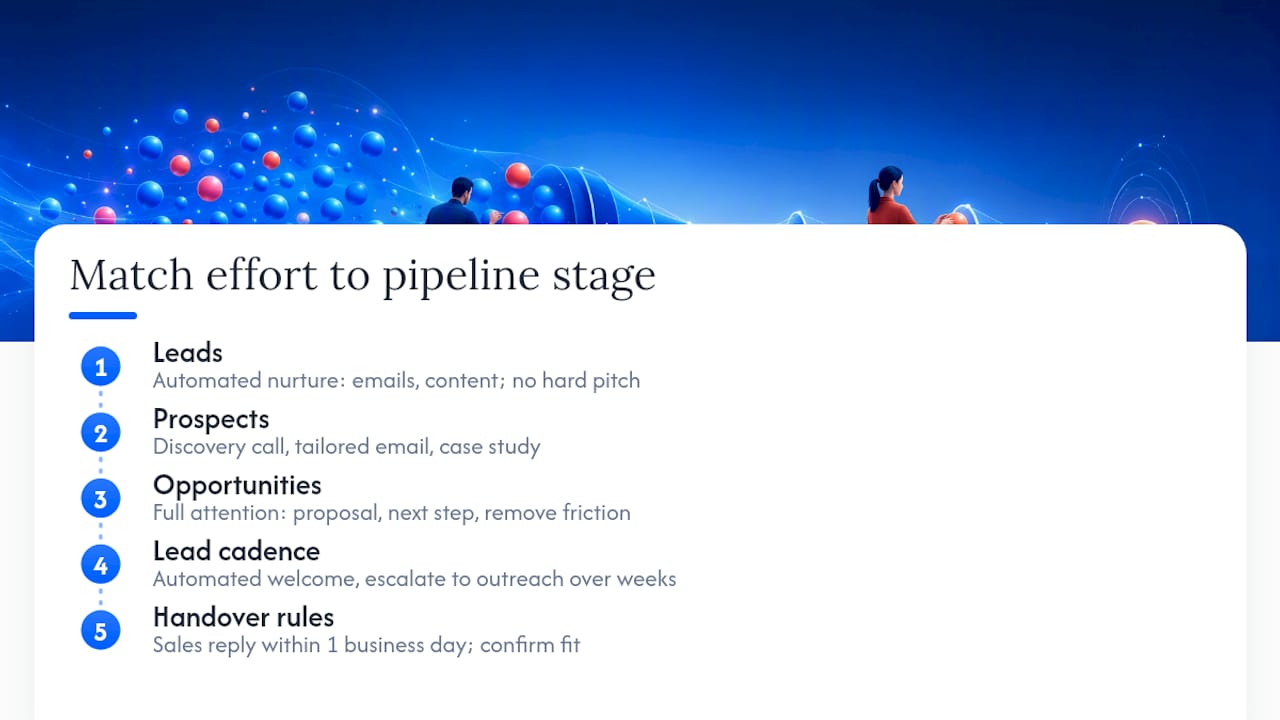
Each stage needs a different kind of effort, and applying prospect-level attention to every lead burns you out fast.
Leads get automated or low-effort nurture: a helpful email series, useful content that answers common questions, and the occasional check-in. No hard pitch yet.
Prospects get personalised discovery. A phone call, a tailored email referencing what they specifically asked about, maybe a case study relevant to their situation.
Opportunities get your full attention: a proposal, a clear next step, and negotiation focused on removing friction rather than convincing them all over again.
A realistic cadence for a new lead might include a sequence of emails and calls spaced out over several weeks, starting with an automated welcome email and gradually escalating to direct outreach, before moving non-responsive leads to long-term nurturing or sales follow-up.
If marketing and sales are separate functions in your business, agree on simple handover rules: sales responds to a qualified prospect within one business day, a meeting only gets booked once organisation fit is confirmed, and nobody gets handed over without at least one documented reply.
Not every prospect becomes an opportunity, and Zendesk’s research on the funnel makes the point that opportunities need clear buying signals, not just polite interest.
Pro Tip: To push a mid-stage opportunity forward, set a specific decision date with the buyer and deliver a short, concrete summary of the return they’ll get by acting before then. Vague follow-ups stall deals; a clear milestone moves them.
You don’t need enterprise software to run this properly. You need consistent habits.
A six-question script you can use on a discovery call or even adapt into a form:
Three KPIs worth tracking separately:
Knowing the difference between a lead and a prospect is one thing. Building an intake form, a scoring rule, and a follow-up cadence that actually runs without you thinking about it every day is another. That’s the gap Mybworkshops exists to close: a structured, three-phase program that walks service-based business owners through building the exact qualification system this article describes, rather than leaving you to piece it together from blog posts.
Inside the lead generation and sales funnel workshop, you’ll walk away with:
If you’d rather see the full range of workshops available before committing to one, the workshops archive lays out every option so you can pick the one that matches where your pipeline is stuck right now.
No. A lead is unqualified initial interest, while a prospect has been checked for fit and has engaged with you directly, as Crunchbase explains.
A lead always comes first. Every prospect started as a lead before qualification confirmed they were a genuine fit.
Prospecting is actively searching for and reaching out to potential customers, often through outbound efforts, while lead qualification is the process of assessing whether an existing lead fits your organisation, opportunity, and stakeholder criteria, as outlined in HubSpot’s qualification framework.
Not quite. Lead generation focuses on attracting new contacts through content, ads, and referrals, while prospecting involves proactively identifying and contacting people who match your ideal customer profile.
Mybworkshops’ lead generation workshop walks you through building an intake form, qualification script, and follow-up cadence tailored to service-based businesses, turning the framework in this article into a working system.