

How to wholesale real estate in Australia: a beginner’s guide

Hands arranging wholesaling real estate contracts

Real estate wholesaling means securing an assignable contract or option over a property and then selling that contractual right to an end buyer for an assignment fee — you never actually purchase the property yourself. As Cockatoo explains, the wholesaler finds a below-market deal, locks it in with a seller, and assigns the contract to an investor before settlement.

Three things you must do before marketing your first deal:

  1. Check your state licensing rules and AML/CTF obligations with your state regulator, AUSTRAC, and the ATO — acting like an agent without a licence carries serious penalties.
  2. Build a verified buyer list of cash investors before you secure a contract, so you have somewhere to assign it.
  3. Use an assignable contract or option deed with a written due-diligence window — never rely on verbal agreements or assume optionality is automatic.

Legal warning: If your wholesaling activity looks like brokering or marketing property on behalf of others, it can trigger real estate licensing requirements and AML/CTF obligations under Australian law. Get local legal advice before you market any deal.


Key takeaways

Wholesaling real estate in Australia requires a sound contract structure, a pre-built buyer list, and a clear understanding of your state’s licensing rules and the AML/CTF obligations that apply from 1 July 2026.

Point Details
Check licensing before marketing State licensing rules vary; marketing or negotiating property for others without a licence can be an offence.
Due diligence is not automatic A due-diligence period must be negotiated and written into the contract before the deal becomes unconditional.
Build your buyer list first Pre-verified cash buyers are the difference between a deal that assigns quickly and one that stalls.
Expect realistic Australian fees Assignment fees in Australia typically range from $10,000 to $40,000 per deal, not the inflated figures from US content.
AML/CTF reforms start 1 July 2026 If your activity constitutes a designated service, enrol with AUSTRAC and implement an AML/CTF programme early.

Table of Contents

How to wholesale real estate: a step-by-step roadmap for beginners

The process breaks into five stages. Work through them in order — skipping ahead is where most beginners run into trouble.
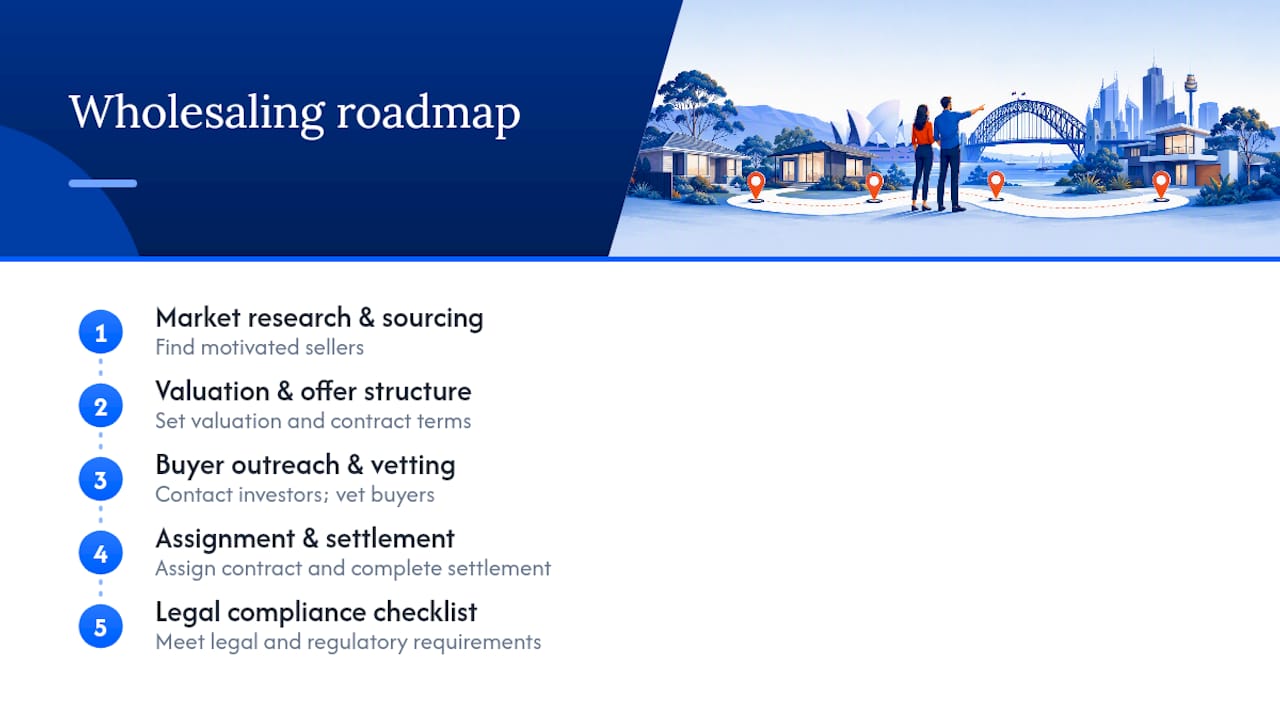
Diagram of five stages of Australian real estate wholesaling

Stage 1: Market research and finding motivated sellers

Start with one suburb or postcode you know well. Study recent sales data on Domain or realestate.com.au to understand what properties sell for after renovation (the after-repair value, or ARV). Then focus your energy on finding motivated sellers: people facing financial pressure, deceased estates, divorce, or properties sitting vacant.

Practical sourcing methods:

  • Letterbox drops in target suburbs (keep language factual and non-promotional)
  • Networking with local conveyancers, solicitors, and property managers who encounter distressed owners
  • Facebook groups for Australian property investors, where off-market leads sometimes circulate
  • Attending local auctions and noting properties that pass in

Pro Tip: Keep a simple spreadsheet tracking every lead: address, seller contact, asking price, estimated ARV, and follow-up date. A basic CRM like HubSpot’s free tier or even Google Sheets works fine at the start.

Stage 2: Valuation, offer, and contract structure

Once you have a motivated seller, run a quick comparable analysis. Calculate your maximum allowable offer (MAO) using this logic: ARV minus renovation estimate minus your assignment fee minus the buyer’s profit margin. If the numbers work, make an offer — but only on the condition the contract is assignable or structured as an option deed.

Key contract requirements at this stage:

  • Confirm the contract includes an explicit assignment clause or use a separate option deed
  • Negotiate a due-diligence period of 14–21 days (this is not automatic under Australian law — it must be written in)
  • Keep the option fee or deposit as low as the seller will accept, typically $1 to a few hundred dollars for an option

Stage 3: Due diligence and inspection

Your due-diligence window is your safety net. Use it. Sprintlaw notes that due-diligence periods are negotiated contractual conditions, not automatic legal rights — so the wording in your contract determines whether you can exit cleanly.

During this window, order or review:

  • Title search (confirm ownership, encumbrances, caveats)
  • Easements and planning overlays via your state’s land titles office
  • Building and pest inspection report
  • Council zoning and development restrictions
  • Any outstanding rates or body corporate levies

If anything material surfaces, you can exit under your due-diligence clause rather than being forced to complete.

Stage 4: Buyer outreach and vetting

Two professionals vetting real estate buyers outdoors

With due diligence underway, contact your buyer list. Send a short deal memo (address, ARV, asking price, assignment fee, settlement date) to your top five to ten vetted investors. Vet every buyer before you assign: ask for proof of funds or a recent settlement statement, confirm they have bought similar properties before, and check their ARV expectations align with yours.

A deal memo should include:

  • Property address and brief description
  • Estimated ARV and renovation budget
  • Your asking price (purchase price plus assignment fee)
  • Due-diligence expiry and settlement date
  • Your contact details and assignment fee amount

Stage 5: Assign the contract and settle

Once a buyer is confirmed, execute a written assignment agreement. This transfers your contractual rights to the buyer — not your obligations, which is an important legal distinction. Where obligation transfer is needed, a novation or tripartite deed is required instead. Your solicitor or conveyancer handles the mechanics from here. Your assignment fee is typically paid at settlement or on execution of the assignment agreement, depending on what you negotiate.


What contracts and paperwork do you actually need?

Getting the paperwork right is the single most reliable risk control in wholesaling. Many beginners focus on finding discounted stock, but contract structure is where deals are won or lost.

Assignment vs novation vs option: what is the difference?

  • Assignment transfers your contractual rights (but not obligations) to a new buyer. The original contract between you and the seller stays in place; you step out of the buyer role and your assignee steps in. This is the most common wholesaling mechanism.
  • Novation replaces the original contract entirely with a new one between the seller and the end buyer, with all parties agreeing. It transfers both rights and obligations and requires the seller’s consent.
  • Option to purchase gives you an exclusive right — not an obligation — to buy the property during a set period. According to EmuMoney’s guide, a valid option deed must state the option fee, the option period, and the exact exercise method. You can then assign the option itself to your end buyer.

Essential clauses to include

Every wholesaling contract or option deed should contain:

  • Assignability clause: explicit wording that the buyer’s interest is assignable without requiring seller consent (or with a consent mechanism that is workable)
  • Due-diligence condition: specific start and end dates, scope of permitted investigations, and the exact termination notice method
  • Option fee and period: the dollar amount, when it is paid, and the precise start and end dates of the option period
  • Exercise method: how the option is exercised (written notice, to whom, by what delivery method, by what time on the expiry date)
  • Assignment fee documentation: a separate assignment agreement recording the fee, the assignor, the assignee, and the contract being assigned

Pro Tip: Always have a solicitor or conveyancer review your contract before you sign. Sprintlaw and LegalVision both offer fixed-fee contract reviews for small business owners — a few hundred dollars spent here can prevent a deal falling over at settlement.


This is the section most beginners skip, and it is the one that matters most.

The core rule

Assigning a contractual right you hold is generally lawful. But if your activity starts to look like brokering, marketing, or negotiating property transactions on behalf of others, it can trigger real estate agent licensing requirements and AML/CTF obligations. The line is not always obvious, and it varies by state.

AUSTRAC’s position: Brokering or selling property as part of carrying on a business can be a designated service subject to AML/CTF rules. Plan for KYC checks and possible enrolment as a reporting entity if your activity meets that threshold.

State-by-state licensing highlights

Licensing triggers differ across Australia. LegalVision’s licensing guide summarises the key activities that commonly require a licence across states and territories.

  • NSW: Selling, leasing, or managing property on behalf of clients requires a real estate agent licence. NSW Fair Trading links Class 1 licences to trust account authority. If you handle deposits or collect money, you need the right licence class.
  • Victoria: Consumer Affairs Victoria administers real estate agent licensing. Marketing or negotiating property for others without a licence is an offence under the Estate Agents Act 1980.
  • Queensland: The Queensland Office of Fair Trading requires a real estate agent licence for anyone who negotiates, lists, or markets property for a fee. Auctioning without a licence is also regulated.
  • WA: The Department of Energy, Mines, Industry Regulation and Safety (DEMIRS) regulates real estate agents. Carrying on business as an agent without registration is prohibited.
  • SA: Consumer and Business Services (CBS) administers licensing. Similar activity-based triggers apply.
  • TAS, NT, ACT: Each territory and state has its own licensing regime with comparable activity-based triggers. Check with the relevant local regulator before you act.

AML/CTF reforms from 1 July 2026

Gadens advises that Tranche 2 AML/CTF reforms will require some real-estate businesses to enrol with AUSTRAC and implement AML/CTF programmes from 1 July 2026. If your wholesaling activity constitutes a designated service, you will need a money laundering and terrorism financing (ML/TF) risk assessment, an AML/CTF policy, and customer due-diligence procedures. Early preparation is strongly advised — do not wait until the deadline.

Trust accounts and funds handling

  • Do not operate a trust account without the correct licence and controls.
  • Never hold buyer deposits in your personal bank account.
  • Engage a licensed conveyancer or solicitor to handle all settlement funds.

How do you find and vet buyers in Australia?

Beginner success correlates strongly with a pre-built buyer list. Without verified cash buyers ready to act, your assigned deals will stall — and a stalled deal can leave you exposed on a contract you cannot exit.

Where to find Australian cash buyers

  1. Local property investor meetups — search Meetup.com for groups in your city; these attract active renovators and buy-and-hold investors.
  2. Australian property investor Facebook groups — groups focused on specific states or strategies (e.g. BRRRR, renovation flipping) often include active buyers.
  3. Conveyancers and solicitors — they see repeat buyers regularly and can make warm introductions.
  4. Auctions — buyers who bid at auction, especially those who miss out, are motivated and pre-qualified.
  5. Property networking events — REIA-affiliated events and local property clubs connect you with serious investors.

Vetting your buyers

Before you assign a contract, confirm:

  • Proof of funds or a recent settlement statement showing capacity to complete
  • At least one prior property purchase in a comparable price range
  • Aligned ARV expectations (walk them through your numbers before they commit)
  • A signed non-disclosure or deal memo acknowledgement

Marketing your contractual right, not the property

This distinction matters legally. You are selling your right under a contract, not the property itself. Your outreach language should reflect that. Avoid phrases like “I have a property for sale at [address]” — that implies you are acting as a selling agent. Instead, use language like “I have an assignable contract available at [address] with an ARV of approximately $X.”

A lead generation system that nurtures buyer relationships over time will serve you far better than one-off cold outreach.


What does wholesaling actually cost, and what can you realistically earn?

Typical costs for a single deal

These are estimates for a single deal. Your actual costs will vary by state, property type, and how much legal work is needed.

Realistic assignment fees in Australia

Australian assignment fees typically range from roughly $10,000 to $40,000 per deal, depending on ARV and market conditions, according to KDS Development’s practitioner guide. That is considerably lower than the figures often promoted in US-based wholesaling content. Australian property markets are more tightly priced, seller expectations are higher, and the pool of deeply discounted properties is smaller.

Sample 30/60-day timeline

  • Days 1–7: Identify motivated seller, run quick ARV analysis, make offer
  • Days 8–14: Execute assignable contract or option deed, begin due diligence
  • Days 15–21: Complete title search, inspection, planning checks
  • Days 22–28: Contact buyer list, send deal memo, vet interested buyers
  • Days 29–35: Execute assignment agreement, hand over to conveyancer
  • Days 36–60: Settlement period; collect assignment fee at or before settlement

Shorter cycles (under 30 days) are possible but leave little room for buyer sourcing. A 45–60 day settlement window gives you more breathing room, especially while you are building your buyer list.


What risks and red flags should beginners watch for?

Red flags when sourcing deals

  • Sellers with unrealistic price expectations who won’t negotiate to a workable MAO
  • Title encumbrances, caveats, or mortgages that complicate assignment
  • Incomplete vendor disclosure or undisclosed defects (building issues, contamination, heritage overlays)
  • Properties in deceased estates where probate is not yet finalised

Operational risks

  • Using marketing language that implies you are a licensed selling agent when you are not
  • Weak or missing assignment wording in the contract (a verbal agreement is not enforceable)
  • Missing option exercise deadlines — once an option expires, you lose your rights entirely
  • Accepting a buyer who cannot actually complete (no proof of funds, no finance pre-approval)

How to protect yourself

  • Have every contract reviewed by a solicitor or conveyancer before signing
  • Diary all option expiry dates and due-diligence end dates with calendar alerts set 48 hours in advance
  • Require written proof of funds from every buyer before executing an assignment
  • Build a clear exit strategy into every deal: know exactly what your termination rights are and how to exercise them

Pro Tip: If you are unsure whether your planned activity triggers a licensing or AML/CTF obligation, contact your state’s fair trading office and AUSTRAC directly before you act. A 30-minute call with a property solicitor costs far less than a compliance breach.


Your starter checklist and 30/60/90-day action plan

Starter checklist

  1. Contact your state fair trading office and confirm which activities require a real estate licence in your state
  2. Review AUSTRAC’s guidance on designated services and assess whether your planned activity triggers AML/CTF obligations
  3. Engage a local property solicitor or conveyancer for a one-hour consultation on contract structure
  4. Set up a simple CRM (HubSpot free, Google Sheets, or Notion) to track leads, contracts, and buyers
  5. Draft a basic assignable contract template with your solicitor’s input
  6. Build an initial buyer list of at least 10 vetted investors before you secure your first contract

30/60/90-day action plan

Period Key tasks Target KPIs
Days 1–30 Research target suburb, identify 10 motivated seller leads, book legal consultation, set up CRM, join 2 local investor groups 10 leads identified, legal advice obtained, CRM active
Run ARV analysis on 5 leads, make 3 offers, secure 1 assignable contract or option, begin due diligence, contact buyer list 1 contract secured, 5 buyers vetted, due diligence complete
Assign first contract, collect assignment fee, review what worked, refine MAO formula, expand buyer list 1 deal assigned, assignment fee collected, buyer list expanded

Keep your experiment budget modest in the first 90 days. One deal completed cleanly teaches you more than three deals attempted carelessly. Measure your progress by leads, contracts, and assigned deals — not by how many letterboxes you dropped.


Build the business skills that make wholesaling work

Wholesaling is not just a property strategy — it is a small business. You need to attract motivated sellers, communicate your value clearly to buyers, and build systems that generate consistent deal flow. The marketing and messaging skills that underpin that are learnable.

Mybworkshops

Mybworkshops offers practical, expert-led workshops that help service-based business owners and investors build the marketing foundations that create real traction. From lead generation systems to compelling copy that converts, the workshops give you the tools to attract the right people and turn interest into results. Browse the full workshop catalogue to find what fits where you are right now.


Sources

The following authoritative sources cover the key areas this guide touches on. Each one is worth reading before you execute your first deal.

A practical reminder: none of these sources replace personalised legal or tax advice. Read them to understand the framework, then confirm how the rules apply to your specific situation with a qualified solicitor and your accountant.

This article provides general information only and is not a substitute for professional legal, tax, or financial advice. Confirm current rules with the relevant primary source or a qualified professional before acting.


FAQ

How do I start wholesaling real estate in Australia?

Start by checking your state’s licensing rules with the relevant fair trading office, then engage a solicitor to draft an assignable contract or option deed. Build a buyer list of vetted cash investors before you secure your first deal.

How much money do I need to start wholesaling?

A single deal can cost as little as $881 in out-of-pocket expenses (option fee, legal review, title search, inspection, and basic marketing), though a mid-range budget of around $2,430 per deal is more realistic. You do not need to purchase the property.

Do I need a real estate licence to wholesale in Australia?

It depends on what you do. Assigning a contract you hold is generally lawful, but marketing or negotiating property on behalf of others without a licence can breach state real estate laws. Check with your state’s fair trading office and get legal advice before you act.

How do I wholesale my products or deals to investors?

Market your contractual right, not the property itself. Send a deal memo to your vetted buyer list with the address, ARV, your asking price, and settlement date. Use language that makes clear you are assigning a contract, not acting as a selling agent.

What is a realistic assignment fee in Australia?

Australian assignment fees typically range from $10,000 to $40,000 per deal depending on the ARV and market, which is considerably lower than figures promoted in US wholesaling content. Margins are tighter in Australia, so accurate ARV analysis and a disciplined MAO calculation are critical.


Hi There, I'm Peggy

I’m the brains (& the energy) behind MYB Workshops.

For 20+ years, I’ve helped business owners ditch the confusion, clarify their message, and build brands that attract the right clients. No fluff, no overwhelm, just proven strategies that work.

If you want to build a brand that feels right and actually brings in business, you’re in the right place!

Hi There, I'm Peggy!

For more than 20 years, I’ve helped businesses grow with better marketing systems that support long-term plans.

Everything inside MYB Workshops is built from the same strategies, frameworks and practices we use in our agency. These aren’t theories or quick fixes. They’re proven approaches shaped by real-world results and applied across hundreds of businesses.

MYB Workshops was created to make those tools and insights accessible to business owners who want greater clarity and confidence in their business.

I’m glad you’re here in the Blog, explore some of the hot topics our clients ask us about. I hope to see you in the workshops, real soon!

Build Your Business

If your business isn’t attracting and converting the right customers, something needs to change.

In MYB Workshops, you get proven strategies, expert guidance, and a clear plan that actually works. 

Start building a marketing system that works, today!

Stop Losing Sales

Brand confusion costs sales. Learn how to position, market, and sell with confidence inside MYB Workshops.

FREEBIES
FREE Brand Clarity Workshop

Crafting Your Brand Identity 

An on-demand workshop to help you create a brand identity that attracts the right clients, builds trust, and drives real results, without the guesswork.

PLUS Grab your FREE workbook to implement everything instantly!

6 Strategies to Build a Website That Converts

3 seconds. That’s all it takes for a visitor to decide if they’ll stay or leave your website.

Download this FREE guide to learn 6 proven strategies to keep visitors engaged and turn them into paying clients.

FREE Branding Guide

Your brand is more than a logo. It’s the foundation of your entire business.

If you skip this step, you risk wasting time and money on marketing that doesn’t convert.

Download this FREE guide and discover 5 key steps to build a brand that attracts, connects and drives long-term success.

Related Blog Articles