A marketing workshop is a facilitated working session that ends with a documented, decision-ready marketing blueprint your business can act on immediately. Not a lecture. Not a brainstorm. A working session where the decisions get made, written down, and assigned to someone. For service-based small businesses, that single output — a strategic blueprint with owner-approved priorities and measurable KPIs — is what separates a productive workshop from an expensive afternoon.
The immediate, practical benefits for service businesses are specific:
A workshop is not a seminar, and the difference matters more than it sounds. A seminar delivers information. A training session builds a skill. A marketing strategy workshop produces decisions and documentation — outputs you leave with, not just ideas you carry in your head.
For service businesses, this distinction is especially important. You sell trust, expertise, and relationships. Your marketing has to reflect that. A well-structured workshop aligns your business on core goals, target audience, and marketing priorities, then produces a documented plan you can hand to anyone on your team.
Workshops also work as a lead-generation tool in their own right. When you run or attend a paid workshop, the facilitator builds authority in the room. Research from practitioners confirms that charging a fee increases attendee commitment and improves show-up rates compared with free events. People pay attention when they pay for it.
Pro Tip: Require participants to complete pre-work before the session — conversion data, current service offers, and basic audience notes. When everyone arrives with that information in hand, the session focuses on making decisions rather than gathering facts.
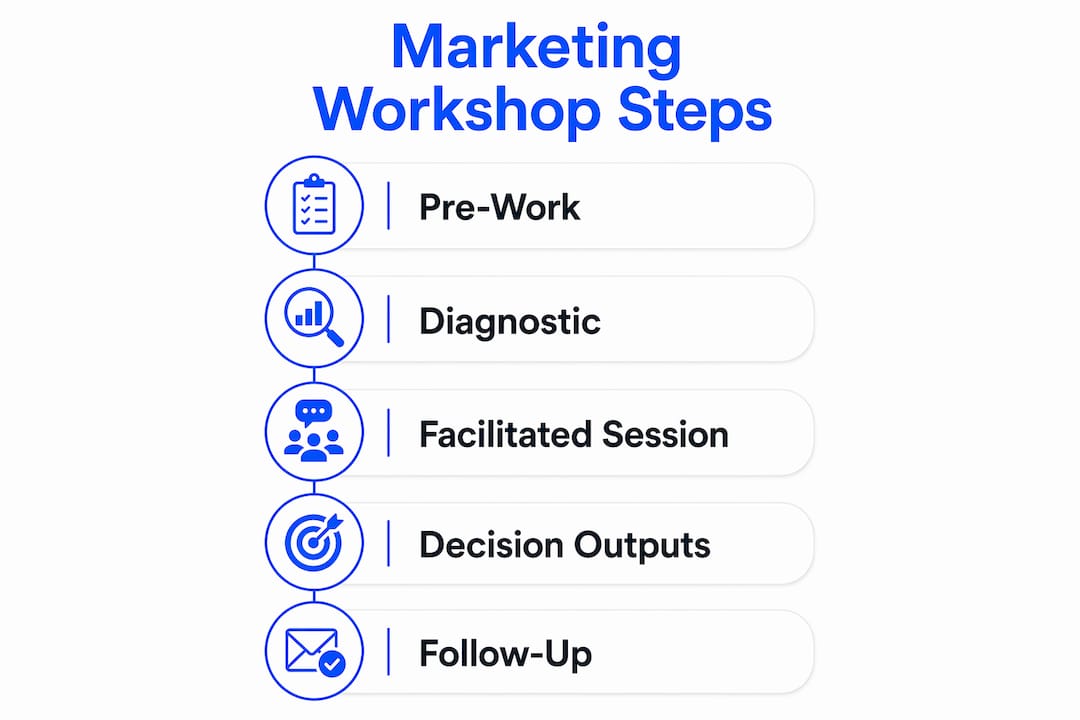
A workshop without a structured agenda produces a list of ideas, not a plan. Every effective session needs to work through these strategic pillars:
| Format | Duration | Typical outputs | Approximate cost (AUD) |
|---|---|---|---|
| Half-day focused sprint | 3–4 hours | Persona profile, messaging statement, channel shortlist | $500–$1,500 |
| Full-day strategy session | full day | Full strategic blueprint, KPIs, prioritised activity plan | $1,500–$4,000 |
| Multi-session programme | 3–6 sessions | Complete marketing system, execution plan, 90-day roadmap | $2,500–$5,000 |
Pre-work is not optional. Participants should bring conversion data from their website, a list of current service offers and pricing, basic notes on their best and worst clients, and any existing brand or messaging documents. Without this, the session spends its first two hours gathering information that should have arrived before the room opened.
Paid workshops consistently outperform free ones on attendance and engagement. Consistent, repeatable workshops also compound value over time, converting a one-off session into a predictable lead-generation system when run regularly.
A good workshop produces tangible documents, not just good intentions. The outputs below are the minimum standard for any session worth attending.
| Deliverable | How to use it | Responsible party |
|---|---|---|
| Strategic blueprint | Campaign briefs, budget allocation, team alignment | Business owner |
| Audience profiles | Content calendar inputs, ad targeting, sales conversations | Owner or internal team |
| Messaging statements | Website copy, social bios, email subject lines | Owner or copywriter |
| Prioritised activity plan | 30/60/90-day execution schedule | Owner and team |
| KPI dashboard setup | Monthly review, budget decisions, performance tracking | Owner or reporting tool |
The strategic blueprint links your commercial goals directly to marketing activities. Each deliverable feeds the next: audience profiles shape messaging, messaging shapes channel selection, and channel selection drives the KPI targets. Turning those KPIs into a regular reporting rhythm is straightforward with a tool like client reporting software that converts workshop outputs into trackable dashboards.
Most workshops fail for the same reasons, and none of them are complicated to fix.
The biggest single failure mode is absent decision-making authority. If the person who approves the budget is not in the room, the session produces a wish list. Every strategic decision made during the workshop needs someone present who can say yes and mean it.
Weak facilitation is the second trap. An experienced facilitator steers conversations toward decisions and sign-offs, not open-ended discussion. Without that discipline, a full-day session can end with pages of notes and zero commitments.
Other common failure modes include vague goals going in, no pre-work completed, and no follow-up plan after the session ends. The fix for each is the same: define it before the day, not during it.
Pro Tip: Apply a simple 30-day accountability rule after any workshop. Every output must have a named owner and a funded next step within 30 days of the session. If it does not have both, it does not get done.
Whether you are evaluating a facilitator or planning your own session, these questions and steps will keep you on track.
Workshops run regularly — monthly, quarterly, or as part of a programme — build a predictable pipeline of warm, interested leads. A one-off session is useful. A repeatable system is a business asset.
Mybworkshops runs a structured three-phase programme built specifically for service-based small business owners in Australia.
Phase 1 is diagnostic: pre-work is reviewed, gaps are identified, and the session agenda is shaped around the decisions that matter most for that business. Phase 2 is the working session itself, facilitated to produce decisions and sign-offs, not just discussion. Phase 3 delivers the documented blueprint plus a 30/60/90-day execution plan, so participants leave knowing exactly what to do next and in what order.
The programme blends personal mentorship with practical tools, including AI-assisted exercises that speed up execution without replacing strategy. Client results include higher website conversion rates and measurably reduced wasted ad spend.
Mybworkshops also uses the workshop itself as a diagnostic step, observing how business owners make decisions and where alignment breaks down before recommending longer-term support. You can see real client examples of businesses built through this process.
A marketing strategy workshop is only as valuable as the documented blueprint it produces. Without that output, it is just a meeting.
| Point | Details |
|---|---|
| Outcome-first test | Every workshop must end with a documented, decision-ready blueprint and assigned KPIs. |
| Pre-work is non-negotiable | Bring conversion data, current offers, and audience notes so session time goes to decisions. |
| Decision-makers must attend | If the budget approver is absent, the session produces ideas, not commitments. |
| Deliverables drive execution | Audience profiles, messaging statements, and a prioritised activity plan are the minimum standard. |
| Mybworkshops’ three-phase approach | Diagnostic, working session, and documented blueprint with a 30/60/90-day execution plan for service businesses. |
If you have been running your business on instinct and hoping your marketing catches up, a structured workshop is the fastest way to close that gap. Mybworkshops is built for exactly this: service-based small business owners who need a clear direction, not more content to consume.
The three-phase programme covers everything from audience clarity and messaging to channel selection and KPI setup, with a documented blueprint you can act on immediately after the session. No vague takeaways. No homework you have to figure out alone. Every session is facilitated to produce decisions, and every participant leaves with an execution plan tied to real business goals.
Browse the full range of sessions and check current schedules at the Mybworkshops programme catalogue, or visit Our Workshops to find the session that fits where your business is right now.
The following sources informed this article. Government and industry-standard resources are noted where relevant.
A marketing strategy workshop is a facilitated working session where a business owner makes documented decisions about their target audience, messaging, channels, and KPIs. It ends with a written plan, not just notes.
A course or seminar delivers education. A workshop produces decisions and a documented output you can act on immediately. The facilitator’s job is to drive sign-offs, not just share information.
Half-day sessions typically range from $500–$1,500, full-day sessions from $1,500–$4,000, and multi-session programmes from $2,500 upward, depending on the facilitator and format.
Bring your website conversion data, current service offers, notes on your best and worst clients, and any existing brand or messaging documents. Pre-work is what makes session time productive.
Mybworkshops uses a three-phase approach: a diagnostic pre-work review, a facilitated decision-making session, and a documented strategic blueprint with a 30/60/90-day execution plan tailored to service-based businesses.