

Focus on lead quality, not lead volume. A handful of well-matched enquiries will out-earn a flood of unqualified ones every time, because quality leads convert faster, pay more, and cost less to service.
A few well-matched leads consistently outperform a high volume of unqualified enquiries because they convert faster, cost less per sale, and produce higher average job values.
| Point | Details |
|---|---|
| Quality beats volume on ROI | One business closed $2.3m from 200 targeted leads while 10,000 low-quality leads closed nothing. |
| Track four KPIs | Monitor lead-to-sale rate, average job value, adjusted CPA, and response time monthly. |
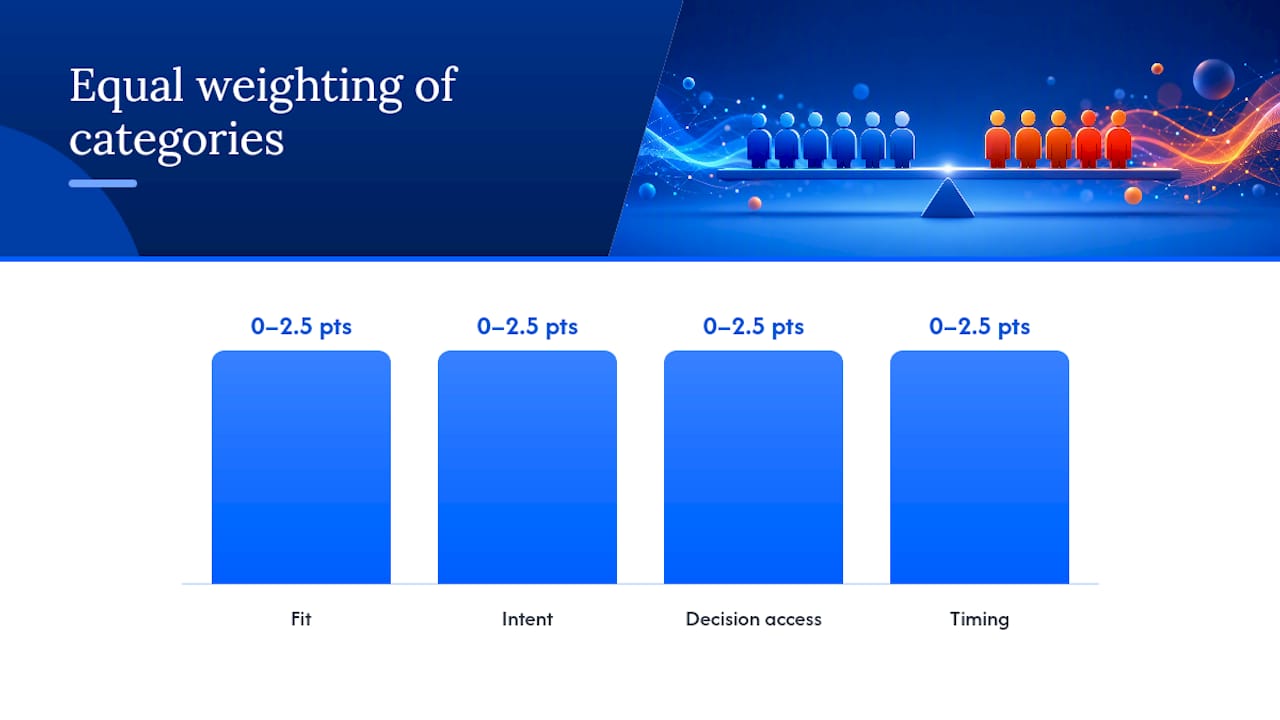
| Score leads on four factors | Rate fit, intent, decision access, and timing out of 2.5 points each. |
| Volume still has a role | New businesses or slow seasons can justify short-term volume with a phased 90-day exit plan. |
| Mybworkshops builds the system | Its three-phase workshop program delivers scripts, scoring rubrics, and a 90-day experiment template. |
Chasing volume quietly bleeds a service business dry. Every unqualified enquiry still costs you something: the time to respond, the fuel to quote onsite, the mental energy of following up with someone who was never going to buy.
Run the numbers and the gap becomes obvious. If you spend 30 minutes on each of 40 dud enquiries a month, that is 20 hours gone, roughly half a working week, for zero revenue. One well-matched client, quoted once and booked within days, can be worth more than all 40 combined. This isn’t theoretical: quality-driven approaches can cut cost per acquisition by up to 60% compared with volume-first tactics, and handyman and trade businesses using shared lead platforms often see close rates near 12%, against 35 to 50% for exclusive, well-targeted enquiries.
There’s a deeper cost too: opportunity cost. Every hour your best salesperson or you, the owner, spends chasing a dead lead is an hour not spent nurturing a prospect who was ready to buy.
Pro Tip: Watch for two early red flags: a lead who won’t share a budget range, and one who asks for a quote before answering a single question about their job. Both usually signal a tyre-kicker, not a client.
“Quality” stops being a vague feeling once you track it. A handful of KPIs turns the concept into something you can actually improve week to week.
A lead scores well when it matches your ideal client profile (fit), shows clear buying signals like a set date or budget (intent), comes from the actual decision-maker (decision access), and needs the work soon rather than “just looking” (timing).
| KPI | What it measures | Target or benchmark |
|---|---|---|
| Lead-to-sale rate | Share of enquiries that convert to paying work | Aim for a multi-fold lift versus your current baseline |
| Average job value | Revenue per converted lead | Track monthly, watch for upward trend |
| CPA (adjusted) | True cost per paying client, including wasted quotes | Should fall as quality rises |
| Response time | Speed of first reply to a genuine enquiry | Under 1 hour where possible |
| Lead score | Composite of fit, intent, access, timing | Set your own pass threshold (e.g. 7/10) |
Quality-first models typically lift conversion rates several-fold compared with low-qualification, high-volume approaches, and they shorten the sales cycle at the same time.
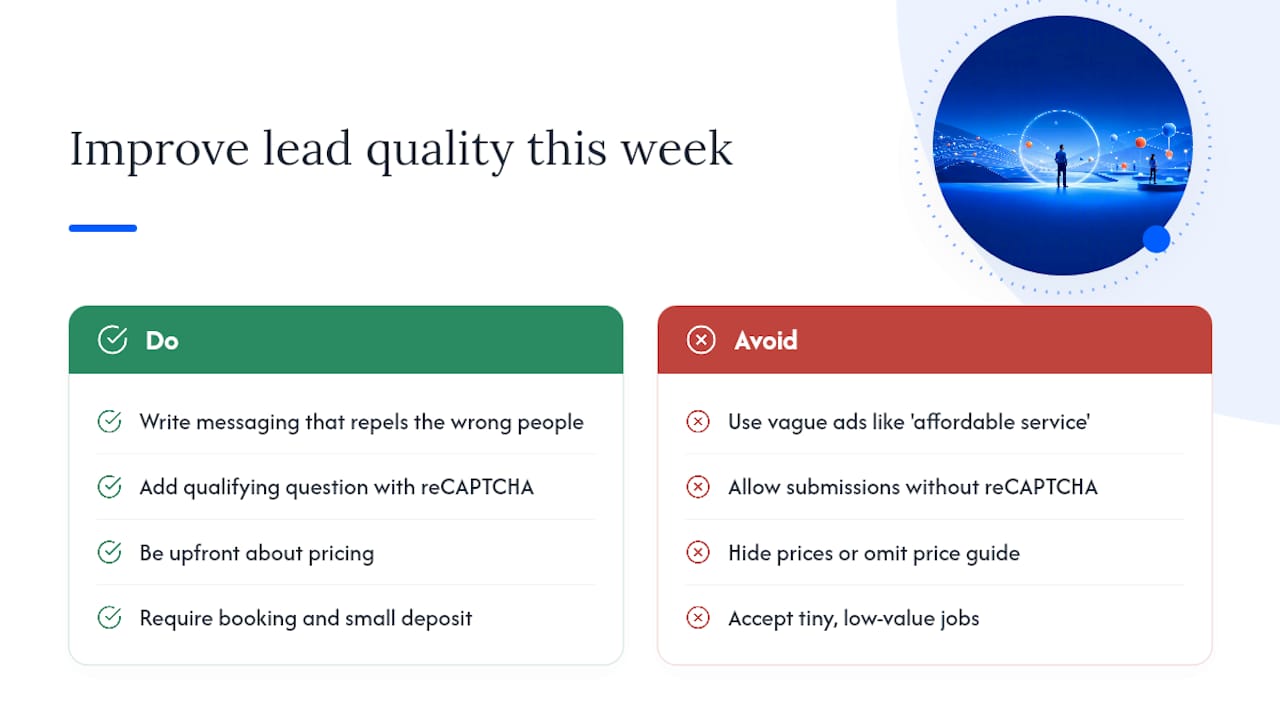
Write messaging that repels the wrong people. Vague ads like “affordable service, call now” invite everyone, including people who can’t afford you. Landing pages that state your specialty, price range, and ideal job type upfront filter out mismatches before they ever pick up the phone. Mybworkshops covers this in detail in its lead magnet guidance for service businesses.
Add a qualifying question to your intake form enhanced with basic bot protection like reCAPTCHA to stop spam submissions from inflating your numbers and skewing your metrics. Ask about budget range, timeline, and property type or job scope before someone can submit an enquiry. This alone removes a chunk of low-intent traffic, and pairing it with basic bot protection like reCAPTCHA stops spam submissions from inflating your numbers and skewing your metrics.
Be upfront about pricing. A rough price guide on your website, even a range, deters shoppers who were never going to afford you and reassures the ones who are a genuine fit. Fixing weak pages that leak leads is covered in the website fix list.
Use booking and deposit systems. Requiring a small deposit to lock in a quote or consult filters out the curious from the committed almost instantly.
Raise your minimum job or booking value. If most of your low-quality enquiries are for tiny jobs, stating a minimum on your site stops the mismatch at the source.
Invest in owned channels. SEO, referrals, and content consistently produce exclusive leads with better lifetime value than shared lead marketplaces, because the enquiry found you specifically rather than a list of five competitors.
Pro Tip: Phrase qualifying questions as helpful, not interrogative. “What’s your rough budget for this?” lands better than “What’s your budget?” because it signals you’re trying to give an accurate quote, not screen them out.
Score every enquiry out of 10 using four categories, 0 to 2.5 points each:
Intake form line: “To give you an accurate quote, tell us your rough budget, preferred timeframe, and the exact job you need done.”
Discovery call opener: “Before we dive in, can I ask what’s prompted you to look into this now, and roughly when you’re hoping to get it sorted?”
Apply thresholds once you’ve scored a lead: 7 to 10 points, accept and prioritise; 4 to 6, nurture with follow-up content or a call-back later; under 4, decline politely or refer elsewhere. This rubric feeds directly into the lead-to-sale rate and CPA metrics from the KPI table above, giving you a live read on whether your filtering is working.
Volume has its place. A brand-new business with no reviews or reputation, one entering a new suburb or region, or one filling a genuinely slow season can justify buying broader lead volume short term to build momentum and gather feedback.
The trick is transitioning deliberately rather than staying stuck there:
Watch pipeline coverage against conversion improvements as you scale back volume. If conversion rises but total booked revenue drops, you’ve cut too fast.
Run a 90-day split test before committing fully:
At 90 days, compare the two. If the quality funnel shows a meaningfully higher lead-to-sale rate and lower time-per-quote, even with fewer total leads, scale it. If results are close, iterate on messaging before reverting. Quality-driven approaches have shown conversion lifts of four to five times in comparable tests, which gives you a realistic benchmark to aim for.
Knowing the theory is one thing. Building the actual forms, scripts, and follow-up systems while running a business is another. Mybworkshops runs a structured three-phase program built for exactly this gap: diagnose where your current funnel is leaking quality, fix the intake and messaging that’s letting mismatched leads through, then scale the channels that bring in more of the right ones.
Attendees leave with the qualifying scripts, a ready-made lead scoring rubric, a landing page checklist, and a 90-day experiment template, so nothing above needs to be built from scratch. Real client outcomes from the program, including before-and-after conversion figures, are documented in the business examples built through the workshops. If you’re ready to stop guessing which leads are worth your time, browse the current workshop lineup and find the session that matches where your funnel is leaking right now.
Lead quantity counts total enquiries; lead quality measures how well those enquiries match your ideal client’s budget, timeline, and needs. A business can have hundreds of leads and few sales if quality is poor.
Quality leads have already self-selected as a fit through targeted messaging, pricing transparency, or qualifying forms, so they arrive closer to a buying decision, which is why exclusive, well-matched leads can close at 35 to 50% against 12% for shared, unfiltered leads.
Track lead-to-sale rate, average job value, adjusted cost per acquisition, response time, and a simple lead score based on fit, intent, decision access, and timing.
Yes, for new businesses building initial momentum, entering a new area, or filling a slow season, but it should shift to a quality-first model within 90 days using a phased plan.
Mybworkshops runs a structured three-phase program that diagnoses your funnel, fixes weak intake and messaging, and scales the channels bringing in better-matched leads, with copyable scripts and templates included.