

An SEO content brief is a single document that tells a writer exactly what to write, why it matters to the business, and how to prove it worked. A usable one lets a writer start within five minutes, with no follow-up questions about keywords, structure, or intent. Semrush and industry frameworks agree on the core fields, and getting them right is what separates a brief from a vague instruction sheet.
TL;DR:
- A well-structured SEO content brief is essential to align content with business goals, target audience, and search intent, reducing revisions and speeding up output.
- Every effective brief must include primary and secondary keywords with intent tags, a clear outline, word count based on competitors, and technical SEO requirements.
- Building the brief involves analyzing top-ranking pages, identifying content gaps, and setting a focus-driven outline to ensure relevant and competitive content.
- Common mistakes like skipping search intent, over-prescriptive instructions, or vague headings cause guesswork and increased revisions, which proper briefs aim to eliminate.
- Tracking key performance indicators such as rankings, clicks, and conversions helps measure brief effectiveness and refine the process over time.
Most small business owners have lived through this: you hire a writer, they hand back a piece that’s technically fine but misses the point entirely. Wrong angle, wrong reader, wrong call to action. That’s not a writer problem. It’s a briefing problem.
An SEO content brief exists to bridge two things that rarely talk to each other naturally: what your business needs the page to achieve, and what the person searching for it actually wants to find. Get that bridge wrong and you end up with content that ranks for nothing or converts nobody.
Whoever owns the keyword research and competitor analysis should build the brief, not the writer. In a small business, that’s usually you or whoever runs marketing. The writer’s job is to execute the plan, not invent it from scratch. Handing a writer a page of raw keywords and saying “make this good” isn’t a brief. It’s a guess dressed up as a task.
A properly built brief pays for itself in the first draft. Siteimprove found that tying the brief directly to business goals and including a wireframe or outline in every brief prevents the structural back-and-forth that eats up hours on both sides. When King Content Agency standardised a nine-section brief format across its writing teams, rewrites dropped significantly because writers stopped guessing at structure and started following it.
What a good brief buys you:
If your writer needs a phone call to understand the assignment, the brief failed before the writing even started.
Every solid brief runs on the same skeleton of information, regardless of industry or business size. Skip a field and you’re not simplifying the brief, you’re moving the guesswork downstream to the writer.
Pro Tip: Tag every secondary keyword with its intent type before you send the brief. A writer who knows “best” signals comparison shopping and “how to” signals a how-to guide will place that language in the right section without being told twice.
Semrush’s content brief guide lists this same core set, brand voice and audience included, as the standard for briefs that actually get followed rather than filed away.
This is the scaffold. Copy it into whatever tool you use, a Google Doc, a Notion page, an email, and fill in the brackets. It works for a homepage, a service page, or a blog post; only the specific focus points change.
Working title: [Draft H1, benefit-led, under 60 characters]
Primary keyword: [Exact target phrase]
Secondary keywords: [3–8 terms with intent tags]
Search intent: [What the searcher wants to walk away knowing or doing]
Audience: [Who, plus experience level]
Word count target: [Range, based on top 3 SERP pages ±20%]
Business goal / CTA: [What action the page drives, and where the CTA sits]
H2: [Opening/definition section]
H2: [Why it matters / who’s affected]
H2: [Core how-to or comparison section]
H2: [Common mistakes or objections]
H2: FAQ
Required citations: [Link authority sources here, one per claim]
Internal links: [List target pages and the anchor text to use]
Primary CTA placement: [Where the call to action sits, and its exact wording]
BeSERP’s word-count guidance, setting the target within 20% of what the top three ranking pages already run, removes the guesswork that leads writers to either pad content pointlessly or cut it short of what the topic needs.
You can build a full brief in a single 30 to 45 minute block if you work in the right order. Jumping between steps, or starting with the outline before you’ve checked the SERP, is what turns this into a half-day job.
Pro Tip: Give the writer one sentence of banned phrasing alongside the tone example. “Don’t write ‘in today’s fast-paced world,’ write like you’re explaining this to a mate over coffee” does more to fix tone than three paragraphs of brand guidelines.
Three mistakes account for most of the wasted revision rounds in briefs built without a template.
The first is skipping search intent entirely and jumping straight to keywords, which leaves the writer guessing whether the page should educate, compare, or sell. The second is handing over keywords with no H2 skeleton, which forces the writer to invent a structure that may not match what’s ranking. The third is the opposite problem: briefs so rigid they dictate every sentence, leaving no room for the writer’s own judgment or voice, which produces flat, robotic copy. A close fourth is keyword overstuffing, cramming secondary terms into every paragraph regardless of whether they read naturally.
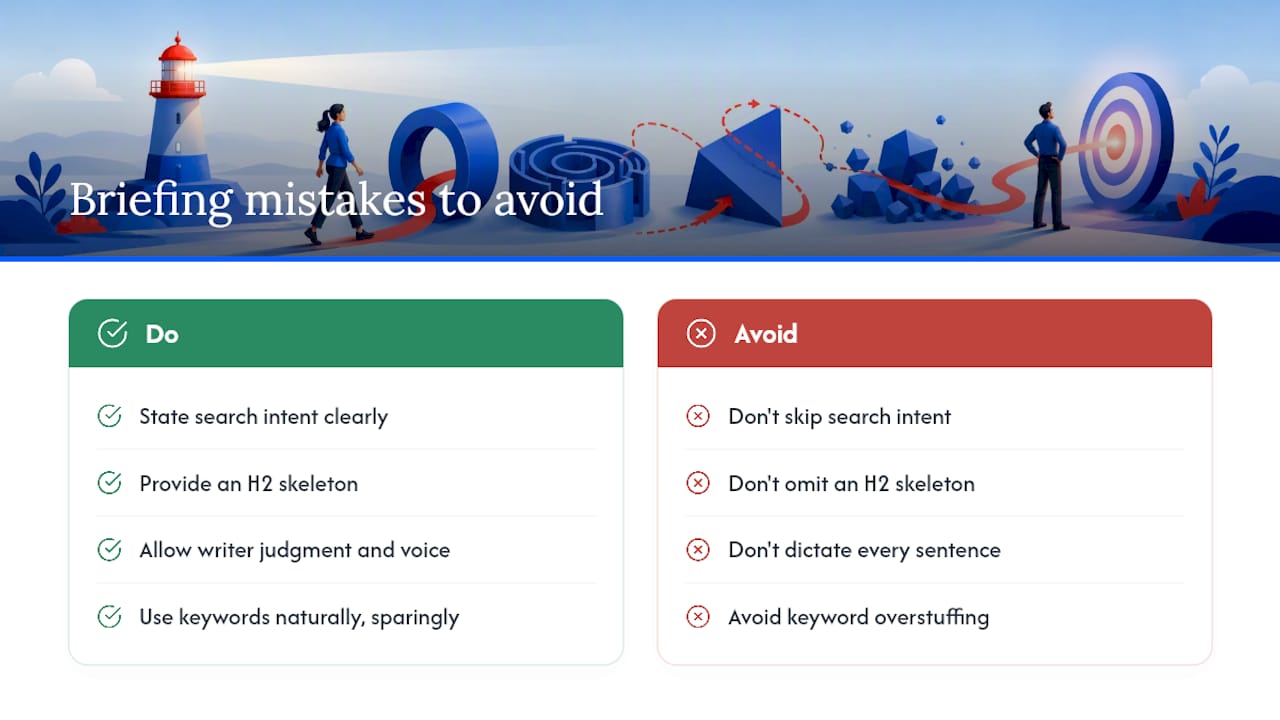
Cut these from any brief you write: “use the keyword as many times as possible,” “write 2,000 words no matter what the topic needs,” and “match the tone of [competitor]” with no further explanation of what that tone actually sounds like.
An editor should reject a first draft that’s missing any row in that table, not just flag it for a later pass. That single rule saves more editing time than almost any other change you can make to your process.
A brief either produces content that performs or it doesn’t, and you find out by tracking a small set of numbers rather than trusting a gut feeling.
Track organic impressions and clicks for the target keyword, its ranking position over the following weeks, the conversion rate on whatever CTA the page carries, how many revision rounds the draft needed, and the total time from brief to publish. If revision counts stay high across multiple briefs built from the same template, the template needs fixing, not the writer.
Run small experiments to sharpen the template over time:
Log every result against the brief version that produced it. Over six to twelve briefs, patterns emerge, certain focus-point phrasing consistently produces cleaner drafts, certain word-count ranges consistently underperform the SERP. That log becomes your evidence for updating the template, rather than changing it on a hunch.
Participants working through marketing modules often use this same H2/H3 skeleton and deliverables checklist to move from a blank page to a publishable draft without the back-and-forth that usually stalls small business content.
A few resources pair directly with the brief structure above:
Those training their own writers or virtual assistants on this system often find the first brief takes longer to build, but every one after that gets faster, because the skeleton doesn’t change, only the content inside it does.
For the canonical field list behind every brief, Semrush’s guide covers the full set in detail. Siteimprove’s strategy piece is worth reading if you want the business-goal-alignment argument spelled out further. King Content Agency’s nine-section template and BeSERP’s 12-point framework both offer ready-to-copy structures if you want a second reference point beyond the skeleton above. For checking your meta title and description formatting before handoff, a tool like the meta tag checker from Pingfloat does the job in seconds.
If you’d rather build this skill inside a structured program with feedback on your actual briefs, MYB Workshops’ content and copywriting workshops walk you through the same process with direct guidance, and you can browse the full workshop catalogue to find the one that matches where your business is right now.
A design brief typically covers the project goal, target audience, scope of work, brand guidelines, and success criteria. An SEO content brief borrows the same logic but swaps design specifics for keyword, intent, outline, and word-count fields.
SEO content is any written material created to satisfy a specific search intent while meeting the technical and structural signals search engines use to rank pages, including relevant keywords, clear headings, and useful internal links.
The core components generally include keyword research, on-page optimisation (titles, headings, content), technical SEO (site speed, crawlability), link building, and user experience. A strong SEO content brief addresses the on-page component directly and touches technical requirements through its checklist.
In SEO, a small share of your pages or keywords typically drives most of your organic traffic and conversions, so it pays to focus brief-writing effort on your highest-potential pages first rather than spreading equal attention across every piece of content.