
About Page Copywriting: 9-Point Audit Checklist for Small Businesses

Business owner auditing About page copy

An effective About page does one job well: it tells visitors who you serve and why you’re credible enough to trust, in language they understand within seconds. The fastest way to start is writing a single positioning sentence that states exactly that, before you touch layout or design. Once you have that sentence, the checklist, structure and legal checks below will carry you the rest of the way.


TL;DR:

  • A single clear positioning sentence at the top helps maintain focus and guides the entire About page structure.
  • Placing benefits and proof of credibility immediately after the main claim increases visitor trust swiftly.
  • Including genuine testimonials and specific, provable claims is necessary to avoid misleading advertising risks and legal penalties.
  • Using natural language, short sentences, and accessible formatting enhances readability, SEO, and compliance.
  • Crafting a tailored, actionable call-to-action aligned with visitor expectations drives better engagement and conversions.

Mybworkshops
Build A Clearer Marketing Engine
MYB Workshops helps service-based business owners strengthen positioning, websites and lead generation with expert-led, actionable marketing strategies.

Visit MYB Workshops

Table of Contents

The checklist: elements every About page needs

Before you write a word of flowing copy, run through this list. It covers the structural pieces that separate a page people trust from one they skim past.

  • Headline pattern: combine who you help with the benefit you deliver, such as “Helping tradies win more quotes without chasing leads.”
  • One-line position statement: your single truth, the sentence that says what you do and for whom, placed high on the page.
  • Benefits-focused copy: two or three sentences on outcomes for the client, not a list of your services.
  • Credibility signals: selective, provable details such as years trading, number of projects, or a specific client outcome, never a vague “industry-leading” claim.
  • Mission and values in plain language: a short paragraph, no corporate mission-statement jargon.
  • Contact and call-to-action placement: a visible next step, worded as an action, not buried at the bottom.
  • Testimonial rules: only genuine quotes, with disclosure if there’s any commercial relationship behind them.
  • Accessibility and readability: short sentences, subheadings, and alt text on any photos.
  • Basic SEO: your main keyword appears naturally in the headline and first paragraph, nowhere else forced.

This approach lines up with government guidance on business websites, which recommends simple words, short sentences and subheadings, alongside mission, history and contact details as the core content an About page should carry.

Pro Tip: Write your one-line position statement on its own first. If you can’t say what you do and for whom in one sentence, your whole page will struggle to find focus.

How to lay out an About page that works

Order matters as much as wording. A reader scanning for thirty seconds needs the big claim first and the proof close behind it.

  1. Headline: who you help and what changes for them.
  2. One-line position statement: the single truth beneath the headline.
  3. Benefits: two or three short sentences on outcomes, not features.
  4. Proof: a credibility signal or a specific, honest result.
  5. Story: a short paragraph on why you started or what drives the business.
  6. Mission: one or two sentences in plain language.
  7. Call to action: a specific next step with a clear link.

A single-founder business usually reads better with a short personal story than a team grid. A business with several client-facing staff benefits from a small team section with names and roles, placed after the story rather than at the top, so the business case comes first. Keep testimonials near the proof section, and keep contact details visible rather than only in the footer. Every headline and button should say what happens next in plain words, “Book a free chat” beats “Learn more” because it tells the reader exactly what they’re clicking into.

A writing and editing workflow you can actually finish

Drafting an About page in one sitting rarely works. Break it into passes and you’ll finish faster with fewer rewrites.

  • Draft the one-line truth first. Expand it into benefits, then add proof points once the core sentence is solid.
  • Clarity pass: read it aloud. Cut any sentence you wouldn’t say to a customer in person.
  • Voice pass: check it sounds like you, not like a template. Swap generic phrases for specific detail.
  • Legal and accuracy pass: check every claim and testimonial against evidence you actually hold.
  • Plain-English pass: shorten sentences, break up long paragraphs, add subheadings where the eye needs a rest.
  • Proofing checklist: spelling, dates, prices, and contact details, checked against the current version of each.

Keep a simple folder of evidence behind any claim or testimonial you publish, screenshots, emails, or signed permission. It takes minutes now and saves a headache later.

SEO and findability without losing your voice

Your About page can work for search without reading like it was written for a robot.

  • Place your primary keyword once in the headline and once in the opening sentence, then let natural variations carry the rest of the page.
  • Write a meta title and description specific to the About page, not a copy of your homepage tags.
  • Add alt text to every photo that describes what’s actually in the image.
  • Use the words your customers actually search, not industry jargon, in subheadings and body copy.
  • Review and refresh the content roughly every six months, which business.gov.au recommends alongside using relevant keywords in page titles, content and metadata.

Stuffing keywords into every sentence does the opposite of what you want. Search engines and readers both notice when a page reads unnaturally, and both reward clarity over repetition.

This is the part most small business owners skip, and it’s the part that carries real risk if you get it wrong—understanding cookie consent in Australia is vital for compliance and trust.

  • Only publish testimonials you can prove are genuine, from real clients, in their own words.
  • Disclose any incentive, discount or commercial relationship behind a review or testimonial.
  • Avoid vague claims like “the best” or “guaranteed results.” If you can’t substantiate it with evidence, don’t publish it.
  • Get written permission for any third-party image or text you use. Attribution alone doesn’t protect you.
  • Keep records: screenshots, signed consent, dated files, anything that proves a claim or testimonial is real.

The ACCC has taken enforcement action over misleading online customer reviews, including a case where a business was ordered to pay a significant penalty amounting to several hundred thousand dollars in penalties. The ACCC’s own guidance on false or misleading claims confirms that businesses must be able to prove any claim they publish, with reasonable grounds behind it, not just good intentions. For images and written content you didn’t create yourself, IP Australia’s guidance on avoiding infringement is worth a read before you publish anything borrowed.

Microcopy you can adapt today

Sometimes the fastest way to unstick a blank page is a template you can reshape into your own voice.

  • Headline templates: “Helping [audience] achieve [outcome]” works for service businesses; “[Business name]: straightforward [service] for [audience]” suits a more direct tone; a question headline like “Tired of [problem]?” works when the pain point is sharp and specific.
  • Position statements: “We help [audience] [achieve outcome] without [common frustration],” or “Since [year], we’ve focused on [one thing], for [audience].”
  • Calls to action: “Book a free chat” for consultations, “Get a quote” for quoted work, “See our workshops” for education or course businesses.
  • Keep the words yours. A template gives you a shape, not a script, swap in the phrases you’d actually say to a client across the table.

Why this checklist works

The pattern above isn’t guesswork. It reflects what government guidance on business websites recommends for content and readability, paired with the legal boundaries the ACCC enforces around testimonials and claims. Our workshops walk small business owners through exactly this kind of page, phase by phase, pairing mentorship with templates so the writing and legal checks happen together instead of as an afterthought. A simple experiment worth running: change your headline to a who-plus-benefit pattern, leave it two weeks, and watch whether enquiries shift.
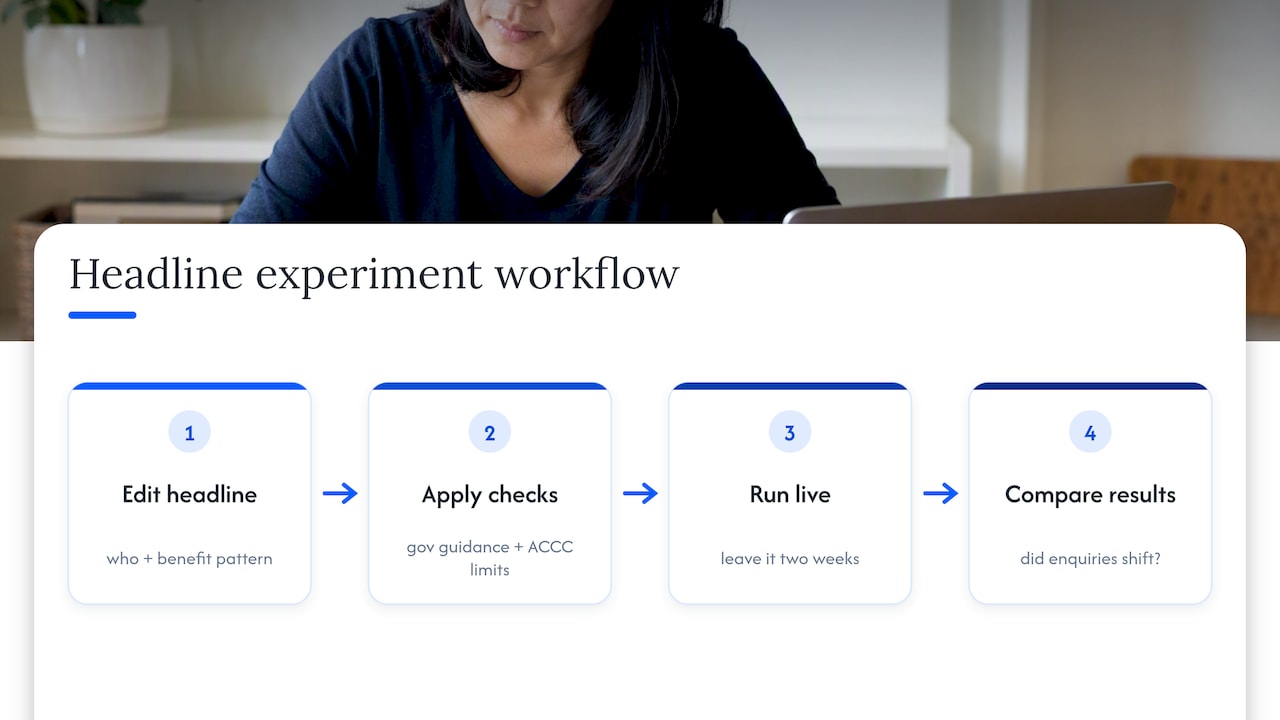
Three-stage About page headline test

Get hands-on help writing your About page

We built our Compelling Homepage Copy Workshop and messaging sessions because most small business owners don’t need another article, they need someone walking through their actual page with them. Our workshops pair practical exercises with templates and direct feedback, so you leave with copy you can publish, not just notes.
Mybworkshops

Check availability and book a session through our workshops page when you’re ready to write the version of your About page that actually converts.

FAQ

Is copywriting still worth it in 2026?

Yes. Clear, provable copy remains one of the few things a small business fully controls, and government guidance still points to plain language and readability as core to a trustworthy website. The tools around writing have changed, but the need for honest, specific copy that reads well hasn’t.

What should I write in about us page?

Cover who you help, your one-line position statement, two or three benefit-focused sentences, a short credibility signal, your mission in plain language, and a clear contact or call-to-action. Business.gov.au guidance recommends including mission, history and contact information as the baseline.

What are the 5 C’s of copywriting?

Definitions vary across sources, but a common version covers being clear, concise, compelling, credible and customer-focused. For an About page specifically, clarity and credibility matter most, since readers are deciding in seconds whether to trust you.

What is the 80/20 rule in copywriting?

Applied to an About page, that means leading with benefits before background.

Sources

Hi There, I'm Peggy

I’m the brains (& the energy) behind MYB Workshops.

For 20+ years, I’ve helped business owners ditch the confusion, clarify their message, and build brands that attract the right clients. No fluff, no overwhelm, just proven strategies that work.

If you want to build a brand that feels right and actually brings in business, you’re in the right place!

Hi There, I'm Peggy!

For more than 20 years, I’ve helped businesses grow with better marketing systems that support long-term plans.

Everything inside MYB Workshops is built from the same strategies, frameworks and practices we use in our agency. These aren’t theories or quick fixes. They’re proven approaches shaped by real-world results and applied across hundreds of businesses.

MYB Workshops was created to make those tools and insights accessible to business owners who want greater clarity and confidence in their business.

I’m glad you’re here in the Blog, explore some of the hot topics our clients ask us about. I hope to see you in the workshops, real soon!

Build Your Business

If your business isn’t attracting and converting the right customers, something needs to change.

In MYB Workshops, you get proven strategies, expert guidance, and a clear plan that actually works. 

Start building a marketing system that works, today!

Stop Losing Sales

Brand confusion costs sales. Learn how to position, market, and sell with confidence inside MYB Workshops.

FREEBIES
FREE Brand Clarity Workshop

Crafting Your Brand Identity 

An on-demand workshop to help you create a brand identity that attracts the right clients, builds trust, and drives real results, without the guesswork.

PLUS Grab your FREE workbook to implement everything instantly!

6 Strategies to Build a Website That Converts

3 seconds. That’s all it takes for a visitor to decide if they’ll stay or leave your website.

Download this FREE guide to learn 6 proven strategies to keep visitors engaged and turn them into paying clients.

FREE Branding Guide

Your brand is more than a logo. It’s the foundation of your entire business.

If you skip this step, you risk wasting time and money on marketing that doesn’t convert.

Download this FREE guide and discover 5 key steps to build a brand that attracts, connects and drives long-term success.

Related Blog Articles