The marketing workshop topics worth your time cover eight areas: audience clarity, core messaging, customer journey mapping, website conversion, channel and content planning, lead capture, measurement, and (when time allows) paid ads or brand foundations. A good session ends with a one-page plan, named owners and dates, not a whiteboard full of ideas nobody actions. You’ll find ready agendas and templates for each topic below, along with the facilitation details MYB Workshops uses to run them.
TL;DR:
- Score each topic from one to five for impact, evidence, ease, and stakeholder support, then run the highest scoring session first before expanding the agenda.
- Use 60 minutes for one topic, three to four hours for two related topics, and a full day only for connected decisions.
- Measurement sessions should select two to four key result indicators and agree exactly how the team will track each one.
- Invite four to eight people in person, or four to six remotely, and bring customer quotes, enquiry figures, and website analytics to ground decisions.
- Book a checkpoint two to four weeks later before attendees leave, assign each action an owner and date, and send the tracker within 24 hours.
Every topic on this list earns its place because it produces a decision, not just a discussion. If a session doesn’t end with something written down and assigned, it was a meeting, not a workshop.
Audience and customer segments. Before anyone talks tactics, the room needs to agree on who they’re actually talking to. The output here is a quick persona or segment brief: three or four lines on who the customer is, what they’re trying to solve, and why they’d choose you over sitting on the problem.
Value proposition and key messages. Once the audience is clear, the group drafts a single core message and two supporting proof points that back it up. This becomes the sentence every piece of marketing gets measured against.
Customer journey and friction audit. Business frames this well: map every interaction from discovery to loyalty, then mark where people drop off. The output is a mapped journey with the top three friction points ranked and ready to fix.
Website and conversion focus. Traffic without conversion is just an expensive hobby. This topic produces one to three priority fixes, things like a confusing homepage headline, a buried contact form, or a product page that doesn’t answer the obvious question.
Content and channel plan. Government guidance on social media and content marketing points to platform selection and content curation as the practical wins here. The output is a short list of chosen channels plus a 90 day content skeleton, not a 12 month calendar nobody will follow, aided by a practical marketing planner for content and campaigns.
Lead capture and nurture. This topic maps what happens after someone shows interest: where their details go, what follow up looks like, and who owns the next step. The output is a simple funnel sketch and one clear next action.
Measurement and success metrics. ABS data on business technology adoption shows that while AI adoption is accelerating across Australian businesses, routine measurement of digital activity often lags behind. This topic fixes that gap: the group picks two to four key result indicators and agrees exactly how each will be tracked.
Optional advanced topics. Paid ads, brand identity work and AI in context are worth a dedicated session once the fundamentals above are locked in, not before. Running an ads workshop before you’ve nailed messaging just means you’re paying to amplify the wrong thing.
Topics are only useful once you’ve got an exercise attached. Here’s how to run the ones that consistently produce results, with timings you can lift straight into your agenda.
For prioritisation, three methods cover most situations. A heatmap vote (everyone places coloured dots on options) works well for visual choices like sketches or journey maps. A straw poll (quick show of hands) suits simple either-or decisions. A decider vote, where one nominated person makes the final call after hearing the discussion, works best when the group is split and time is short. Budget five to ten minutes for any of these.
Running remotely changes the mechanics but not the structure. Use breakout rooms capped at four people, a shared template (Google Slides or a Miro board works fine) that everyone can edit simultaneously, and a visible timer on screen so breakouts don’t drift. Cap any single activity at 45 minutes online: attention drops faster on video calls than in a room.
Pro Tip: Print or screen-share a single “parking lot” note for off-topic ideas. It keeps the session moving without losing good thinking that belongs in a different workshop.
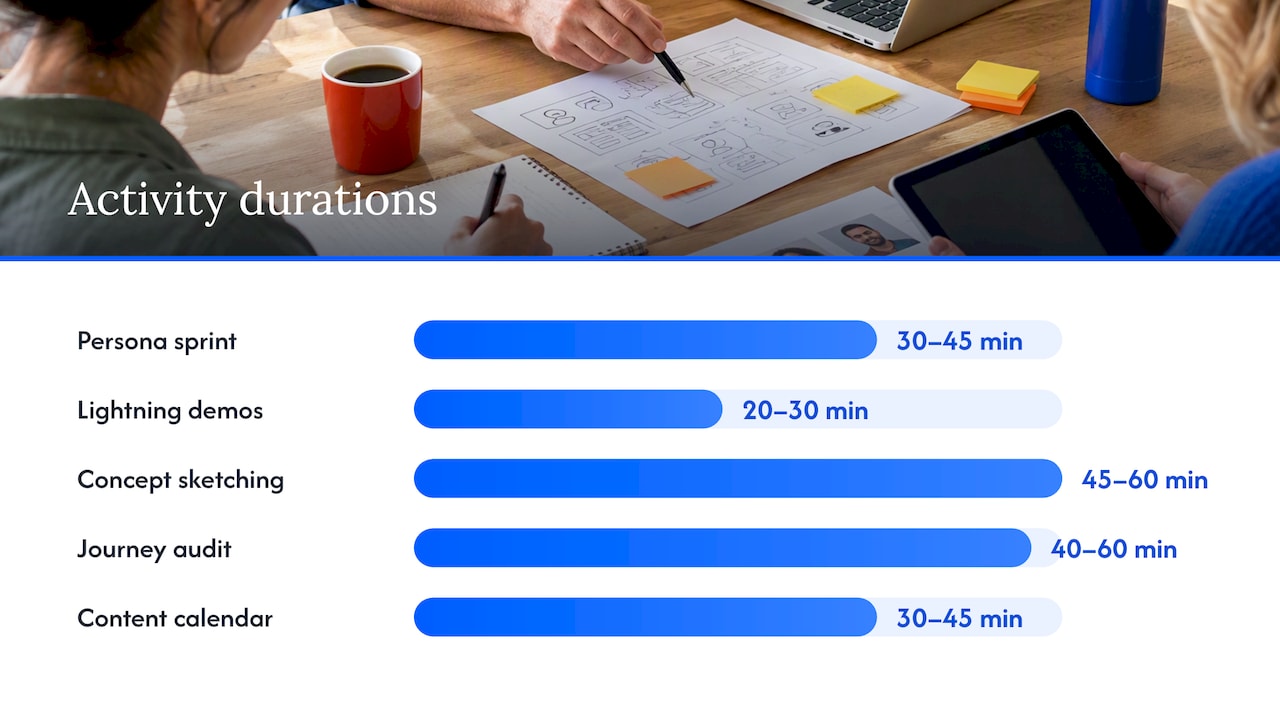
Pick the agenda that matches your time, not the other way around. A 60 minute session forcing in four topics will do none of them properly.
Build in a 10 to 15 minute buffer every two hours regardless of format, and move any topic that’s clearly bigger than its slot to a follow-up session rather than rushing the output.
The right mix of people in the room matters more than almost anything else you’ll plan.
Good facilitation is mostly good preparation. Here’s what to have ready before anyone walks in or logs on.
Government guidance on running small business workshops consistently points to practical workbooks and hands-on templates as what makes a session stick, rather than slides alone.
Pro Tip: Send the action tracker to every attendee within 24 hours while the discussion is still fresh. Delay it a week and half the urgency disappears.
With eight possible topics and limited time, you need a way to pick rather than guessing based on what feels urgent that week.
Score each candidate topic from one to five on four criteria: business impact (how much this could move revenue or leads), evidence available (do you already have data pointing here, or would you be guessing), ease of implementation (can the fixes be actioned within weeks), and stakeholder buy-in (will the right people actually show up and engage). Add the four scores together and run the topics with the highest combined total first.
Before the session, gather a handful of concrete inputs: recent website traffic or enquiry numbers, two or three direct customer quotes or complaints, and a rough sense of what’s already been tried and failed. Ask stakeholders directly what’s keeping them up at night about growth, not just what topic sounds interesting.
Our sessions run through a three-phase structure built specifically so service-based business owners leave with something usable, not just notes. Phase one clarifies direction and audience, phase two builds the messaging, brand and website decisions that flow from it, and phase three turns all of that into working lead generation and measurement systems.
You can read more on what a marketing workshop actually involves before deciding which topics suit your stage of business.
AI tools have a place in a marketing workshop, but only once the strategy underneath them is settled. Using AI to draft ten social captions means nothing if nobody agrees on the core message those captions should carry.
The most useful approach is to treat AI as a topic in context, not a separate session. During a messaging workshop, that might mean using an AI tool to generate draft variations of a key message for the group to react to and refine, rather than accept as final. During a content planning session, it might mean drafting a first-pass content calendar that a human then edits for accuracy and voice.
ABS data from 2024-25 shows AI adoption accelerating across Australian businesses, but the same release notes that routine measurement of digital activity often lags behind the tools themselves. That’s a useful discipline to bring into any workshop: before adopting a tool, agree which business problem it’s solving, how you’ll measure whether it’s working, and what quality checks sit between the AI output and anything that goes public. A tool that speeds up drafting but produces generic copy isn’t a win; it’s a shortcut that still needs the strategy work done properly first.
A workshop’s real test isn’t the energy in the room on the day. It’s whether the action list from week one is still being worked on by week six.
The simplest fix is a scheduled follow-up checkpoint, booked before anyone leaves the session, not chased up afterwards. Two to four weeks out works well for most action items: long enough for owners to make progress, short enough that momentum hasn’t died.
Beyond a single checkpoint, ongoing mentorship matters most for the topics with the longest implementation tail, things like website rebuilds or lead generation systems that take months, not days. Regular access to a mentor or strategist to answer questions as they come up prevents a plan from stalling the first time someone hits a decision they’re unsure about. That’s part of why our own workshops include 12 months of access and live Q&A rather than a single session and a goodbye.
Community support plays a similar role. Hearing how another business owner solved a similar sticking point often unblocks progress faster than another solo session with a facilitator. The combination of a clear action tracker, a scheduled check-in, and somewhere to ask questions in between is what turns a good workshop into a plan that actually gets built.
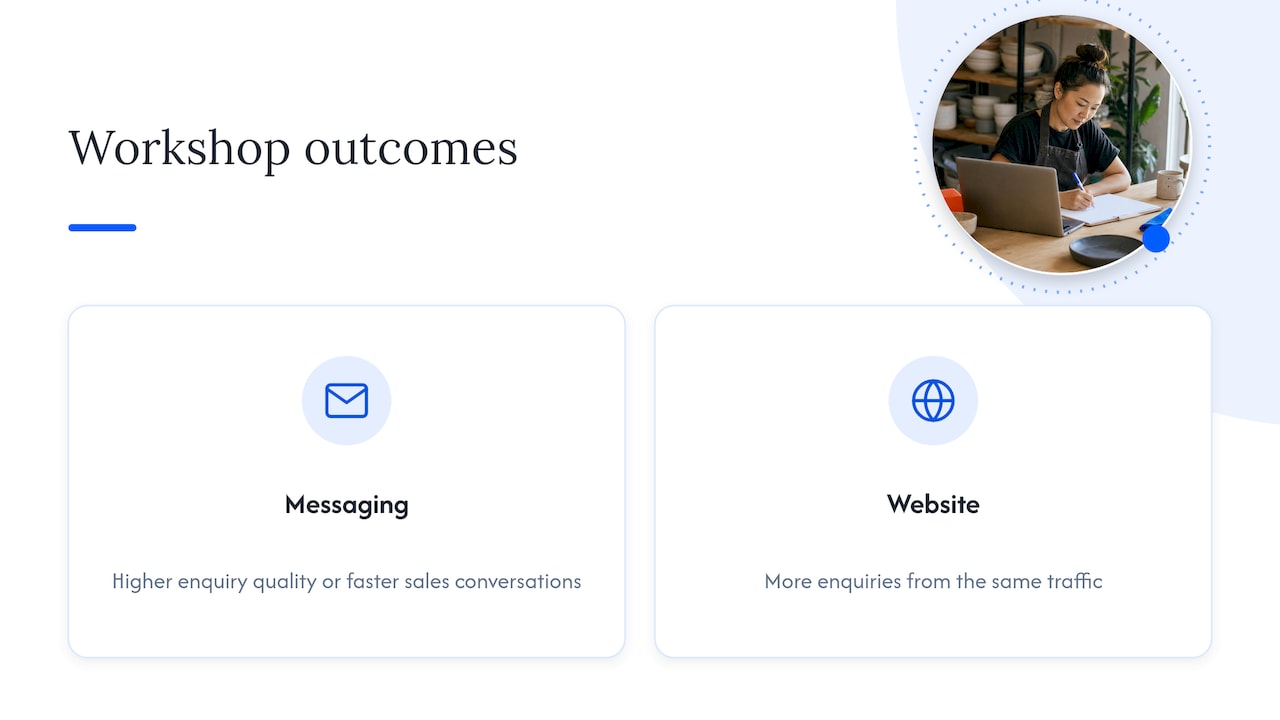
The value of a workshop topic shows up in what happens after the session, not during it. A messaging workshop that produces a sharper one-line value proposition should show up later as higher enquiry quality or faster sales conversations. A website conversion workshop that fixes a confusing homepage should show up as more enquiries from the same traffic, not just a tidier page.
Our own workshops are built around this cause-and-effect expectation: the three-phase structure that underpins our workshops is specifically designed to connect strategy decisions to measurable outcomes like improved conversions and reduced wasted ad spend. A business strategy session that clarifies direction feeds directly into the messaging and website work that follows, so the output of one topic becomes the input for the next rather than sitting as an isolated exercise.
When you’re assessing whether a workshop topic is worth running, ask what you’d expect to see change in the weeks after, enquiries, conversion rate, time to close, repeat business, and build that expectation into the one-page plan before the session ends. A topic without a measurable follow-on effect is probably better run as a shorter exercise inside a bigger session, rather than its own dedicated workshop.
If you’d rather not build every agenda and template from scratch, our business strategy workshop gives you the structured starting point most of the topics above build on.
Browse the full workshop listing to find the session that matches the topic your business needs most right now.
The highest-value topics are audience and customer segments, core messaging, customer journey mapping, website conversion, channel and content planning, lead capture, and measurement. Each should produce a concrete output, like a one-page plan or a prioritised fix list, rather than ending in open discussion.
Definitions vary slightly, but a common version covers company, customers, competitors, collaborators and climate (the broader market context). It’s a useful lens for a strategy-focused workshop, though most practical sessions focus more narrowly on audience, messaging and channels to keep the output actionable.
Beyond marketing specifically, effective workshop topics generally share two traits: a clear decision to be made and evidence the group can work from. For marketing sessions, that points back to audience clarity, messaging, journey mapping, conversion and measurement as the topics most likely to produce real action.
The most commonly run topics include customer segmentation, value proposition development, content and channel planning, website optimisation, and lead generation. Business.gov.au’s social media and content marketing workshop also points to platform selection and content curation as recurring focus areas for small businesses.
A single focused topic suits a 60 minute session, while two related topics (like messaging and journey mapping) work well in a 3 to 4 hour block. Full-day sessions suit stakeholder groups covering multiple connected topics, such as strategy through to website and lead generation.