

A business growth framework is a repeatable, structured system that translates your high-level vision into measurable daily and weekly actions across every function of your business. You know it’s working when you see consistent, repeatable revenue improvement, healthier margins, and fewer bottlenecks slowing your team down. The short version: start with a single quarterly loop — assess, prioritise, run, review — and build from there.
This matters particularly for Australian service businesses, where growth often stalls not from lack of ambition but from lack of structure. Tracking metrics like Customer Acquisition Cost (CAC) and Lifetime Value (LTV) within a clear framework turns guesswork into decisions. Simon-Kucher’s research describes a growth framework as a dynamic internal system that aligns functions across the business and recommends quarterly strategy check-ins paired with monthly operational reviews to keep it running.
Building a growth framework doesn’t require a consultant or a complicated document. It requires honesty, a clear process, and the discipline to run it consistently. Here’s how to do it in 90 days.
Before setting any targets, map where you actually are. Run a SWOT analysis, interview your three best clients, and pull your last 90 days of revenue, conversion rate, and average job value. Identify your single biggest bottleneck. Val-in’s research argues that frameworks must be paired with an execution method to turn strategic decisions into measurable outcomes, and that starts with knowing your real starting point.
A revenue target is not a strategy. Deloitte’s analysis makes this explicit: a growth strategy is the structured path that defines trade-offs, resource allocation, and capability development required to reach that target. Set two or three specific objectives (for example, increase conversion rate from 20% to 35%, or grow average job value by 25%) and define the leading KPIs that will tell you whether you’re on track before the quarter ends.
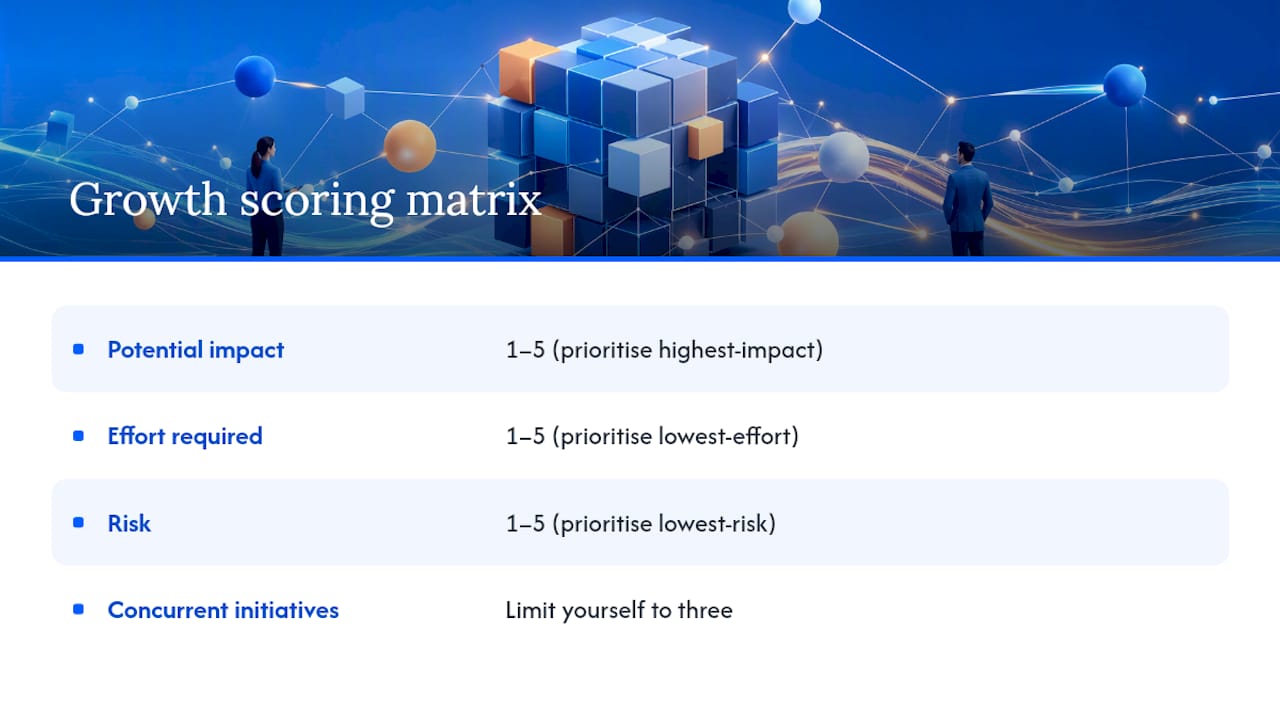
List every growth opportunity you can see, then score each one on three dimensions: potential impact (1–5), effort required (1–5), and risk (1–5). Prioritise the highest-impact, lowest-effort, lowest-risk items. Limit yourself to three concurrent initiatives. This scoring matrix prevents the resource dilution that kills most growth plans.
For each priority initiative, assign a single owner, a deadline, and a resource budget. Map the first quarter as a simple roadmap: what happens in weeks 1–4, weeks 5–8, and weeks 9–12. Keep it on one page. The BDA’s three-horizon model is useful here — allocate most resources to your immediate-quarter priorities, a smaller portion to medium-term capability building, and a small reserve for longer-horizon bets.
This is where most plans die. Schedule your monthly operational review (30–45 minutes, review KPIs, flag blockers) and your quarterly strategy check-in (half a day, assess progress, reset priorities) before you do anything else. At each review, make a data-backed stop, continue, or fix decision on every initiative.
90-day starter checklist:
Pro Tip: Budget time, not just money, for the first 90 days. The biggest cost is usually four to six hours of your own focused thinking time, not software or external spend.
Most frameworks don’t fail because the strategy was wrong. They fail because of predictable, avoidable execution problems. Cascade’s research on strategic drift documents how spreading initiatives too thin is one of the most common causes of framework failure, and recommends limiting concurrent priorities and assigning clear ownership.
Common pitfalls and how to avoid them:
“A growth target — for example, doubling revenue — is not a strategy. A growth strategy is the structured path that defines trade-offs, resource allocation, and capability development required to reach that target.” — Deloitte
Red flags in the first 90–180 days: If your KPIs haven’t moved after two monthly reviews, don’t wait. Stop the initiative, diagnose the root cause, and reallocate the resource. Early course-correction is far cheaper than a full quarter of wasted effort. For a deeper look at why Australian service businesses hit these walls, this guide to common growth barriers is worth reading.
The cadence is what converts a framework from a document into a running system. Monthly operational reviews keep your leading indicators on track; quarterly strategy check-ins reset direction. Weekly stand-ups (15 minutes, three questions: what did we do, what’s next, what’s blocked) are optional but useful for teams of two or more.
| KPI | What it measures | Target range | Why it matters |
|---|---|---|---|
| Customer Acquisition Cost (CAC) | Cost to win one new client | Varies by service; track trend | Rising CAC signals marketing inefficiency |
| Lifetime Value (LTV) | Total revenue from one client | a healthy LTV:CAC ratio | Drives pricing and retention decisions |
| Conversion rate | Enquiries converted to paying clients | for most service businesses | Leading indicator of sales health |
| Gross margin | Revenue minus direct delivery costs | a strong gross margin typical for service businesses | Measures whether growth is profitable |
| Utilisation rate | Billable hours as % of available hours | a utilisation rate range typical for service teams | Flags capacity and pricing issues |
| Average job value | Average revenue per client engagement | Track trend quarter on quarter | Rising value signals offer strength |
Pro Tip: Track five KPIs, not fifteen. A small set of leading indicators — conversion rate, CAC, gross margin, average job value, and LTV — tells you almost everything you need to know about a service business’s health.
Consider a solo bookkeeping practice in Sydney with a solid client base but stagnant revenue. The owner’s main bottleneck: most enquiries came from word-of-mouth but rarely converted because there was no clear follow-up process and the service offer was vague.
Three actions taken in the first 90 days:
Before and after metrics (90 days):
| Metric | Before | After 90 days |
|---|---|---|
| Conversion rate improved significantly over 90 days | ||
| Average job value increased noticeably over 90 days | ||
| Active pipeline grew substantially over 90 days |
The next step for this business was to build a referral partnership with two local financial planners, addressing the partnerships pillar. The small business growth playbook from The SMB Hub describes this pattern — attract, convert, retain, systematise, reinvest — as the underlying motion for sustainable small business growth, with the specific tactics shifting as revenue grows.
A business plan is a broad, often multi-year document written for external audiences — banks, investors, or grant bodies. A growth framework is an internal operating tool, built for you and your team, designed to be run on a short cycle. Kaizen AI Consulting’s analysis explains that growth strategies operate in 12–18 month cycles and focus on KPIs and execution routines, while business plans are broader and less frequently updated.
The practical difference: a business plan sits in a drawer; a growth framework runs every month. One describes where you want to go; the other tells you what to do on Tuesday.
A framework that contradicts your values will be quietly ignored. Before you set KPIs, write down the two or three non-negotiables that define how you want to work — the quality standards, the client relationships, the pace of growth you’re comfortable with. Then check every initiative against them. If a growth opportunity requires you to compromise on quality or take on more clients than you can serve well, it fails the culture test regardless of its revenue potential.
Practically, this means your vision statement should sit at the top of your one-page quarterly roadmap, visible at every review. When a team member or partner questions a decision, the answer should trace back to that statement. Culture alignment isn’t a values exercise done once at a retreat; it’s a filter applied at every quarterly check-in.
Buy-in comes from involvement, not announcement. If you have a team, bring one or two key people into the Step 2 objective-setting conversation. People support what they help build. Share the one-page roadmap with everyone who has an owner role, and make the monthly KPI dashboard visible to the whole team, not just leadership.
For external stakeholders — accountants, key suppliers, or referral partners — a brief quarterly update (two or three sentences on progress and next priorities) keeps them informed without creating overhead. The goal is a shared language around growth, so that when you say “we’re focusing on conversion rate this quarter,” everyone knows what that means and why.
You don’t need expensive software to run a growth framework. The right tool is the one your team will actually use consistently.
For data collection and KPI tracking, Google Looker Studio (free) connects to most data sources and builds a live dashboard in a few hours. For project and initiative tracking, Trello or Notion work well for small teams; both have free tiers that cover the basics. Xero is the most widely used accounting platform among Australian small businesses and gives you gross margin and cashflow data in real time. For customer relationship management, HubSpot’s free CRM handles pipeline tracking and conversion rate measurement without complexity.
The revbranding.com.au growth framework guide stresses that frameworks must be stress-tested for scalability — meaning the tools you choose should grow with you, not require a full rebuild when you add a second service line or a second staff member.
For demand generation tracking specifically, marketing that actually works covers how to measure what’s driving leads before you invest more in any channel.
The compounding effect of a consistent growth framework shows up over two to three years, not two to three months. Businesses that run quarterly strategy check-ins and monthly operational reviews build a body of data about what works in their specific market, with their specific clients, at their specific price point. That knowledge is genuinely hard to replicate.
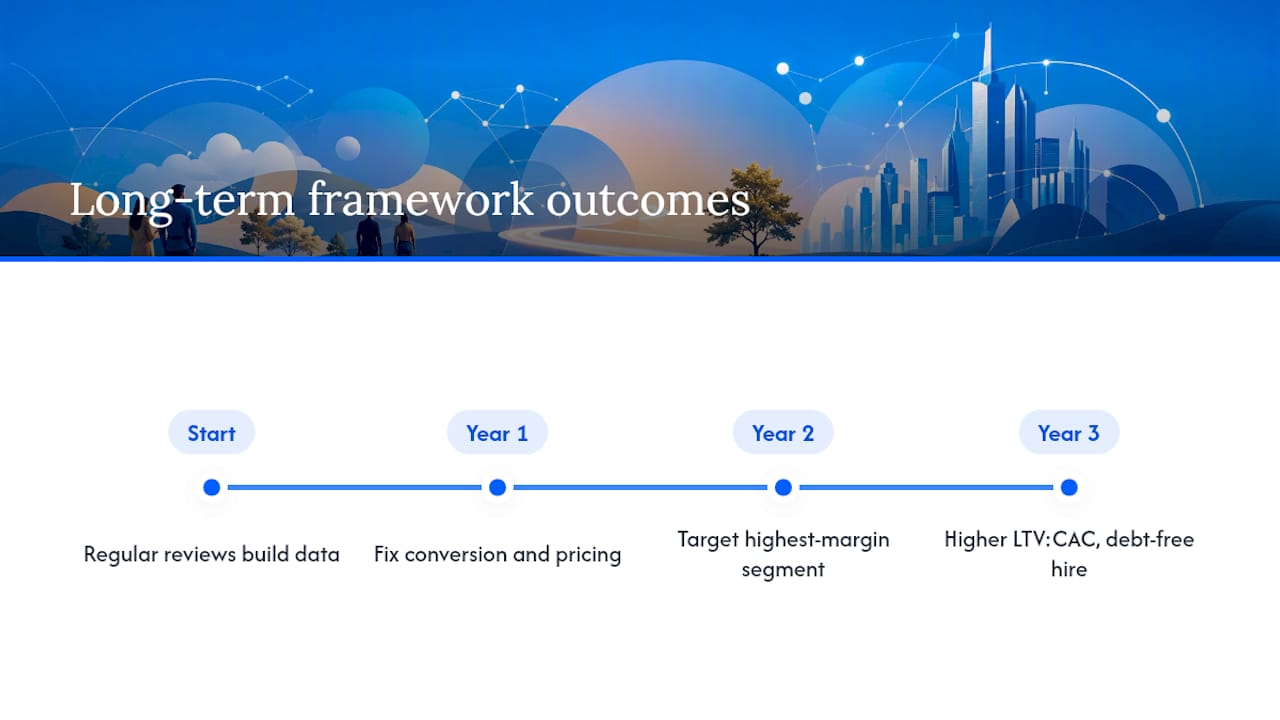
A practical example: a small IT support firm in Melbourne that committed to a framework in year one spent the first two quarters fixing conversion and pricing. By year two, they had enough data to identify their highest-margin client segment and redirect all marketing spend toward it. By year three, their LTV:CAC ratio had improved substantially and they were able to bring on a second technician without taking on debt, because the cashflow model was predictable.
The pattern holds across service categories. The BDA’s three-horizon model provides a useful lens here: businesses that allocate resources across short, medium, and long-term horizons consistently outperform those that reinvest everything into immediate revenue. The framework is what makes that allocation deliberate rather than accidental.
The framework that works for a solo operator won’t work unchanged for a team of eight. As you grow, the framework needs to scale in three specific ways.
First, delegation of ownership. In a solo business, you own every initiative. At five people, each pillar should have a named owner who runs their own monthly sub-review and reports up to the quarterly check-in. Second, the KPI set expands. You add staff-level metrics (output per person, utilisation by team member) and client-level metrics (retention by service line, NPS by segment) alongside the business-level KPIs. Third, the scoring matrix for new opportunities becomes more rigorous. Entering a new market or launching a new service line requires a mini-assessment of its own — product-market fit, pricing, delivery capacity — before it gets added to the roadmap.
For growth strategies tailored to Australian small businesses, the stage-appropriate moves shift significantly between the startup, stabilising, and scaling phases. The framework structure stays the same; the content inside it changes.
A business growth framework works because it converts vision into a repeatable quarterly system, tracks the right KPIs, and forces explicit trade-offs that prevent resource dilution.
| Point | Details |
|---|---|
| Definition and cadence | A growth framework is a dynamic internal system; run monthly operational reviews and quarterly strategy check-ins to keep it live. |
| Five-step build process | Assess, set KPIs, prioritise, plan, then run the cadence — all achievable within a 90-day starter cycle. |
| Limit concurrent initiatives | Cap active priorities at three to avoid strategic drift and keep ownership clear. |
| Track five core KPIs | CAC, LTV, conversion rate, gross margin, and average job value cover most of what a service business needs to monitor. |
| Mybworkshops workshops | Mybworkshops offers expert-led workshops and templates that help service business owners build and run this framework step by step. |
Knowing the framework is one thing. Running it consistently, with the right structure and support, is where most service business owners get stuck.
Mybworkshops offers expert-led online workshops built specifically for Australian service business owners who want to move from scattered tactics to a clear, repeatable growth system. The workshops cover brand strategy, offer design, demand generation, conversion, and the operational cadence that holds it all together — with practical templates and AI prompts you can use immediately. Real business owners have used these workshops to increase conversions and reduce wasted marketing spend, with results documented in client examples here.
If you’re ready to build your framework with guided support, browse the available workshops and find the session that matches your current bottleneck.
A company growth framework is a structured, repeatable internal system that aligns every business function — marketing, sales, operations, finance, and people — around shared growth objectives and measurable KPIs, reviewed on a regular cadence.
Definitions vary across models, but the four pillars most consistently cited for service businesses are: market and customer intelligence, offer and pricing, demand generation, and sales and conversion. A complete framework typically adds operations, finance, people, and customer retention.
A business plan is a broad, multi-year document often written for external audiences; a growth framework is an internal operating tool that runs on 12–18 month cycles, focused on KPIs and execution routines rather than narrative description.
A Sydney bookkeeping practice used a growth framework to refine its service offer, build a follow-up process, and track conversion rate monthly — lifting its conversion rate and average job value significantly within 90 days.
Run a monthly operational review (30–45 minutes) to track leading KPIs and flag blockers, and a quarterly strategy check-in (half a day) to reset priorities and assess overall direction.