

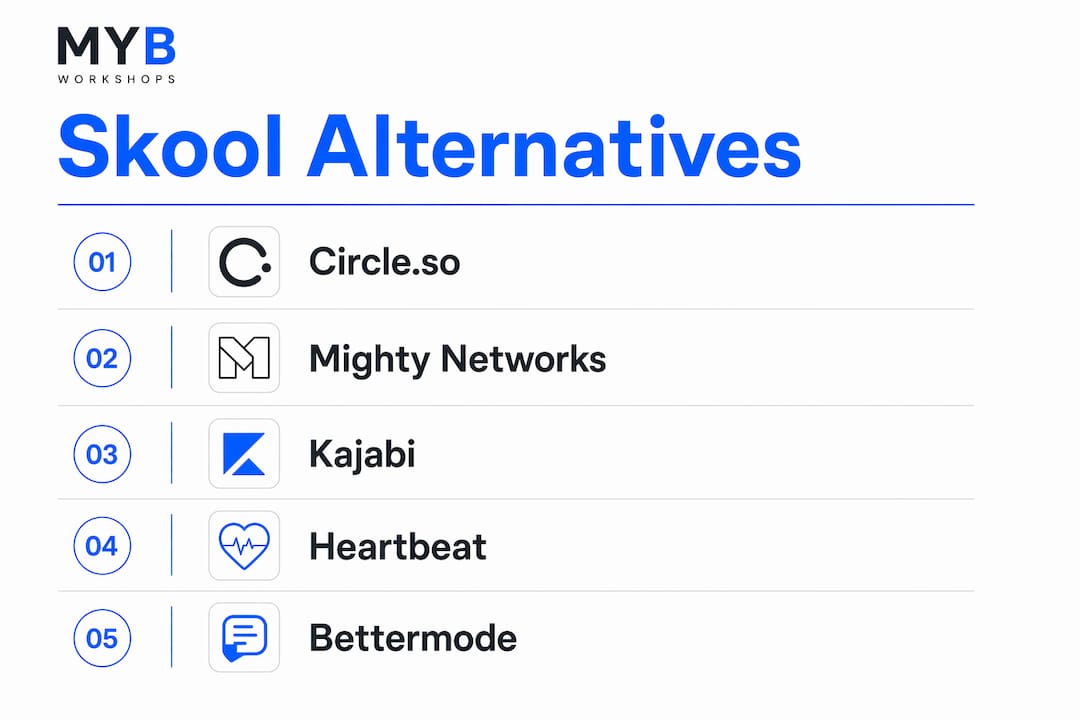
The strongest Skool.com alternatives for Australian course creators and community builders in 2026 are Circle.so, Mighty Networks, Kajabi, Heartbeat, Teachable, Thinkific, and Podia, each offering capabilities that go well beyond what Skool provides out of the box. Whether you need richer course tools, better branding control, or more flexible pricing, there is a platform built for exactly that.
The table below covers all major alternatives across the dimensions that matter most for your decision.
| Platform | Best for | Pricing (from) | Key features | Branding control | Community tools | Learning tools | Ease of use |
|---|---|---|---|---|---|---|---|
| Circle.so | Scaling community businesses | $39/mo | Spaces, courses, events, email, automation | High (white-label on Plus) | Strong | Strong | Moderate |
| Mighty Networks | Engagement-focused communities | $49/mo | Courses, challenges, gamification, events | Moderate (branded app on Business) | Very strong | Strong | Moderate |
| Kajabi | Course-first businesses with marketing funnels | $143/mo | Email automation, funnels, courses, coaching | Moderate | Moderate | Very strong | Moderate |
| Heartbeat | Flexible, event-driven communities | $40/mo | Programs, spaces, events, live interaction | High | Strong | Moderate | Easy |
| Bettermode | Brand and product communities | $399/mo | Custom domains, embeds, API integrations | Very high | Strong | Limited | Moderate |
| Teachable | Self-paced course delivery | $39/mo | Course builder, quizzes, certificates | Moderate | Basic | Very strong | Easy |
| Thinkific | Structured LMS with assessments | $49/mo | Drag-and-drop builder, progress tracking | Moderate | Basic | Very strong | Easy |
| Podia | Simple all-in-one course and membership | $39/mo | Courses, memberships, digital downloads, email | Moderate | Moderate | Strong | Very easy |
| Discord | Free real-time communities | Free | Chat, voice, channels | None | Moderate | None | Easy |
| Slack | Professional team communities | $7.25/user/mo | Channels, integrations, threads | None | Moderate | None | Easy |
| Geneva | Event-centric communities | Free/paid | Events, chat rooms, groups | Low | Moderate | None | Easy |
| Disciple | Branded mobile community apps | Custom | White-label app, membership tiers | Very high | Strong | Moderate | Moderate |
| Discourse | Self-hosted forum communities | Free (self-hosted) | Open-source, plugins, SEO | High (self-hosted) | Strong | Moderate | Technical |
| Public discussion communities | Free | Subreddits, upvotes, discovery | None | Moderate | None | Easy | |
| Facebook Groups | Casual communities with existing audiences | Free | Groups, events, posts | None | Moderate | None | Very easy |
| Whop | Digital memberships and subscriptions | Free + fees | Memberships, digital products, subscriptions | Low | Basic | Basic | Easy |
| Heights Platform | Courses with gamification and drip content | $49/mo | Drip content, gamification, memberships | Moderate | Moderate | Strong | Easy |
| PeerBoard | Embedded community forums | Free/paid | Embedded forums, API, social features | Moderate | Moderate | Basic | Easy |
| Vanilla Forums (Higher Logic) | Enterprise community management | Custom | Advanced moderation, analytics, custom integrations | High | Very strong | Moderate | Complex |
| CircleSpace | Niche audience communities | Custom | Curated content, specialised spaces | Moderate | Moderate | Moderate | Moderate |
| Swarm | Knowledge-sharing communities | $29/mo | Collaboration, structured content | Moderate | Moderate | Moderate | Easy |
| Uscreen | Video-first subscription communities | Custom | Video hosting, subscriptions, community | Moderate | Moderate | Strong (video) | Moderate |
| eFront | Enterprise LMS with compliance tools | Custom | Compliance tracking, analytics, reporting | High | Basic | Very strong | Complex |
| Elgg | Custom self-hosted social networks | Free (self-hosted) | Open-source, plugin architecture | Very high | Strong | Moderate | Technical |
| Learniverse | AI-powered learning communities | Custom | AI tools, learning paths, engagement | Moderate | Moderate | Strong | Moderate |
| AI Native Engineer | AI-driven community management | Custom | Automated moderation, AI engagement tools | Moderate | Strong (AI) | Moderate | Technical |
Quick recommendations:
Skool is a community and course platform built around simplicity. Launched in 2019 by Sam Ovens, it combines a community feed, a basic courses tab, a calendar, and a gamified leaderboard into one clean interface. Skool charges a flat $99/month with no transaction fees beyond Stripe’s standard processing, which makes it genuinely attractive for coaches and accountability group leaders just getting started.
The gamification is Skool’s real differentiator. Members earn points for posting and commenting, which drives daily logins better than most platforms. For coaching communities where engagement and streak-building matter, that loop works well. Setup takes under an hour, and the mobile app pushes notifications reliably.
The limitations become clear as your business grows. Skool has no native course builder. You can upload files and host a calendar of live events, but if you want to sell a structured self-paced course, you need to link out to an external platform. There is also a 10,000-member cap on the standard plan, no native email marketing, basic analytics, and minimal branding control. Every Skool community looks essentially the same.
Creators typically start looking for Skool alternatives when they hit one of these walls:
Pro Tip: Before you migrate, export your member list from Skool. It is the one piece of data that transfers cleanly. Community content, gamification history, and leaderboard rankings do not export, so document what matters before you move.
The platforms below cover the full range of what Australian creators and educators are building in 2026, from solo coaches to enterprise learning programmes.
Circle is the most direct upgrade path from Skool for creators who are building a real community business. It brings together Spaces (organised discussion areas), native courses with drip content, live events, email broadcasts, and workflow automation in one platform. Circle offers strong export options in JSON and CSV formats, which matters when you are thinking about long-term data ownership.

Pricing starts at a monthly rate with transaction fees decreasing on higher-tier plans; the highest tiers include white-label branded apps. The trade-off: a truly branded mobile app is expensive on Circle, making it better suited to creators already generating consistent revenue.
Pros: Multi-product monetisation, structured Spaces, strong course-community integration, good export tools.
Cons: White-label app requires the most expensive plan; costs can climb quickly as you add features.
Mighty Networks sits between Skool and Circle in terms of complexity. It includes native courses, live events, member challenges, and one of the best gamification systems available, with points, levels, and badges that genuinely drive retention. The Business plan at $119/month includes a branded white-label mobile app, which is significantly cheaper than Circle’s equivalent offering.

The catch is a transaction fee on top of Stripe fees, which can increase costs as your membership revenue grows, depending on your plan. For creators prioritising a polished branded app without paying $399/month, it offers the best value in this category.
Pros: Excellent gamification, polished branded app at mid-tier pricing, strong events and challenges features.
Cons: Transaction fees reduce profitability at scale; some creators find the customisation ceiling limiting.
Kajabi is the platform for creators whose primary business is selling courses and digital products at scale. It combines courses, coaching programmes, memberships, email automation, sales funnels, and landing pages in one system. There are no transaction fees on any plan, and pricing starts at $143/month. The email marketing and funnel tools are genuinely powerful, not afterthoughts.
Dedicated LMS platforms like Teachable and Thinkific are often more effective for simple course delivery, but Kajabi wins when marketing is as important as the course itself. The community features are functional rather than exceptional, so if deep community engagement is your goal, Kajabi is not the strongest choice.
Pros: Best-in-class email marketing and funnels, no transaction fees, strong course delivery.
Cons: Expensive entry point; community tools are secondary to course and marketing features.
Heartbeat is a flexible community platform built around interactive programmes and event-driven engagement. It lets you create customisable spaces to organise content and conversation, and it handles live events well. Pricing starts at $40/month, making it one of the more affordable options with genuine community depth. It suits creators who need adaptable programme structures without the complexity of a full LMS.
Bettermode is built for organisations embedding communities within existing products or websites. It offers very high branding control, custom domains, API integrations, and a flexible content model that can mirror your existing digital ecosystem. Pricing starts at $399/month, which positions it firmly in the business and enterprise segment. Solo creators and small coaching businesses will find it over-engineered for their needs.
Pros: Exceptional branding control, strong API and integration options, suits product-led communities.
Cons: High entry price; overkill for individual creators.
Teachable is purpose-built for self-paced course delivery. The course builder is clean and well-organised, with quizzes, completion certificates, and student progress tracking. Pricing starts at $39/month, though the Basic plan carries a 5% transaction fee. The Pro plan at a higher price point removes that fee entirely. Community features are minimal, so Teachable works best when your course is the product and community is a secondary consideration.
Thinkific offers a drag-and-drop course builder with no transaction fees on any paid plan, which is a genuine advantage over Teachable at the entry level. It handles assessments, progress tracking, and structured learning paths well. Pricing starts at $49/month. Like Teachable, it is a course-first platform, and its community tools are basic. For Australian educators building structured training programmes or academies, Thinkific is a practical and cost-effective choice.
Podia is the simplest all-in-one option for creators who want to sell courses, digital downloads, and memberships from one dashboard without a steep learning curve. Pricing starts at $39/month. The interface is genuinely easy to use, and the built-in email marketing covers basic needs. It is not the deepest platform in any single category, but for creators who want everything in one place without complexity, it delivers.
Discord is free, widely used, and excellent for real-time chat-based communities. It has no native course hosting, no membership billing, and conversations scroll away quickly, which makes it structurally weak for paid communities. Most paid communities outgrow Discord within a year and migrate to Circle, Skool, or Mighty Networks. It works well as a free community layer or for informal groups where real-time interaction is the entire point.
Slack is a professional communication platform with strong integrations and organised channel structures. It starts at $7.25 per user per month, which makes it expensive at scale. There are no native course or event features. It suits professional communities and corporate learning environments where members are already using Slack for work, rather than creators building paid membership businesses.
Geneva combines event management with flexible chat rooms and group spaces. It is free to start and handles event organisation well. It lacks native course delivery and monetisation tools, making it better suited to communities where events and real-time interaction are the core offering rather than structured learning.
Disciple focuses on branded mobile apps and membership monetisation. It offers a white-label app experience and strong membership tiering, which suits community builders who want their brand front and centre on mobile. Pricing is custom, so you will need to contact them directly for a quote relevant to your audience size.
Discourse is open-source forum software that you can self-host for full data ownership and SEO benefits. It is extensible through plugins and gives you complete control over your community’s appearance and functionality. The trade-off is technical setup time and ongoing server management. For organisations with technical resources who want long-term control and public-facing SEO value, it is one of the smartest long-term choices available.
Both platforms offer free access to large existing audiences. Reddit suits public discussion communities built around shared interests, while Facebook Groups work well for creators with established Facebook audiences who want casual engagement. Neither supports paid memberships natively, neither offers course hosting, and neither gives you ownership of your audience data. They are useful as discovery and awareness channels, not as the foundation of a paid community business.
Whop focuses on digital memberships and subscriptions outside traditional course ecosystems. It is free to start, with fees applied per transaction. It suits creators selling digital products, trading signals, or niche subscription content rather than structured courses or deep community experiences.
Heights Platform combines course delivery with gamification, drip content, and membership tools. It starts at $49/month and offers a solid middle ground for educators who want more engagement features than Teachable provides without the full complexity of Circle or Mighty Networks.
PeerBoard embeds community forums directly into websites or apps via API. It suits product teams adding community engagement to an existing digital product rather than standalone community builders. The free plan covers basic needs, with paid plans adding more customisation.
Vanilla Forums is an enterprise-grade community platform with advanced moderation tools, detailed analytics, and extensive customisation options. It is built for large organisations running communities at scale, with pricing to match. It is not relevant for individual creators or small businesses.
Uscreen is built for video-first educators who want to monetise through subscriptions. It handles video hosting, subscription billing, and community features in one platform. Pricing is custom. It suits fitness instructors, video course creators, and anyone whose primary content format is video rather than text or live events.
These platforms serve specific niches. eFront is an enterprise LMS with compliance and reporting tools suited to corporate training environments. Elgg is open-source social networking software for developers who want fully customisable self-hosted communities. Learniverse integrates AI tools into learning and community engagement for tech-forward educators. AI Native Engineer focuses on automated community moderation and engagement workflows for developers. CircleSpace targets niche audience groups with curated content experiences. Swarm organises knowledge-sharing communities around structured content and member collaboration, starting at $29/month.
The right platform depends less on features and more on where your business is right now. An early-stage creator validating a paid community idea has completely different needs from a course business generating consistent monthly revenue and planning to scale.
Start by being honest about these questions:
For Australian creators, member retention and reducing churn are as important as acquisition. A platform that makes onboarding confusing or engagement hard to sustain will cost you members regardless of its feature list. Ease of use for your members matters as much as ease of use for you.
Pro Tip: Document a 90-day content and engagement plan before you commit to any platform. Choosing a platform with features you are not ready to use leads to complexity without benefit, and often to low engagement and burnout.
Migration is a real cost that most comparisons underplay. Circle provides the best export tools in JSON and CSV formats. Mighty Networks has limited export options and you lose engagement history. Skool exports member lists but not community content. If you anticipate outgrowing your first platform within 12–24 months, starting with Circle or Mighty Networks from day one avoids a painful rebuild later.
A few practical pointers for choosing well:
Choosing the right platform is only part of the picture. The creators who get the most from Circle, Kajabi, or Mighty Networks are the ones who arrive with a clear brand, a defined audience, and a marketing system that brings new members in consistently.

Mybworkshops runs expert-led workshops specifically designed for Australian service-based business owners who want to build that foundation properly. The structured three-phase programme covers brand clarity, website performance, and practical marketing strategies that attract and convert the right clients, with personal mentorship and AI tools woven in throughout. You will leave with a working marketing engine, not just a better understanding of what one looks like. If you are building a community or course business and want the strategy to back it up, explore the full workshop range to find the right starting point.
Yes, depending on what you need. Circle.so offers more flexibility, structured Spaces, native courses, and better export tools. Kajabi is stronger for course-first businesses with email marketing and sales funnels. Mighty Networks suits creators who want gamification and a branded mobile app without paying $399/month.
Skool does not offer a free plan. The standard price is $99/month flat with no transaction fees beyond Stripe’s standard processing. Discord and Facebook Groups are free alternatives, though neither supports native courses or paid memberships.
Substack is a writing and newsletter platform, not a community or course platform. It suits writers monetising through paid subscriptions to written content. Skool is built around community engagement, gamification, and basic course hosting. They serve different purposes, though some creators use Substack for content and a separate platform for community.
For serious community businesses, yes. Circle offers structured Spaces, advanced monetisation, native email marketing, and workflow automation that Skool does not provide. Skool is better for creators who want the simplest possible setup and are focused on early-stage engagement with a coaching or accountability group model.
The best Skool.com alternative for Australian creators in 2026 depends on whether you prioritise community depth, course delivery, branding control, or marketing integration, and no single platform wins on all four.
| Point | Details |
|---|---|
| Skool’s core limits | No native course builder, no email marketing, minimal branding, and a 10,000-member cap on the standard plan. |
| Circle for scaling | Circle.so offers structured Spaces, native courses, and strong export tools, making it the strongest upgrade path from Skool. |
| Watch transaction fees | Platforms charging 2–5% transaction fees accumulate significant costs as membership revenue grows compared to flat-rate plans. |
| Match platform to stage | Early-stage creators benefit from simple tools like Teachable or Thinkific; scaling businesses need modular platforms like Circle or Kajabi. |
| Mybworkshops | Mybworkshops offers expert-led workshops to help Australian business owners build the brand and marketing foundation that makes any community platform perform. |