
Your website copy is either working as a salesperson or working against you. The role of website copywriting in conversions is straightforward: clear, targeted words reduce visitor doubt, answer the right questions at the right moment, and guide people toward taking action. When copy is vague or inward-facing, visitors leave. When it speaks directly to what someone needs, they stay, trust you, and enquire.
Conversion copywriting is the discipline of writing specifically to move a reader toward a desired action, whether that is booking a call, submitting a form, or making a purchase. Unlike general writing, it is accountable writing: if it does not measurably lift conversions, it gets rewritten.
The core elements that make copy convert are:
Brevity is not about cutting words for the sake of it. It is about removing anything that delays the reader from understanding your offer. Visitors scan before they read, so front-loading your key message is the single most reliable way to hold attention.
Pro Tip: Before rewriting any page, open Google Search Console and find the queries driving impressions but few clicks. Those queries tell you exactly what your visitors wanted to read and did not find.
Strong copy is not just well-written. It is structured to guide a decision. These are the elements that do the heavy lifting:
Pro Tip: Intersperse proof throughout your page rather than saving it for one section. A short testimonial after your service description and another near your CTA keeps trust building all the way to the conversion point.

Visitors form a first impression in under 50 milliseconds. That means your headline and opening line are doing most of the qualifying work before anyone reads a full sentence.

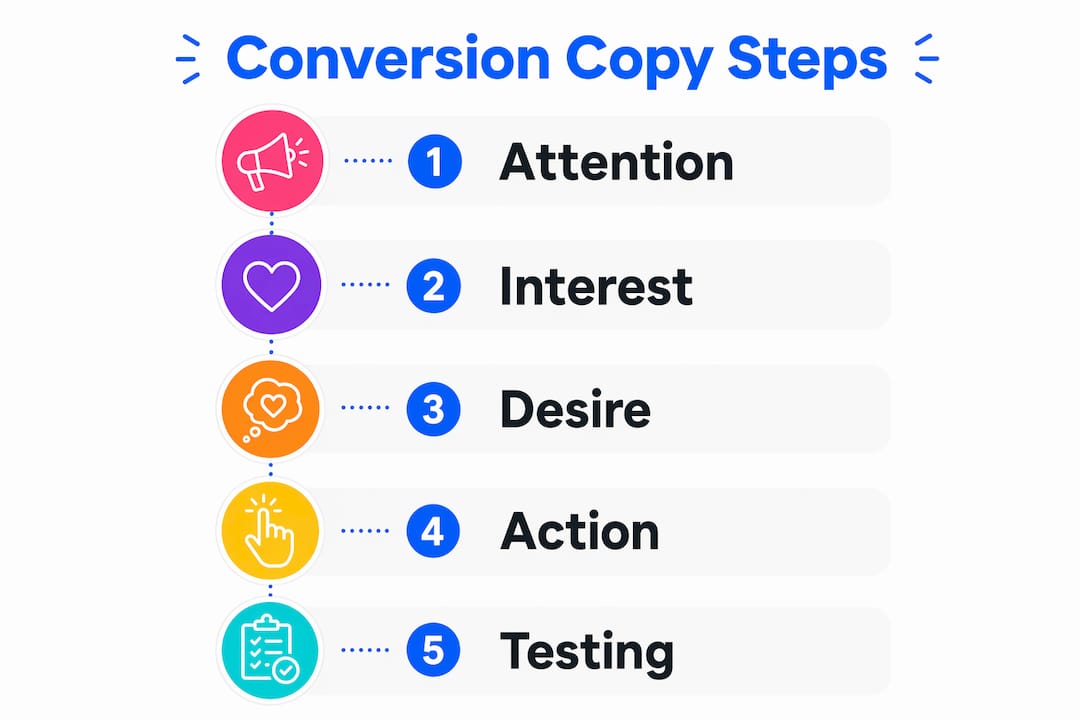
Persuasion psychology underpins every high-converting page. The AIDA framework (Attention, Interest, Desire, Action) gives you a reliable sequence: grab attention with a specific headline, build interest by naming the problem, create desire by showing the outcome, then make the action obvious. The sequence matters because presenting proof before the visitor understands the problem is wasted effort, and asking for a commitment before handling objections creates resistance.
Clarity in messaging drives conversion and also improves lead quality. When your copy is precise about who you help and what they get, the enquiries you receive are better qualified. Your sales conversations become shorter and easier.
| Copy element | Common mistake | What converts instead |
|---|---|---|
| Headline | Vague or clever | Specific outcome for a named audience |
| Value proposition | Feature list | Benefit stated in customer language |
| CTA | “Contact us” | “Book your free 20-minute call” |
| Proof | Clustered at the bottom | Placed near decision points throughout |
| Objection handling | Absent | Addressed before the CTA |
A/B testing is what separates opinion from evidence. Without testing, you are guessing. With it, you build a body of knowledge about what your specific audience responds to, and each test compounds into better copy over time.
Improving your copy is not a one-off project. It is an ongoing part of running a website that works. A practical approach looks like this:
You can also check common copywriting mistakes that quietly reduce enquiries, even on pages that look polished.
Advertising copy and website copy serve different jobs, and confusing the two is one of the most common reasons pages underperform.
Advertising copy interrupts. It needs to grab attention fast, often from someone who was not looking for you. It is short, punchy, and built around a single hook. Website copy, by contrast, works with visitors who have already shown intent. They arrived because they searched for something specific. Your job is not to grab their attention but to confirm they are in the right place and guide them through a decision.
The practical implication: do not write your service pages like ads. Ads tease. Service pages answer. A visitor who lands on your page from a search for “bookkeeper Fremantle” already wants a bookkeeper. They need to know you service their area, what it costs, and what happens when they enquire, not a punchy tagline.
Copy written without a clear customer in mind tends to be vague, inward-facing, and forgettable. The most effective copy is written for one specific person in one specific situation.
Start by mapping what your ideal customer already believes, fears, and wants when they land on your page. A tradie looking for a bookkeeper is not thinking about accounting software. They are thinking about whether the ATO is going to come after them and whether they can afford to hand this off. Copy that speaks to that specific anxiety converts. Generic copy about “comprehensive financial services” does not. You can explore this further in Mybworkshops’ guide on creating your ideal customer.
Understanding digital marketing mistakes that come from misreading your audience can also sharpen how you frame your copy from the start.
Stories convert because they make outcomes feel real. A case study framed as a story (“Sarah ran a cleaning business with a website that got traffic but no calls. Within six weeks of rewriting her service page, she had more enquiries than she could handle”) is more persuasive than a bullet point claiming “proven results.”
The structure that works best is simple: name the problem the customer had, describe what changed, and show the outcome. Keep it specific. Vague stories (“a client saw great results”) do nothing. Specific stories with real details build the kind of trust that moves people to enquire. You do not need many. One or two well-told stories on a service page can do more work than a dozen generic testimonials.
Conversion rate is the primary measure: what percentage of visitors take the desired action? Well-written service business pages typically have conversion rates that are considered healthy, but actual percentages vary widely; if your rate is very low, copy is usually the first place to look.
Beyond conversion rate, track CTA click rate (are people reaching and clicking your CTA?), form-start rate (are they beginning to enquire?), and scroll depth (are they reading far enough to see your proof?). These diagnostic metrics tell you where visitors are dropping off, which points directly to the copy or structure that needs fixing. Revenue per visitor ties it all together: how much does each visitor generate on average? That single figure captures the combined effect of conversion rate and the quality of enquiries your copy attracts.
More than half of website visits happen on mobile, and mobile visitors are less patient. Long paragraphs, buried CTAs, and headlines that only make sense on a wide screen all cost you enquiries.
On mobile, your headline and CTA need to be visible without scrolling. Keep paragraphs to two or three sentences. Make your phone number or enquiry button a tap, not a hunt. Test your pages on your own phone regularly. If you have to pinch, zoom, or scroll three times to find out what you do and how to contact you, your mobile visitors are leaving. For a practical checklist, Mybworkshops’ guide on landing pages that convert covers mobile-specific structure in detail.
If you want to put these principles into practice with structured guidance, Mybworkshops’ copywriting and marketing workshops walk you through the full process, from customer research to copy that converts.
Website copy is the highest-leverage place to invest when your site gets traffic but not enough enquiries: clarity, proof placement, and specific CTAs drive the measurable difference.
| Point | Details |
|---|---|
| Headlines carry most of the weight | The headline drives roughly 80% of a page’s conversion performance, so get it specific and outcome-focused. |
| Flip the language from “we” to “you” | Copy focused on what the visitor gets, not what you offer, consistently improves conversion rates. |
| Place proof near decision points | Testimonials and trust signals near CTAs outperform proof clustered at the bottom of a page. |
| Test one element at a time | Changing a headline, CTA, or proof placement individually lets you know exactly what improved results. |
| Mobile visitors need instant clarity | Your headline and CTA must be visible without scrolling, and paragraphs should stay short on small screens. |
A website copywriter writes the words on your website specifically to reduce visitor confusion, build trust, and guide people toward taking a desired action such as enquiring, booking, or buying.
A conversion copywriter combines audience research, persuasion psychology, and A/B testing to write copy engineered around one measurable goal: increasing the percentage of visitors who take a specific action.
Well-written service business pages typically have conversion rates that are considered healthy, but actual percentages vary widely. Higher rates usually reflect tight audience targeting combined with copy that closely matches visitor intent.
Definitions vary across practitioners, but a widely used version covers: Clear (easy to understand), Concise (no wasted words), Compelling (gives a reason to act), Credible (backed by proof), and Customer-focused (written for the reader’s needs, not the business’s).