

Most Australian small businesses land somewhere between $1,200 and $3,000 a month for SEO, plus GST, once you factor in the real cost of a competitive market. The single biggest thing that moves that number up or down isn’t the provider you pick. It’s how contested your industry and location are, and how much technical debt your website is carrying before anyone starts. Get a proper audit or a scoped estimate before you sign anything.
TL;DR:
- Small Australian businesses typically pay between $1,200 and $2,500 per month for SEO, with highly competitive industries potentially costing up to $6,000.
- Cost variations depend heavily on industry competition, location, website technical debt, content needs, and link acquisition difficulty, not just the provider chosen.
- The most common SEO pricing model for SMEs is a monthly retainer combined with a one-off technical audit, which costs $1,500 to $4,000.
- Expect minimal technical work and link building at lower budgets, but skipping these areas delays long-term results and increases future costs.
- SEO results generally appear within three to six months, with significant impact usually visible by twelve months, requiring at least six to twelve months of consistent investment.
Think of SEO pricing less like a fixed menu and more like a renovation quote. The number depends entirely on the state of the house and what you’re trying to build.
Across the market, most small businesses pay between $1,200 and $2,500 per month for an ongoing SEO campaign, with local, single-location businesses sometimes starting closer to $800. That’s the entry point, not the ceiling. For businesses that need to compete harder, either because the industry is crowded or the site needs real rebuilding, the effective range often climbs to $2,500–$6,000 a month.
Four rough bands cover most of the market:
The blended hours behind these numbers vary too. An entry-level package might buy eight to twelve hours a month, mostly junior time. A growth package can include 30 to 50 hours with a senior strategist overseeing the work. Ecommerce sites and multi-location businesses usually sit at the higher end of whichever band they’re in, simply because there’s more to manage across categories, locations, or product pages.
Australian providers charge in roughly four ways, and each one carries different risks for a small business owner trying to plan cashflow.
For most SMEs, a monthly retainer paired with a project-based technical audit at the start gives the best of both: predictable ongoing spend, with a fixed cost for the foundational fix-up work.
Ask three providers for a quote on the same business and you can expect wildly different numbers. That’s not necessarily a sign someone is padding their fee. It reflects the fact that SEO scope can mean very different things, and quotes can differ by three times or more depending on what’s actually included.
A few factors explain most of the gap:
Pro Tip: When you get a quote, ask the provider to walk you through exactly which of these five factors drove their number. If they can’t explain it in plain terms, that’s a scope problem, not a pricing problem.
Comparing proposals line by line beats comparing headline prices. Two providers quoting $2,000 a month can be offering completely different amounts of actual work.
The most common casualty at the lower end is technical work and link building, both of which take real time and rarely fit inside an $800 budget alongside content. Skipping them doesn’t save money long term. It just delays the point at which you need to pay for a bigger fix, because an audit deferred is usually a bigger bill later.
A proper technical SEO audit costs $1,500 to $4,000 as a one-off project, and skipping it is one of the most common, and most expensive, mistakes small businesses make. Committing to a monthly retainer without knowing what’s actually wrong with your site is like renovating a kitchen without checking if the wiring is safe.
A few one-off costs worth planning for:
The smart sequence is audit first, then retainer. Fold any urgent fixes the audit uncovers into the first month or two of the ongoing plan, so you’re not paying twice for the same discovery work.
A good proposal reads like a scope of work, not a sales pitch. Before you sign anything, run it through this checklist.
During the sales call, ask directly: what does the first 90 days look like, what happens if targets aren’t met, and can they show examples of similar work in your industry. Watch for red flags like guaranteed rankings (nobody can promise this honestly), scopes so vague they could mean anything, no mention of an audit, or a link-building plan that sounds like it’s buying links rather than earning them. If two quotes look wildly different, ask both providers to itemise hours against the same list of deliverables. That’s the only fair way to compare them.
Patience is part of the budget, not separate from it. Most campaigns show early technical improvements within three months, meaningful traffic growth by six months, and genuine lead or revenue impact by around twelve months. That timeline holds whether you’re a Sydney firm or a regional tradie, because it’s driven by how search engines re-crawl and re-rank content, not by geography.

Budget for at least six to twelve months of retainer spend, and always add 10% GST on top of any quoted figure, since some providers quote ex-GST and others don’t. Rather than committing your full budget upfront, test a smaller scope for the first quarter, then scale spend once you can see SEO’s actual contribution to enquiries, not just traffic.
On paper, hiring an in-house SEO specialist looks cheaper than an agency retainer. In practice, it rarely is once you account for the full picture.
A single in-house hire gives you one person’s skillset, whereas a retainer usually buys access to a small team covering technical, content, and link-building specialities. Replicating that in-house means multiple salaries, which quickly outpaces even a growth-tier agency retainer of $3,000–$6,000 a month. There’s also the ramp-up cost: a new hire needs software licences, ongoing training, and months to become genuinely effective, none of which shows up in a simple salary comparison.
The trade-off runs the other way too. In-house staff build deep knowledge of your business and can move faster on internal changes because they don’t need a briefing cycle. For a business with enough scale to justify a full-time role, and enough internal marketing capability to manage that person well, in-house can work. For most SMEs without an existing marketing function, a retainer remains the more practical, lower-risk starting point, because you’re buying a team’s worth of expertise without carrying the full employment cost.
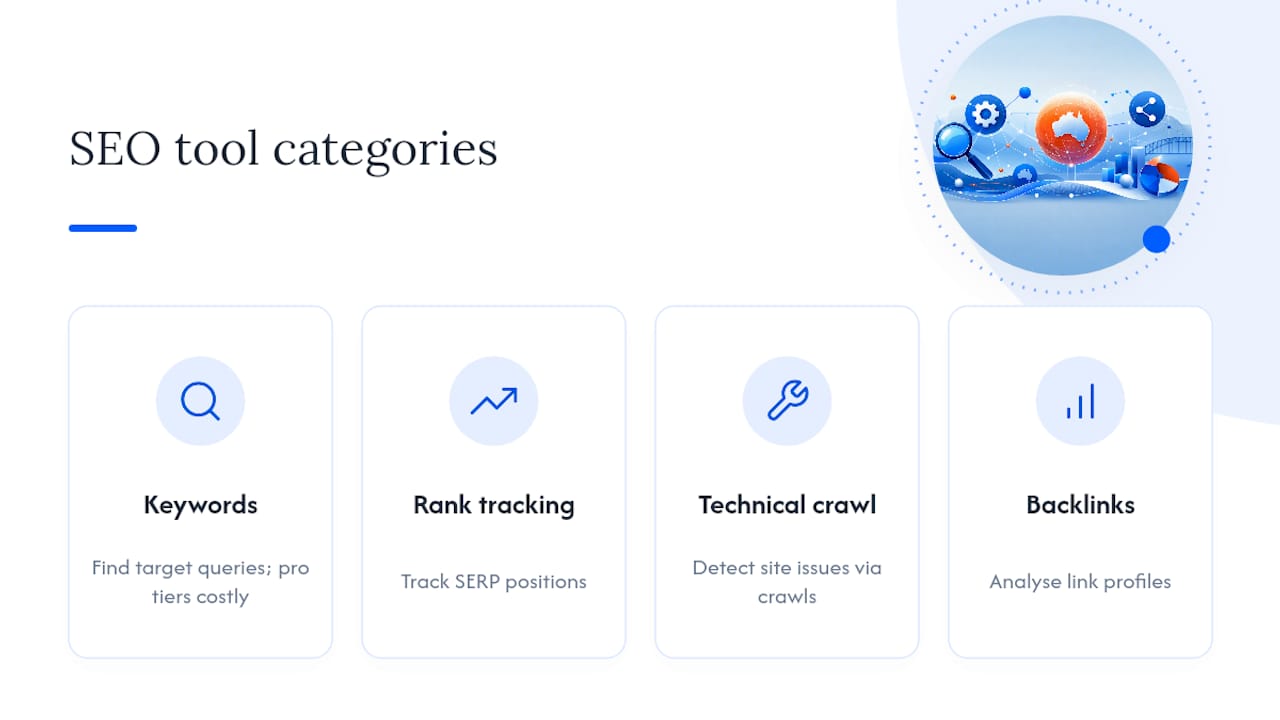
Most quoted SEO retainers already bundle tool costs into the fee, but it’s worth understanding what’s behind that line item, because it affects what a fair price actually looks like.
Providers typically run subscriptions for keyword research, rank tracking, technical crawling, and backlink analysis, and these tools aren’t cheap at a professional tier. That cost gets spread across a provider’s whole client base, which is part of why a solo freelancer working from a laptop might charge less than an agency running enterprise-grade software across a dedicated team. If you’re comparing two quotes and one seems suspiciously cheap, it’s worth asking what tools they’re actually using to track and report on your campaign. A provider with no meaningful toolset is often relying on guesswork dressed up as strategy, and that shows up in the quality of their reporting more than anything else. Ask to see a sample report before committing, so you know what data you’re actually paying to receive each month.
Location changes the price, but not always in the direction people expect. Metro markets like Sydney and Melbourne typically carry higher SEO costs because competition is fiercer. More businesses are fighting for the same search terms, which means more content, more link-building effort, and more hours needed to make a dent.
Regional and less contested markets can achieve solid results on comparatively modest budgets, because fewer pages and local signals are needed to compete effectively. A tradie in regional Tasmania targeting a handful of local suburbs faces a fundamentally smaller job than a similar business trying to rank across greater Sydney.
That said, “regional” doesn’t automatically mean “cheap.” A regional business competing nationally online, selling products through ecommerce rather than serving a local area, faces the same national-level competition as a capital city business. Location matters most when your customers are local too. If your business serves a defined geographic area, your SEO budget should scale with how contested that specific area is, not with which state you happen to be in.
Here’s something worth sitting with: a lot of SEO spend gets wasted not because the SEO work is bad, but because the website it’s driving traffic to doesn’t convert, or the brand behind it isn’t clear enough to earn trust once someone lands there. Hiring an agency solves the traffic problem. It doesn’t always solve the foundation problem underneath it.

Mybworkshops takes a different approach for service-based business owners who want to fix that foundation first, or run alongside their SEO spend rather than instead of it. The program runs across three phases, blending hands-on mentorship with practical AI tools, so you learn to build a marketing engine that turns the traffic you’re already paying for into actual enquiries and clients. Participants have used the framework to lift conversions and cut wasted ad spend, because a stronger website and clearer brand foundation mean every visitor, whether they arrived through SEO, ads, or word of mouth, has a better reason to become a customer. If your website struggles to convert clicks into enquiries, that’s worth fixing before or alongside any SEO retainer, not after. Have a look through the current workshop offerings and find the one that matches where your business is right now.
The pricing bands throughout this guide draw on Australian market data from the SEO Cost Calculator Australia, verified pricing benchmarks from WhatsTheDamage’s 2026 SEO cost guide, and pricing analysis from 3P Digital’s Australian SEO pricing breakdown. For a broader look at what different budget levels buy across agency and studio models, Chrome Cactus’s comparison of $5K/month outcomes is a useful reference point. If you’d rather start by strengthening your website and brand foundations, explore MYB Workshops directly.
Most small businesses pay between $1,200 and $2,500 a month, with local single-location campaigns sometimes starting around $800 and competitive markets running $2,500–$6,000. Always confirm whether the quote includes GST.
Hourly consulting rates in Australia generally run $100 to $300 per hour, depending on the specialist’s experience and whether you’re working with a freelancer or an agency.
It’s worth it when the provider ties their work to measurable business outcomes, like qualified leads, rather than just rankings or traffic. Combining SEO spend with a website and brand foundation strong enough to convert that traffic, an area Mybworkshops focuses on, makes the investment go further.
For businesses with limited time and no in-house expertise, professional SEO usually delivers faster, more consistent results than DIY efforts, particularly for technical fixes and link building. Small, well-scoped campaigns can still work well if paired with a clear understanding of what you’re paying for and why.
Competition in your industry and geography matters most, followed closely by how much technical work your existing website needs before content and links can be effective.