
The fastest way to grow revenue is to offer relevant upgrades to the customers you already have, at the moment they’re most receptive, using permission based language rather than pressure. Existing customers are 60 to 70% more likely to buy than new prospects, and a well timed upsell can lift customer lifetime value by 20 to 40%. Start this week with one prepaid plan or one milestone triggered offer, phrase it as a genuine suggestion, and measure what happens.
TL;DR:
- Customers who have already purchased are 60 to 70 percent more likely to buy upgrades, especially when offers are timed and framed ethically.
- Using simple, relevant tiers such as prepaid plans or bundled services can increase customer lifetime value by making options clear and attractive.
- Post-job follow-up messages, milestone renewals, and positive reviews are the most effective triggers for automated upsell offers.
- Training staff with scripts and segmenting clients based on their behavior improves both acceptances and customer satisfaction.
- Automated workflows combined with honest, permission-based framing can generate significant revenue increases with minimal pushiness.
You don’t need a dozen new offers. You need a handful of the right ones, presented well, at the right time. Here are the ideas worth testing first.
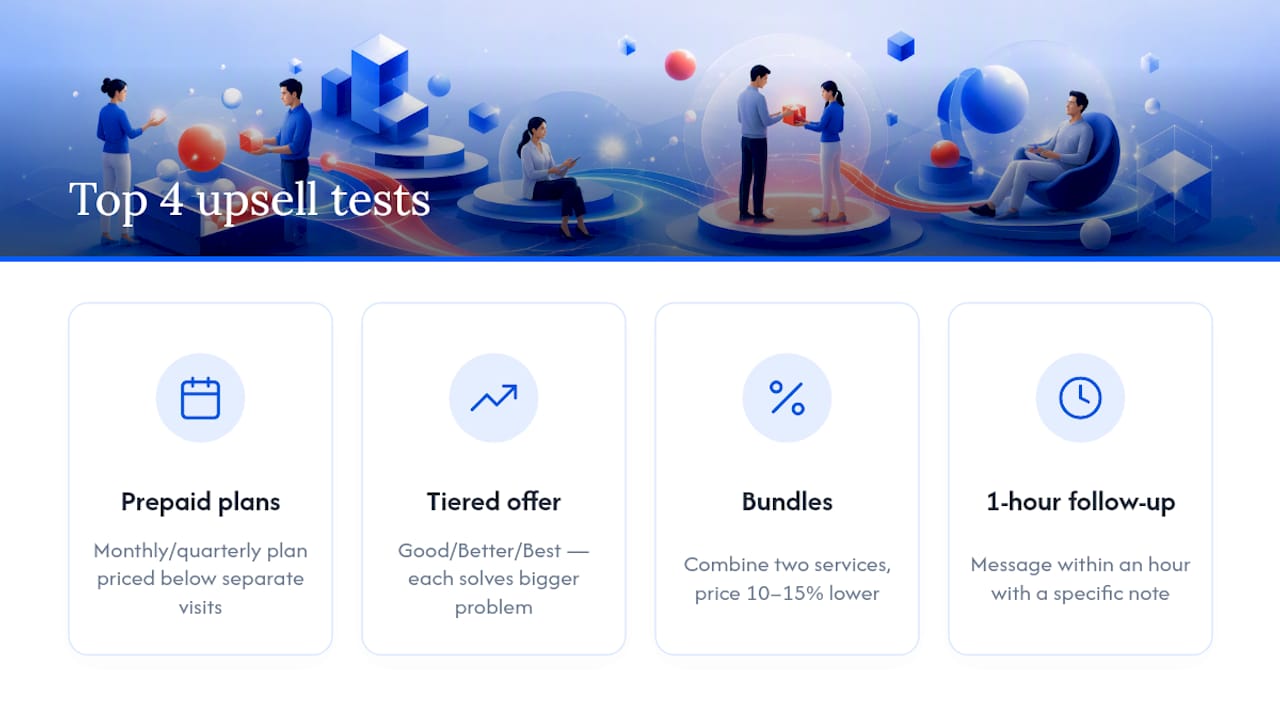
1. Prepaid maintenance plans and memberships. Package your most frequently repeated service into a monthly or quarterly plan. A gardening business might offer a “quarterly tidy up” membership instead of one-off call outs. Price it slightly below the sum of individual visits so the saving is obvious, and make the inclusions specific.
2. Good, better, best tiers. Structure three clear levels for time based or outcome based work. A bookkeeper might offer basic reconciliation, reconciliation plus reporting, and a full advisory tier. Each step up should solve a slightly bigger problem, not just add more of the same thing.
3. Bundles that protect your margin. Combine two services customers already buy separately, such as a haircut and colour treatment, and price the bundle 10 to 15% below buying them apart. This lifts perceived value without eating into profit the way a blanket discount does.
4. The one hour follow up. Message the customer within an hour of finishing the job, while the result is still fresh. A tradesperson might send “Noticed your hot water system is nine years old, want a quote to get ahead of it before it fails?” Keep it short and specific to what you observed.
5. QR menus and self serve upgrade pages. A printed QR code linking to an upgrade menu lets clients browse options privately, without feeling pitched. Self directed browsing increases conversion because there’s no social pressure attached to saying yes.
6. One clear add on at checkout. Offer a single, relevant extra when the customer is already paying, rather than a list of five. A single offer gets considered; five feels like a sales pitch.
7. Introductory pricing on the upgrade. Lower the first month’s price or offer a one time trial rate to reduce the risk of trying a higher tier.
8. Upsell at the feedback moment. When a client leaves a good review or thanks you directly, that’s a natural window to mention a next step, since goodwill is already at its peak.
9. Win back dormant clients with a curated offer. Don’t just ask lapsed customers to “come back”. Offer them a specific, upgraded package built around what they bought before.
10. Payment plans for big ticket upgrades. Spreading a large renovation or consulting package over instalments removes the single biggest barrier: the upfront number.
11. Referral incentives tied to upgrades. Reward referrals more generously when the referred client buys the higher tier, which nudges your best clients to talk about your best offer.
12. Short pilots for expensive services. Let a client trial a premium service for 30 days before committing annually. This works especially well for retainer style offers where the client can’t yet picture the ongoing value.
The line between helpful and pushy comes down to permission and framing, not the offer itself. Ethical upgrade selling means educating the customer, offering clear options, and asking before advising, rather than assuming the sale.
Three scripts worth practising:
Salon: “Your colour is holding well. A lot of clients with this shade add a monthly gloss treatment to keep it this fresh between full colours, would you like to hear how that works?”
Contractor: “While I was under there I noticed the insulation is thinning. I can quote a top up while I’m already on site, no obligation if you’d rather leave it.”
Consultant: “Based on what you’ve told me about growth plans, some clients at this stage add a quarterly strategy check in. Want me to outline what that looks like?”
Pro Tip: Write your three best scripts down and rehearse them out loud before you ever say them to a client. A script that sounds natural in your head often sounds stiff the first time you say it aloud.
Automation doesn’t replace good timing, it protects it. The highest converting triggers are post job completion, renewal or milestone windows, and after a positive review, because each one catches the customer at peak satisfaction or peak need.
| Trigger | Best channel | Who should send it |
|---|---|---|
| Post job completion | SMS or email | Automated |
| Renewal or milestone | Automated, human review above threshold | |
| After positive feedback | Email or call | Automated for low value, human for high value |
Set a dollar threshold above which offers hand off to a real person. Automation is efficient for a $50 add on; a $2,000 upgrade deserves a phone call.
Your pricing structure does half the persuading before anyone says a word. Build good, better, best tiers around outcomes, not features. Instead of “includes two extra hours”, write “finishes the project a week sooner.” Bundling and cross selling can lift average order value by 10 to 30% when the framing is right.
Training turns a good idea into a habit. Most upsell programs fail not because the offer is wrong, but because nobody on the floor feels confident raising it.
Pro Tip: Give new staff permission to say “let me check with my manager” on big ticket upgrades. It takes the pressure off and keeps the conversation honest.
Track three numbers: upsell conversion rate, attachment rate, and the resulting lift in average order value. Measuring these three metrics separately tells you whether an offer is being seen, being accepted, or actually moving revenue.
One service business added three automated triggers and generated $28,000 in extra revenue within 90 days, which shows how much upside is sitting in timing alone.
Existing customers already trust you, and that trust translates into a 20 to 40% lift in lifetime value once you start offering relevant upgrades consistently. Mybworkshops built its three phase program around exactly this kind of implementation gap: templates, scripts, and automated workflows you practise in a workshop before rolling them out live. The next step is small. Pick one script and one trigger, and test both this month.
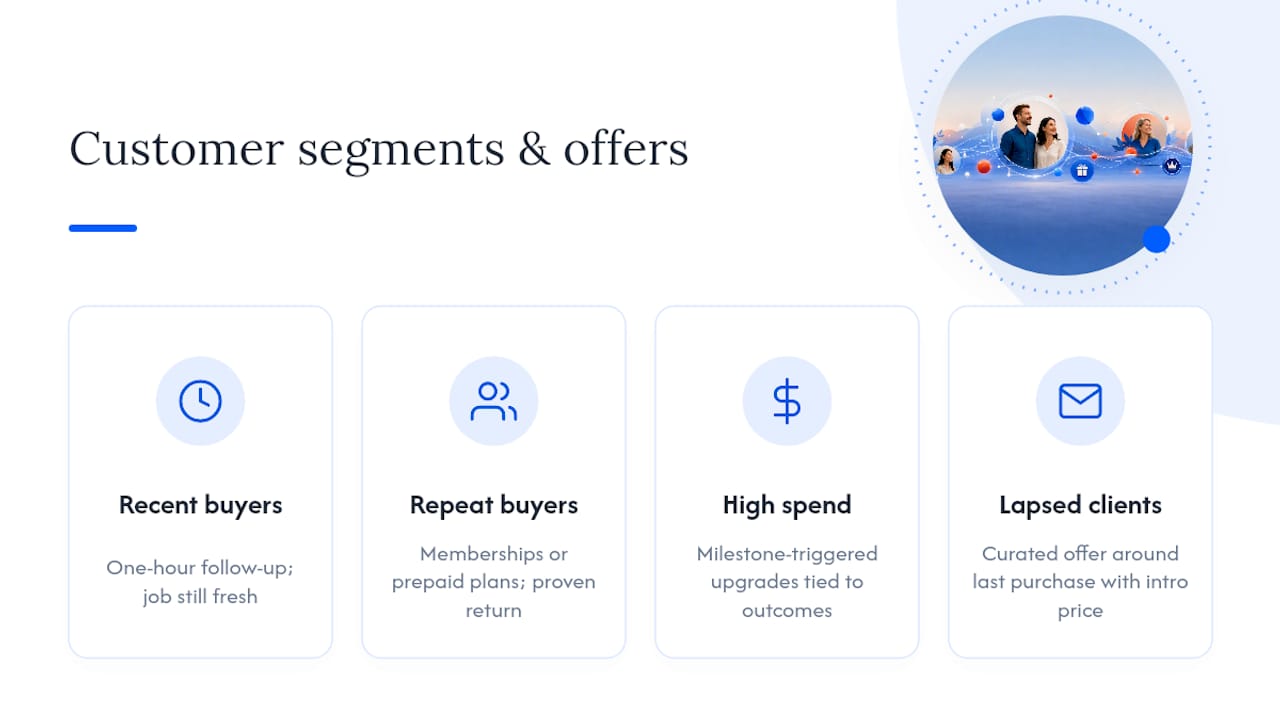
Not every client wants the same upgrade, and sending the same offer to everyone is the fastest way to make a good idea feel like spam. Start by grouping customers by behaviour rather than demographics: recent buyers, repeat buyers, high spend clients, and lapsed clients each need a different message.
Recent buyers respond best to the one hour follow up, because the job is still fresh in their mind. Repeat buyers are your best candidates for memberships or prepaid plans, since they’ve already proven they’ll come back. High spend clients are the group most likely to accept a bigger, milestone triggered upgrade, particularly when it’s framed around an outcome they’ve already told you matters to them.
Lapsed or dormant clients need a different approach entirely. A generic “we miss you” email rarely works. A curated offer built around their last purchase, paired with an introductory price to reduce the risk of coming back, performs far better.
Segmenting doesn’t require expensive software. A basic spreadsheet or your existing booking system’s tags can separate customers by last visit date, total spend, or service type. The goal isn’t complexity, it’s relevance: a plumber shouldn’t pitch a $3,000 hot water system to someone who only ever books a $90 tap repair. Match the offer to the pattern the customer has already shown you, and conversion follows naturally.
Upselling works best when it removes friction rather than adding pressure. Research into upselling as a decision process shows it unfolds in two stages: the customer makes their initial choice, then decides whether to accept an upgrade, and the effort and framing of that first decision shapes how open they are to the second. A customer who felt rushed or confused during the first choice is far less likely to say yes to anything extra.
A few principles show up again and again in what actually converts. Small commitments build momentum: asking a client to agree to a free add on first makes the bigger upgrade feel like a natural next step rather than a leap. Anchoring works the same way in pricing: showing the premium tier first makes the middle tier look reasonable by comparison, even though nothing about the middle tier has changed.
Framing outcomes over features also matters more than most business owners expect. “Save two hours a week” lands better than “includes an extra service module”, because people buy results, not inclusions. And asking permission before presenting an offer shifts the entire interaction from transactional to collaborative, which is why it consistently outperforms a straight pitch.
Timing plays into all of this too. A customer who has just received good news, a finished job, a glowing result, a positive review, is measurably more open to hearing about a next step than one who’s mid task or mid complaint.
The most common mistake is pitching before the customer has finished processing the value of what they already bought. Jumping straight into an upgrade before a client has even used your first service breaks trust rather than building it.
Overloading the offer is the second big one. Presenting five add ons at once forces the customer to make five decisions, and when faced with too many options, most people choose none. One clear, relevant offer beats a menu of extras every time.
Ignoring the decline is a quieter mistake but just as damaging. If a customer says no and your team keeps pushing or brings it up again immediately, the relationship takes the hit, not just the sale. A genuine decline path has to be respected, not treated as a negotiating tactic.
Skipping the “why” is another frequent failure. Naming the upgrade without explaining what problem it solves leaves the customer to guess at the value, and most won’t bother. Price before value is the same error in a different order: leading with a number before the customer understands the outcome makes even a fair price feel steep.
Finally, treating every customer the same, regardless of what they’ve bought or how long they’ve been with you, wastes the advantage you get from segmentation. A one size fits all upsell message will always underperform an offer built around what a specific customer has already shown you they value.
Reading the ideas above is the easy part. Turning them into scripts your team actually uses, and triggers that fire automatically, is where most service businesses stall out. Mybworkshops runs structured, three phase workshops built specifically for service business owners who want a working system, not another list of tips to file away.
Inside the relevant sessions, you’ll walk out with the actual scripts covered above, an automation workflow mapped to your own services, and coaching on where to place the handoff between automated and human follow up. Real client outcomes from the program show the same pattern this article covers: small, permission based changes compound into meaningful revenue over a few months, not a few days. Browse the workshop archives for templates and scripts you can adapt this week, or check our current workshops to see when the next cohort opens. If you’d rather see what this looks like in practice first, the business outcomes from past participants are worth a look before you commit.
A prepaid maintenance plan, a good/better/best service tier, or a post job message offering a relevant add on within an hour of finishing work are all proven, low pressure examples.
Ask permission before offering, lead with an observation, explain the outcome before the price, give an easy way to decline, train staff on scripts, follow up after positive reviews, segment offers by customer history, use one clear offer instead of many, monitor feedback alongside conversion, and hand off high value offers to a real person.
A haircut client being offered a bundled colour treatment at a small discount, or a tradesperson quoting a top up on ageing equipment they noticed while on site, are both straightforward upsell examples.
Build upgrade paths into your existing marketing, from post job follow ups to renewal reminders, and make sure your website and messaging reflect the same tiered offers your team presents in person. Structured programs like those from Mybworkshops help you build this consistently rather than relying on ad hoc scripts.